Introduction to Science
UNIT ONE, LESSON 1.1
BY MARGIELENE D. JUDAN
LESSON OUTLINE
What is Science?
Science as a Body of Knowledge
Science as a Product and a Process
Limits of Science
What comes to your mind
when you hear the word
“SCIENCE”?
Thick Textbooks
Lab Coats/ Lab Gowns
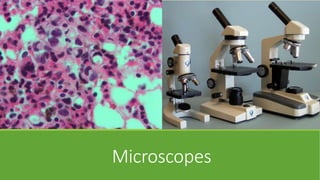
Microscopes
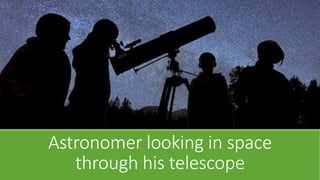
Astronomer looking in space
through his telescope
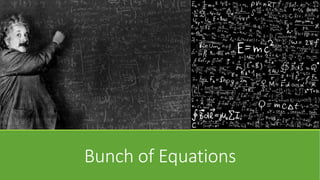
Bunch of Equations
Chemical Reactions in Beakers
Launching Rockets to Space
Or maybe even ETs and UFOs
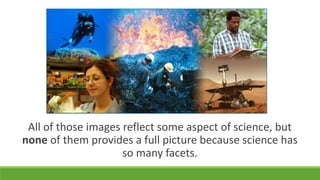
All of those images reflect some aspect of science, but
none of them provides a full picture because science has
so many facets.
WHAT IS SCIENCE?
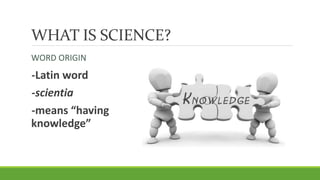
-Latin word
-scientia
-means “having
knowledge”
WORD ORIGIN
WHAT IS SCIENCE?
AS A BODY OF KNOWLEDGE
Science is a systematized
body of knowledge based
on gathered facts,
observation and
experimentation.
AS A PRODUCT AND A PROCESS
Science as a product is an ever-changing body
of knowledge.
It is an ongoing process of investigating and
thinking:
1. a way of thinking that involves reasoning,
and
2. A way of investigating that involves
questions, observations, experimentations,
and predictions.
WHAT IS SCIENCE?
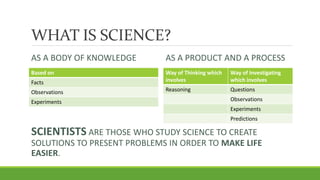
AS A BODY OF KNOWLEDGE
Based on
Facts
Observations
Experiments
AS A PRODUCT AND A PROCESS
Way of Thinking which
involves
Way of Investigating
which involves
Reasoning Questions
Observations
Experiments
Predictions
SCIENTISTS ARE THOSE WHO STUDY SCIENCE TO CREATE
SOLUTIONS TO PRESENT PROBLEMS IN ORDER TO MAKE LIFE
EASIER.
LIMITS OF SCIENCE
1.Ethics and Morality
2.Mathematics
3.Reason
4.Why?
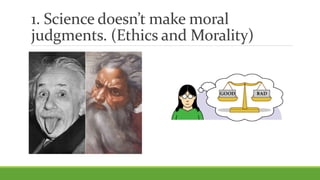
1. Science doesn’t make moral
judgments. (Ethics and Morality)
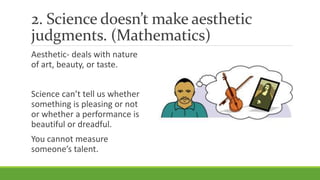
2. Science doesn’t make aesthetic
judgments. (Mathematics)
Aesthetic- deals with nature
of art, beauty, or taste.
Science can’t tell us whether
something is pleasing or not
or whether a performance is
beautiful or dreadful.
You cannot measure
someone’s talent.
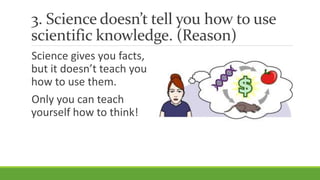
3. Science doesn’t tell you how to use
scientific knowledge. (Reason)
Science gives you facts,
but it doesn’t teach you
how to use them.
Only you can teach
yourself how to think!
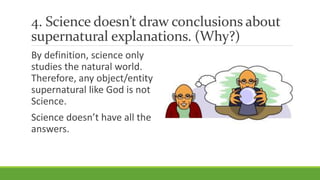
4. Science doesn’t draw conclusions about
supernatural explanations. (Why?)
By definition, science only
studies the natural world.
Therefore, any object/entity
supernatural like God is not
Science.
Science doesn’t have all the
answers.
Ponder upon with superstitions. Do
you think they are true, reliable and
scientific? Prove and give examples.
Now, that you are equipped with the
basic concepts of Science, you’re now
ready to go through Science 7! Welcome
to the study of the natural world!
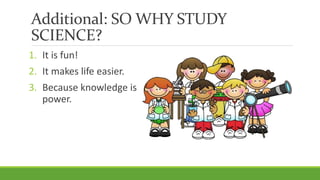
Additional: SO WHY STUDY
SCIENCE?
1. It is fun!
2. It makes life easier.
3. Because knowledge is
power.
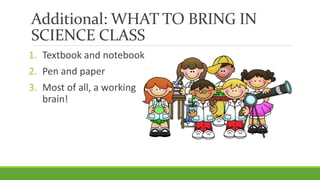
Additional: WHAT TO BRING IN
SCIENCE CLASS
1. Textbook and notebook
2. Pen and paper
3. Most of all, a working
brain!
Sources:
Science Links 7
http://undsci.berkeley.edu/

Unit 1, Lesson 1.1 - Introduction to Science

  • 1.
    Introduction to Science UNITONE, LESSON 1.1 BY MARGIELENE D. JUDAN
  • 2.
    LESSON OUTLINE What isScience? Science as a Body of Knowledge Science as a Product and a Process Limits of Science
  • 3.
    What comes toyour mind when you hear the word “SCIENCE”?
  • 4.
  • 5.
  • 6.
  • 7.
    Astronomer looking inspace through his telescope
  • 8.
  • 9.
  • 10.
  • 11.
    Or maybe evenETs and UFOs
  • 12.
    All of thoseimages reflect some aspect of science, but none of them provides a full picture because science has so many facets.
  • 13.
    WHAT IS SCIENCE? -Latinword -scientia -means “having knowledge” WORD ORIGIN
  • 14.
    WHAT IS SCIENCE? ASA BODY OF KNOWLEDGE Science is a systematized body of knowledge based on gathered facts, observation and experimentation. AS A PRODUCT AND A PROCESS Science as a product is an ever-changing body of knowledge. It is an ongoing process of investigating and thinking: 1. a way of thinking that involves reasoning, and 2. A way of investigating that involves questions, observations, experimentations, and predictions.
  • 15.
    WHAT IS SCIENCE? ASA BODY OF KNOWLEDGE Based on Facts Observations Experiments AS A PRODUCT AND A PROCESS Way of Thinking which involves Way of Investigating which involves Reasoning Questions Observations Experiments Predictions SCIENTISTS ARE THOSE WHO STUDY SCIENCE TO CREATE SOLUTIONS TO PRESENT PROBLEMS IN ORDER TO MAKE LIFE EASIER.
  • 16.
    LIMITS OF SCIENCE 1.Ethicsand Morality 2.Mathematics 3.Reason 4.Why?
  • 17.
    1. Science doesn’tmake moral judgments. (Ethics and Morality)
  • 18.
    2. Science doesn’tmake aesthetic judgments. (Mathematics) Aesthetic- deals with nature of art, beauty, or taste. Science can’t tell us whether something is pleasing or not or whether a performance is beautiful or dreadful. You cannot measure someone’s talent.
  • 19.
    3. Science doesn’ttell you how to use scientific knowledge. (Reason) Science gives you facts, but it doesn’t teach you how to use them. Only you can teach yourself how to think!
  • 20.
    4. Science doesn’tdraw conclusions about supernatural explanations. (Why?) By definition, science only studies the natural world. Therefore, any object/entity supernatural like God is not Science. Science doesn’t have all the answers.
  • 21.
    Ponder upon withsuperstitions. Do you think they are true, reliable and scientific? Prove and give examples.
  • 22.
    Now, that youare equipped with the basic concepts of Science, you’re now ready to go through Science 7! Welcome to the study of the natural world!
  • 23.
    Additional: SO WHYSTUDY SCIENCE? 1. It is fun! 2. It makes life easier. 3. Because knowledge is power.
  • 24.
    Additional: WHAT TOBRING IN SCIENCE CLASS 1. Textbook and notebook 2. Pen and paper 3. Most of all, a working brain!
  • 27.