Science club in schools; Activities
with illustration for problem solving
and psychomotor skill
development
ROSHIN ANIE ROY
Introduction
 The scientific and technological advancement of today is a long
forward journey form stone age. Each individual has his our interests
talents and abilities. Even a progressive syllabus fails tocat to the
needs of each science educators, now a days are found to exhibit
growing interest and means of stimulating group participation and
mobilizing interest in learning science organizing science clubs is
one among such activities. Thorough activities of a science club,
learning of science becomes joyful.
Objectives of science club
 To develop a general interest in science
 To inculcate scientific attitude and provide opportunities for training
in scientific method
 To develop interest in scientific hobbies
 To develop habits of exploration and creative faculties
 To encourage individual and group activities
 To develop in children a sense of healthy competition
 To make the students and public science minded
 To stimulate active participation and initiative among students in
learning process
 To keep the students in touch with the recent advances in science
 To provide challenging opportunities to the gifted
11/15/2015
Organisation of science club
A properly organised science club will be a valuable aid to teaching
science and also means of motivating the children for learning
science
• Science club is run by the students for the students, the science
teacher is the pivot of all activities
• Science teacher can explain the importance and benefit of
organising science club and can arouse enthusiasm among
students
• Science club should have its own constitution
• Should be general body and executive body
• Principal should be the patron and science teacher should be the
sponsors
 Executive members are chosen from the student members
(President, vice president, secretary, treasurer, librarian, publicity
officer, etc)
 The executive committee has to chalk out programmes
 The activities of the club should be taken by the students
 Should be regular meetings, discussions, planning, feedback etc
Activities of science club
1. Organizing lectures, debates, seminars, symposia etc.
2. Holding science exhibition and fair
3. Celebrating birth days of eminent scientist
4. Participating in science fairs
5. Conducting visual programmes of s scientific interest
6. Arranging visit to places of scientific interest
7. Preparing of charts, postures, models etc
8. Developing school garden
9.Displaying science news
10.Improvising and preparing hand-made apparatus
11.General reading of scientific literature
12.Rendering school services in health and sanitation
13.Visiting other science clubs
14.conducting essay competition on scientific problems
15.Managing a first aid squad
16.Participating in scientific hobbies-Preparation of soaps, ink ,candle
matches, toys, bleaching powder, nail polish, chalk etc.
17.Helping the community by way of demonstration on health and
hygiene, improvement of agriculture, eradication of superstitious
belief etc.
18.Celebrating science days
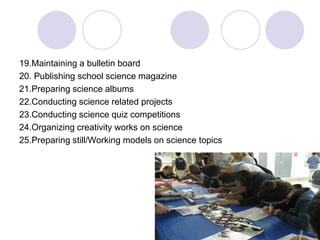
19.Maintaining a bulletin board
20. Publishing school science magazine
21.Preparing science albums
22.Conducting science related projects
23.Conducting science quiz competitions
24.Organizing creativity works on science
25.Preparing still/Working models on science topics
Problem solving
 Problem solving is a scientific method in which the leaner applies his
ability, previously acquired knowledge and experiences to new
situations and challenges. It analyses the current problem and
situation in multiple ways, generates solutions determines a
practical solution and applies it
 It fosters creative thinking ability
 It develops comprehension power
 It develops communication competence
 it facilitates more involvement of pupils
 it develops pupils ability to analyse and synthesis
 it dollops pupils convincing power
ACTIVITIES OF THE SCIENCE
CLUB- DEVELOPMENT OF
PSYCHOMOTOR SKILLS
• Science club gives a great impetus to science learning. The
environment and facilities, a science club provides are most
congenial for the expression of pupil talents.
• Individuals differ on their interests, abilities and skill. It may not be
possible to cater for individual needs in a routine science
programme. But a science club in the place where the people can
engage in their individual interests. It provides an opportunity to the
pupils to express their creative abilities in the field of science and
encourage development of new ideas.
• The important difference between the science club activities and the
classroom activities is that the class work is formal and the pupils
are asked to do something, where as a club is informal and the
pupils are free to choose their activities. In a science club the pupils
work not to satisfy their teacher but themselves. A science club
provides freedom, whereas in a class the pupils have to conform to
a strict system.
 Young pupil’s are always eager to do something and a science club
is the place were they can work and develop their skill. Pupil who
desire to study deep into a particular area of science may do so in a
science club. Moreover there is some carry over from the science
club to the classroom. Pupils, who work in the science club are more
enthusiastic and like more interest in the classroom activities. The
regular class becomes more likely due to the effect of their
supplementary work in the science club.
 One important value of science activity is social
project, the pupils learn to work in a co-operation with others. They
learn to understand each other and to share responsibilities. So if
they face a problem, they can solve it easily. They work together
and this doing of manual work in the science club helps to create an
attitude congenial to avoiding consciousness of their socio-
economic status
 A pupil who is actively involved and participated in science club with
his own interest will be to able to develop scientific attitude naturally.
Thus when a pupil having scientific attitude face a problem, he can
easily identify it and can solve it effectively by his own effort.
Science club is the place when the pupil works with many pupil. So
he is able to work in co-operation able to know others attitude and
point of view of a problem. He can discuss with the co members of
the club about the problem. So science club plays an important role
in encourage problem solving skills in pupils.
Conclusion
• Science clubs channelize the energies of students and make use of
their skills and talents, which satisfy their instincts and urges and
helps in their overall personality development
• Through activities of a science club, learning of science become
joyful
• The science club caters to freedom for expression, where as the
classroom atmosphere leads to conformity and repression
• Students organise thought and translate into action
• Develop a zealous enthusiasm to strive for the cause of scientific
enterprise
• In the classroom everything is done in a formal, artificial and
controlled atmosphere. This will never give the child and
opportunity for his free fights in the world of science.
All these lead to the need for an organization providing an outlet for
the pent up emotions of children and for pooling their energies. An
organization which caters for the in calculation of scientific attitude
and genuine interest in science and also can supplement the work of
the classroom and give the syllabus a practical dimension may be
called a science club.
Questions
1. What are the aims and activities of
science clubs?
2. What is the role of science club in
problem solving and development of
psychomotor skills?
REFERENCE
scienceclub.org
• https://twitter.com/BBCScienceClub
http://ml.wikipedia.org/
• Science Education-Dr. K Sivarajan, Prof.
A. Faziluddin- Calicut University
Publishers. Page No. 259-261
Science club in schools

Science club in schools

  • 1.
    Science club inschools; Activities with illustration for problem solving and psychomotor skill development ROSHIN ANIE ROY
  • 2.
    Introduction  The scientificand technological advancement of today is a long forward journey form stone age. Each individual has his our interests talents and abilities. Even a progressive syllabus fails tocat to the needs of each science educators, now a days are found to exhibit growing interest and means of stimulating group participation and mobilizing interest in learning science organizing science clubs is one among such activities. Thorough activities of a science club, learning of science becomes joyful.
  • 3.
    Objectives of scienceclub  To develop a general interest in science  To inculcate scientific attitude and provide opportunities for training in scientific method  To develop interest in scientific hobbies  To develop habits of exploration and creative faculties  To encourage individual and group activities  To develop in children a sense of healthy competition  To make the students and public science minded  To stimulate active participation and initiative among students in learning process  To keep the students in touch with the recent advances in science  To provide challenging opportunities to the gifted 11/15/2015
  • 4.
    Organisation of scienceclub A properly organised science club will be a valuable aid to teaching science and also means of motivating the children for learning science • Science club is run by the students for the students, the science teacher is the pivot of all activities • Science teacher can explain the importance and benefit of organising science club and can arouse enthusiasm among students • Science club should have its own constitution • Should be general body and executive body • Principal should be the patron and science teacher should be the sponsors
  • 5.
     Executive membersare chosen from the student members (President, vice president, secretary, treasurer, librarian, publicity officer, etc)  The executive committee has to chalk out programmes  The activities of the club should be taken by the students  Should be regular meetings, discussions, planning, feedback etc
  • 6.
    Activities of scienceclub 1. Organizing lectures, debates, seminars, symposia etc. 2. Holding science exhibition and fair 3. Celebrating birth days of eminent scientist 4. Participating in science fairs 5. Conducting visual programmes of s scientific interest 6. Arranging visit to places of scientific interest 7. Preparing of charts, postures, models etc 8. Developing school garden 9.Displaying science news 10.Improvising and preparing hand-made apparatus 11.General reading of scientific literature
  • 7.
    12.Rendering school servicesin health and sanitation 13.Visiting other science clubs 14.conducting essay competition on scientific problems 15.Managing a first aid squad 16.Participating in scientific hobbies-Preparation of soaps, ink ,candle matches, toys, bleaching powder, nail polish, chalk etc. 17.Helping the community by way of demonstration on health and hygiene, improvement of agriculture, eradication of superstitious belief etc. 18.Celebrating science days
  • 8.
    19.Maintaining a bulletinboard 20. Publishing school science magazine 21.Preparing science albums 22.Conducting science related projects 23.Conducting science quiz competitions 24.Organizing creativity works on science 25.Preparing still/Working models on science topics
  • 9.
    Problem solving  Problemsolving is a scientific method in which the leaner applies his ability, previously acquired knowledge and experiences to new situations and challenges. It analyses the current problem and situation in multiple ways, generates solutions determines a practical solution and applies it  It fosters creative thinking ability  It develops comprehension power  It develops communication competence  it facilitates more involvement of pupils  it develops pupils ability to analyse and synthesis  it dollops pupils convincing power
  • 10.
    ACTIVITIES OF THESCIENCE CLUB- DEVELOPMENT OF PSYCHOMOTOR SKILLS • Science club gives a great impetus to science learning. The environment and facilities, a science club provides are most congenial for the expression of pupil talents. • Individuals differ on their interests, abilities and skill. It may not be possible to cater for individual needs in a routine science programme. But a science club in the place where the people can engage in their individual interests. It provides an opportunity to the pupils to express their creative abilities in the field of science and encourage development of new ideas. • The important difference between the science club activities and the classroom activities is that the class work is formal and the pupils are asked to do something, where as a club is informal and the pupils are free to choose their activities. In a science club the pupils work not to satisfy their teacher but themselves. A science club provides freedom, whereas in a class the pupils have to conform to a strict system.
  • 11.
     Young pupil’sare always eager to do something and a science club is the place were they can work and develop their skill. Pupil who desire to study deep into a particular area of science may do so in a science club. Moreover there is some carry over from the science club to the classroom. Pupils, who work in the science club are more enthusiastic and like more interest in the classroom activities. The regular class becomes more likely due to the effect of their supplementary work in the science club.  One important value of science activity is social project, the pupils learn to work in a co-operation with others. They learn to understand each other and to share responsibilities. So if they face a problem, they can solve it easily. They work together and this doing of manual work in the science club helps to create an attitude congenial to avoiding consciousness of their socio- economic status
  • 12.
     A pupilwho is actively involved and participated in science club with his own interest will be to able to develop scientific attitude naturally. Thus when a pupil having scientific attitude face a problem, he can easily identify it and can solve it effectively by his own effort. Science club is the place when the pupil works with many pupil. So he is able to work in co-operation able to know others attitude and point of view of a problem. He can discuss with the co members of the club about the problem. So science club plays an important role in encourage problem solving skills in pupils.
  • 13.
    Conclusion • Science clubschannelize the energies of students and make use of their skills and talents, which satisfy their instincts and urges and helps in their overall personality development • Through activities of a science club, learning of science become joyful • The science club caters to freedom for expression, where as the classroom atmosphere leads to conformity and repression • Students organise thought and translate into action • Develop a zealous enthusiasm to strive for the cause of scientific enterprise • In the classroom everything is done in a formal, artificial and controlled atmosphere. This will never give the child and opportunity for his free fights in the world of science.
  • 14.
    All these leadto the need for an organization providing an outlet for the pent up emotions of children and for pooling their energies. An organization which caters for the in calculation of scientific attitude and genuine interest in science and also can supplement the work of the classroom and give the syllabus a practical dimension may be called a science club.
  • 15.
    Questions 1. What arethe aims and activities of science clubs? 2. What is the role of science club in problem solving and development of psychomotor skills?
  • 16.
    REFERENCE scienceclub.org • https://twitter.com/BBCScienceClub http://ml.wikipedia.org/ • ScienceEducation-Dr. K Sivarajan, Prof. A. Faziluddin- Calicut University Publishers. Page No. 259-261