Lecture-1
What Is Science?
What is Science?
The word “science” probably brings to mind
many different pictures:
• A fat textbook
• White lab coats and microscopes
• An astronomer peering through a telescope
• A naturalist in the rainforest
• Einstein’s equations scribbled on a
chalkboard
• The launch of the space shuttle
• Bubbling beakers ….
All of those images reflect some aspect
of science, but none of them provides a
full picture because science has so many
facets:
What is Science?
Science is both a body of knowledge and a process
 In school, science may sometimes seem like a
collection of isolated and static facts listed in a
textbook
but that’s only a small part of the story.
 Just as importantly, science is also a process of
discovery that allows us to link isolated facts
into coherent and comprehensive
understandings of the natural world.
Science is exciting
Science is a way of discovering
 what’s in the universe
 how those things work today
 how they worked in the past
 how they are likely to work in the future.
Scientists are motivated by the thrill of seeing or figuring out
something that no one has before.
Science is useful
 The knowledge generated by science is
powerful and reliable.
It can be used to
 develop new technologies,
 treat diseases
 deal with many other sorts of problems.
Science is ongoing
 Science is continually refining and expanding our
knowledge of the universe, and as it does
 it leads to new questions for future investigation
 Science will never be “finished.”
Science is a global human endeavor
 People all over the world participate in the
process of science.
 And you can too!
Discovery: The spark for science
 “aha!” moments may not happen frequently, but
they are often experiences that drive science and
scientists.
 For a scientist, every day holds the possibility of
discovery
 coming up with a brand new idea or of observing
something that no one has ever seen before. Vast
bodies of knowledge have yet to be built and
many of the most basic questions about the
universe have yet to be answered:
Discovery: The spark for science
• Vast bodies of knowledge have yet to be built
and many of the most basic questions about
the universe have yet to be answered
Discovery: The spark for science
•What causes gravity?
•How do tectonic plates move around on Earth’s
surface?
•How do our brains store memories?
•How do water molecules interact with each other?
We don’t know the complete answers to these and
an overwhelming number of other questions, but
the prospect of answering them beckons science
forward.
 Scientific questions can seem complex (e.g., what
chemical reactions allow cells to break the bonds
in sugar molecules), but they don’t have to be.

 You’ve probably posed many perfectly valid
scientific questions yourself: like
• how can airplanes fly,
• why do cakes rise in the oven,
• why do apples turn brown once they’re cut?
EVERYDAY SCIENCE QUESTIONS
 You can discover the answers to many of these
“everyday” science questions in your local
library
 but for others, science may not have the answers
yet
 answering such questions can lead to astonishing
new discoveries.
EVERYDAY SCIENCE QUESTIONS
For example, we still don’t know much about
 how your brain remembers to buy milk at
the grocery store.
 Just as we’re motivated to answer
questions about our everyday experiences,
scientists confront such questions at all
scales, including questions about the very
nature of the universe.
 The process of scientific discovery is not limited to
professional scientists working in labs.
The everyday experience of deducing that
 your car won’t start because of a bad fuel pump
 figuring out that the centipedes in your backyard
prefer shady rocks shares
fundamental similarities with classically scientific
discoveries like
 working out DNA’s double helix.
 These activities all involve making observations
and analyzing evidence
 they all provide the satisfaction of finding an
answer that makes sense of all the facts.
 In fact, some psychologists argue that the way
individual humans learn (especially as children)
bears a lot of similarity to the progress of science
 both involve making observations, considering
evidence, testing ideas, and holding on to those
that work.
Lecture-2
A science checklist
A Science Checklist
 Science turns out to be difficult to define
precisely. (Philosophers have been arguing
about it for decades!)
 The problem is that the term “science”
applies to a remarkably broad set of human
activities
 To get a grasp on what science is, we’ll look
at a checklist that summarizes key
characteristics of science
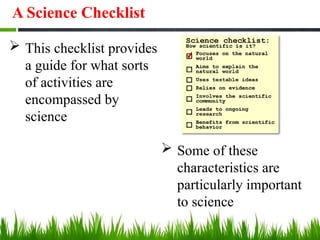
 This checklist provides
a guide for what sorts
of activities are
encompassed by
science
 Some of these
characteristics are
particularly important
to science
A Science Checklist
Science asks questions about the natural world
Science studies the natural world. This includes the
components of the physical universe around us like
• atoms
• plants
• eco- system
• people
• societies
• Galaxies
as well as the natural forces at work on those
things.
Science aims to explain and understand
Science as a collective institution aims to produce more and
more accurate natural explanations of
 how the natural world works
 what its components are,
 how the world got to be the way it is now.
Classically, science’s main goal has been building knowledge
and understanding,
Science works with testable ideas
 Only testable ideas are within the purview of
science.
 For an idea to be testable, it must logically
generate specific expectations
 a set of observations that we could expect to
make if the idea were true
 a set of observations that would be inconsistent
with the idea and lead you to believe that it is
not true
Science relies on evidence
 Scientific ideas must not only be testable, but must
actually be tested preferably with many different lines of
evidence by many different people.
 Scientists actively seek evidence to test their ideas
 even if the test is difficult and means for example,
1. spending years working on a single experiment
2. , traveling to Antarctica to measure carbon dioxide levels
in an ice core
3. collecting DNA samples from thousands of volunteers all
over the world.
Science is embedded in the scientific community
 The progress of science depends on interactions within
the scientific community.
 the community of people and organizations that
generate scientific ideas, test those ideas, publish
scientific journals, organize conferences, train scientists,
distribute re- search funds, etc.
 This scientific community provides the cumulative
knowledge base that allows science to build on itself.
 It is also responsible for the further testing and scrutiny
of ideas and for performing checks and balances on the
work of community members
Science is embedded in the scientific community
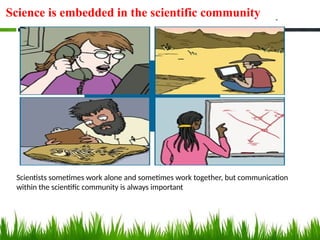
Scientists sometimes work alone and sometimes work together, but communication
within the scientific community is always important
Scientific ideas lead to ongoing research
 Science is an ongoing endeavor.
 It did not end with the most recent edition of your college
physics textbook and will not end even once we know the
answers to big questions, such as
 how our 20,000 genes interact to build a human being
 So long as there are unexplored and unexplained parts of
the natural world, science will continue to investigate
them.
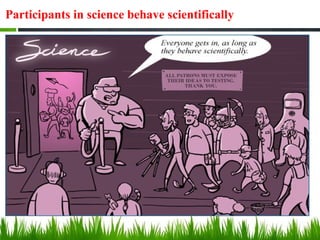
Participants in science behave scientifically
 Science is sometimes misconstrued as an elite
endeavor in which one has to be a member of “the
club” in order to be taken seriously.
That’s a bit misleading.
 In fact, science is now open to anyone regardless
of
 age
 Gender
 religious commitment
 physical ability
 Ethnicity
 country of origin
 political views
 However, science only works because the people
involved with it behave “scientifically” that is,
behave in ways that push science forward
Participants in science behave scientifically
Lecrure-3
Scope of Science?
What has science done for you?
 Science affects us all, every day of the year,
from the moment we wake up, all day long, and
through the night.
 your digital alarm clock
 the weather report
 the bus you ride in,
 your decision to eat a baked potato instead of
fries
 your cell phone
 the antibiotics that treat your sore throat
 the clean water that comes from your faucet
 the light that you turn off at the end of the day
have all been brought to you courtesy of science.
 The modern world would not be modern at all
without the understandings and technology
enabled by science.
What has science done for you?
Without modern science, there would be:
 no way to use electricity
 no plastic.
 no modern agriculture
 no modern medicine
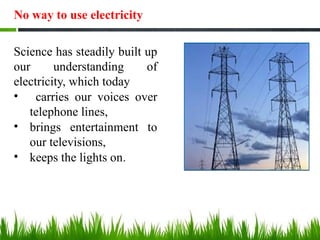
No way to use electricity
Science has steadily built up
our understanding of
electricity, which today
• carries our voices over
telephone lines,
• brings entertainment to
our televisions,
• keeps the lights on.
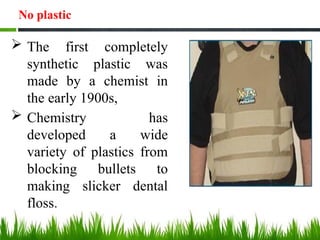
No plastic
 The first completely
synthetic plastic was
made by a chemist in
the early 1900s,
 Chemistry has
developed a wide
variety of plastics from
blocking bullets to
making slicker dental
floss.
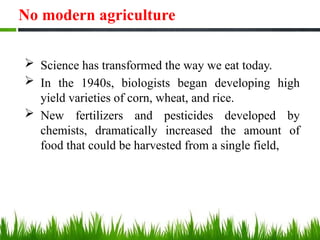
No modern agriculture
 Science has transformed the way we eat today.
 In the 1940s, biologists began developing high
yield varieties of corn, wheat, and rice.
 New fertilizers and pesticides developed by
chemists, dramatically increased the amount of
food that could be harvested from a single field,
No modern agriculture
 Massively increasing the
amount of food available
to feed the world
 Transforming the
economic structure of
agricultural practices.
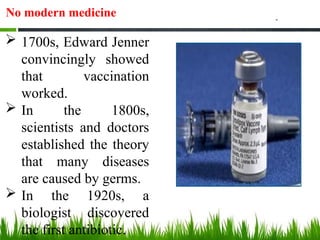
No modern medicine
 1700s, Edward Jenner
convincingly showed
that vaccination
worked.
 In the 1800s,
scientists and doctors
established the theory
that many diseases
are caused by germs.
 In the 1920s, a
biologist discovered
the first antibiotic.
Discovery: The spark for science
 The eradication of smallpox
 The prevention of nutritional deficiencies
 Successful treatments for infections
 The impact of modern medicine on global health
has been powerful.
 In fact, without science, many people alive today
would have instead died of diseases that are now
easily treated.
Conclusion
 Scientific knowledge can improve the quality of
life at many different levels
 from the routine workings of our everyday lives
to global issues.
Science informs public policy and personal
decisions on
• energy,
• conservation
 transportation
 Communication
 Defense
 Economics
 health
 leisure, and exploration.
 It’s almost impossible to overstate how many
aspects of modern life are impacted by scientific
knowledge.
Conclusion
Lecture-4
Scientific Methods
An exploration of how the Scientific Method has evolved throughout
history, from its origins in ancient civilizations to the modern era and
future prospects.
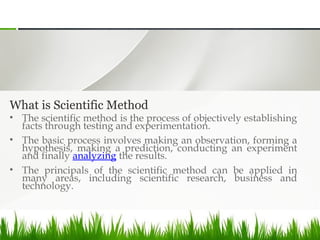
What is Scientific Method
• The scientific method is the process of objectively establishing
facts through testing and experimentation.
• The basic process involves making an observation, forming a
hypothesis, making a prediction, conducting an experiment
and finally analyzing the results.
• The principals of the scientific method can be applied in
many areas, including scientific research, business and
technology.
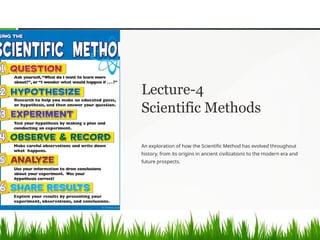
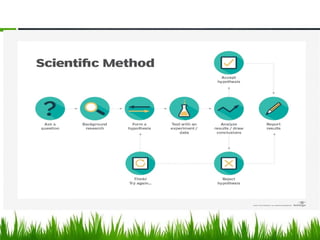
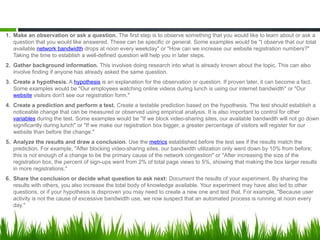
1. Make an observation or ask a question. The first step is to observe something that you would like to learn about or ask a
question that you would like answered. These can be specific or general. Some examples would be "I observe that our total
available network bandwidth drops at noon every weekday" or "How can we increase our website registration numbers?"
Taking the time to establish a well-defined question will help you in later steps.
2. Gather background information. This involves doing research into what is already known about the topic. This can also
involve finding if anyone has already asked the same question.
3. Create a hypothesis. A hypothesis is an explanation for the observation or question. If proven later, it can become a fact.
Some examples would be "Our employees watching online videos during lunch is using our internet bandwidth" or "Our
website visitors don't see our registration form."
4. Create a prediction and perform a test. Create a testable prediction based on the hypothesis. The test should establish a
noticeable change that can be measured or observed using empirical analysis. It is also important to control for other
variables during the test. Some examples would be "If we block video-sharing sites, our available bandwidth will not go down
significantly during lunch" or "If we make our registration box bigger, a greater percentage of visitors will register for our
website than before the change."
5. Analyze the results and draw a conclusion. Use the metrics established before the test see if the results match the
prediction. For example, "After blocking video-sharing sites, our bandwidth utilization only went down by 10% from before;
this is not enough of a change to be the primary cause of the network congestion" or "After increasing the size of the
registration box, the percent of sign-ups went from 2% of total page views to 5%, showing that making the box larger results
in more registrations."
6. Share the conclusion or decide what question to ask next: Document the results of your experiment. By sharing the
results with others, you also increase the total body of knowledge available. Your experiment may have also led to other
questions, or if your hypothesis is disproven you may need to create a new one and test that. For example, "Because user
activity is not the cause of excessive bandwidth use, we now suspect that an automated process is running at noon every
day."
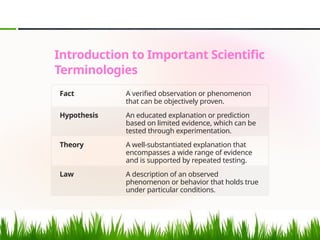
Introduction to Important Scientific
Terminologies
Fact A verified observation or phenomenon
that can be objectively proven.
Hypothesis An educated explanation or prediction
based on limited evidence, which can be
tested through experimentation.
Theory A well-substantiated explanation that
encompasses a wide range of evidence
and is supported by repeated testing.
Law A description of an observed
phenomenon or behavior that holds true
under particular conditions.
Lecture-5
THE BRANCHES OF
SCIENCE
THE BRANCHES OF
SCIENCE
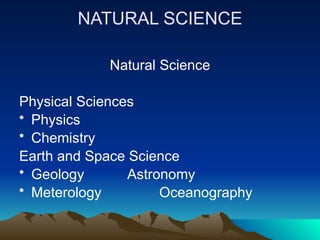
NATURAL SCIENCE
Natural Science
Physical Sciences
• Physics
• Chemistry
Earth and Space Science
• Geology Astronomy
• Meterology Oceanography
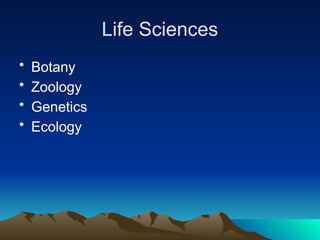
Life Sciences
• Botany
• Zoology
• Genetics
• Ecology
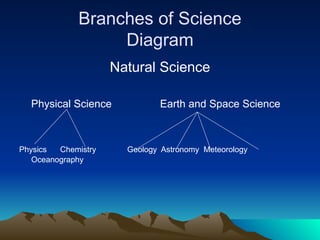
Branches of Science
Diagram
Natural Science
Physical Science Earth and Space Science
Physics Chemistry Geology Astronomy Meteorology
Oceanography
Branches of Science
Diagram
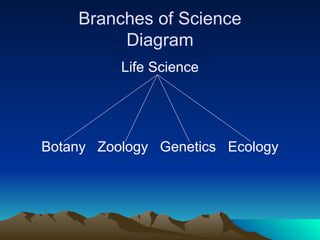
Life Science
Botany Zoology Genetics Ecology
Physical Science
• Physics – The science that deals with the
properties, changes and interactions of
matter and energy.
Physical Science
• Chemistry – The science that deals with
composition, properties and reactions of
substances.
Earth and Space Science
• Geology – the science that deals with the
development of the Earth’s crust, its rocks
and fossils.
Earth and Space Science
• Astronomy – The science that deals with
the origin, size, motion of stars and
planets.
Earth and Space Science
• Meteorology – the science of the
atmosphere and its phenomena (the study
of the weather)
Earth and Space Science
• Oceanography – The study of the
environment of the ocean (plants and
animals)
Life Science
• Botany – the science that deals with plants
and plant life.
Life Science
• Zoology – The science that deals with
animals and animal life.
Life Science
• Genetics – The branch of biology that
deals with heredity and variation in animal
and plant species.
Life Science
• Ecology – The branch of biology that deals
with the relations between living
organisms and their environment.
Physics and Biology
Five Broad Subjects
1. Biomolecular Systems
2. Neural Networks
3. Immunology
4. Evolution
5. Population Biology
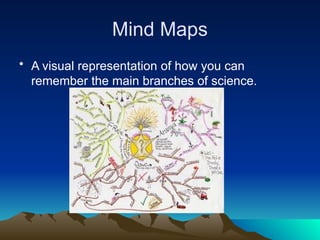
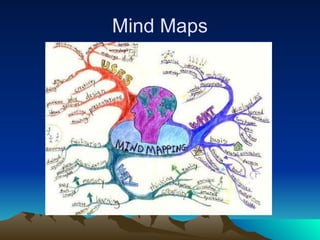
Mind Maps
• A visual representation of how you can
remember the main branches of science.
Mind Maps
YOUR MISSION
• CREATE A MIND MAP (A VISUAL
REPRESENTATION) OF HOW YOU CAN
REMEMBER THE MAIN BRANCHES OF
SCIENCE.
Lecture-6
Scientific Communication 67
68
Scientific Communication
Scientific communication refers to the process of conveying scientific
information, knowledge, research findings, and data to various
audiences in a clear, effective, and accurate manner.
It plays a crucial role in the scientific community and serves several
key purposes
69
Of Scientific Communication
70
1. Sharing Knowledge
Scientists communicate their
research findings and
discoveries to the broader
scientific community and
the public. This knowledge-
sharing allows others to
build upon existing research
and contributes to the
collective body of scientific
knowledge.
71
2. Peer
Review
Scientific communication includes the submission of
research papers to peer-reviewed journals, where
experts in the field assess the quality and validity of
the research. This peer review process ensures the
reliability and credibility of scientific work.
72
3. Collaboration Effective communication fosters
collaboration among researchers,
enabling them to work together on
complex scientific problems and share
resources and expertise.
73
4. Education
Scientists
communicate
through academic
lectures,
presentations, and
teaching, passing
on their knowledge
and skills to the
next generation of
scientists.
74
5. Policy and
Decision-
Making
Scientific communication plays a critical role in informing
policymakers, government agencies, and the public about
important scientific findings, which can influence policy
decisions and public awareness on issues such as climate
change, public health, and more.
75
Forms of Scientific
Communication
76
Research Papers
Published in scientific journals, these
papers provide a detailed account of
research methods, results, and
conclusions.
77
Conferences and
Symposia
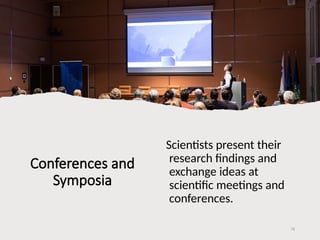
Scientists present their
research findings and
exchange ideas at
scientific meetings and
conferences.
78
Publications
Beyond research papers,
scientists may write books,
review articles, and popular
science articles to
communicate their work to
different audiences.
79
Science
Communication and
Outreach
Engaging with the
public through
various channels,
including science
journalism, social
media, and public
talks, to explain
scientific concepts
in accessible ways.
80
Teaching and
Mentoring
Educators and
mentors
communicate
scientific principles
and methodologies
to students and
junior researchers.
81
Summary
In essence, effective scientific
communication is essential for
the dissemination of knowledge,
the progress of scientific inquiry,
and the broader impact of
scientific research on society. It
involves using language and
visuals that are clear and
understandable to the intended
audience while upholding the
principles of accuracy, honesty,
and transparency in conveying
scientific findings.
82
Lecture-7
Introduction to
Physics
PHYSICS?
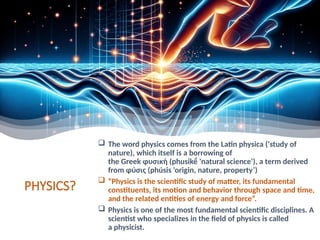
 The word physics comes from the Latin physica ('study of
nature), which itself is a borrowing of
the Greek φυσική (phusikḗ 'natural science'), a term derived
from φύσις (phúsis 'origin, nature, property’)
 “Physics is the scientific study of matter, its fundamental
constituents, its motion and behavior through space and time,
and the related entities of energy and force”.
 Physics is one of the most fundamental scientific disciplines. A
scientist who specializes in the field of physics is called
a physicist.
BRANCHES OF
PHYSICS
Basic Concepts of Physics
Contents
• What is Physics?
• Velocity
• Acceleration
• Vectors
• Force
• Forces in nature
• Newton’s Law of Motion
• Friction
•
Physics is…
•Physics = study of how force and
energy affect matter.
•Basic Physics = the study of forces
and motion.
Part one
Velocity
Velocity
•Velocity describes how far an object
moves in a certain amount of time.
•Velocity = Distance divided by Time
•V = d/t
•Velocity is different from speed
because it specifies direction.
Velocity
•Example:
•5 meters per second (m/s) is a
speed.
•5 meters per second (m/s) north is a
velocity.
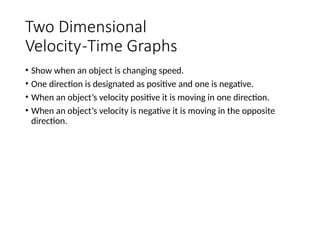
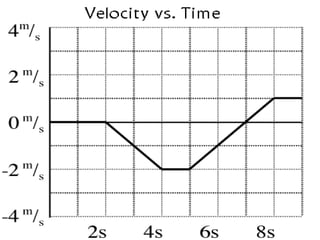
Two Dimensional
Velocity-Time Graphs
• Show when an object is changing speed.
• One direction is designated as positive and one is negative.
• When an object’s velocity positive it is moving in one direction.
• When an object’s velocity is negative it is moving in the opposite
direction.
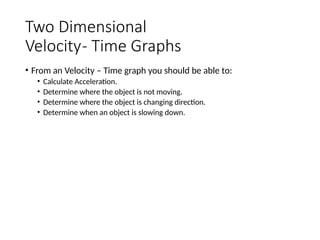
Two Dimensional
Velocity- Time Graphs
• From an Velocity – Time graph you should be able to:
• Calculate Acceleration.
• Determine where the object is not moving.
• Determine where the object is changing direction.
• Determine when an object is slowing down.
Part Two
Acceleration
Acceleration
• Acceleration = the rate at which velocity changes.
• When something is accelerating its velocity is constantly changing.
• Measured in m/s2
(meters per second per second).
Example:
•If a car is accelerating at 4 meters per second per
second (4m/s2
) from rest, how fast is it going after 1
second?
•4 m/s
•How fast is it going after two seconds?
•8 m/s
•After 3 seconds?
•12 m/s
•Its velocity increases by 4 m/s every second.
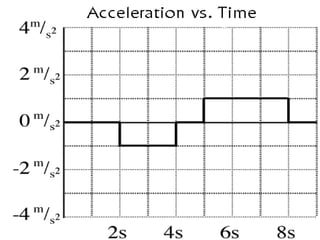
Two Dimensional
Acceleration-Time Graphs
• Show how fast velocity is changing.
• One direction is designated as positive and one is negative.
• When an object’s acceleration is acting in the same direction as it’s
motion, it speeds up.
• When an object’s acceleration is acting in the opposite direction as its
motion it slows down.
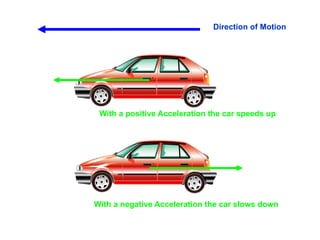
Direction of Motion
With a positive Acceleration the car speeds up
With a negative Acceleration the car slows down
Two Dimensional
Acceleration-Time Graphs
• When acceleration is at zero it means that velocity is not changing. IT
DOESN’T NECESSARILY MEAN THAT THE OBJECT IS NOT MOVING!!
Calculating Acceleration
• Acceleration can be calculated by determining the slope of a velocity
vs. time graph, but it can also be calculated using the following
formula.
• Acceleration = (Vf – Vi)/t (measured in m/s2
)
• Vf = Final Velocity
• Vi = Starting Velocity
• t = Time
Practice Calculating Acceleration
• A car is traveling at 28 meters per second north; 10 seconds later
the car is traveling 15 meters per second north. What is the car’s
acceleration?
• A car with a mass of 2150 kg is traveling at west 70 m/s, two
minutes later the car is traveling west at 100 m/s. What is the
car’s acceleration?
Part Three
Vectors
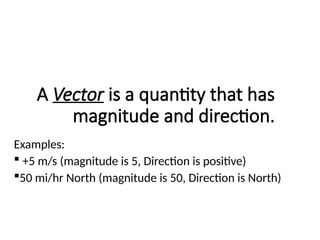
A Vector is a quantity that has
magnitude and direction.
Examples:
 +5 m/s (magnitude is 5, Direction is positive)
50 mi/hr North (magnitude is 50, Direction is North)
Examples of Vectors
• Force
• Velocity
• Acceleration
Drawing Vectors
• Vectors are represented with arrows.
• The arrow’s size reflects the magnitude of the vector.
• The longer the arrow, the larger the magnitude.
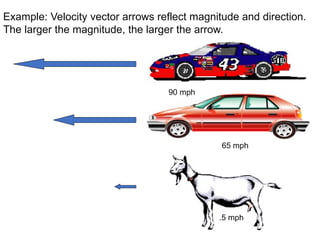
Example: Velocity vector arrows reflect magnitude and direction.
The larger the magnitude, the larger the arrow.
90 mph
65 mph
.5 mph
Vector Addition
• To use vector addition all vectors must be the same type of vector
(Example: Force, Velocity, Acceleration)
• Vector arrows can be added together if they are acting in the same
direction.
• Vector arrows can be subtracted if they act in opposite directions.
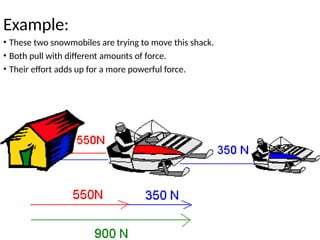
Example:
• These two snowmobiles are trying to move this shack.
• Both pull with different amounts of force.
• Their effort adds up for a more powerful force.
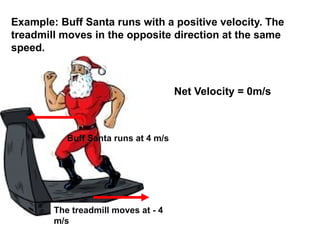
Buff Santa runs at 4 m/s
The treadmill moves at - 4
m/s
Example: Buff Santa runs with a positive velocity. The
treadmill moves in the opposite direction at the same
speed.
Net Velocity = 0m/s
Basics of Force
• Before discussing Newton’s laws you need to know
some basic information about force.
• Force is a vector and can be represented with a vector
diagram (or free body diagram).
• The unit used when measuring force is the Newton (N).
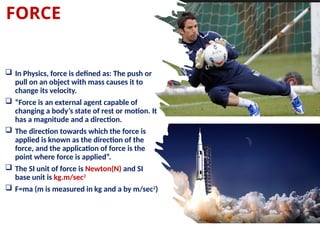
FORCE
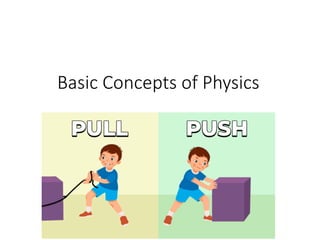
 In Physics, force is defined as: The push or
pull on an object with mass causes it to
change its velocity.
 “Force is an external agent capable of
changing a body’s state of rest or motion. It
has a magnitude and a direction.
 The direction towards which the force is
applied is known as the direction of the
force, and the application of force is the
point where force is applied”.
 The SI unit of force is Newton(N) and SI
base unit is kg.m/sec2
 F=ma (m is measured in kg and a by m/sec2
)
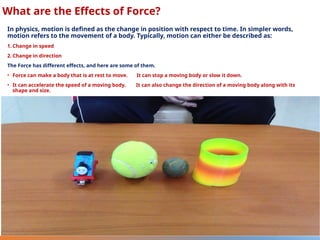
What are the Effects of Force?
In physics, motion is defined as the change in position with respect to time. In simpler words,
motion refers to the movement of a body. Typically, motion can either be described as:
1. Change in speed
2. Change in direction
The Force has different effects, and here are some of them.
• Force can make a body that is at rest to move. It can stop a moving body or slow it down.
• It can accelerate the speed of a moving body. It can also change the direction of a moving body along with its
shape and size.
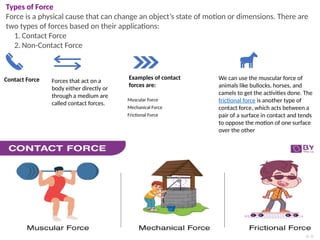
Types of Force
Force is a physical cause that can change an object’s state of motion or dimensions. There are
two types of forces based on their applications:
1. Contact Force
2. Non-Contact Force
Contact Force Forces that act on a
body either directly or
through a medium are
called contact forces.
Examples of contact
forces are:
Muscular Force
Mechanical Force
Frictional Force
We can use the muscular force of
animals like bullocks, horses, and
camels to get the activities done. The
frictional force is another type of
contact force, which acts between a
pair of a surface in contact and tends
to oppose the motion of one surface
over the other
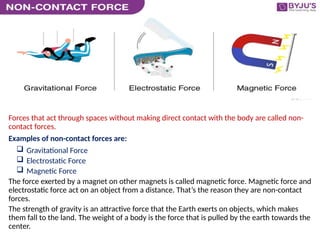
Forces that act through spaces without making direct contact with the body are called non-
contact forces.
Examples of non-contact forces are:
 Gravitational Force
 Electrostatic Force
 Magnetic Force
The force exerted by a magnet on other magnets is called magnetic force. Magnetic force and
electrostatic force act on an object from a distance. That’s the reason they are non-contact
forces.
The strength of gravity is an attractive force that the Earth exerts on objects, which makes
them fall to the land. The weight of a body is the force that is pulled by the earth towards the
center.
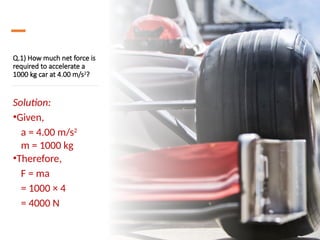
Q.1) How much net force is
required to accelerate a
1000 kg car at 4.00 m/s2
?
Solution:
•Given,
a = 4.00 m/s2
m = 1000 kg
•Therefore,
F = ma
= 1000 × 4
= 4000 N
Q.3) A hammer having a mass of 1 kg going
with a speed of 6 m/s hits a wall and comes to
rest in 0.1 sec. Compute the obstacle force that
makes the hammer stop.
Solution:
Given,
Mass of Hammer, m = 1 kg
Initial Velocity, Vi = 6 m/s
Final Velocity, Vf = 0 m/s
Time Taken, t = 0.1 s
The acceleration is:
a = (Vf – Vi)/t
Therefore, a = -60 m/sec2
[-ve sign indicates retardation]
Thus, the retarding Force, F = ma = 1 × 60 =
60 N
•Frequently Asked Questions – FAQs
Q1 Which is the weakest force in nature?
•Gravity is the weakest force as its coupling constant is small in value.
Q2 Which force is strongest?
•The strongest force is the strong nuclear force which is 100 times stronger
than the electromagnetic force.
Q3 What are some types of forces?
•Basically, there are two types of forces:
•Non-contact forces
•Contact forces
Q4 What are some examples of force?
•Some examples of force are:
•Gravitational force
•Electric force
•Magnetic force
•Nuclear force
•Frictional force
Q5. Which force causes a charged balloon to attract another balloon?
•Electrostatic force
Newton’s Three Laws
•These laws are about FORCE and
MOTION
• When forces act on objects their motion is affected.
Newton’s first law
• Moving objects will continue moving while objects at rest will
continue to rest.
• …Until an unbalanced force changes the object’s behavior.
• If the net force is anything but 0N, the object will accelerate (speed
up, slow down, or turn)
What’s the difference between balanced forces
and unbalanced forces?
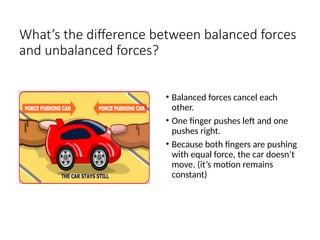
• Balanced forces cancel each
other.
• One finger pushes left and one
pushes right.
• Because both fingers are pushing
with equal force, the car doesn’t
move. (it’s motion remains
constant)
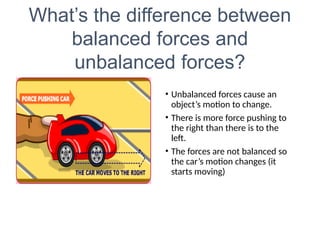
• Unbalanced forces cause an
object’s motion to change.
• There is more force pushing to
the right than there is to the
left.
• The forces are not balanced so
the car’s motion changes (it
starts moving)
What’s the difference between
balanced forces and
unbalanced forces?
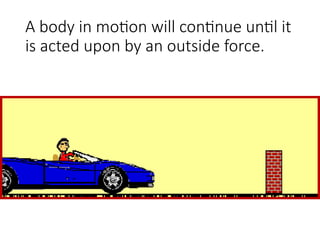
A body in motion will continue until it
is acted upon by an outside force.
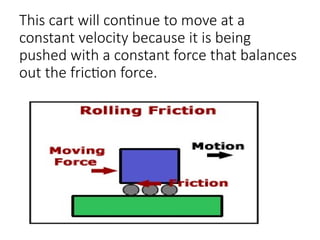
This cart will continue to move at a
constant velocity because it is being
pushed with a constant force that balances
out the friction force.
Friction
• There are many different types of friction but the most common are
Static Friction and Kinetic Friction.
• Static Friction – Friction between non-moving surfaces.
• Kinetic Friction – Friction between moving surfaces.
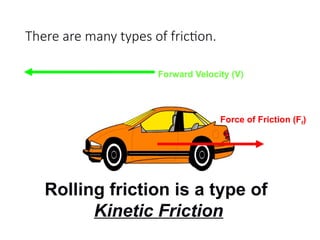
There are many types of friction.
Forward Velocity (V)
Force of Friction (Ff)
Rolling friction is a type of
Kinetic Friction
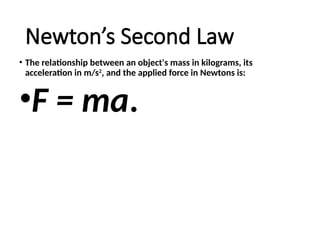
Newton’s Second Law
• The relationship between an object's mass in kilograms, its
acceleration in m/s2
, and the applied force in Newtons is:
•F = ma.
Newton’s Second Law
•Or…
•The heavier something is, the
more force is required to
accelerate it!!
Newton’s second law and Gravity.
•Newton’s second law can be changed to
solve for acceleration (a = F/m).
•Gravity accelerates EVERYTHING at a
rate of 9.8 m/s2
•How much force does gravity put on
you? (Hint: you need to know your mass in kilograms. 1kg
= 2.2 lbs)
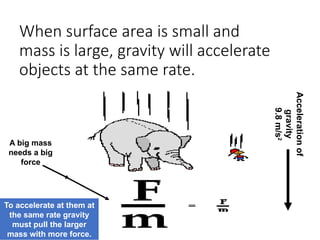
When surface area is small and
mass is large, gravity will accelerate
objects at the same rate.
Acceleration
of
gravity
9.8
m/s
2
A big mass
needs a big
force
To accelerate at them at
the same rate gravity
must pull the larger
mass with more force.
Newton’s Third Law
• Whenever one object exerts a force on a second object, the second
object exerts an equal and opposite force on the first object.
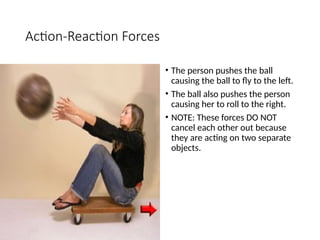
Action-Reaction Forces
• The person pushes the ball
causing the ball to fly to the left.
• The ball also pushes the person
causing her to roll to the right.
• NOTE: These forces DO NOT
cancel each other out because
they are acting on two separate
objects.
Newton’s Third Law
•These equal and opposite forces are
called Action – Reaction forces.
Basic concepts of
Biology
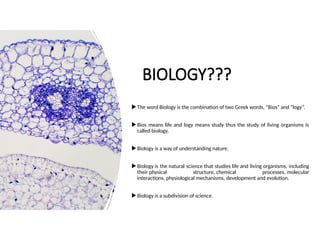
BIOLOGY???
The word Biology is the combination of two Greek words, ”Bios” and “logy”.
Bios means life and logy means study thus the study of living organisms is
called biology.
Biology is a way of understanding nature.
Biology is the natural science that studies life and living organisms, including
their physical structure, chemical processes, molecular
interactions, physiological mechanisms, development and evolution.
Biology is a subdivision of science.
IMPORTANCE OF
BIOLOGY???
It plays an important role in understanding
 Complex forms of life involving humans, animals, invertebrates and
plants, etc.
 Complex relationship between humans, plants, animals and other forms
of life.
 Ways in order to care for themselves, animals, and plants in the proper
manner.
 The interaction between humanity and the world.
 The importance and uses of resources (renewable and non-renewable)
and potential threats to these resources available in the environment.
 Developing interests among humans for the protection and conservation
of biological as well as other resources.
FIELDS OF BIOLOGY
The field of biology is split into three main categories,
each of which focuses on how living systems operate
at a different scale:
1. The Cell and molecular biology, which is focused on .
understanding how processes at the scale of the
smallest biological unit and molecular scale underpin
biological function in all organisms
2. Physiology, which is focused on examining the
processes and functions within an organism
3. Ecology and Evolutionary Biology, which is focused
on examining on how processes operating at large
spatial and temporal scales influence the kinds of
organisms and living systems that exist on earth.
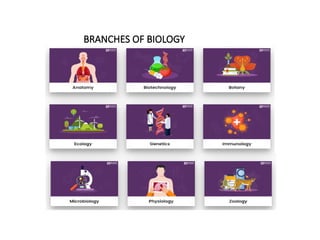
BRANCHES OF BIOLOGY
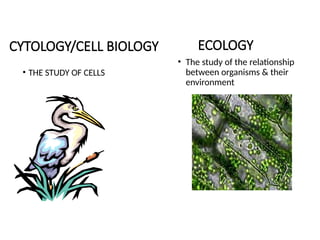
CYTOLOGY/CELL BIOLOGY
• THE STUDY OF CELLS
ECOLOGY
• The study of the relationship
between organisms & their
environment
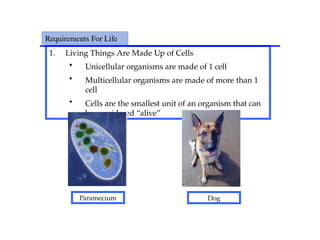
1. Living Things Are Made Up of Cells
• Unicellular organisms are made of 1 cell
• Multicellular organisms are made of more than 1
cell
• Cells are the smallest unit of an organism that can
be considered “alive”
Requirements For Life
Paramecium Dog
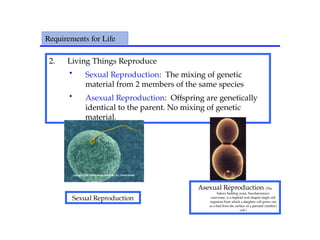
2. Living Things Reproduce
• Sexual Reproduction: The mixing of genetic
material from 2 members of the same species
• Asexual Reproduction: Offspring are genetically
identical to the parent. No mixing of genetic
material.
Requirements for Life
Sexual Reproduction
Asexual Reproduction (The
bakers budding yeast, Saccharomyces
cerevisiae, is a haploid oval-shaped single cell
organism from which a daughter cell grows out
as a bud from the surface of a parental (mother)
cell.)
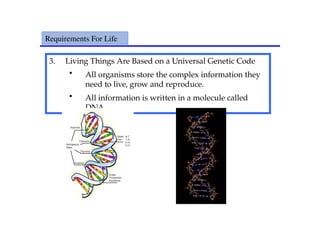
3. Living Things Are Based on a Universal Genetic Code
• All organisms store the complex information they
need to live, grow and reproduce.
• All information is written in a molecule called
DNA.
Requirements For Life
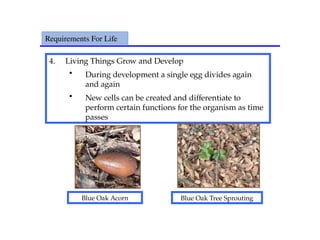
4. Living Things Grow and Develop
• During development a single egg divides again
and again
• New cells can be created and differentiate to
perform certain functions for the organism as time
passes
Requirements For Life
Blue Oak Acorn Blue Oak Tree Sprouting
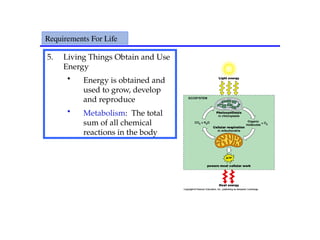
5. Living Things Obtain and Use
Energy
• Energy is obtained and
used to grow, develop
and reproduce
• Metabolism: The total
sum of all chemical
reactions in the body
Requirements For Life
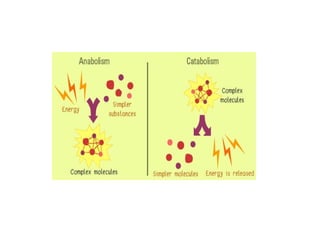
Anabolism (constructive process)
This is a process where by living organisms use
simpler substances to put together, or build complex
substances such as carbohydrates, proteins and fats.
Such an activity is known as an anabolic activity.
Catabolism (destructive process)
This is when the cells in living organisms,
breakdown complex substances and molecules into
simpler substances, often to release energy for use.
Metabolism
This is the sum of all the chemical reactions
(anabolic and catabolic activities) that go on in the
cells of living organisms. It is a continous process
because the moment metabolism stops, the living
organism will die.
Requirements For Life
6. Living Things Respond to Their Environment
• Detect changes
• Living things can detect changes in their internal or external environment,
such as light, temperature, water, or pressure. This ability is called
irritability.
• Respond
• Living things respond to these changes in many ways, including movement,
changing their behavior, or changing their biochemistry. For example, a dog
salivates when it smells food, a flower opens in sunlight, and a cuttlefish
changes color to match its background
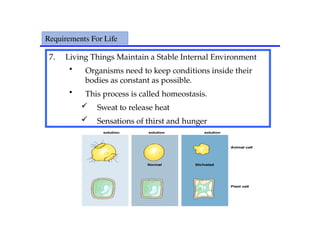
7. Living Things Maintain a Stable Internal Environment
• Organisms need to keep conditions inside their
bodies as constant as possible.
• This process is called homeostasis.
 Sweat to release heat
 Sensations of thirst and hunger
Requirements For Life
• The human body, for example, maintains blood pH
within the very narrow range of 7.35 to 7.45.
• A pH below this range is called acidosis and a pH above
this range is alkalosis.
• Either condition can be life threatening. One can live
only a few hours with a blood pH below 7.0 or above 7.7,
and a pH below 6.8 or above 8.0 is quickly fatal.
• Yet the body's metabolism constantly produces a variety
of acidic waste products that challenge its ability to
maintain pH in a safe range.
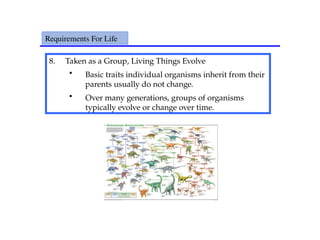
8. Taken as a Group, Living Things Evolve
• Basic traits individual organisms inherit from their
parents usually do not change.
• Over many generations, groups of organisms
typically evolve or change over time.
Requirements For Life
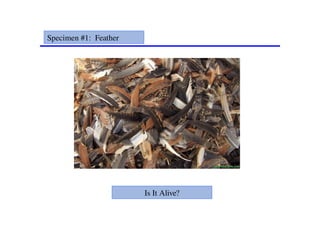
Specimen #1: Feather
Is It Alive?
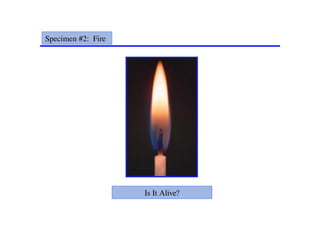
Specimen #2: Fire
Is It Alive?
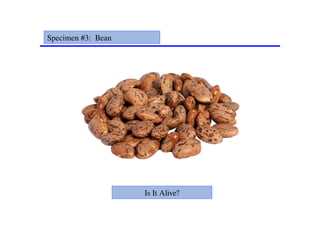
Specimen #3: Bean
Is It Alive?
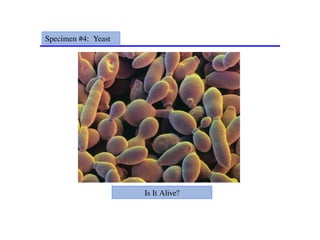
Specimen #4: Yeast
Is It Alive?
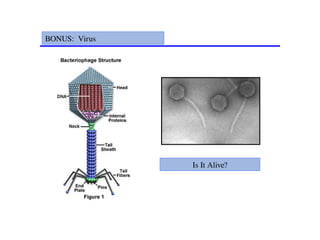
BONUS: Virus
Is It Alive?
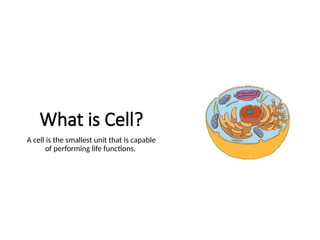
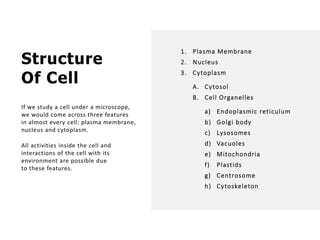
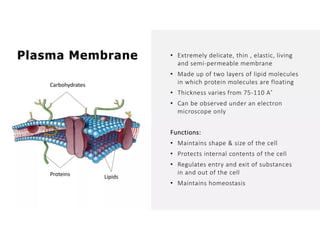
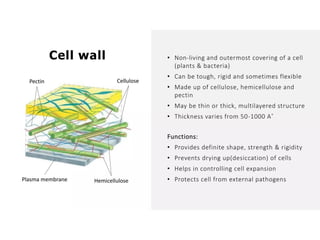
What is Cell?
A cell is the smallest unit that is capable
of performing life functions.
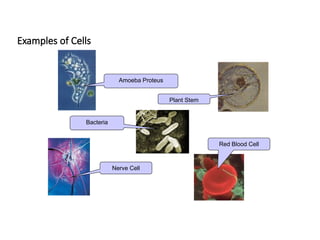
Examples of Cells
Amoeba Proteus
Plant Stem
Red Blood Cell
Nerve Cell
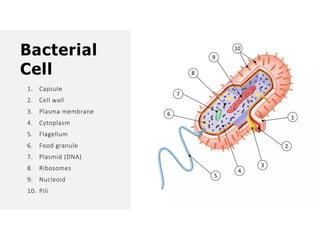
Bacteria
Overall Natural Science-1.pptxjsjsbaksnsbksjsbsjs

Overall Natural Science-1.pptxjsjsbaksnsbksjsbsjs

  • 1.
  • 2.
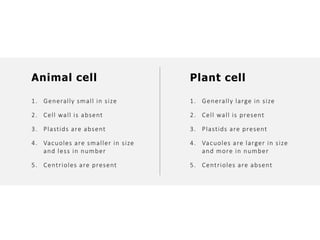
    What is Science? Theword “science” probably brings to mind many different pictures: • A fat textbook • White lab coats and microscopes • An astronomer peering through a telescope • A naturalist in the rainforest
  • 3.
    • Einstein’s equationsscribbled on a chalkboard • The launch of the space shuttle • Bubbling beakers …. All of those images reflect some aspect of science, but none of them provides a full picture because science has so many facets: What is Science?
  • 4.
    Science is botha body of knowledge and a process  In school, science may sometimes seem like a collection of isolated and static facts listed in a textbook but that’s only a small part of the story.  Just as importantly, science is also a process of discovery that allows us to link isolated facts into coherent and comprehensive understandings of the natural world.
  • 5.
    Science is exciting Scienceis a way of discovering  what’s in the universe  how those things work today  how they worked in the past  how they are likely to work in the future. Scientists are motivated by the thrill of seeing or figuring out something that no one has before.
  • 6.
    Science is useful The knowledge generated by science is powerful and reliable. It can be used to  develop new technologies,  treat diseases  deal with many other sorts of problems.

  • 7.
    Science is ongoing Science is continually refining and expanding our knowledge of the universe, and as it does  it leads to new questions for future investigation  Science will never be “finished.”
  • 8.
    Science is aglobal human endeavor  People all over the world participate in the process of science.  And you can too!
  • 9.
    Discovery: The sparkfor science  “aha!” moments may not happen frequently, but they are often experiences that drive science and scientists.  For a scientist, every day holds the possibility of discovery  coming up with a brand new idea or of observing something that no one has ever seen before. Vast bodies of knowledge have yet to be built and many of the most basic questions about the universe have yet to be answered:
  • 10.
    Discovery: The sparkfor science • Vast bodies of knowledge have yet to be built and many of the most basic questions about the universe have yet to be answered
  • 11.
    Discovery: The sparkfor science •What causes gravity? •How do tectonic plates move around on Earth’s surface? •How do our brains store memories? •How do water molecules interact with each other? We don’t know the complete answers to these and an overwhelming number of other questions, but the prospect of answering them beckons science forward.
  • 12.
     Scientific questionscan seem complex (e.g., what chemical reactions allow cells to break the bonds in sugar molecules), but they don’t have to be.   You’ve probably posed many perfectly valid scientific questions yourself: like • how can airplanes fly, • why do cakes rise in the oven, • why do apples turn brown once they’re cut? EVERYDAY SCIENCE QUESTIONS
  • 13.
    EVERYDAY SCIENCE QUESTIONS You can discover the answers to many of these “everyday” science questions in your local library  but for others, science may not have the answers yet  answering such questions can lead to astonishing new discoveries.
  • 14.
    EVERYDAY SCIENCE QUESTIONS Forexample, we still don’t know much about  how your brain remembers to buy milk at the grocery store.  Just as we’re motivated to answer questions about our everyday experiences, scientists confront such questions at all scales, including questions about the very nature of the universe.
  • 15.
     The processof scientific discovery is not limited to professional scientists working in labs. The everyday experience of deducing that  your car won’t start because of a bad fuel pump  figuring out that the centipedes in your backyard prefer shady rocks shares fundamental similarities with classically scientific discoveries like  working out DNA’s double helix.
  • 16.
     These activitiesall involve making observations and analyzing evidence  they all provide the satisfaction of finding an answer that makes sense of all the facts.  In fact, some psychologists argue that the way individual humans learn (especially as children) bears a lot of similarity to the progress of science  both involve making observations, considering evidence, testing ideas, and holding on to those that work.
  • 17.
  • 18.
    A Science Checklist Science turns out to be difficult to define precisely. (Philosophers have been arguing about it for decades!)  The problem is that the term “science” applies to a remarkably broad set of human activities  To get a grasp on what science is, we’ll look at a checklist that summarizes key characteristics of science
  • 19.
     This checklistprovides a guide for what sorts of activities are encompassed by science  Some of these characteristics are particularly important to science A Science Checklist
  • 20.
    Science asks questionsabout the natural world Science studies the natural world. This includes the components of the physical universe around us like • atoms • plants • eco- system • people • societies • Galaxies as well as the natural forces at work on those things.
  • 21.
    Science aims toexplain and understand Science as a collective institution aims to produce more and more accurate natural explanations of  how the natural world works  what its components are,  how the world got to be the way it is now. Classically, science’s main goal has been building knowledge and understanding,
  • 22.
    Science works withtestable ideas  Only testable ideas are within the purview of science.  For an idea to be testable, it must logically generate specific expectations  a set of observations that we could expect to make if the idea were true  a set of observations that would be inconsistent with the idea and lead you to believe that it is not true
  • 23.
    Science relies onevidence  Scientific ideas must not only be testable, but must actually be tested preferably with many different lines of evidence by many different people.  Scientists actively seek evidence to test their ideas  even if the test is difficult and means for example, 1. spending years working on a single experiment 2. , traveling to Antarctica to measure carbon dioxide levels in an ice core 3. collecting DNA samples from thousands of volunteers all over the world.
  • 24.
    Science is embeddedin the scientific community  The progress of science depends on interactions within the scientific community.  the community of people and organizations that generate scientific ideas, test those ideas, publish scientific journals, organize conferences, train scientists, distribute re- search funds, etc.  This scientific community provides the cumulative knowledge base that allows science to build on itself.  It is also responsible for the further testing and scrutiny of ideas and for performing checks and balances on the work of community members
  • 25.
    Science is embeddedin the scientific community Scientists sometimes work alone and sometimes work together, but communication within the scientific community is always important
  • 26.
    Scientific ideas leadto ongoing research  Science is an ongoing endeavor.  It did not end with the most recent edition of your college physics textbook and will not end even once we know the answers to big questions, such as  how our 20,000 genes interact to build a human being  So long as there are unexplored and unexplained parts of the natural world, science will continue to investigate them.
  • 27.
    Participants in sciencebehave scientifically  Science is sometimes misconstrued as an elite endeavor in which one has to be a member of “the club” in order to be taken seriously. That’s a bit misleading.  In fact, science is now open to anyone regardless of  age  Gender  religious commitment  physical ability
  • 28.
     Ethnicity  countryof origin  political views  However, science only works because the people involved with it behave “scientifically” that is, behave in ways that push science forward Participants in science behave scientifically
  • 29.
    Participants in sciencebehave scientifically
  • 30.
  • 31.
    What has sciencedone for you?  Science affects us all, every day of the year, from the moment we wake up, all day long, and through the night.  your digital alarm clock  the weather report  the bus you ride in,  your decision to eat a baked potato instead of fries  your cell phone
  • 32.
     the antibioticsthat treat your sore throat  the clean water that comes from your faucet  the light that you turn off at the end of the day have all been brought to you courtesy of science.  The modern world would not be modern at all without the understandings and technology enabled by science. What has science done for you?
  • 33.
    Without modern science,there would be:  no way to use electricity  no plastic.  no modern agriculture  no modern medicine
  • 34.
    No way touse electricity Science has steadily built up our understanding of electricity, which today • carries our voices over telephone lines, • brings entertainment to our televisions, • keeps the lights on.
  • 35.
    No plastic  Thefirst completely synthetic plastic was made by a chemist in the early 1900s,  Chemistry has developed a wide variety of plastics from blocking bullets to making slicker dental floss.
  • 36.
    No modern agriculture Science has transformed the way we eat today.  In the 1940s, biologists began developing high yield varieties of corn, wheat, and rice.  New fertilizers and pesticides developed by chemists, dramatically increased the amount of food that could be harvested from a single field,
  • 37.
    No modern agriculture Massively increasing the amount of food available to feed the world  Transforming the economic structure of agricultural practices.
  • 38.
    No modern medicine 1700s, Edward Jenner convincingly showed that vaccination worked.  In the 1800s, scientists and doctors established the theory that many diseases are caused by germs.  In the 1920s, a biologist discovered the first antibiotic.
  • 39.
    Discovery: The sparkfor science  The eradication of smallpox  The prevention of nutritional deficiencies  Successful treatments for infections  The impact of modern medicine on global health has been powerful.  In fact, without science, many people alive today would have instead died of diseases that are now easily treated.
  • 40.
    Conclusion  Scientific knowledgecan improve the quality of life at many different levels  from the routine workings of our everyday lives to global issues. Science informs public policy and personal decisions on • energy, • conservation
  • 41.
     transportation  Communication Defense  Economics  health  leisure, and exploration.  It’s almost impossible to overstate how many aspects of modern life are impacted by scientific knowledge. Conclusion
  • 42.
    Lecture-4 Scientific Methods An explorationof how the Scientific Method has evolved throughout history, from its origins in ancient civilizations to the modern era and future prospects.
  • 43.
    What is ScientificMethod • The scientific method is the process of objectively establishing facts through testing and experimentation. • The basic process involves making an observation, forming a hypothesis, making a prediction, conducting an experiment and finally analyzing the results. • The principals of the scientific method can be applied in many areas, including scientific research, business and technology.
  • 45.
    1. Make anobservation or ask a question. The first step is to observe something that you would like to learn about or ask a question that you would like answered. These can be specific or general. Some examples would be "I observe that our total available network bandwidth drops at noon every weekday" or "How can we increase our website registration numbers?" Taking the time to establish a well-defined question will help you in later steps. 2. Gather background information. This involves doing research into what is already known about the topic. This can also involve finding if anyone has already asked the same question. 3. Create a hypothesis. A hypothesis is an explanation for the observation or question. If proven later, it can become a fact. Some examples would be "Our employees watching online videos during lunch is using our internet bandwidth" or "Our website visitors don't see our registration form." 4. Create a prediction and perform a test. Create a testable prediction based on the hypothesis. The test should establish a noticeable change that can be measured or observed using empirical analysis. It is also important to control for other variables during the test. Some examples would be "If we block video-sharing sites, our available bandwidth will not go down significantly during lunch" or "If we make our registration box bigger, a greater percentage of visitors will register for our website than before the change." 5. Analyze the results and draw a conclusion. Use the metrics established before the test see if the results match the prediction. For example, "After blocking video-sharing sites, our bandwidth utilization only went down by 10% from before; this is not enough of a change to be the primary cause of the network congestion" or "After increasing the size of the registration box, the percent of sign-ups went from 2% of total page views to 5%, showing that making the box larger results in more registrations." 6. Share the conclusion or decide what question to ask next: Document the results of your experiment. By sharing the results with others, you also increase the total body of knowledge available. Your experiment may have also led to other questions, or if your hypothesis is disproven you may need to create a new one and test that. For example, "Because user activity is not the cause of excessive bandwidth use, we now suspect that an automated process is running at noon every day."
  • 46.
    Introduction to ImportantScientific Terminologies Fact A verified observation or phenomenon that can be objectively proven. Hypothesis An educated explanation or prediction based on limited evidence, which can be tested through experimentation. Theory A well-substantiated explanation that encompasses a wide range of evidence and is supported by repeated testing. Law A description of an observed phenomenon or behavior that holds true under particular conditions.
  • 47.
  • 48.
  • 49.
    NATURAL SCIENCE Natural Science PhysicalSciences • Physics • Chemistry Earth and Space Science • Geology Astronomy • Meterology Oceanography
  • 50.
    Life Sciences • Botany •Zoology • Genetics • Ecology
  • 51.
    Branches of Science Diagram NaturalScience Physical Science Earth and Space Science Physics Chemistry Geology Astronomy Meteorology Oceanography
  • 52.
    Branches of Science Diagram LifeScience Botany Zoology Genetics Ecology
  • 53.
    Physical Science • Physics– The science that deals with the properties, changes and interactions of matter and energy.
  • 54.
    Physical Science • Chemistry– The science that deals with composition, properties and reactions of substances.
  • 55.
    Earth and SpaceScience • Geology – the science that deals with the development of the Earth’s crust, its rocks and fossils.
  • 56.
    Earth and SpaceScience • Astronomy – The science that deals with the origin, size, motion of stars and planets.
  • 57.
    Earth and SpaceScience • Meteorology – the science of the atmosphere and its phenomena (the study of the weather)
  • 58.
    Earth and SpaceScience • Oceanography – The study of the environment of the ocean (plants and animals)
  • 59.
    Life Science • Botany– the science that deals with plants and plant life.
  • 60.
    Life Science • Zoology– The science that deals with animals and animal life.
  • 61.
    Life Science • Genetics– The branch of biology that deals with heredity and variation in animal and plant species.
  • 62.
    Life Science • Ecology– The branch of biology that deals with the relations between living organisms and their environment.
  • 63.
    Physics and Biology FiveBroad Subjects 1. Biomolecular Systems 2. Neural Networks 3. Immunology 4. Evolution 5. Population Biology
  • 64.
    Mind Maps • Avisual representation of how you can remember the main branches of science.
  • 65.
  • 66.
    YOUR MISSION • CREATEA MIND MAP (A VISUAL REPRESENTATION) OF HOW YOU CAN REMEMBER THE MAIN BRANCHES OF SCIENCE.
  • 67.
  • 68.
  • 69.
    Scientific Communication Scientific communicationrefers to the process of conveying scientific information, knowledge, research findings, and data to various audiences in a clear, effective, and accurate manner. It plays a crucial role in the scientific community and serves several key purposes 69
  • 70.
  • 71.
    1. Sharing Knowledge Scientistscommunicate their research findings and discoveries to the broader scientific community and the public. This knowledge- sharing allows others to build upon existing research and contributes to the collective body of scientific knowledge. 71
  • 72.
    2. Peer Review Scientific communicationincludes the submission of research papers to peer-reviewed journals, where experts in the field assess the quality and validity of the research. This peer review process ensures the reliability and credibility of scientific work. 72
  • 73.
    3. Collaboration Effectivecommunication fosters collaboration among researchers, enabling them to work together on complex scientific problems and share resources and expertise. 73
  • 74.
    4. Education Scientists communicate through academic lectures, presentations,and teaching, passing on their knowledge and skills to the next generation of scientists. 74
  • 75.
    5. Policy and Decision- Making Scientificcommunication plays a critical role in informing policymakers, government agencies, and the public about important scientific findings, which can influence policy decisions and public awareness on issues such as climate change, public health, and more. 75
  • 76.
  • 77.
    Research Papers Published inscientific journals, these papers provide a detailed account of research methods, results, and conclusions. 77
  • 78.
    Conferences and Symposia Scientists presenttheir research findings and exchange ideas at scientific meetings and conferences. 78
  • 79.
    Publications Beyond research papers, scientistsmay write books, review articles, and popular science articles to communicate their work to different audiences. 79
  • 80.
    Science Communication and Outreach Engaging withthe public through various channels, including science journalism, social media, and public talks, to explain scientific concepts in accessible ways. 80
  • 81.
    Teaching and Mentoring Educators and mentors communicate scientificprinciples and methodologies to students and junior researchers. 81
  • 82.
    Summary In essence, effectivescientific communication is essential for the dissemination of knowledge, the progress of scientific inquiry, and the broader impact of scientific research on society. It involves using language and visuals that are clear and understandable to the intended audience while upholding the principles of accuracy, honesty, and transparency in conveying scientific findings. 82
  • 83.
  • 86.
    PHYSICS?  The wordphysics comes from the Latin physica ('study of nature), which itself is a borrowing of the Greek φυσική (phusikḗ 'natural science'), a term derived from φύσις (phúsis 'origin, nature, property’)  “Physics is the scientific study of matter, its fundamental constituents, its motion and behavior through space and time, and the related entities of energy and force”.  Physics is one of the most fundamental scientific disciplines. A scientist who specializes in the field of physics is called a physicist.
  • 90.
  • 109.
  • 110.
    Contents • What isPhysics? • Velocity • Acceleration • Vectors • Force • Forces in nature • Newton’s Law of Motion • Friction •
  • 111.
    Physics is… •Physics =study of how force and energy affect matter. •Basic Physics = the study of forces and motion.
  • 112.
  • 113.
    Velocity •Velocity describes howfar an object moves in a certain amount of time. •Velocity = Distance divided by Time •V = d/t •Velocity is different from speed because it specifies direction.
  • 114.
    Velocity •Example: •5 meters persecond (m/s) is a speed. •5 meters per second (m/s) north is a velocity.
  • 115.
    Two Dimensional Velocity-Time Graphs •Show when an object is changing speed. • One direction is designated as positive and one is negative. • When an object’s velocity positive it is moving in one direction. • When an object’s velocity is negative it is moving in the opposite direction.
  • 117.
    Two Dimensional Velocity- TimeGraphs • From an Velocity – Time graph you should be able to: • Calculate Acceleration. • Determine where the object is not moving. • Determine where the object is changing direction. • Determine when an object is slowing down.
  • 118.
  • 119.
    Acceleration • Acceleration =the rate at which velocity changes. • When something is accelerating its velocity is constantly changing. • Measured in m/s2 (meters per second per second).
  • 120.
    Example: •If a caris accelerating at 4 meters per second per second (4m/s2 ) from rest, how fast is it going after 1 second? •4 m/s •How fast is it going after two seconds? •8 m/s •After 3 seconds? •12 m/s •Its velocity increases by 4 m/s every second.
  • 121.
    Two Dimensional Acceleration-Time Graphs •Show how fast velocity is changing. • One direction is designated as positive and one is negative. • When an object’s acceleration is acting in the same direction as it’s motion, it speeds up. • When an object’s acceleration is acting in the opposite direction as its motion it slows down.
  • 122.
    Direction of Motion Witha positive Acceleration the car speeds up With a negative Acceleration the car slows down
  • 124.
    Two Dimensional Acceleration-Time Graphs •When acceleration is at zero it means that velocity is not changing. IT DOESN’T NECESSARILY MEAN THAT THE OBJECT IS NOT MOVING!!
  • 125.
    Calculating Acceleration • Accelerationcan be calculated by determining the slope of a velocity vs. time graph, but it can also be calculated using the following formula. • Acceleration = (Vf – Vi)/t (measured in m/s2 ) • Vf = Final Velocity • Vi = Starting Velocity • t = Time
  • 126.
    Practice Calculating Acceleration •A car is traveling at 28 meters per second north; 10 seconds later the car is traveling 15 meters per second north. What is the car’s acceleration? • A car with a mass of 2150 kg is traveling at west 70 m/s, two minutes later the car is traveling west at 100 m/s. What is the car’s acceleration?
  • 127.
  • 128.
    A Vector isa quantity that has magnitude and direction. Examples:  +5 m/s (magnitude is 5, Direction is positive) 50 mi/hr North (magnitude is 50, Direction is North)
  • 129.
    Examples of Vectors •Force • Velocity • Acceleration
  • 130.
    Drawing Vectors • Vectorsare represented with arrows. • The arrow’s size reflects the magnitude of the vector. • The longer the arrow, the larger the magnitude.
  • 131.
    Example: Velocity vectorarrows reflect magnitude and direction. The larger the magnitude, the larger the arrow. 90 mph 65 mph .5 mph
  • 132.
    Vector Addition • Touse vector addition all vectors must be the same type of vector (Example: Force, Velocity, Acceleration) • Vector arrows can be added together if they are acting in the same direction. • Vector arrows can be subtracted if they act in opposite directions.
  • 133.
    Example: • These twosnowmobiles are trying to move this shack. • Both pull with different amounts of force. • Their effort adds up for a more powerful force.
  • 134.
    Buff Santa runsat 4 m/s The treadmill moves at - 4 m/s Example: Buff Santa runs with a positive velocity. The treadmill moves in the opposite direction at the same speed. Net Velocity = 0m/s
  • 135.
    Basics of Force •Before discussing Newton’s laws you need to know some basic information about force. • Force is a vector and can be represented with a vector diagram (or free body diagram). • The unit used when measuring force is the Newton (N).
  • 136.
    FORCE  In Physics,force is defined as: The push or pull on an object with mass causes it to change its velocity.  “Force is an external agent capable of changing a body’s state of rest or motion. It has a magnitude and a direction.  The direction towards which the force is applied is known as the direction of the force, and the application of force is the point where force is applied”.  The SI unit of force is Newton(N) and SI base unit is kg.m/sec2  F=ma (m is measured in kg and a by m/sec2 )
  • 137.
    What are theEffects of Force? In physics, motion is defined as the change in position with respect to time. In simpler words, motion refers to the movement of a body. Typically, motion can either be described as: 1. Change in speed 2. Change in direction The Force has different effects, and here are some of them. • Force can make a body that is at rest to move. It can stop a moving body or slow it down. • It can accelerate the speed of a moving body. It can also change the direction of a moving body along with its shape and size.
  • 138.
    Types of Force Forceis a physical cause that can change an object’s state of motion or dimensions. There are two types of forces based on their applications: 1. Contact Force 2. Non-Contact Force Contact Force Forces that act on a body either directly or through a medium are called contact forces. Examples of contact forces are: Muscular Force Mechanical Force Frictional Force We can use the muscular force of animals like bullocks, horses, and camels to get the activities done. The frictional force is another type of contact force, which acts between a pair of a surface in contact and tends to oppose the motion of one surface over the other
  • 139.
    Forces that actthrough spaces without making direct contact with the body are called non- contact forces. Examples of non-contact forces are:  Gravitational Force  Electrostatic Force  Magnetic Force The force exerted by a magnet on other magnets is called magnetic force. Magnetic force and electrostatic force act on an object from a distance. That’s the reason they are non-contact forces. The strength of gravity is an attractive force that the Earth exerts on objects, which makes them fall to the land. The weight of a body is the force that is pulled by the earth towards the center.
  • 140.
    Q.1) How muchnet force is required to accelerate a 1000 kg car at 4.00 m/s2 ? Solution: •Given, a = 4.00 m/s2 m = 1000 kg •Therefore, F = ma = 1000 × 4 = 4000 N
  • 141.
    Q.3) A hammerhaving a mass of 1 kg going with a speed of 6 m/s hits a wall and comes to rest in 0.1 sec. Compute the obstacle force that makes the hammer stop. Solution: Given, Mass of Hammer, m = 1 kg Initial Velocity, Vi = 6 m/s Final Velocity, Vf = 0 m/s Time Taken, t = 0.1 s The acceleration is: a = (Vf – Vi)/t Therefore, a = -60 m/sec2 [-ve sign indicates retardation] Thus, the retarding Force, F = ma = 1 × 60 = 60 N
  • 142.
    •Frequently Asked Questions– FAQs Q1 Which is the weakest force in nature? •Gravity is the weakest force as its coupling constant is small in value. Q2 Which force is strongest? •The strongest force is the strong nuclear force which is 100 times stronger than the electromagnetic force. Q3 What are some types of forces? •Basically, there are two types of forces: •Non-contact forces •Contact forces Q4 What are some examples of force? •Some examples of force are: •Gravitational force •Electric force •Magnetic force •Nuclear force •Frictional force Q5. Which force causes a charged balloon to attract another balloon? •Electrostatic force
  • 145.
    Newton’s Three Laws •Theselaws are about FORCE and MOTION • When forces act on objects their motion is affected.
  • 146.
    Newton’s first law •Moving objects will continue moving while objects at rest will continue to rest. • …Until an unbalanced force changes the object’s behavior. • If the net force is anything but 0N, the object will accelerate (speed up, slow down, or turn)
  • 147.
    What’s the differencebetween balanced forces and unbalanced forces? • Balanced forces cancel each other. • One finger pushes left and one pushes right. • Because both fingers are pushing with equal force, the car doesn’t move. (it’s motion remains constant)
  • 148.
    • Unbalanced forcescause an object’s motion to change. • There is more force pushing to the right than there is to the left. • The forces are not balanced so the car’s motion changes (it starts moving) What’s the difference between balanced forces and unbalanced forces?
  • 149.
    A body inmotion will continue until it is acted upon by an outside force.
  • 150.
    This cart willcontinue to move at a constant velocity because it is being pushed with a constant force that balances out the friction force.
  • 151.
    Friction • There aremany different types of friction but the most common are Static Friction and Kinetic Friction. • Static Friction – Friction between non-moving surfaces. • Kinetic Friction – Friction between moving surfaces.
  • 152.
    There are manytypes of friction. Forward Velocity (V) Force of Friction (Ff) Rolling friction is a type of Kinetic Friction
  • 153.
    Newton’s Second Law •The relationship between an object's mass in kilograms, its acceleration in m/s2 , and the applied force in Newtons is: •F = ma.
  • 154.
    Newton’s Second Law •Or… •Theheavier something is, the more force is required to accelerate it!!
  • 155.
    Newton’s second lawand Gravity. •Newton’s second law can be changed to solve for acceleration (a = F/m). •Gravity accelerates EVERYTHING at a rate of 9.8 m/s2 •How much force does gravity put on you? (Hint: you need to know your mass in kilograms. 1kg = 2.2 lbs)
  • 156.
    When surface areais small and mass is large, gravity will accelerate objects at the same rate. Acceleration of gravity 9.8 m/s 2 A big mass needs a big force To accelerate at them at the same rate gravity must pull the larger mass with more force.
  • 157.
    Newton’s Third Law •Whenever one object exerts a force on a second object, the second object exerts an equal and opposite force on the first object.
  • 158.
    Action-Reaction Forces • Theperson pushes the ball causing the ball to fly to the left. • The ball also pushes the person causing her to roll to the right. • NOTE: These forces DO NOT cancel each other out because they are acting on two separate objects.
  • 159.
    Newton’s Third Law •Theseequal and opposite forces are called Action – Reaction forces.
  • 160.
  • 161.
    BIOLOGY??? The word Biologyis the combination of two Greek words, ”Bios” and “logy”. Bios means life and logy means study thus the study of living organisms is called biology. Biology is a way of understanding nature. Biology is the natural science that studies life and living organisms, including their physical structure, chemical processes, molecular interactions, physiological mechanisms, development and evolution. Biology is a subdivision of science.
  • 162.
    IMPORTANCE OF BIOLOGY??? It playsan important role in understanding  Complex forms of life involving humans, animals, invertebrates and plants, etc.  Complex relationship between humans, plants, animals and other forms of life.  Ways in order to care for themselves, animals, and plants in the proper manner.  The interaction between humanity and the world.  The importance and uses of resources (renewable and non-renewable) and potential threats to these resources available in the environment.  Developing interests among humans for the protection and conservation of biological as well as other resources.
  • 163.
    FIELDS OF BIOLOGY Thefield of biology is split into three main categories, each of which focuses on how living systems operate at a different scale: 1. The Cell and molecular biology, which is focused on . understanding how processes at the scale of the smallest biological unit and molecular scale underpin biological function in all organisms 2. Physiology, which is focused on examining the processes and functions within an organism 3. Ecology and Evolutionary Biology, which is focused on examining on how processes operating at large spatial and temporal scales influence the kinds of organisms and living systems that exist on earth.
  • 164.
  • 165.
    CYTOLOGY/CELL BIOLOGY • THESTUDY OF CELLS ECOLOGY • The study of the relationship between organisms & their environment
  • 166.
    1. Living ThingsAre Made Up of Cells • Unicellular organisms are made of 1 cell • Multicellular organisms are made of more than 1 cell • Cells are the smallest unit of an organism that can be considered “alive” Requirements For Life Paramecium Dog
  • 167.
    2. Living ThingsReproduce • Sexual Reproduction: The mixing of genetic material from 2 members of the same species • Asexual Reproduction: Offspring are genetically identical to the parent. No mixing of genetic material. Requirements for Life Sexual Reproduction Asexual Reproduction (The bakers budding yeast, Saccharomyces cerevisiae, is a haploid oval-shaped single cell organism from which a daughter cell grows out as a bud from the surface of a parental (mother) cell.)
  • 168.
    3. Living ThingsAre Based on a Universal Genetic Code • All organisms store the complex information they need to live, grow and reproduce. • All information is written in a molecule called DNA. Requirements For Life
  • 169.
    4. Living ThingsGrow and Develop • During development a single egg divides again and again • New cells can be created and differentiate to perform certain functions for the organism as time passes Requirements For Life Blue Oak Acorn Blue Oak Tree Sprouting
  • 170.
    5. Living ThingsObtain and Use Energy • Energy is obtained and used to grow, develop and reproduce • Metabolism: The total sum of all chemical reactions in the body Requirements For Life
  • 171.
    Anabolism (constructive process) Thisis a process where by living organisms use simpler substances to put together, or build complex substances such as carbohydrates, proteins and fats. Such an activity is known as an anabolic activity. Catabolism (destructive process) This is when the cells in living organisms, breakdown complex substances and molecules into simpler substances, often to release energy for use. Metabolism This is the sum of all the chemical reactions (anabolic and catabolic activities) that go on in the cells of living organisms. It is a continous process because the moment metabolism stops, the living organism will die.
  • 173.
    Requirements For Life 6.Living Things Respond to Their Environment • Detect changes • Living things can detect changes in their internal or external environment, such as light, temperature, water, or pressure. This ability is called irritability. • Respond • Living things respond to these changes in many ways, including movement, changing their behavior, or changing their biochemistry. For example, a dog salivates when it smells food, a flower opens in sunlight, and a cuttlefish changes color to match its background
  • 174.
    7. Living ThingsMaintain a Stable Internal Environment • Organisms need to keep conditions inside their bodies as constant as possible. • This process is called homeostasis.  Sweat to release heat  Sensations of thirst and hunger Requirements For Life
  • 175.
    • The humanbody, for example, maintains blood pH within the very narrow range of 7.35 to 7.45. • A pH below this range is called acidosis and a pH above this range is alkalosis. • Either condition can be life threatening. One can live only a few hours with a blood pH below 7.0 or above 7.7, and a pH below 6.8 or above 8.0 is quickly fatal. • Yet the body's metabolism constantly produces a variety of acidic waste products that challenge its ability to maintain pH in a safe range.
  • 176.
    8. Taken asa Group, Living Things Evolve • Basic traits individual organisms inherit from their parents usually do not change. • Over many generations, groups of organisms typically evolve or change over time. Requirements For Life
  • 177.
  • 178.
  • 179.
  • 180.
  • 181.
  • 182.
    What is Cell? Acell is the smallest unit that is capable of performing life functions.
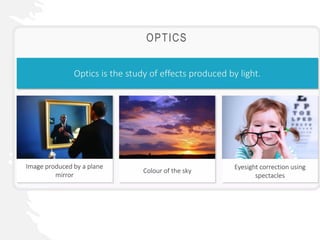
  • 183.
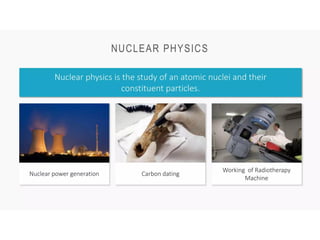
    Examples of Cells AmoebaProteus Plant Stem Red Blood Cell Nerve Cell Bacteria