Refraction Author:  Irina Jagiloviča e-mail:   [email_address]   www:   www.optometristiem.lv
Case history Patient’s personal details Visual history When patient will use his new glasses: concerning professional and leisure activities Eye health: family history of eye problems, eye infections, eye surgery, vision trainings undertaken etc. Patient’s general health: diabetes, high blood pressure, allergies, medications taken
Case history Reason of the visit Nature of the problem: visual fatigue, blurred vision, double vision Location at which problem occurs: in far distance, mid-distance, close-up, centrally, peripherally The circumstances in which the problem occurs: reading, working at computer screen driving The time and frequency of occurrence Date and mode of occurrence: sudden or gradual
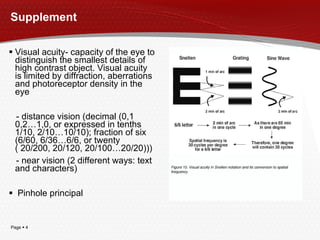
Supplement Visual acuity- capacity of the eye to distinguish the smallest details of high contrast object.  Visual acuity is limited by diffraction, aberrations and photoreceptor density in the eye  - distance vision (decimal (0,1 0,2…1,0, or expressed in tenths 1/10, 2/10…10/10); fraction of six (6/60, 6/36…6/6, or twenty ( 20/200, 20/120, 20/100…20/20))) - near vision (2 different ways: text and characters) Pinhole principal
Objective Refraction Auto-Refractometry (the sphere often over-minused, because of the stimulation of accommodation. Cylinder often over-estimated). The higher degree of ametropia, the greater the degree of imprecision.
Objective Refraction Retinoscopy (or skiascopy)
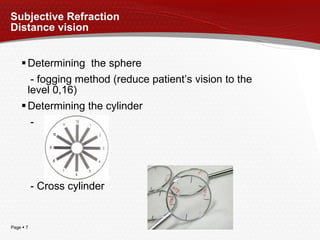
Subjective Refraction Distance vision Determini n g  the  sphere - fogging method (reduce patient’s vision to the level 0,16) Determining the cylinder -  - Cross cylinder
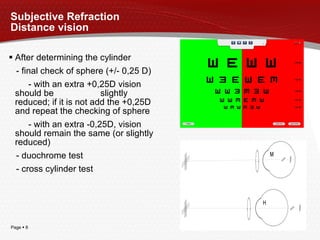
Subjective Refraction Distance vision After determining the cylinder - final check of sphere (+/- 0,25 D) - with an extra +0,25D vision should be  slightly reduced; if it is not add the +0,25D and repeat the checking of sphere - with an extra -0,25D, vision should remain the same (or slightly reduced) - duochrome test - cross cylinder test
Binocular Balance Having determined the refraction of the right and left eye separately under monocular conditions, it is important to ensure that these refractions correspond well under binocular conditions. The spherical component is adjusted as necessary to equalize the accommodative effort of the two eyes. Note that most binocular balance techniques can be performed only when the patient has equal visual acuity in both eyes
Binocular Balance Dissociate the two eyes by: - alternate occlusion - vertical prism (3 Δ BDR and  3 Δ BUL) - polarizing filters Note which is patient’s dominant eye, a slight imbalance in favour of that eye may be conserved. Be careful never to reverse the natural dominance of one eye relative to the other
Binocular Vision Evaluation Evaluation of motor component: Head position  Eye movements Convergence Vers ions Tropia  and Phoria recognition Hir s c h berg  Mado x Von Graefe Cover  test un  Prism cover  tests Polarized cross test Physional reserves
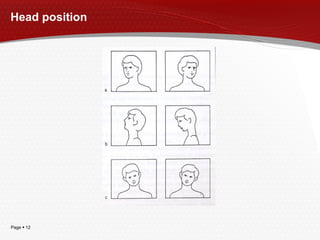
Head position
Eye Movements Ductions : - adduction- nasal - abcuction - lateral - elevation- superior  movement of one eye - depression- inferior Versions:  - in 8 directions  movement of two eye (conjunctive) Vergences: - convergence  -  divergence  movement of two (disjunctive)
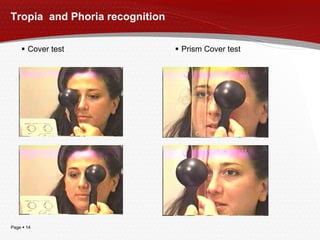
Tropia  and Phoria recognition Cover test Prism Cover test
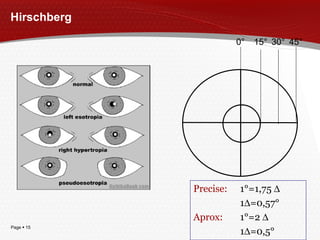
Hirschberg 15° 0 ° 30 ° 4 5° Pr ecise : 1°=1,75   1  =0,57° Ap rox : 1°=2   1  =0,5°
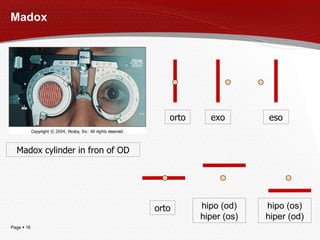
Madox orto eso exo orto hipo (od) hiper (os) Mado x  c ylinder   in fron of OD hipo (o s ) hiper (o d )
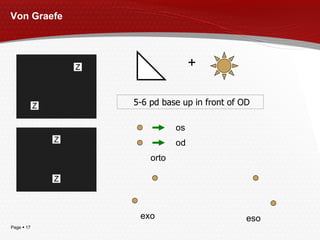
Von Graefe + 5-6 pd  base up in front of OD os od e x o e s o orto
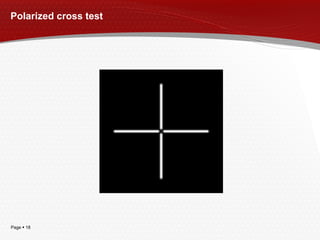
Polarized cross test
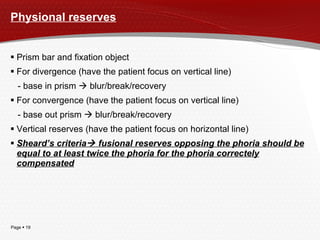
Physional reserves Prism bar and fixation object For divergence (have the patient focus on vertical line) - base in prism    blur/break/recovery For convergence (have the patient focus on vertical line) - base out prism    blur/break/recovery Vertical reserves (have the patient focus on horizontal line) Sheard’s criteria   fusional reserves opposing the phoria should be equal to at least twice the phoria for the phoria correctely compensated
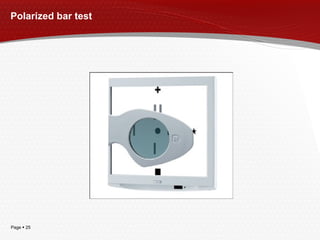
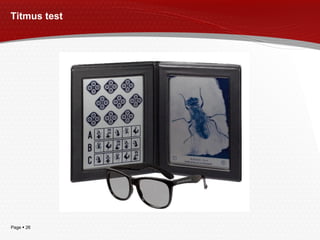
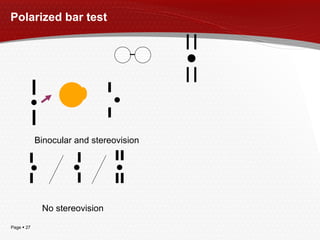
Binocular Vision Evaluation Evaluation of sensory component: Type of binocular vision : Bagolini test Worth test S c h ober test Stereovision : Lang test Titmus test Polariz ed   bar  test
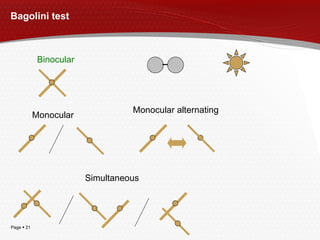
Bagolini test Binocular Monocular Monocular  alternating Simultaneous
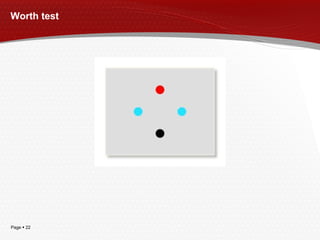
Worth test
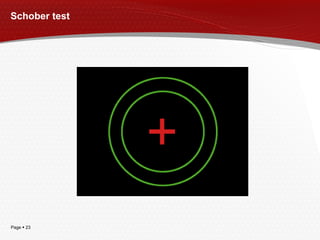
S c h ober test
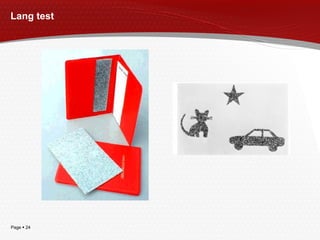
Lang test
Polariz ed   bar  test
Titmus test
Polarized bar test Bino cular and  stere ovision N o  stereo vision
Subjective Refraction. Near Vision Minimum addition method Correct distance vision precisely Determine the minimum addition at 40 cm Add +0,75D 0r +1,00D to the minimum addition Check the patient’s visual comfort  - bring the test closer to the patient until the smallest characters are no longer able to be seen clearly. This should occur at approximately 25 cm from the eyes (if < 20 cm, the addition is too strong, if > 30 cm the addition is too weak.) - adjust the value of addition  (from 0,25D to 0,50 D) in accordance with required working or reading distance. If different from 40 cm at which the test was conducted. Reduce the addition for longer working distance, increase for shorter working distance.
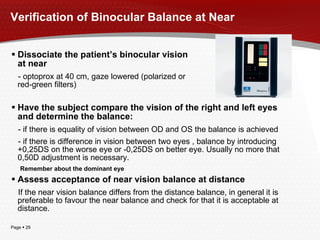
Verification of Binocular Balance at Near Have the subject compare the vision of the right and left eyes and determine the balance: - if there is equality of vision between OD and OS the balance is achieved - if there is difference in vision between two eyes , balance by introducing +0,25DS on the worse eye or -0,25DS on better eye. Usually no more that 0,50D adjustment is necessary. Remember about the dominant eye Assess acceptance of near vision balance at distance If the near vision balance differs from the distance balance, in general it is preferable to favour the near balance and check for that it is acceptable at distance. Dissociate the patient’s binocular vision at near - optoprox at 40 cm, gaze lowered (polarized or red-green filters)
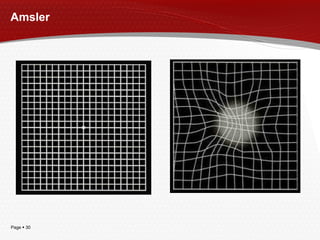
Amsler
In the Case of Non-Presbiopic Patient Uncorrected ametropia ( hypermetropia, astigmatism) Binocular vision disorder (convergence insufficiency, severe heterophoria) Accommodative problems:  - excess/spam  (low  N R A  , ok  P R A , low AA) - insufficiency (not corrected myopia,  low PRA,  low AA)
Prescribing prism Minimum value of the prism that restores comfortable fusion Prefer trial frame rather than phoropter Consider associated phoria tests and dissociated Distribute most of the prism value on non dominant eye (aberration) Remember decentration rule    P=d(cm)xF(D) Follow up visits each 0,5 year
Referrences Essilor. Ophtalmic and Optics Files. Practical Refraction.
Thank you

Refraction

  • 1.
    Refraction Author: Irina Jagiloviča e-mail: [email_address] www: www.optometristiem.lv
  • 2.
    Case history Patient’spersonal details Visual history When patient will use his new glasses: concerning professional and leisure activities Eye health: family history of eye problems, eye infections, eye surgery, vision trainings undertaken etc. Patient’s general health: diabetes, high blood pressure, allergies, medications taken
  • 3.
    Case history Reasonof the visit Nature of the problem: visual fatigue, blurred vision, double vision Location at which problem occurs: in far distance, mid-distance, close-up, centrally, peripherally The circumstances in which the problem occurs: reading, working at computer screen driving The time and frequency of occurrence Date and mode of occurrence: sudden or gradual
  • 4.
    Supplement Visual acuity-capacity of the eye to distinguish the smallest details of high contrast object. Visual acuity is limited by diffraction, aberrations and photoreceptor density in the eye - distance vision (decimal (0,1 0,2…1,0, or expressed in tenths 1/10, 2/10…10/10); fraction of six (6/60, 6/36…6/6, or twenty ( 20/200, 20/120, 20/100…20/20))) - near vision (2 different ways: text and characters) Pinhole principal
  • 5.
    Objective Refraction Auto-Refractometry(the sphere often over-minused, because of the stimulation of accommodation. Cylinder often over-estimated). The higher degree of ametropia, the greater the degree of imprecision.
  • 6.
  • 7.
    Subjective Refraction Distancevision Determini n g the sphere - fogging method (reduce patient’s vision to the level 0,16) Determining the cylinder - - Cross cylinder
  • 8.
    Subjective Refraction Distancevision After determining the cylinder - final check of sphere (+/- 0,25 D) - with an extra +0,25D vision should be slightly reduced; if it is not add the +0,25D and repeat the checking of sphere - with an extra -0,25D, vision should remain the same (or slightly reduced) - duochrome test - cross cylinder test
  • 9.
    Binocular Balance Havingdetermined the refraction of the right and left eye separately under monocular conditions, it is important to ensure that these refractions correspond well under binocular conditions. The spherical component is adjusted as necessary to equalize the accommodative effort of the two eyes. Note that most binocular balance techniques can be performed only when the patient has equal visual acuity in both eyes
  • 10.
    Binocular Balance Dissociatethe two eyes by: - alternate occlusion - vertical prism (3 Δ BDR and 3 Δ BUL) - polarizing filters Note which is patient’s dominant eye, a slight imbalance in favour of that eye may be conserved. Be careful never to reverse the natural dominance of one eye relative to the other
  • 11.
    Binocular Vision EvaluationEvaluation of motor component: Head position Eye movements Convergence Vers ions Tropia and Phoria recognition Hir s c h berg Mado x Von Graefe Cover test un Prism cover tests Polarized cross test Physional reserves
  • 12.
  • 13.
    Eye Movements Ductions: - adduction- nasal - abcuction - lateral - elevation- superior movement of one eye - depression- inferior Versions: - in 8 directions movement of two eye (conjunctive) Vergences: - convergence - divergence movement of two (disjunctive)
  • 14.
    Tropia andPhoria recognition Cover test Prism Cover test
  • 15.
    Hirschberg 15° 0° 30 ° 4 5° Pr ecise : 1°=1,75  1  =0,57° Ap rox : 1°=2  1  =0,5°
  • 16.
    Madox orto esoexo orto hipo (od) hiper (os) Mado x c ylinder in fron of OD hipo (o s ) hiper (o d )
  • 17.
    Von Graefe +5-6 pd base up in front of OD os od e x o e s o orto
  • 18.
  • 19.
    Physional reserves Prismbar and fixation object For divergence (have the patient focus on vertical line) - base in prism  blur/break/recovery For convergence (have the patient focus on vertical line) - base out prism  blur/break/recovery Vertical reserves (have the patient focus on horizontal line) Sheard’s criteria  fusional reserves opposing the phoria should be equal to at least twice the phoria for the phoria correctely compensated
  • 20.
    Binocular Vision EvaluationEvaluation of sensory component: Type of binocular vision : Bagolini test Worth test S c h ober test Stereovision : Lang test Titmus test Polariz ed bar test
  • 21.
    Bagolini test BinocularMonocular Monocular alternating Simultaneous
  • 22.
  • 23.
    S c hober test
  • 24.
  • 25.
    Polariz ed bar test
  • 26.
  • 27.
    Polarized bar testBino cular and stere ovision N o stereo vision
  • 28.
    Subjective Refraction. NearVision Minimum addition method Correct distance vision precisely Determine the minimum addition at 40 cm Add +0,75D 0r +1,00D to the minimum addition Check the patient’s visual comfort - bring the test closer to the patient until the smallest characters are no longer able to be seen clearly. This should occur at approximately 25 cm from the eyes (if < 20 cm, the addition is too strong, if > 30 cm the addition is too weak.) - adjust the value of addition (from 0,25D to 0,50 D) in accordance with required working or reading distance. If different from 40 cm at which the test was conducted. Reduce the addition for longer working distance, increase for shorter working distance.
  • 29.
    Verification of BinocularBalance at Near Have the subject compare the vision of the right and left eyes and determine the balance: - if there is equality of vision between OD and OS the balance is achieved - if there is difference in vision between two eyes , balance by introducing +0,25DS on the worse eye or -0,25DS on better eye. Usually no more that 0,50D adjustment is necessary. Remember about the dominant eye Assess acceptance of near vision balance at distance If the near vision balance differs from the distance balance, in general it is preferable to favour the near balance and check for that it is acceptable at distance. Dissociate the patient’s binocular vision at near - optoprox at 40 cm, gaze lowered (polarized or red-green filters)
  • 30.
  • 31.
    In the Caseof Non-Presbiopic Patient Uncorrected ametropia ( hypermetropia, astigmatism) Binocular vision disorder (convergence insufficiency, severe heterophoria) Accommodative problems: - excess/spam (low N R A , ok P R A , low AA) - insufficiency (not corrected myopia, low PRA, low AA)
  • 32.
    Prescribing prism Minimumvalue of the prism that restores comfortable fusion Prefer trial frame rather than phoropter Consider associated phoria tests and dissociated Distribute most of the prism value on non dominant eye (aberration) Remember decentration rule  P=d(cm)xF(D) Follow up visits each 0,5 year
  • 33.
    Referrences Essilor. Ophtalmicand Optics Files. Practical Refraction.
  • 34.