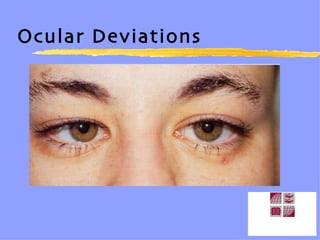
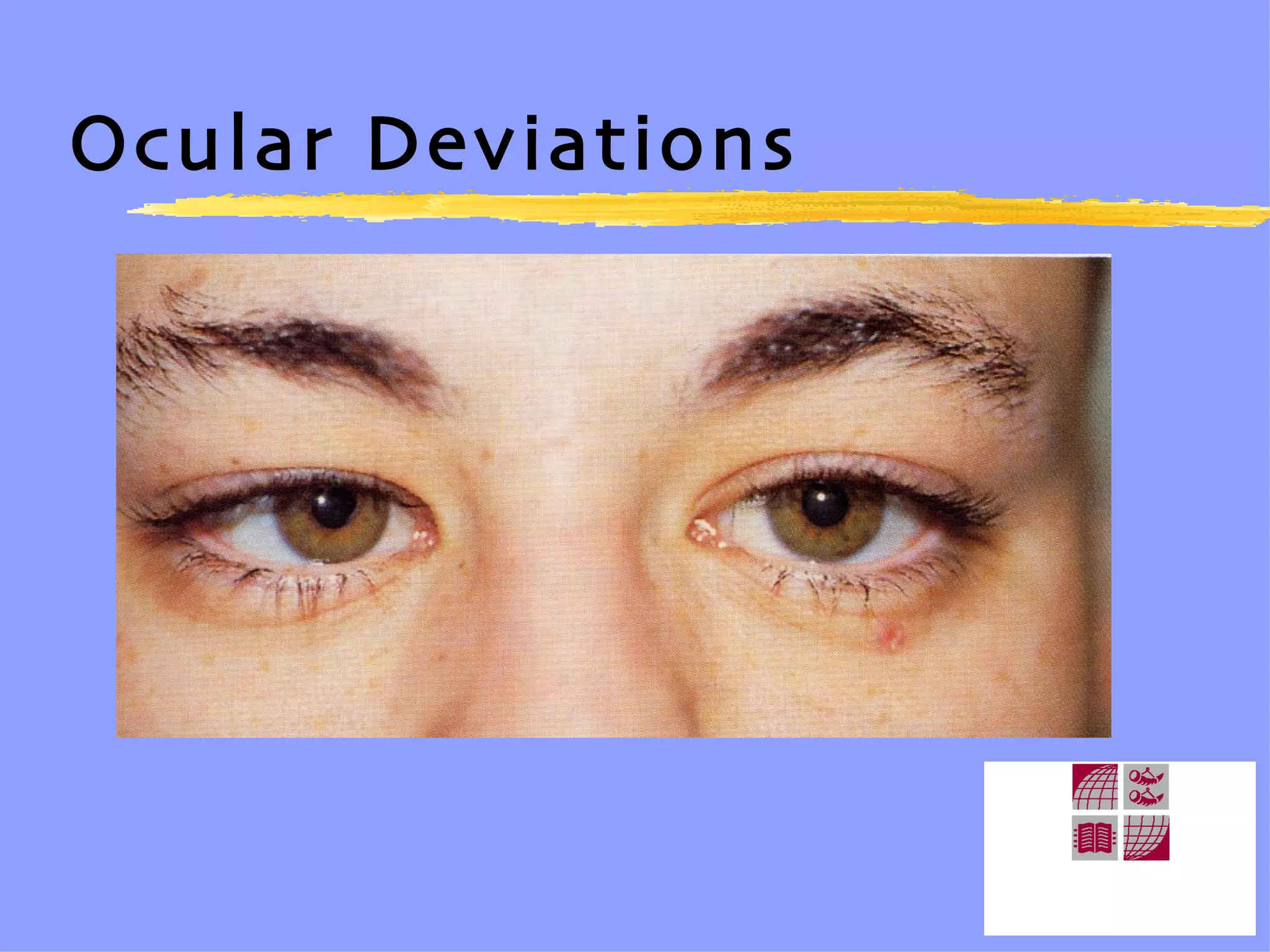
Ocular Deviations
Heterophoria A deviation kept latent by the fusion reflex
Heterotropia A manifest deviation of the eyes Strabismus Squint “ cock eyed”
Heterophoria Orthophoria: the visual axes remain in alignment when fusion is prevented Esophoria: the visual axes converge from alignment when fusion is prevented Exophoria: the visual axes diverge from alignment when fusion is prevented
Clinical Records It is not necessary to specify the eye as a phoria is “shared” Record the size in ∆ Record the distance the test was performed Distance 5SOP Near 2XOP
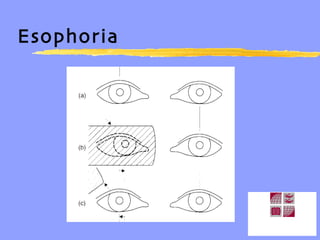
Esophoria
Heterophoria Orthophoria: the visual axes remain in alignment when fusion is prevented Hyperphoria: one line of sight is higher than the other when fusion is prevented Hypophoria: one line of sight is lower than the other when fusion is prevented
Vertical Phorias A right hyperphoria is the same as a left hypophoria  It is important to specify the eye
Clinical Records It is necessary to specify the eye in vertical phorias Record the size in ∆ Record the distance the test was performed Distance 5RHyperphoria Near 2L/R
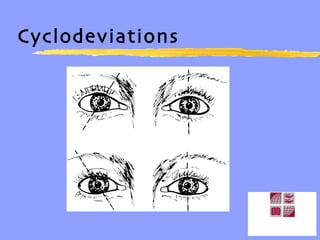
Rotations Excyclophoria: upper poles of the corneas deviate outwards when fusion is prevented Incyclophoria: upper poles of the corneas deviate inwards when fusion is prevented
Cyclodeviations
Physiological Exophoria At near it is usual for the phoria to be relatively more divergent than the distance phoria Accommodative lag gives less drive through AC/A Small XOP common at near
Aetiology Static or Anatomical Kinetic or Accommodative Neurogenic Innervational
Vergence system Convergence insufficiency Convergence Excess Divergence insufficiency Divergence excess
Convergence Insufficiency Distance 3XOP Near 12XOP Breaks from XOP to XOT Orthoptic therapy helps
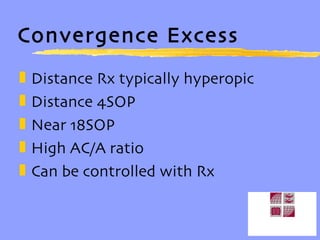
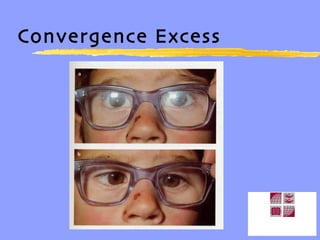
Convergence Excess Distance Rx typically hyperopic Distance 4SOP Near 18SOP High AC/A ratio Can be controlled with Rx
Convergence Excess
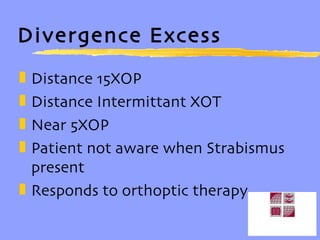
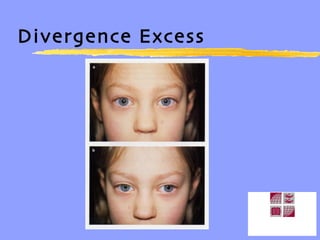
Divergence Excess Distance 15XOP Distance Intermittant XOT Near 5XOP Patient not aware when Strabismus present Responds to orthoptic therapy
Divergence Excess
Divergence Insufficiency Distance 8SOP Near 2XOP
Heterotropia Incomitant Concomitant
Incomitant Strabismus The angle of deviation varies with direction of gaze Paralytic in origin Angle of squint largest when eyes turned in direction of affected muscle Assessment of ocular motility essential Often need to be referred
Incomitant Squint
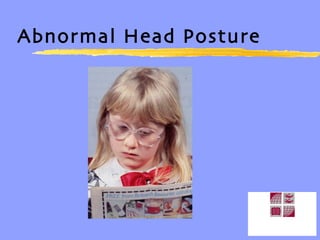
Abnormal Head Posture
Concomitant Strabismus Angle of deviation is constant for all directions of gaze May be intermittant Often an accommodative element (Donder’s squint) Alternating strabismus Congenital Childhood
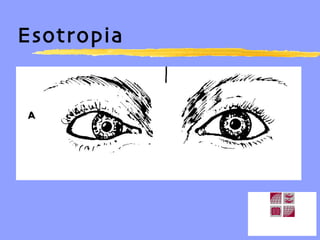
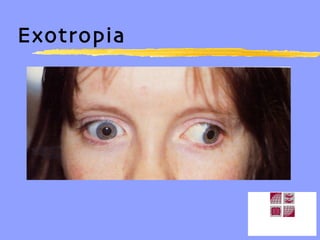
Heterotropia Esotropia: the visual axes converge from alignment Exotropia: the visual axes diverge from alignment
Esotropia
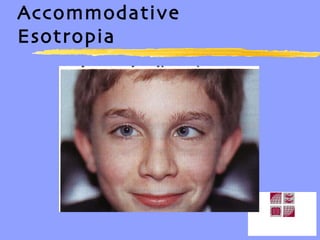
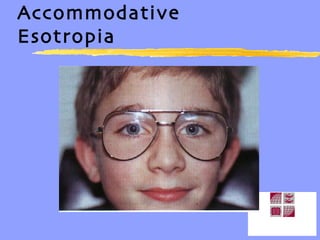
Accommodative Esotropia
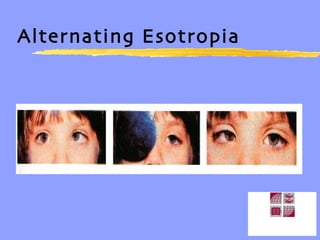
Alternating Esotropia
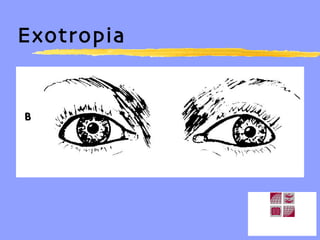
Exotropia
Exotropia
Clinical Records It is necessary to specify the eye in strabismus Record the size in ∆ Record the distance the test was performed Distance 5RSOT Near 2LXOT Alt D & N, prefers R fix
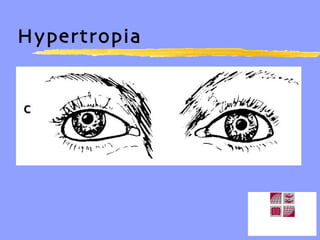
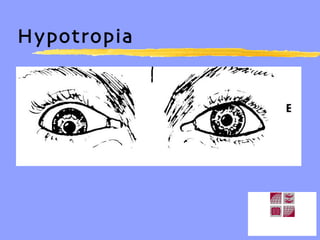
Heterotropia Hypertropia:  one line of sight is higher than the other Hypotropia: one line of sight is lower than the other
Hypertropia
Hypotropia
Clinical Records It is necessary to specify the eye in strabismus Record the size in ∆ Record the distance the test was performed Distance 15RHyperT Near 10LHypoT Alt D & N, prefers R fix
Clinical Tests Cover test Ocular motility Additional tests as required
Summary Phoria or Tropia? Tropia: incomitant or concomitant? Incomitant: Old or New? Work in a systematic manner

ocular Deviations