This document provides an introduction to 4G networks, including their history and evolution. 4G was introduced to provide high-bandwidth internet access to users on the move. It has progressed from initial commercial deployments in Scandinavia in 2009 using LTE technology to widespread adoption around the world today. Key features of 4G include high speeds of up to 1 Gbps, quality of service, support for mobile broadband internet usage, and packet-switched connectivity. The document compares 4G to 3G and outlines advantages like broadband access anywhere as well as disadvantages such as initial high battery usage and implementation challenges. Potential applications of 4G include public safety services, traffic management, mobile commerce, entertainment, and more.
CONTENTS
• Introduction
• Historyof mobile generation
• Evolution of 4G
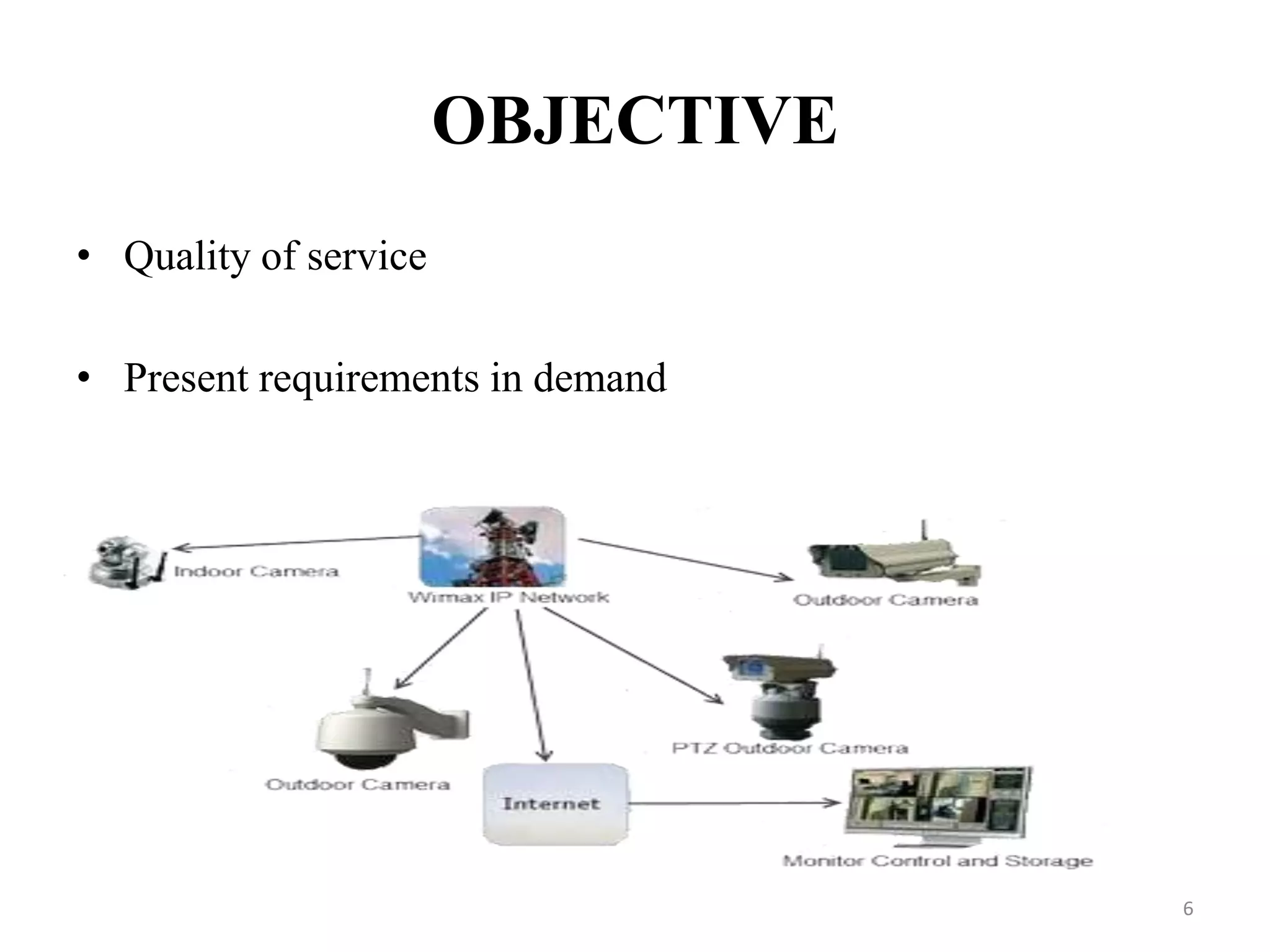
• Objectives
• Features
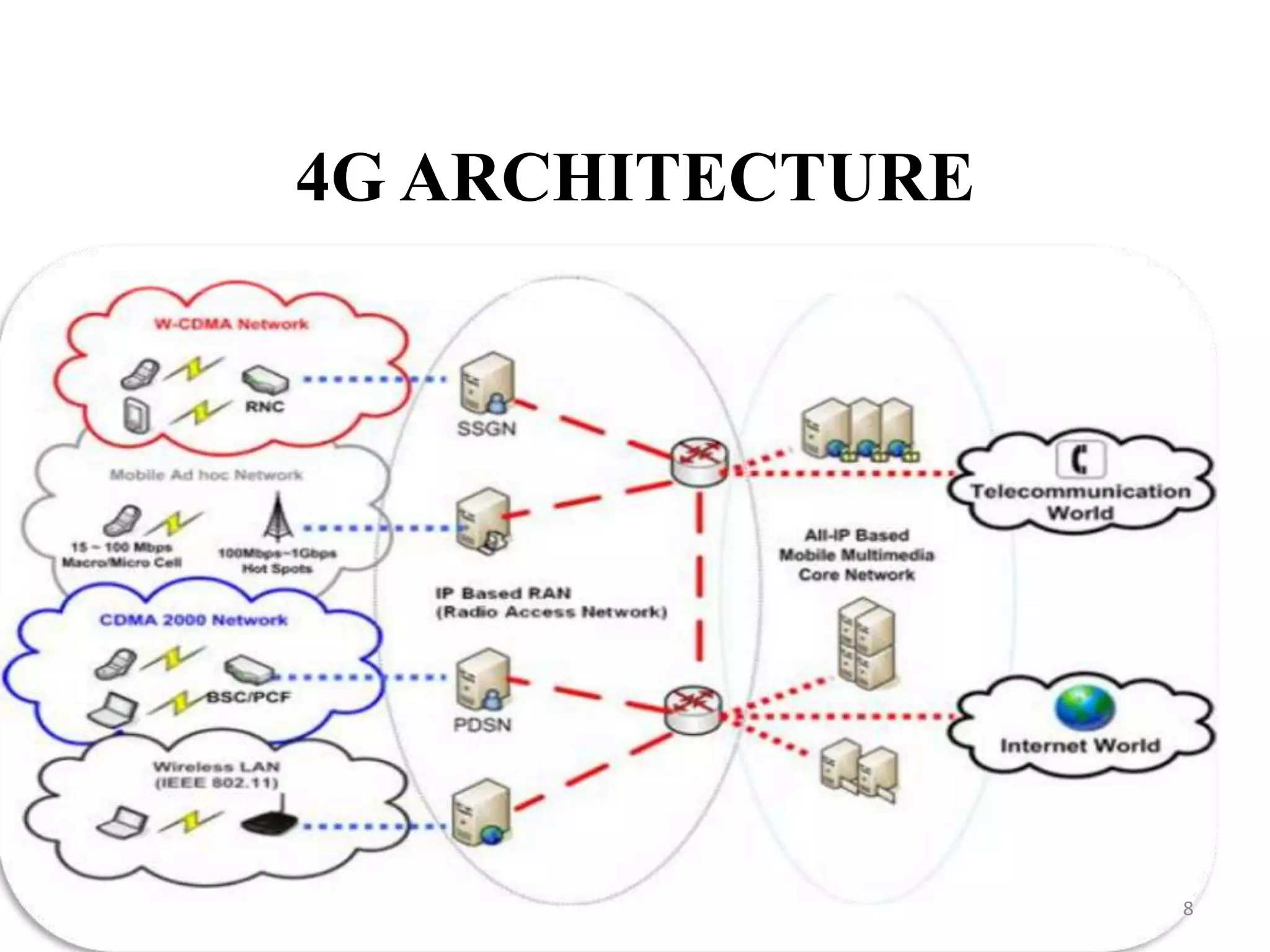
• 4G architecture
• 4G network in India
• 3G vs 4G
• Advantages
• Disadvantages
• Applications
2
3.
INTRODUCTION TO 4G
•4G was introduced to provide
a Wide Area Network for
internet access
• It provided high bandwidth
and broadband
• According to the WWRF,4G is
a combination of wired and
wireless networks in computer
• 4G networks are projected to
provide speeds of 100 Mbps
while moving and 1 Gbps
while stationary
3
4.
HISTORY OF MOBILE
GENERATION
•Analog transmission (1G) in 1981
• Digital transmission (2G) in 1992
• Multimedia transmission (3G) in 2001
• Mobile ultra-broadband transmission (4G) in 2012
4
5.
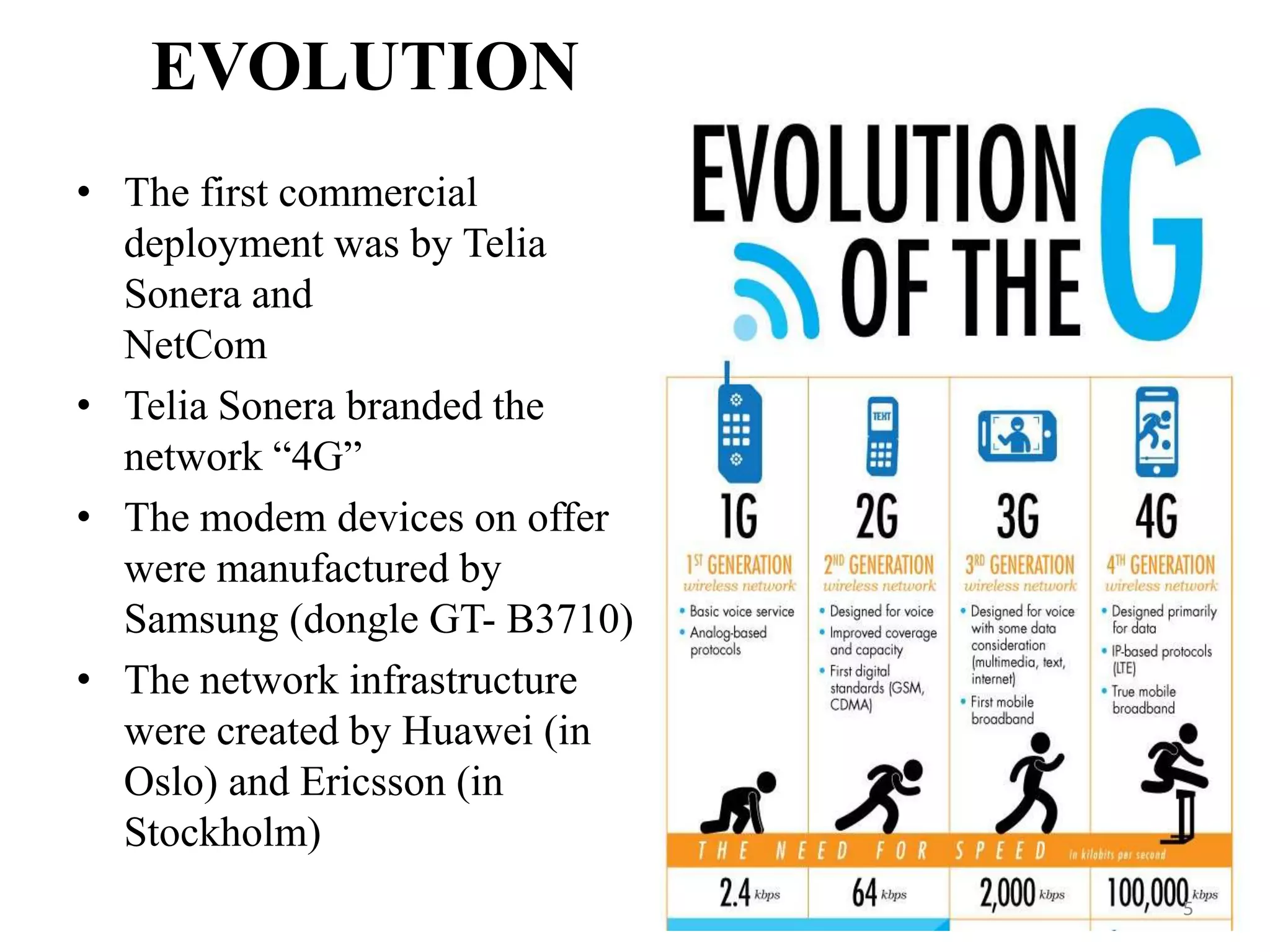
EVOLUTION
• The firstcommercial
deployment was by Telia
Sonera and
NetCom
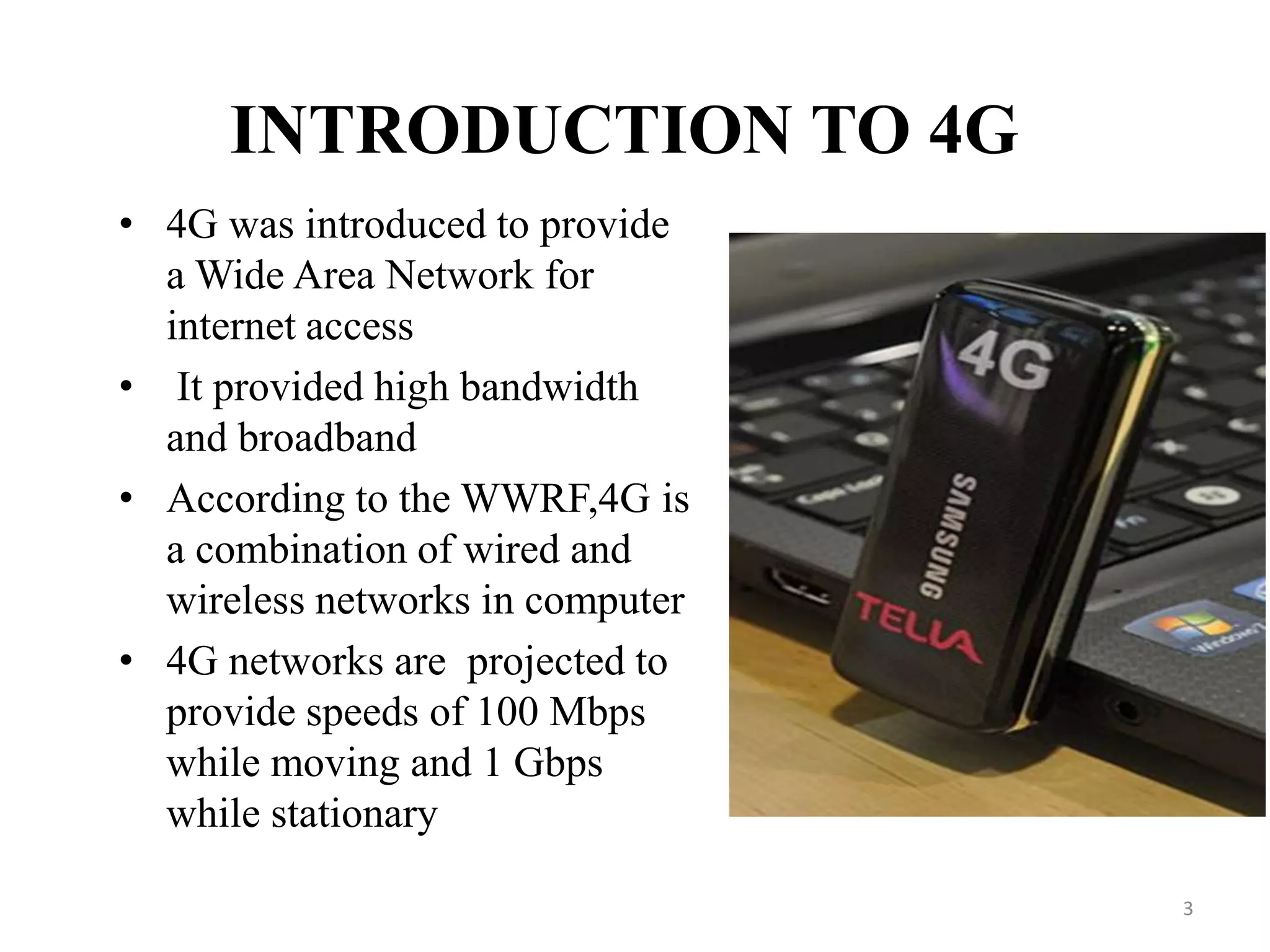
• Telia Sonera branded the
network “4G”
• The modem devices on offer
were manufactured by
Samsung (dongle GT- B3710)
• The network infrastructure
were created by Huawei (in
Oslo) and Ericsson (in
Stockholm)
5
4G NETWORK ININDIA
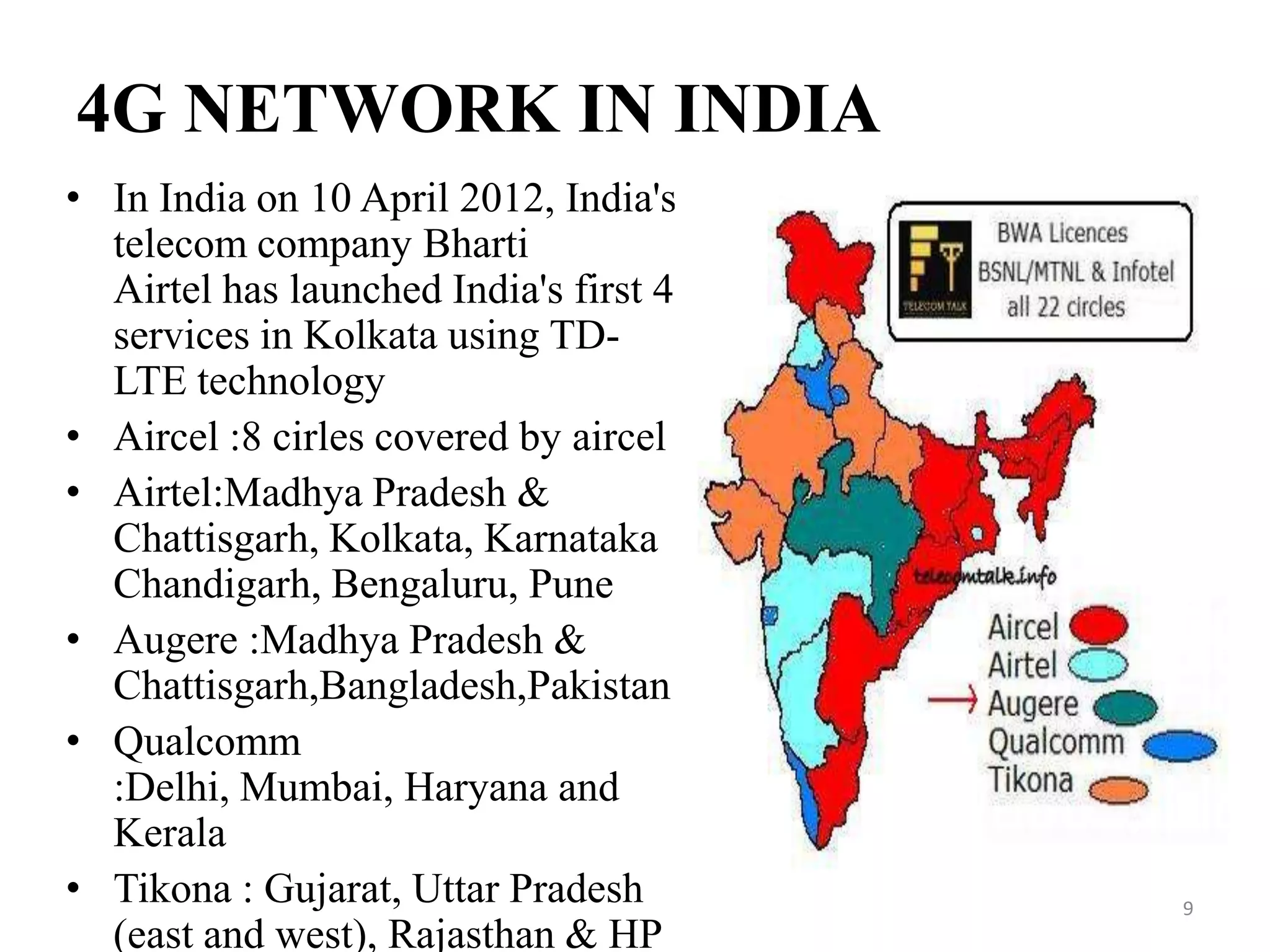
• In India on 10 April 2012, India's
telecom company Bharti
Airtel has launched India's first 4g
services in Kolkata using TD-
LTE technology
• Aircel :8 cirles covered by aircel
• Airtel:Madhya Pradesh &
Chattisgarh, Kolkata, Karnataka
Chandigarh, Bengaluru, Pune
• Augere :Madhya Pradesh &
Chattisgarh,Bangladesh,Pakistan
• Qualcomm
:Delhi, Mumbai, Haryana and
Kerala
• Tikona : Gujarat, Uttar Pradesh
(east and west), Rajasthan & HP
9
10.
3G vs 4G
3G4G
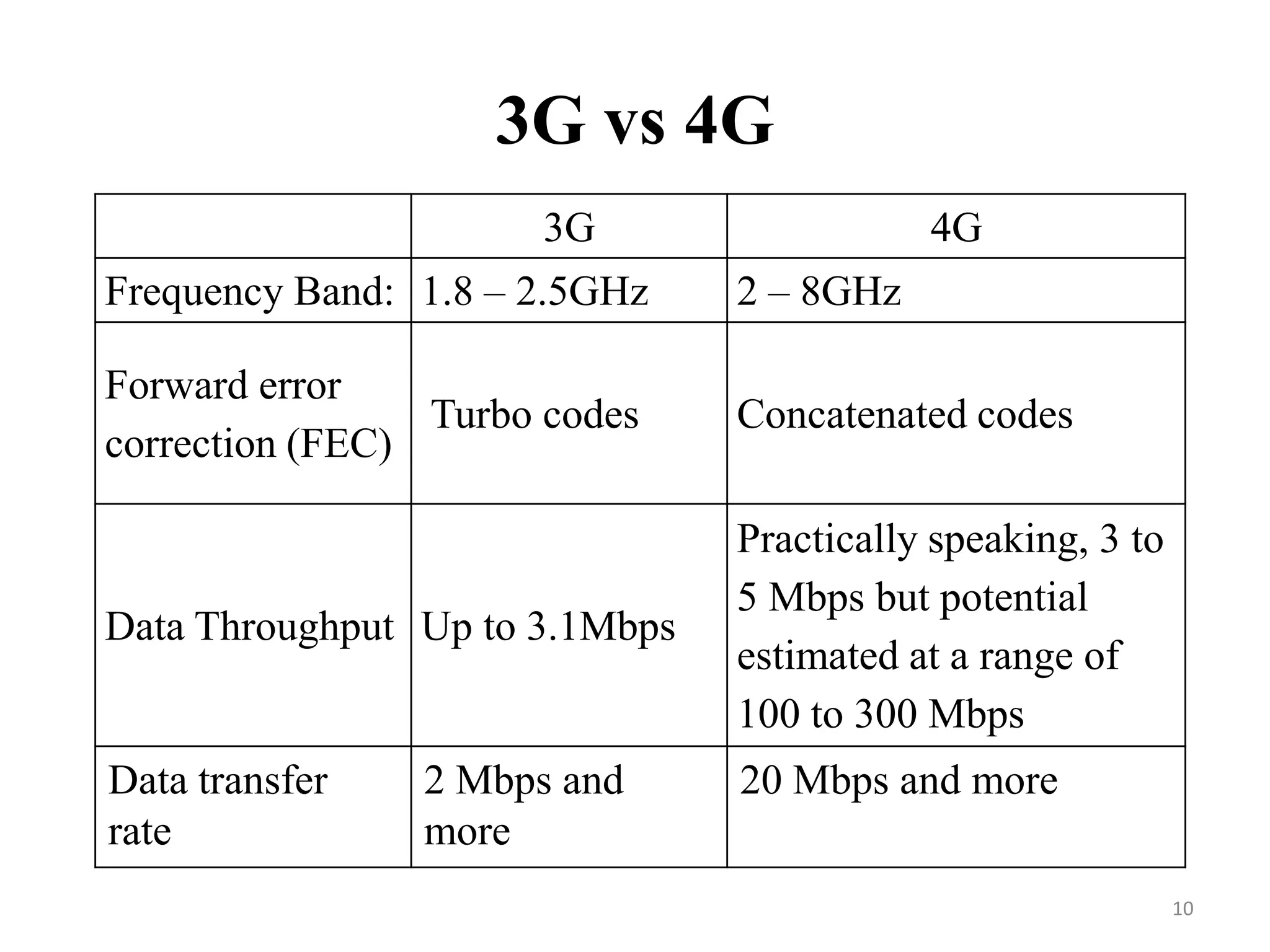
Frequency Band: 1.8 – 2.5GHz 2 – 8GHz
Forward error
correction (FEC)
Turbo codes Concatenated codes
Data Throughput Up to 3.1Mbps
Practically speaking, 3 to
5 Mbps but potential
estimated at a range of
100 to 300 Mbps
Data transfer
rate
2 Mbps and
more
20 Mbps and more
10
11.
3G vs 4G
3G4G
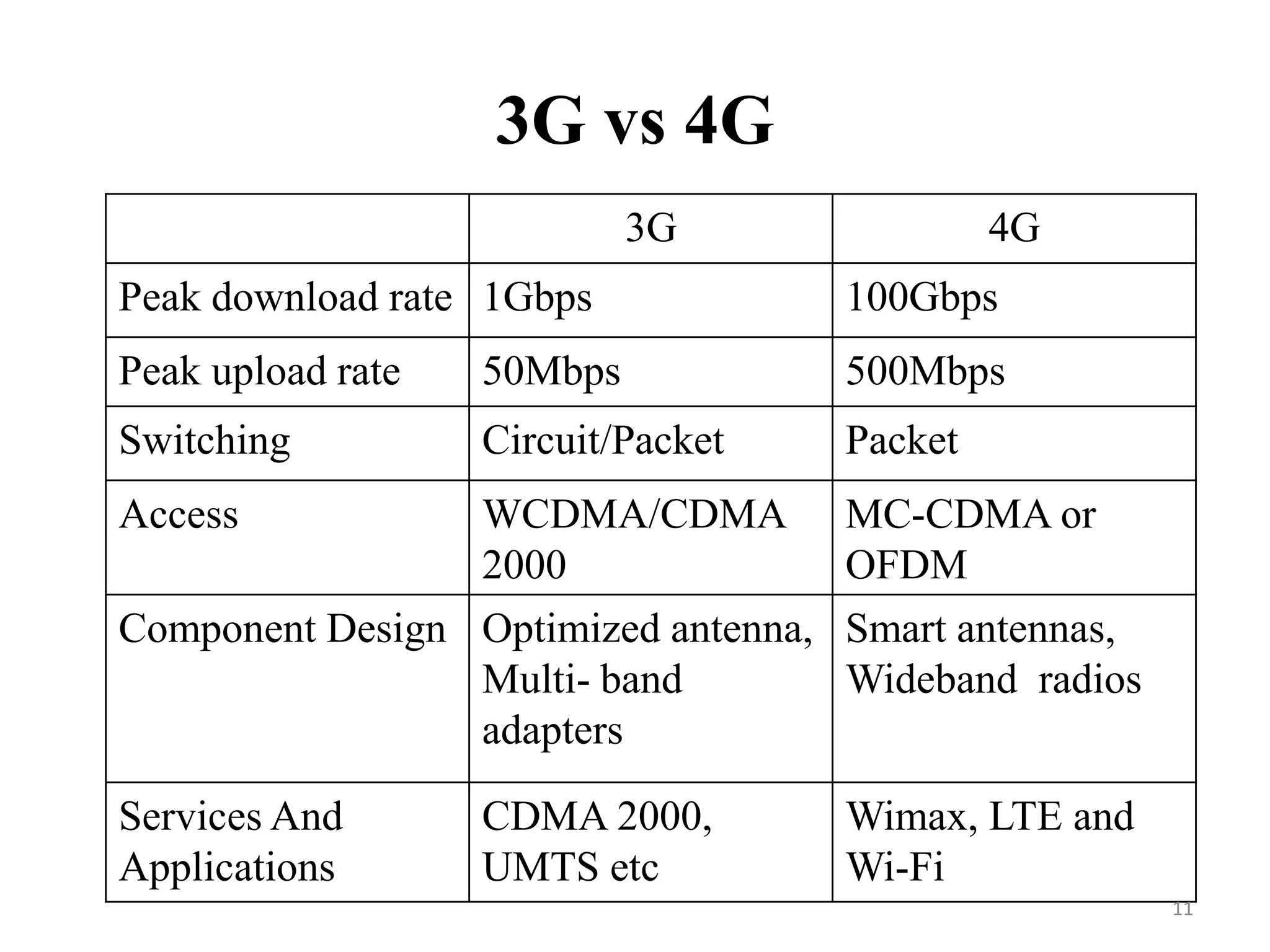
Peak download rate 1Gbps 100Gbps
Peak upload rate 50Mbps 500Mbps
Switching Circuit/Packet Packet
Access WCDMA/CDMA
2000
MC-CDMA or
OFDM
Component Design Optimized antenna,
Multi- band
adapters
Smart antennas,
Wideband radios
Services And
Applications
CDMA 2000,
UMTS etc
Wimax, LTE and
Wi-Fi
11
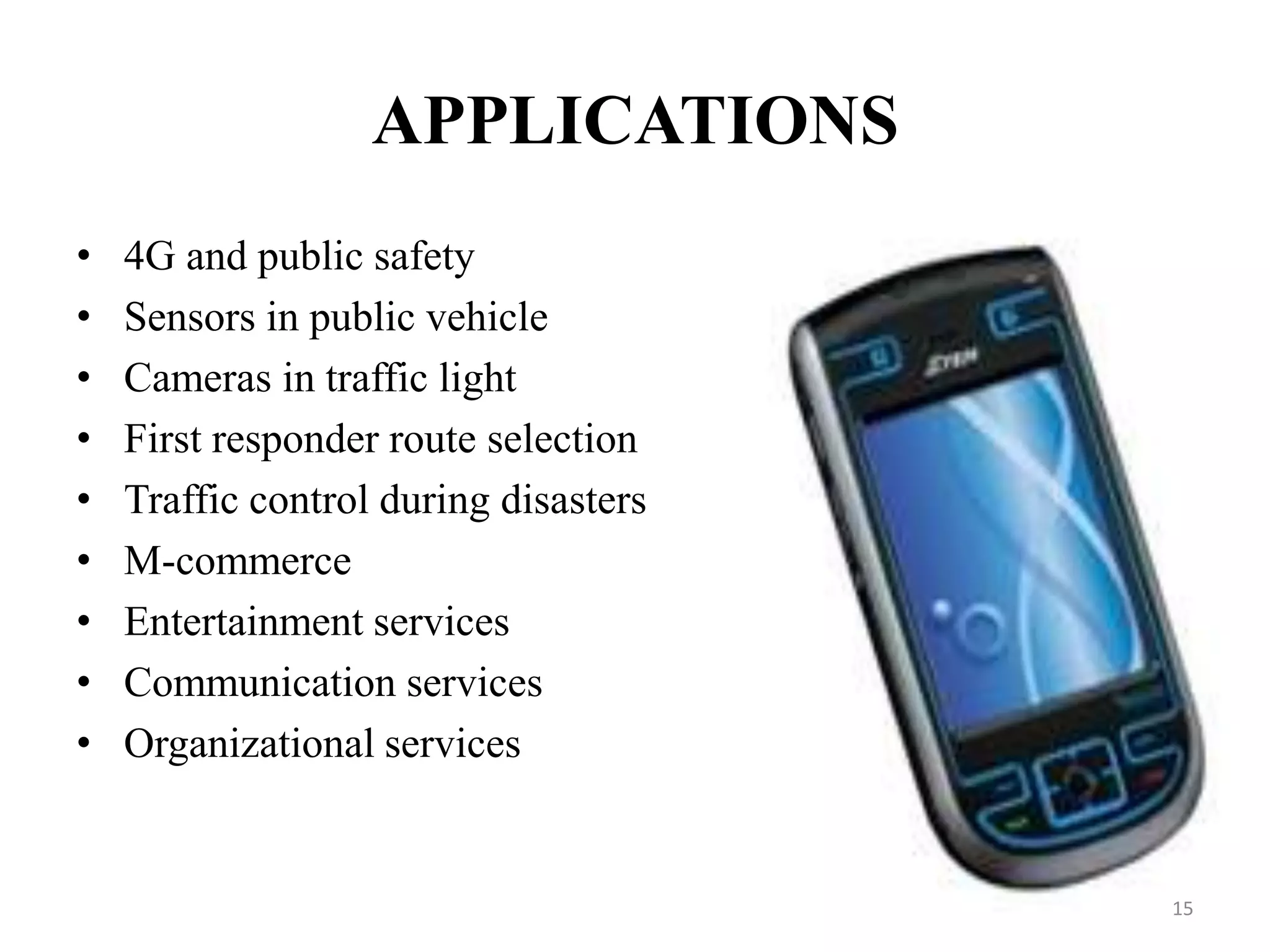
APPLICATIONS
• 4G andpublic safety
• Sensors in public vehicle
• Cameras in traffic light
• First responder route selection
• Traffic control during disasters
• M-commerce
• Entertainment services
• Communication services
• Organizational services
15