This document discusses multiple access techniques in wireless communication. It describes several techniques including Frequency Division Multiple Access (FDMA), Time Division Multiple Access (TDMA), Code Division Multiple Access (CDMA), and Space Division Multiple Access (SDMA). It also covers packet radio access methods like ALOHA, slotted ALOHA, and Carrier Sense Multiple Access (CSMA). Each technique allows multiple users to share wireless spectrum resources simultaneously through dividing access in frequency, time, code, or space.
Overview of the presentation on mobile computing focusing on multiple access in wireless communication.
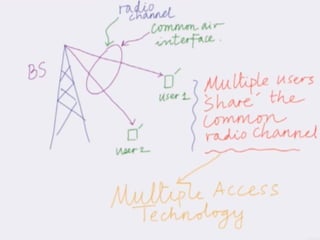
Explains multiple access as a method that allows multiple terminals to transmit over shared mediums like wireless, with a focus on sharing radio spectrum.
Introduction of various multiple access techniques including FDMA, TDMA, CDMA, and SDMA.
Details on FDMA, which divides frequency bands into separate channels for users, often used in first-generation mobile phones.
Description of TDMA, allocating time slots for users on the same frequency to avoid interference and enhance capacity.
Explains CDMA where multiple transmitters share a single channel simultaneously using different codes for separation.
Discusses SDMA using spatial separation for user communication, particularly in mobile ad-hoc networks.
Introduces packet radio as a method using packet switching to transmit digital data with protocols like ALOHA and CSMA.
Describes Pure ALOHA where stations transmit frames randomly, facing collision issues and frame acknowledgment requirements.
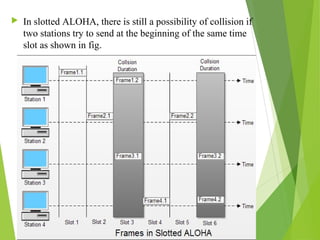
Explains Slotted ALOHA improving efficiency by defining slots for frame transmission, but still vulnerable to collisions.
Describes CSMA, a MAC protocol where nodes check channel availability before transmitting to reduce collisions.
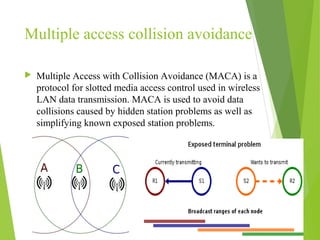
MACA protocol for slotted media access in WLANs which enhances data transmission by using RTS/CTS signals.
Multiple access in
wirelesscommunication
Subject : Mobile Computing and Wireless Communication
CE-B
Maulik togadiya
2.
What is Multipleaccess?
Multiple access method allows several terminals connected
to the same multi-point transmission medium to transmit
over it. Examples of shared physical media are wireless
networks, bus networks, ring networks and half
duplex point-to-point links.
Multiple access schemes to allow many users to share
simultaneously a finite amount of radio spectrum resources.
2
Frequency division multipleaccess
(FDMA)
The frequency band is divided into channels of equal
bandwidth so that each conversation is carried on a
different frequency.
A specific frequency band is given to one person, and it
will received by identifying each of the frequency on the
receiving end. It is often used in the first generation of
analog mobile phone.
Each station assigned a fixed frequency.
5
6.
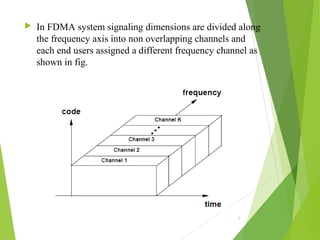
In FDMAsystem signaling dimensions are divided along
the frequency axis into non overlapping channels and
each end users assigned a different frequency channel as
shown in fig.
6
7.
Time division multipleaccess
(TDMA)
Time frame is divided into slots (channels). Each user is
allocated a particular time slot or channel.
Time Division Multiple Access (TDMA) is a digital
cellular telephone communication technology. It facilitates
many users to share the same frequency without
interference. Its technology divides a signal into different
timeslots, and increases the data carrying capacity.
7
8.
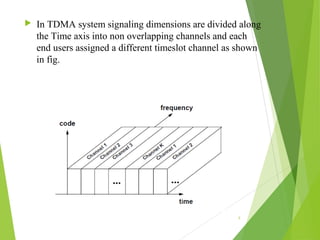
In TDMAsystem signaling dimensions are divided along
the Time axis into non overlapping channels and each
end users assigned a different timeslot channel as shown
in fig.
8
9.
Code division multipleaccess
(CDMA)
Code division multiple access (CDMA) is a channel
access method used by various radio communication
technologies.
CDMA is an example of multiple access , where
several transmitters can send information
simultaneously over a single communication channel.
This allows several users to share a band of
frequencies. To permit this without undue interference
between the users, CDMA employs spread-spectrum
technology.
9
10.
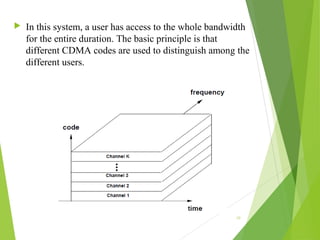
In thissystem, a user has access to the whole bandwidth
for the entire duration. The basic principle is that
different CDMA codes are used to distinguish among the
different users.
10
11.
Space division multipleaccess
(CDMA)
If there are no separation in frequency or time or code
domain ,an alternative way of separating different users is
spatial separation
SDMA is a MIMO -based wireless communication network
architecture, primarily suitable for mobile ad-hoc networks,
which enables access to a communication channel by
identifying the user location and establishing a one-to-one
mapping between the network bandwidth division and the
identified spatial location.
11
12.
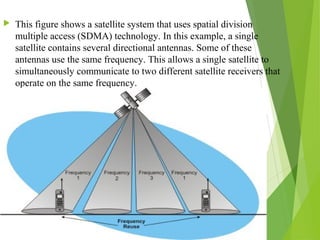
This figureshows a satellite system that uses spatial division
multiple access (SDMA) technology. In this example, a single
satellite contains several directional antennas. Some of these
antennas use the same frequency. This allows a single satellite to
simultaneously communicate to two different satellite receivers that
operate on the same frequency.
12
13.
Packet radio access
Packet radio is a form of packet switching technology used
to transmit digital data via radio or wireless
communications links. It uses the same concepts of data
transmission via Datagram that are fundamental to
communications via the Internet.
There are three medium access protocol appropriate for
packet radio networks: ALOHA, slotted ALOHA,
and Carrier Sense Multiple Access (CSMA).
13
14.
Pure aloha
In pureALOHA, the stations transmit frames whenever they have data to
send.
When two or more stations transmit simultaneously, there is collision and
the frames are destroyed.
In pure ALOHA, whenever any station transmits a frame, it expects the
acknowledgement from the receiver.
If acknowledgement is not received within specified time, the station
assumes that the frame (or acknowledgement) has been destroyed.
If the frame is destroyed because of collision the station waits for a
random amount of time and sends it again.
14
15.
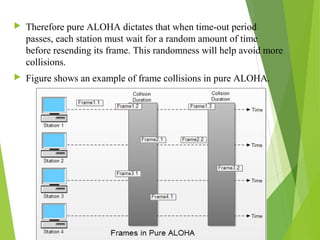
Therefore pureALOHA dictates that when time-out period
passes, each station must wait for a random amount of time
before resending its frame. This randomness will help avoid more
collisions.
Figure shows an example of frame collisions in pure ALOHA.
15
16.
Slotted aloha
SlottedALOHA was invented to improve the efficiency of
pure ALOHA as chances of collision in pure ALOHA are very
high.
In slotted ALOHA, the time of the shared channel is divided
into discrete intervals called slots.
The stations can send a frame only at the beginning of the slot
and only one frame is sent in each slot.
In slotted ALOHA, if any station is not able to place the frame
onto the channel at the beginning of the slot i.e. it misses the
time slot then the station has to wait until the beginning of the
next time slot. 16
17.
In slottedALOHA, there is still a possibility of collision if
two stations try to send at the beginning of the same time
slot as shown in fig.
17
18.
Carrier sense multipleaccess
Carrier sense multiple access (CSMA) is a probabilistic
media access control (MAC) protocol in which a node
verifies the absence of other traffic before transmitting on
transmission medium.
CSMA is set of rule that which the device attached to the
network first determine whether the channel or carrier is in
use or free and then act accordingly.
18
19.
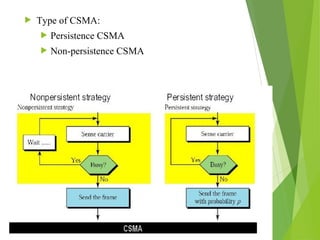
Type ofCSMA:
Persistence CSMA
Non-persistence CSMA
19
20.
Multiple access collisionavoidance
20
Multiple Access with Collision Avoidance (MACA) is a
protocol for slotted media access control used in wireless
LAN data transmission. MACA is used to avoid data
collisions caused by hidden station problems as well as
simplifying known exposed station problems.
21.
In MACA,a wireless network node announces that it is
going to send the data frame, informing the other nodes to
remain silent. When a node intends to transmit the data
frame, it communicates using a signal known as Request-
To-Send (RTS) that includes the length of the data frame
to transmit. If the recipient permits the transmission, it
responds back to the sender with a signal known as Clear-
To-Send (CTS), which includes the length of the data
frame that it is about to receive.
In the meantime, the nodes that listen to the RTS signal
must remain silent until the data is fully transmitted in
order to avoid conflict with CTS.
WLAN data transmission collisions can still happen, and
MACA for Wireless (MACAW) is brought to extend the
functionality of MACA. It demands nodes to send
acknowledgments after every successful frame
transmission.
21