5G WIRELESS
TECHNOLOGY
Presentation by
ARYA M NAIR
BE CSE 3rd year
EASA College of Engg. And
Tech.
Contents…
 Evolution from 1G to 4G
 Introduction to 5G
 How does 5G Work?
 Comparison of 1G to 5G Technologies
 5G Network Architecture
 Hardware & Software of 5G
 Features
 Applications
 Conclusion
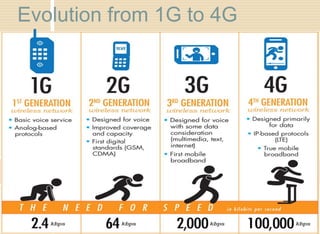
Evolution from 1G to 4G
5G-Introduction
 5G Wireless: 5th generation wireless technology
 Complete wireless communication with almost no
limitations
 Can be called REAL wireless world
 Has incredible transmission speed
 Concept is only theory not real
How is 5G implemented?
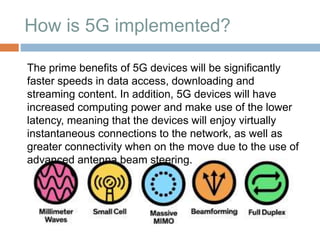
The prime benefits of 5G devices will be significantly
faster speeds in data access, downloading and
streaming content. In addition, 5G devices will have
increased computing power and make use of the lower
latency, meaning that the devices will enjoy virtually
instantaneous connections to the network, as well as
greater connectivity when on the move due to the use of
advanced antenna beam steering.
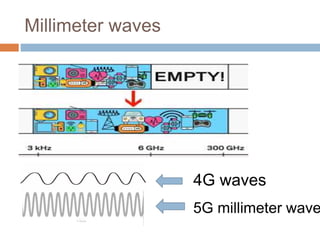
Millimeter waves
4G waves
5G millimeter wave
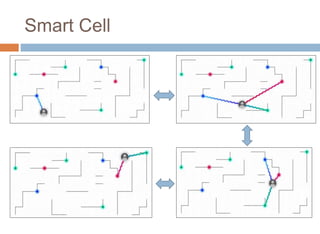
Smart Cell
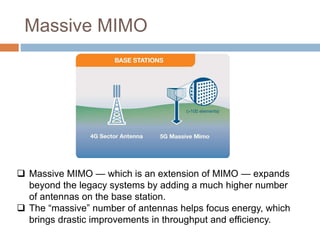
Massive MIMO
 Massive MIMO — which is an extension of MIMO — expands
beyond the legacy systems by adding a much higher number
of antennas on the base station.
 The “massive” number of antennas helps focus energy, which
brings drastic improvements in throughput and efficiency.
Beamforming
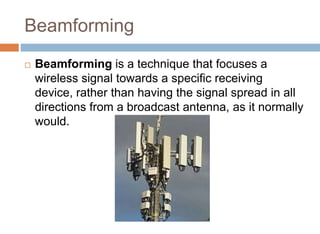
 Beamforming is a technique that focuses a
wireless signal towards a specific receiving
device, rather than having the signal spread in all
directions from a broadcast antenna, as it normally
would.
Full Duplex
 With 5G, a transceiver will be able to transmit and
receive data at the same time, on the same
frequency.
 Full-duplex communication is considered a way to
potentially double the speed of wireless
communication and is considered a key technique
for 5G systems.
COMPARISON OF 1G TO 5G
TECHNOLOGIES
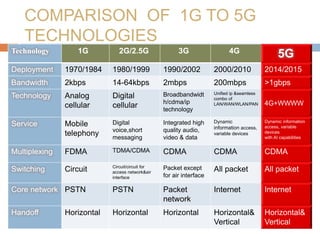
Technology 1G 2G/2.5G 3G 4G
5G
Deployment 1970/1984 1980/1999 1990/2002 2000/2010 2014/2015
Bandwidth 2kbps 14-64kbps 2mbps 200mbps >1gbps
Technology Analog
cellular
Digital
cellular
Broadbandwidt
h/cdma/ip
technology
Unified ip &seamless
combo of
LAN/WAN/WLAN/PAN 4G+WWWW
Service Mobile
telephony
Digital
voice,short
messaging
Integrated high
quality audio,
video & data
Dynamic
information access,
variable devices
Dynamic information
access, variable
devices
with AI capabilities
Multiplexing FDMA TDMA/CDMA CDMA CDMA CDMA
Switching Circuit Circuit/circuit for
access network&air
interface
Packet except
for air interface
All packet All packet
Core network PSTN PSTN Packet
network
Internet Internet
Handoff Horizontal Horizontal Horizontal Horizontal&
Vertical
Horizontal&
Vertical
5G Network Architecture
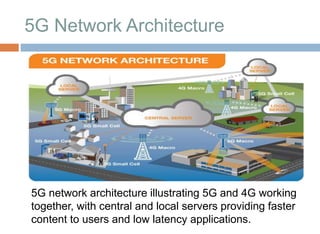
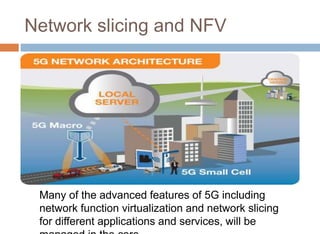
5G network architecture illustrating 5G and 4G working
together, with central and local servers providing faster
content to users and low latency applications.
Network slicing and NFV
Many of the advanced features of 5G including
network function virtualization and network slicing
for different applications and services, will be
Hardware & Software of 5G
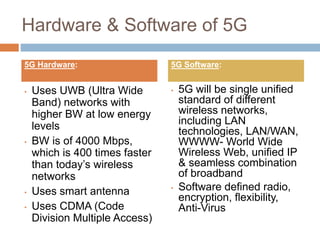
• Uses UWB (Ultra Wide
Band) networks with
higher BW at low energy
levels
• BW is of 4000 Mbps,
which is 400 times faster
than today’s wireless
networks
• Uses smart antenna
• Uses CDMA (Code
Division Multiple Access)
• 5G will be single unified
standard of different
wireless networks,
including LAN
technologies, LAN/WAN,
WWWW- World Wide
Wireless Web, unified IP
& seamless combination
of broadband
• Software defined radio,
encryption, flexibility,
Anti-Virus
5G Hardware: 5G Software:
Features
 Worldwide cellular
 Extraordinary data capabilities
 High connectivity
 More power & features in hand held
phones
 Large phone memory
 More dialing speed
 More clarity in audio & video and lot
more…
Applications of 5G
ANY QUERIES?
Thank You All….. !!!

5G Technology PPT

  • 1.
    5G WIRELESS TECHNOLOGY Presentation by ARYAM NAIR BE CSE 3rd year EASA College of Engg. And Tech.
  • 2.
    Contents…  Evolution from1G to 4G  Introduction to 5G  How does 5G Work?  Comparison of 1G to 5G Technologies  5G Network Architecture  Hardware & Software of 5G  Features  Applications  Conclusion
  • 3.
  • 4.
    5G-Introduction  5G Wireless:5th generation wireless technology  Complete wireless communication with almost no limitations  Can be called REAL wireless world  Has incredible transmission speed  Concept is only theory not real
  • 5.
    How is 5Gimplemented? The prime benefits of 5G devices will be significantly faster speeds in data access, downloading and streaming content. In addition, 5G devices will have increased computing power and make use of the lower latency, meaning that the devices will enjoy virtually instantaneous connections to the network, as well as greater connectivity when on the move due to the use of advanced antenna beam steering.
  • 6.
  • 7.
  • 8.
    Massive MIMO  MassiveMIMO — which is an extension of MIMO — expands beyond the legacy systems by adding a much higher number of antennas on the base station.  The “massive” number of antennas helps focus energy, which brings drastic improvements in throughput and efficiency.
  • 9.
    Beamforming  Beamforming isa technique that focuses a wireless signal towards a specific receiving device, rather than having the signal spread in all directions from a broadcast antenna, as it normally would.
  • 10.
    Full Duplex  With5G, a transceiver will be able to transmit and receive data at the same time, on the same frequency.  Full-duplex communication is considered a way to potentially double the speed of wireless communication and is considered a key technique for 5G systems.
  • 11.
    COMPARISON OF 1GTO 5G TECHNOLOGIES Technology 1G 2G/2.5G 3G 4G 5G Deployment 1970/1984 1980/1999 1990/2002 2000/2010 2014/2015 Bandwidth 2kbps 14-64kbps 2mbps 200mbps >1gbps Technology Analog cellular Digital cellular Broadbandwidt h/cdma/ip technology Unified ip &seamless combo of LAN/WAN/WLAN/PAN 4G+WWWW Service Mobile telephony Digital voice,short messaging Integrated high quality audio, video & data Dynamic information access, variable devices Dynamic information access, variable devices with AI capabilities Multiplexing FDMA TDMA/CDMA CDMA CDMA CDMA Switching Circuit Circuit/circuit for access network&air interface Packet except for air interface All packet All packet Core network PSTN PSTN Packet network Internet Internet Handoff Horizontal Horizontal Horizontal Horizontal& Vertical Horizontal& Vertical
  • 12.
    5G Network Architecture 5Gnetwork architecture illustrating 5G and 4G working together, with central and local servers providing faster content to users and low latency applications.
  • 13.
    Network slicing andNFV Many of the advanced features of 5G including network function virtualization and network slicing for different applications and services, will be
  • 14.
    Hardware & Softwareof 5G • Uses UWB (Ultra Wide Band) networks with higher BW at low energy levels • BW is of 4000 Mbps, which is 400 times faster than today’s wireless networks • Uses smart antenna • Uses CDMA (Code Division Multiple Access) • 5G will be single unified standard of different wireless networks, including LAN technologies, LAN/WAN, WWWW- World Wide Wireless Web, unified IP & seamless combination of broadband • Software defined radio, encryption, flexibility, Anti-Virus 5G Hardware: 5G Software:
  • 15.
    Features  Worldwide cellular Extraordinary data capabilities  High connectivity  More power & features in hand held phones  Large phone memory  More dialing speed  More clarity in audio & video and lot more…
  • 16.
  • 17.
  • 18.