Power point presentation
on
cell splitting and sectoring

MADE BY:
:

SHWETANSHU GUPTA
MIET (342/08)
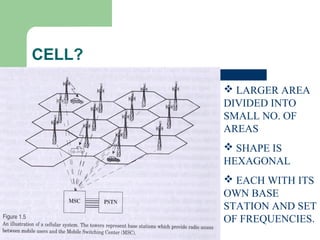
CELL?
 LARGER AREA
DIVIDED INTO
SMALL NO. OF
AREAS
 SHAPE IS
HEXAGONAL
 EACH WITH ITS
OWN BASE
STATION AND SET
OF FREQUENCIES.
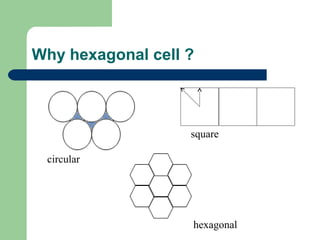
Why hexagonal cell ?

square
circular

hexagonal
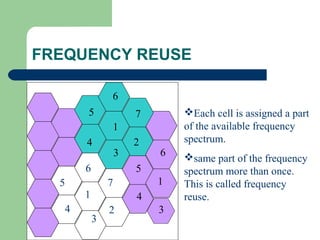
FREQUENCY REUSE
6
5

Each cell is assigned a part
of the available frequency
spectrum.

7
1

4

3

6
5
4

2

6

5
1

7
1

4
3

2

3

same part of the frequency
spectrum more than once.
This is called frequency
reuse.
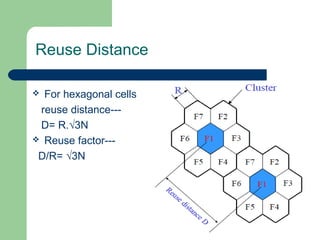
Reuse Distance
For hexagonal cells
reuse distance--D= R.√3N
 Reuse factor--D/R= √3N

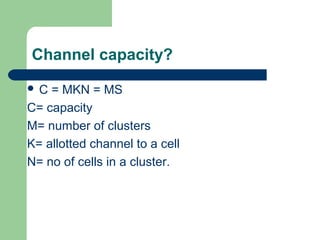
Channel capacity?
C

= MKN = MS
C= capacity
M= number of clusters
K= allotted channel to a cell
N= no of cells in a cluster.
Why cell splitting and sectoring?


As users increases channel capacity
decreases.



Techniques are needed to provide extra
channels.



cell splitting and sectoring increases
capacity.
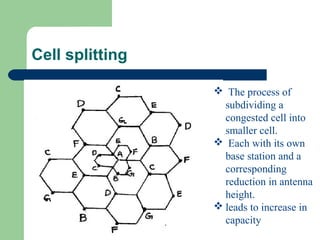
Cell splitting
 The process of
subdividing a
congested cell into
smaller cell.
 Each with its own
base station and a
corresponding
reduction in antenna
height.
 leads to increase in
capacity
Limitations:
 Handoffs

are more frequent.
 Channel assignments become difficult.
 All cells are not split simultaneously so
special care have to be taken for proper
allocation of problem.
Umbrella approach:
Handoff issues must be addressed so that high speed and low
speed traffic can be accommodated simultaneously.
Cell sectoring:
 To

overcome some limitations like cochannel interference, cell sectoring is done.
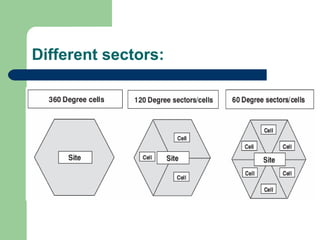
 Involves replacing an omni- directional
antenna at the base station by several
directional antennas,
Different sectors:
Advantages:
 It

improves S/I ratio.
 It reduces interference which increases
capacity.
 It enables to reduce the cluster size and
provides an additional freedom in assigning
channels.
Limitations:
 Increased

number of antennas at each base

station.
 Decrease in trunk efficiency.
 Loss of traffic.
 Since sectoring reduces the coverage area of
a particular group of channels, the number of
handoffs increases as well.
cell splitting and sectoring

cell splitting and sectoring

  • 1.
    Power point presentation on cellsplitting and sectoring MADE BY: : SHWETANSHU GUPTA MIET (342/08)
  • 2.
    CELL?  LARGER AREA DIVIDEDINTO SMALL NO. OF AREAS  SHAPE IS HEXAGONAL  EACH WITH ITS OWN BASE STATION AND SET OF FREQUENCIES.
  • 3.
    Why hexagonal cell? square circular hexagonal
  • 4.
    FREQUENCY REUSE 6 5 Each cellis assigned a part of the available frequency spectrum. 7 1 4 3 6 5 4 2 6 5 1 7 1 4 3 2 3 same part of the frequency spectrum more than once. This is called frequency reuse.
  • 5.
    Reuse Distance For hexagonalcells reuse distance--D= R.√3N  Reuse factor--D/R= √3N 
  • 6.
    Channel capacity? C = MKN= MS C= capacity M= number of clusters K= allotted channel to a cell N= no of cells in a cluster.
  • 7.
    Why cell splittingand sectoring?  As users increases channel capacity decreases.  Techniques are needed to provide extra channels.  cell splitting and sectoring increases capacity.
  • 8.
    Cell splitting  Theprocess of subdividing a congested cell into smaller cell.  Each with its own base station and a corresponding reduction in antenna height.  leads to increase in capacity
  • 9.
    Limitations:  Handoffs are morefrequent.  Channel assignments become difficult.  All cells are not split simultaneously so special care have to be taken for proper allocation of problem.
  • 10.
    Umbrella approach: Handoff issuesmust be addressed so that high speed and low speed traffic can be accommodated simultaneously.
  • 11.
    Cell sectoring:  To overcomesome limitations like cochannel interference, cell sectoring is done.  Involves replacing an omni- directional antenna at the base station by several directional antennas,
  • 12.
  • 13.
    Advantages:  It improves S/Iratio.  It reduces interference which increases capacity.  It enables to reduce the cluster size and provides an additional freedom in assigning channels.
  • 15.
    Limitations:  Increased number ofantennas at each base station.  Decrease in trunk efficiency.  Loss of traffic.  Since sectoring reduces the coverage area of a particular group of channels, the number of handoffs increases as well.