Presented by:
Ahmed Atef Elnaggar
Supervisor:
Prof. Shawkat K.Guirguis
 Introduction
 What is & why 4G
 Generation timeline
 History of different generations
 0G – 1G
 2G (Advantages, disadvantages) – 2.5
 3G (Reasons for New Research)
Contents
 4G
 Features of 4G technology
 Evolution of 4G
 Applications of 4G technology
 Telecom companies developing 4G
 Infrastructure for 4G
 Communications architecture
 Types of
Multiplexing(FDMA,TDMA,CDMA,OFDM)
 Different technologies of 4G
 UWB – Smart antennas – IPv6 – QOS – SDR- VOIP
 Effects on radio communicators
 Conclusion
 References
Contents cont.
 Abbreviation of fourth generation wireless technology.
 The term 4G is used broadly to include several types of
broadband wireless access communication systems, not
only cellular telephone systems.
 One of the terms to describe 4G is
MAGIC Mobile Multimedia
Anytime Anywhere
Global Mobility Support
Integrated wireless Solution
Customized Personal Service
Introduction to 4G
What is & why 4G?
• It will provide a comprehensive IP solution where voice ,
data and multimedia can be given to user on an “anytime ,
any-where” basis.
• The successor of 3G, will soon become the standard for
cellular wireless.
• It will provide seamless mobility and internet access at a rate
of 100 Mbps.
• It is launched in the year 2010.
• 4G is currently available in some countries but it is still
being perfected.
• The aim is to achieve “ultra broadband speed” – to be
counted in gigabytes per second.
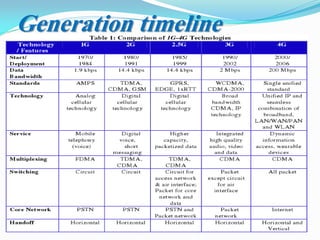
Generation timeline
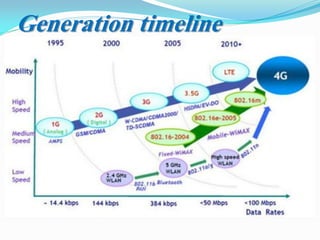
Generation timeline
history
Generation refers change in nature of Service compatible
transmission technology and new frequency bands.
0G (Zero Generation Mobile System)
 At the end of the 1940’s, the first radio telephone service was
introduced, and was designed to users in cars to the public land-line
based telephone network.
 In the 1960’s, a system launched by Bell Systems, called, Improved
Mobile Telephone Service (IMTS), brought quite a few improvements
such as direct dialing and more bandwidth. The very first analog
systems were based upon IMTS and were created in the late 60s and
early 70s.
1G Technology
 1G refers to the first-generation of wireless telephone technology
was developed in 1970’s.
 1G had two major improvements:
 the invention of the microprocessor.
 the digital transform of the control link between the phone and
the cell site.
 Analog signal.
 Drawbacks
 Poor Voice Quality.
 Poor Battery Life.
 Large Phone Size.
 No Security.
 Frequent Call Drops.
 Limited capacity and poor handoff reliability.
2G Technology
 Around 1980’s.
 2G phones using global system for mobile communications
(GSM) were first used in the early 1990’s in Europe.
 GSM provides voice and limited data services and uses digital
modulation for improved audio quality& capacity where more
people could use there phones at the same time.
 2G systems use digital communication techniques with TDM,
FDM, CDMA.
 Digital AMPS, CDMA2000 were some of the other 2GSystems.
 Digital data can be compressed and multiplexed much more
effectively than analog voice encodings.
 Multiplexing -multiple analog message signals or digital data
streams are combined into one signal.
 For 1 and 2G standards, bandwidth maximum is 9.6 Kbit/sec,
(I.E) approximately 6 times slower than an ISDN.
Advantages 2G
 Allows for lower powered radio signals that require less battery
 The digital voice encoding allows digital error checking
 increase sound quality
 lowers the noise level
 Going all-digital allowed for the introduction of digital data
transfer (SMS –“short message service”, E-mail).
Disadvantages 2G
 Cell towers had a limited coverage area
 Jagged Decay curve
 Abrupt dropped calls
 Analog –gradual sound reduction
 “Spotty” coverage
 An interim stage that is taken between 2G and 3G that is 2.5G.
 It is basically an enhancement of major technologies to provide
increased capacity and to increase higher bit rates.
 A very important aspect of 2.5G is the data channel are optimized for
packet data which include access to internet through mobile devices.
 Drawbacks
 The GSM is circuit switched.
 connection oriented technology. where the end systems are
dedicated for the entire call session.
 This causes inefficiency in the usage of bandwidth and resources.
 The GSM-enabled systems do not support high data rates.
 They are unable to handle complex data such as video.
2.5G Technology
3G Technology
 Adds multimedia facilities to 2G phones by allowing audio,
video, and graphics applications.
 Large capacity and broadband capabilities
 Allows the transmission of 384kbps for mobile systems and up to
2Mbps
 Increased spectrum efficiency –5Mhz
 A greater number of users that can be simultaneously
supported by a radio frequency bandwidth
 High data rates at lower incremental cost than 2G–Global
roaming
 CDMA –Code Division Multiple Access
 Form of multiplexing
 Does not divide up the channel by time or frequency
 Encodes data with a special code associated with each channel
Reasons for New Research
 Even though 3G has successfully been introduced to mobile
users, there are some issues that are debated by 3G providers and
users.
 High input fees for the 3G service licenses
 Great differences in the licensing terms
 3G phones are expensive
 High band width requirement.
Fourth Generation
 Most features are:
 Faster and more reliable
 100 Mb/s
 Lower cost than previous generations
 Multi-standard wireless system
 Bluetooth, Wired, Wireless
 Ad Hoc Networking
 IPv6 Core
 OFDM used instead of CDMA
 Potentially IEEE standard 802.11n
 Most information is proprietary
Evolution of 4G
• In 2008. the ITU-R organization specified the ،MT Advanced
(International Mobile Telecommunications Advanced)
requirements for 4G standards, setting peak speed requirements
for 4G service at loo Mb it/s for high mobility communication
(such as from trains and cars) and 1Gbit/s for low mobility
communication (such as pedestrians and stationary users)
• The 1st commercial deployment was by Telia Sonera & NetCom.
• Telia Sonera branded the network “4G”.
• The modem devices on offer were manufactured by Samsung
(dongle GT-B3710).
• The network infrastructure were created by Huawei (in Oslo) and
Ericsson (in Stockholm)
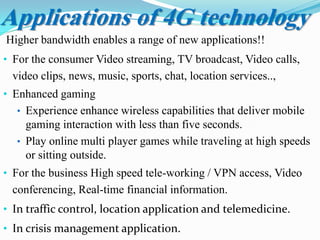
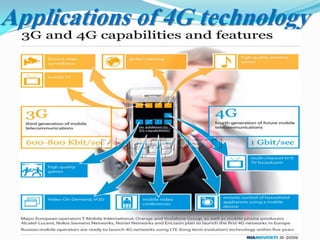
Applications of 4G technology
Higher bandwidth enables a range of new applications!!
• For the consumer Video streaming, TV broadcast, Video calls,
video clips, news, music, sports, chat, location services..,
• Enhanced gaming
• Experience enhance wireless capabilities that deliver mobile
gaming interaction with less than five seconds.
• Play online multi player games while traveling at high speeds
or sitting outside.
• For the business High speed tele-working / VPN access, Video
conferencing, Real-time financial information.
• In traffic control, location application and telemedicine.
• In crisis management application.
Applications of 4G technology
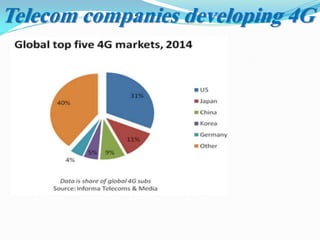
 NTT DOCOMO (Japan)
 DIGIWEB (Ireland)
 SPRINT (Chicago)
 VERIZON Wireless
 VODAFONE Group
 American wireless provider clear wire
 …etc
Telecom companies developing 4G
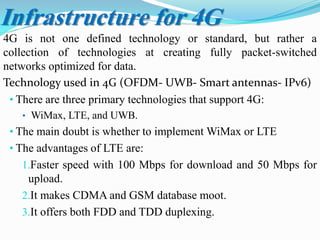
4G is not one defined technology or standard, but rather a
collection of technologies at creating fully packet-switched
networks optimized for data.
Technology used in 4G (OFDM- UWB- Smart antennas- IPv6)
• There are three primary technologies that support 4G:
• WiMax, LTE, and UWB.
• The main doubt is whether to implement WiMax or LTE
• The advantages of LTE are:
1.Faster speed with 100 Mbps for download and 50 Mbps for
upload.
2.It makes CDMA and GSM database moot.
3.It offers both FDD and TDD duplexing.
Infrastructure for 4G
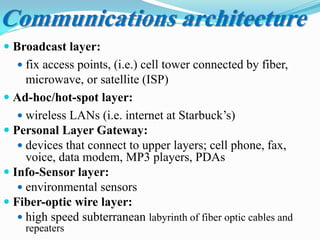
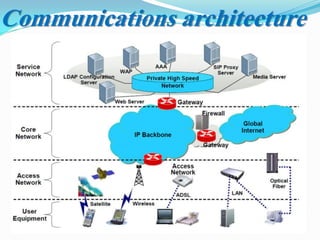
Communications architecture
 Broadcast layer:
 fix access points, (i.e.) cell tower connected by fiber,
microwave, or satellite (ISP)
 Ad-hoc/hot-spot layer:
 wireless LANs (i.e. internet at Starbuck’s)
 Personal Layer Gateway:
 devices that connect to upper layers; cell phone, fax,
voice, data modem, MP3 players, PDAs
 Info-Sensor layer:
 environmental sensors
 Fiber-optic wire layer:
 high speed subterranean labyrinth of fiber optic cables and
repeaters
Communications architecture
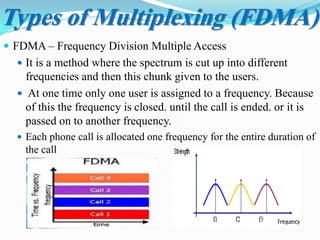
Types of Multiplexing (FDMA)
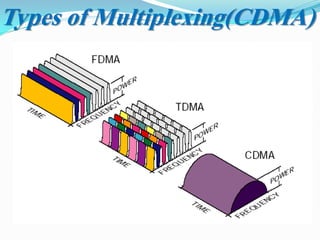
 FDMA – Frequency Division Multiple Access
 It is a method where the spectrum is cut up into different
frequencies and then this chunk given to the users.
 At one time only one user is assigned to a frequency. Because
of this the frequency is closed. until the call is ended. or it is
passed on to another frequency.
 Each phone call is allocated one frequency for the entire duration of
the call
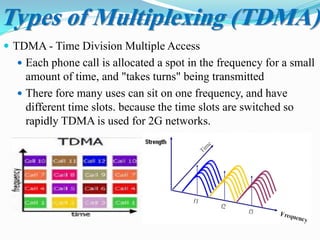
Types of Multiplexing (TDMA)
 TDMA - Time Division Multiple Access
 Each phone call is allocated a spot in the frequency for a small
amount of time, and "takes turns" being transmitted
 There fore many uses can sit on one frequency, and have
different time slots. because the time slots are switched so
rapidly TDMA is used for 2G networks.
Types of Multiplexing(CDMA)
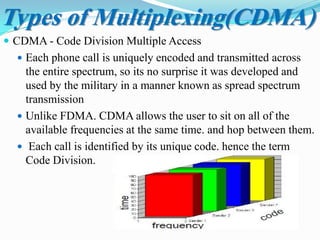
 CDMA - Code Division Multiple Access
 Each phone call is uniquely encoded and transmitted across
the entire spectrum, so its no surprise it was developed and
used by the military in a manner known as spread spectrum
transmission
 Unlike FDMA. CDMA allows the user to sit on all of the
available frequencies at the same time. and hop between them.
 Each call is identified by its unique code. hence the term
Code Division.
Types of Multiplexing(CDMA)
 Orthogonal frequency division multiplexing
 OFDM works by splitting the radio signal into multiple
smaller sub-signals that are then transmitted
simultaneously at different frequencies to the receiver.
 Allows to transfer more than other forms of multiplexing
(Time, Frequency, Code, etc.)
 Simplifies the design of the transmitter and the receiver.
 Currently used in WiMax (802.16) and Wi-Fi(802.1 la/g).
 Allows for almost the entire frequency band.
 No gaps to prevent interference needed.
Types of Multiplexing(OFDM)
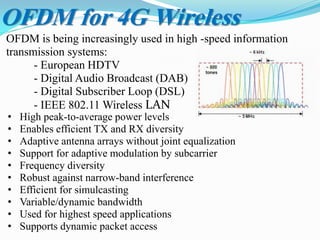
OFDM is being increasingly used in high -speed information
transmission systems:
- European HDTV
- Digital Audio Broadcast (DAB)
- Digital Subscriber Loop (DSL)
- IEEE 802.11 Wireless LAN
OFDM for 4G Wireless
• High peak-to-average power levels
• Enables efficient TX and RX diversity
• Adaptive antenna arrays without joint equalization
• Support for adaptive modulation by subcarrier
• Frequency diversity
• Robust against narrow-band interference
• Efficient for simulcasting
• Variable/dynamic bandwidth
• Used for highest speed applications
• Supports dynamic packet access
• WiMax formed to provide conformance and
interoperability of the IEEE 802.16 standard. It aims
to provide wireless data over long distance from
point-to-point link to cellular mobile type access.
• Wipro a part of IEEE 802.16e in process to provide
collaborative and generic mobile WiMax.
• 3GPP LTE a project aims to improve the mobile
phone standard to cope with future requirements.
• 3GPP 2 UMB a project to improve the CDMA2000
mobile phone standard for next generation
applications.
Different technologies of 4G
• An advanced technology that can be used in 4G
technology.
• It is typically detected as noise.
• It can use any part of the frequency spectrum,
which means that it can use frequencies that are
currently in use by other radio frequency devices .
• It uses a frequency of 3.1 to 10.6 Hz.
• It uses less power, since it transmits pulse instead
of continuous signal.
• Special antennas are needed to tune and aim the
signal.
UWB (ultra wide band)
• smart antenna can be employed to find tune and
turn up signal information.
• smart antenna can send signal back in the same
direction that they come from.
• There are two types of smart antennas
• switched beam antenna: It has fixed beams of transition. and
switch from predefined beam to another when the user with the
phone moves through out the sector.
• Adaptive array antenna: It represents the most advanced smart
antenna approach to data using a variety of new signal
processing algorithms to locate and track the user, minimize
interference and maximize intended signal reception.
Smart antennas
• IPv6 means Internet Protocol Version 6.
• The Internet Protocol (IP) is the method or protocol which data is
sent from one computer to another on the internet.
• Each computer (known as a host) on the Internet has at least one IP
that uniquely identifies it from all other computers on the Internet.
• It includes l28 bits, which is 4 times more than 32bits IP address in
IPv4.
• Unlike 3G, based on two parallel infrastructure circuit
switched and packet switched network nodes, 4G will be
based on packet switching only.
• This will require low latency data transmission.
• IPv6 support large number of wireless enabled devices.
By increasing the number of IP addresses,
• IPv6 removes the need for NAT (Network Address Translation).
IPv6
• In wireless networks, Quality of Service (QOS)
refers to the measure of the performance for
a system reflecting its transmission quality and
service availability.
• 4G is expected to have at least a reliability of 99.99%.
• In 4G QOS may be divided in following ways:
• Transaction-level QOS describes both the time it takes to
complete a transaction and the packet loss rate.
• Circuit-level QOS includes call blocking for new as well
as existing calls.
• User-level QOS depends on user mobility and app. type.
QOS(quality of service)
• A software defined radio is one that can be
configured to any radio or frequency standard
through the use of software.
• The phone should automatically switch from
operating on a CDMA frequency to a TDMA
frequency whenever it is required.
• Roaming can be an issue with different standards,
but with a software defined ratio, users can just
download the interface upon entering new
territory, or the software could just download
automatically.
Soft ware defined ratio(SDR)
• Voice Over Internet Protocol
• Allows only packets (IP) to be transferred,
eliminating the complexity of 2 protocols over the
same circuit.
• All voice data will be wrapped up in a packet
• Lower latency data transmission (Faster
Transmission)
• Samples voice between 8000 to 64000 times per
second and creates stream of bits which is then
compressed and put into a packet.
• Increases battery life due to greater data
transmission.
VOIP
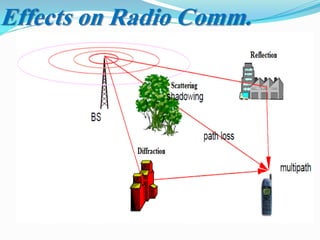
During propagation, the radio signal experiences different
effects (phenomenon)which affect the signal quality, signal
degradation can be classified by type:
• Path Loss Due to distance covered by the radio signal,
"Free space path loss “ .
• Signal attenuation Resulting from shadowing effects
introduced by the obstacles between transmitter and
receiver
• Fading of the signal Caused by numerous effects all of
which are related to the Radio propagation phenomenon
Effects on Radio Comm.
• Reflection
– Propagating wave impinges on an object which is large
compared to wavelength
– E.g., the surface of the Earth, buildings, walls, etc.
• Diffraction
– Radio path between transmitter and receiver obstructed
by surface with sharp irregular edge
– Waves bend around the obstacle, even when LOS does
not exist
• Scattering
– Objects smaller than the wavelength of the propagating
wave
Effects on Radio Comm.
• Migration to 4G networks ensures convergence of
networks, technologies, applications and services.
 4G can serve as a flexible platform, Flexible channel
bandwidth betn. 5 and 20MHz, optionally up to 40MHz.
 Wireless carriers have an opportunity to shorten
Investment return, improve operating efficiency and
increase revenues.
 4G is promising Generation of wireless communication
that will change people’s lives.
 4G is a packet switched wireless system with wide area
coverage and high throughput.
4G wireless uses OFDM and millimeter wireless
Conclusion
• Docomo: Towards 4G Technology.
http://www.nttdocomo.com/technologies.future/toward/index.html
• Frequently Asked Questions on 4G By Zahid Ghadialy.
http://www.3g4g.co.uk/4G/fag.html
• Telenor: Mobility Aspects in 4G Networks white Paper.
http://www.telenor.com/pub/not02/N432002.pdf
• ITU global standard for international mobile
telecommunications ´IMT-Advanced´, Circular letter, ITU-R
March 2008.
• AT&T commits to LTE-Advanced deployment in 2013, Hesse and
Mead unfazed". Engadget. 2011-11-08. Retrieved 2012-07-31.
• Teliasonera First To Offer 4G Mobile Services". The Wall Street
Journal. 2009-12-14.
References
4G

4G

  • 1.
    Presented by: Ahmed AtefElnaggar Supervisor: Prof. Shawkat K.Guirguis
  • 2.
     Introduction  Whatis & why 4G  Generation timeline  History of different generations  0G – 1G  2G (Advantages, disadvantages) – 2.5  3G (Reasons for New Research) Contents
  • 3.
     4G  Featuresof 4G technology  Evolution of 4G  Applications of 4G technology  Telecom companies developing 4G  Infrastructure for 4G  Communications architecture  Types of Multiplexing(FDMA,TDMA,CDMA,OFDM)  Different technologies of 4G  UWB – Smart antennas – IPv6 – QOS – SDR- VOIP  Effects on radio communicators  Conclusion  References Contents cont.
  • 4.
     Abbreviation offourth generation wireless technology.  The term 4G is used broadly to include several types of broadband wireless access communication systems, not only cellular telephone systems.  One of the terms to describe 4G is MAGIC Mobile Multimedia Anytime Anywhere Global Mobility Support Integrated wireless Solution Customized Personal Service Introduction to 4G
  • 5.
    What is &why 4G? • It will provide a comprehensive IP solution where voice , data and multimedia can be given to user on an “anytime , any-where” basis. • The successor of 3G, will soon become the standard for cellular wireless. • It will provide seamless mobility and internet access at a rate of 100 Mbps. • It is launched in the year 2010. • 4G is currently available in some countries but it is still being perfected. • The aim is to achieve “ultra broadband speed” – to be counted in gigabytes per second.
  • 6.
  • 7.
  • 8.
    history Generation refers changein nature of Service compatible transmission technology and new frequency bands. 0G (Zero Generation Mobile System)  At the end of the 1940’s, the first radio telephone service was introduced, and was designed to users in cars to the public land-line based telephone network.  In the 1960’s, a system launched by Bell Systems, called, Improved Mobile Telephone Service (IMTS), brought quite a few improvements such as direct dialing and more bandwidth. The very first analog systems were based upon IMTS and were created in the late 60s and early 70s.
  • 9.
    1G Technology  1Grefers to the first-generation of wireless telephone technology was developed in 1970’s.  1G had two major improvements:  the invention of the microprocessor.  the digital transform of the control link between the phone and the cell site.  Analog signal.  Drawbacks  Poor Voice Quality.  Poor Battery Life.  Large Phone Size.  No Security.  Frequent Call Drops.  Limited capacity and poor handoff reliability.
  • 10.
    2G Technology  Around1980’s.  2G phones using global system for mobile communications (GSM) were first used in the early 1990’s in Europe.  GSM provides voice and limited data services and uses digital modulation for improved audio quality& capacity where more people could use there phones at the same time.  2G systems use digital communication techniques with TDM, FDM, CDMA.  Digital AMPS, CDMA2000 were some of the other 2GSystems.  Digital data can be compressed and multiplexed much more effectively than analog voice encodings.  Multiplexing -multiple analog message signals or digital data streams are combined into one signal.  For 1 and 2G standards, bandwidth maximum is 9.6 Kbit/sec, (I.E) approximately 6 times slower than an ISDN.
  • 11.
    Advantages 2G  Allowsfor lower powered radio signals that require less battery  The digital voice encoding allows digital error checking  increase sound quality  lowers the noise level  Going all-digital allowed for the introduction of digital data transfer (SMS –“short message service”, E-mail). Disadvantages 2G  Cell towers had a limited coverage area  Jagged Decay curve  Abrupt dropped calls  Analog –gradual sound reduction  “Spotty” coverage
  • 12.
     An interimstage that is taken between 2G and 3G that is 2.5G.  It is basically an enhancement of major technologies to provide increased capacity and to increase higher bit rates.  A very important aspect of 2.5G is the data channel are optimized for packet data which include access to internet through mobile devices.  Drawbacks  The GSM is circuit switched.  connection oriented technology. where the end systems are dedicated for the entire call session.  This causes inefficiency in the usage of bandwidth and resources.  The GSM-enabled systems do not support high data rates.  They are unable to handle complex data such as video. 2.5G Technology
  • 13.
    3G Technology  Addsmultimedia facilities to 2G phones by allowing audio, video, and graphics applications.  Large capacity and broadband capabilities  Allows the transmission of 384kbps for mobile systems and up to 2Mbps  Increased spectrum efficiency –5Mhz  A greater number of users that can be simultaneously supported by a radio frequency bandwidth  High data rates at lower incremental cost than 2G–Global roaming  CDMA –Code Division Multiple Access  Form of multiplexing  Does not divide up the channel by time or frequency  Encodes data with a special code associated with each channel
  • 14.
    Reasons for NewResearch  Even though 3G has successfully been introduced to mobile users, there are some issues that are debated by 3G providers and users.  High input fees for the 3G service licenses  Great differences in the licensing terms  3G phones are expensive  High band width requirement.
  • 15.
    Fourth Generation  Mostfeatures are:  Faster and more reliable  100 Mb/s  Lower cost than previous generations  Multi-standard wireless system  Bluetooth, Wired, Wireless  Ad Hoc Networking  IPv6 Core  OFDM used instead of CDMA  Potentially IEEE standard 802.11n  Most information is proprietary
  • 16.
    Evolution of 4G •In 2008. the ITU-R organization specified the ،MT Advanced (International Mobile Telecommunications Advanced) requirements for 4G standards, setting peak speed requirements for 4G service at loo Mb it/s for high mobility communication (such as from trains and cars) and 1Gbit/s for low mobility communication (such as pedestrians and stationary users) • The 1st commercial deployment was by Telia Sonera & NetCom. • Telia Sonera branded the network “4G”. • The modem devices on offer were manufactured by Samsung (dongle GT-B3710). • The network infrastructure were created by Huawei (in Oslo) and Ericsson (in Stockholm)
  • 17.
    Applications of 4Gtechnology Higher bandwidth enables a range of new applications!! • For the consumer Video streaming, TV broadcast, Video calls, video clips, news, music, sports, chat, location services.., • Enhanced gaming • Experience enhance wireless capabilities that deliver mobile gaming interaction with less than five seconds. • Play online multi player games while traveling at high speeds or sitting outside. • For the business High speed tele-working / VPN access, Video conferencing, Real-time financial information. • In traffic control, location application and telemedicine. • In crisis management application.
  • 18.
  • 19.
     NTT DOCOMO(Japan)  DIGIWEB (Ireland)  SPRINT (Chicago)  VERIZON Wireless  VODAFONE Group  American wireless provider clear wire  …etc Telecom companies developing 4G
  • 20.
    4G is notone defined technology or standard, but rather a collection of technologies at creating fully packet-switched networks optimized for data. Technology used in 4G (OFDM- UWB- Smart antennas- IPv6) • There are three primary technologies that support 4G: • WiMax, LTE, and UWB. • The main doubt is whether to implement WiMax or LTE • The advantages of LTE are: 1.Faster speed with 100 Mbps for download and 50 Mbps for upload. 2.It makes CDMA and GSM database moot. 3.It offers both FDD and TDD duplexing. Infrastructure for 4G
  • 21.
    Communications architecture  Broadcastlayer:  fix access points, (i.e.) cell tower connected by fiber, microwave, or satellite (ISP)  Ad-hoc/hot-spot layer:  wireless LANs (i.e. internet at Starbuck’s)  Personal Layer Gateway:  devices that connect to upper layers; cell phone, fax, voice, data modem, MP3 players, PDAs  Info-Sensor layer:  environmental sensors  Fiber-optic wire layer:  high speed subterranean labyrinth of fiber optic cables and repeaters
  • 22.
  • 23.
    Types of Multiplexing(FDMA)  FDMA – Frequency Division Multiple Access  It is a method where the spectrum is cut up into different frequencies and then this chunk given to the users.  At one time only one user is assigned to a frequency. Because of this the frequency is closed. until the call is ended. or it is passed on to another frequency.  Each phone call is allocated one frequency for the entire duration of the call
  • 24.
    Types of Multiplexing(TDMA)  TDMA - Time Division Multiple Access  Each phone call is allocated a spot in the frequency for a small amount of time, and "takes turns" being transmitted  There fore many uses can sit on one frequency, and have different time slots. because the time slots are switched so rapidly TDMA is used for 2G networks.
  • 25.
    Types of Multiplexing(CDMA) CDMA - Code Division Multiple Access  Each phone call is uniquely encoded and transmitted across the entire spectrum, so its no surprise it was developed and used by the military in a manner known as spread spectrum transmission  Unlike FDMA. CDMA allows the user to sit on all of the available frequencies at the same time. and hop between them.  Each call is identified by its unique code. hence the term Code Division.
  • 26.
  • 27.
     Orthogonal frequencydivision multiplexing  OFDM works by splitting the radio signal into multiple smaller sub-signals that are then transmitted simultaneously at different frequencies to the receiver.  Allows to transfer more than other forms of multiplexing (Time, Frequency, Code, etc.)  Simplifies the design of the transmitter and the receiver.  Currently used in WiMax (802.16) and Wi-Fi(802.1 la/g).  Allows for almost the entire frequency band.  No gaps to prevent interference needed. Types of Multiplexing(OFDM)
  • 28.
    OFDM is beingincreasingly used in high -speed information transmission systems: - European HDTV - Digital Audio Broadcast (DAB) - Digital Subscriber Loop (DSL) - IEEE 802.11 Wireless LAN OFDM for 4G Wireless • High peak-to-average power levels • Enables efficient TX and RX diversity • Adaptive antenna arrays without joint equalization • Support for adaptive modulation by subcarrier • Frequency diversity • Robust against narrow-band interference • Efficient for simulcasting • Variable/dynamic bandwidth • Used for highest speed applications • Supports dynamic packet access
  • 29.
    • WiMax formedto provide conformance and interoperability of the IEEE 802.16 standard. It aims to provide wireless data over long distance from point-to-point link to cellular mobile type access. • Wipro a part of IEEE 802.16e in process to provide collaborative and generic mobile WiMax. • 3GPP LTE a project aims to improve the mobile phone standard to cope with future requirements. • 3GPP 2 UMB a project to improve the CDMA2000 mobile phone standard for next generation applications. Different technologies of 4G
  • 30.
    • An advancedtechnology that can be used in 4G technology. • It is typically detected as noise. • It can use any part of the frequency spectrum, which means that it can use frequencies that are currently in use by other radio frequency devices . • It uses a frequency of 3.1 to 10.6 Hz. • It uses less power, since it transmits pulse instead of continuous signal. • Special antennas are needed to tune and aim the signal. UWB (ultra wide band)
  • 31.
    • smart antennacan be employed to find tune and turn up signal information. • smart antenna can send signal back in the same direction that they come from. • There are two types of smart antennas • switched beam antenna: It has fixed beams of transition. and switch from predefined beam to another when the user with the phone moves through out the sector. • Adaptive array antenna: It represents the most advanced smart antenna approach to data using a variety of new signal processing algorithms to locate and track the user, minimize interference and maximize intended signal reception. Smart antennas
  • 32.
    • IPv6 meansInternet Protocol Version 6. • The Internet Protocol (IP) is the method or protocol which data is sent from one computer to another on the internet. • Each computer (known as a host) on the Internet has at least one IP that uniquely identifies it from all other computers on the Internet. • It includes l28 bits, which is 4 times more than 32bits IP address in IPv4. • Unlike 3G, based on two parallel infrastructure circuit switched and packet switched network nodes, 4G will be based on packet switching only. • This will require low latency data transmission. • IPv6 support large number of wireless enabled devices. By increasing the number of IP addresses, • IPv6 removes the need for NAT (Network Address Translation). IPv6
  • 33.
    • In wirelessnetworks, Quality of Service (QOS) refers to the measure of the performance for a system reflecting its transmission quality and service availability. • 4G is expected to have at least a reliability of 99.99%. • In 4G QOS may be divided in following ways: • Transaction-level QOS describes both the time it takes to complete a transaction and the packet loss rate. • Circuit-level QOS includes call blocking for new as well as existing calls. • User-level QOS depends on user mobility and app. type. QOS(quality of service)
  • 34.
    • A softwaredefined radio is one that can be configured to any radio or frequency standard through the use of software. • The phone should automatically switch from operating on a CDMA frequency to a TDMA frequency whenever it is required. • Roaming can be an issue with different standards, but with a software defined ratio, users can just download the interface upon entering new territory, or the software could just download automatically. Soft ware defined ratio(SDR)
  • 35.
    • Voice OverInternet Protocol • Allows only packets (IP) to be transferred, eliminating the complexity of 2 protocols over the same circuit. • All voice data will be wrapped up in a packet • Lower latency data transmission (Faster Transmission) • Samples voice between 8000 to 64000 times per second and creates stream of bits which is then compressed and put into a packet. • Increases battery life due to greater data transmission. VOIP
  • 36.
    During propagation, theradio signal experiences different effects (phenomenon)which affect the signal quality, signal degradation can be classified by type: • Path Loss Due to distance covered by the radio signal, "Free space path loss “ . • Signal attenuation Resulting from shadowing effects introduced by the obstacles between transmitter and receiver • Fading of the signal Caused by numerous effects all of which are related to the Radio propagation phenomenon Effects on Radio Comm.
  • 37.
    • Reflection – Propagatingwave impinges on an object which is large compared to wavelength – E.g., the surface of the Earth, buildings, walls, etc. • Diffraction – Radio path between transmitter and receiver obstructed by surface with sharp irregular edge – Waves bend around the obstacle, even when LOS does not exist • Scattering – Objects smaller than the wavelength of the propagating wave Effects on Radio Comm.
  • 38.
  • 39.
    • Migration to4G networks ensures convergence of networks, technologies, applications and services.  4G can serve as a flexible platform, Flexible channel bandwidth betn. 5 and 20MHz, optionally up to 40MHz.  Wireless carriers have an opportunity to shorten Investment return, improve operating efficiency and increase revenues.  4G is promising Generation of wireless communication that will change people’s lives.  4G is a packet switched wireless system with wide area coverage and high throughput. 4G wireless uses OFDM and millimeter wireless Conclusion
  • 40.
    • Docomo: Towards4G Technology. http://www.nttdocomo.com/technologies.future/toward/index.html • Frequently Asked Questions on 4G By Zahid Ghadialy. http://www.3g4g.co.uk/4G/fag.html • Telenor: Mobility Aspects in 4G Networks white Paper. http://www.telenor.com/pub/not02/N432002.pdf • ITU global standard for international mobile telecommunications ´IMT-Advanced´, Circular letter, ITU-R March 2008. • AT&T commits to LTE-Advanced deployment in 2013, Hesse and Mead unfazed". Engadget. 2011-11-08. Retrieved 2012-07-31. • Teliasonera First To Offer 4G Mobile Services". The Wall Street Journal. 2009-12-14. References