Bioassay & DRC
Dr Naser Ashraf Tadvi
Associate Professor
Assay
• Analysis done to determine the presence of a
substance & amount of that substance
(Known or unknown) in biological fluids is
known as Assay.
• Determines Activity and potency of drug
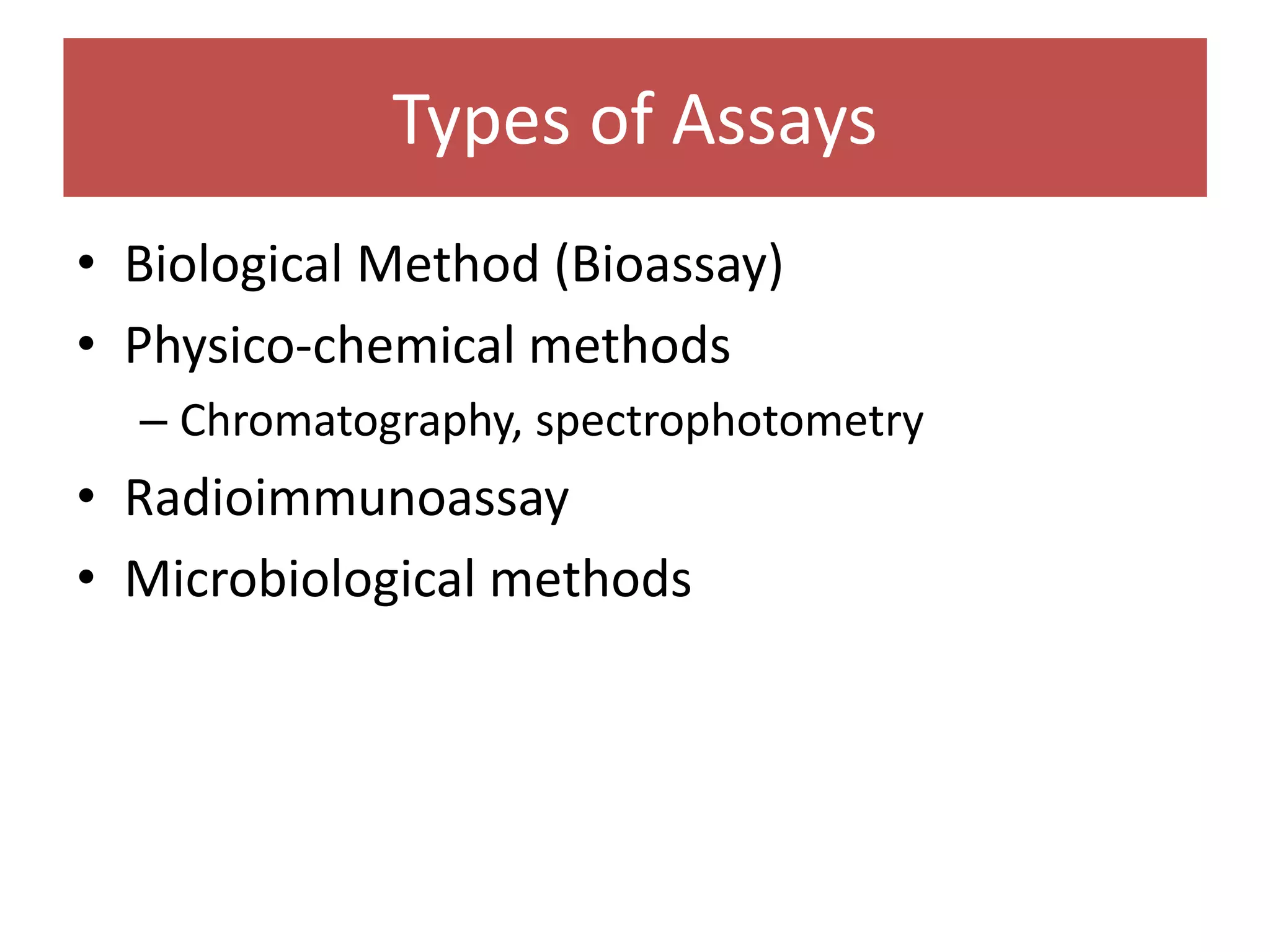
Types of Assays
• Biological Method (Bioassay)
• Physico-chemical methods
– Chromatography, spectrophotometry
• Radioimmunoassay
• Microbiological methods
Bioassay
• Measurement of the concentration or potency
of a drug from magnitude of its main
biological effect
Main Pharmacological effect of drug
Compared with
Pharmacological effect of standard drug
Potency ratios are compared quantitatively
Indications(Uses) of Bioassay
• Measure pharmacological activity of new/
chemically undefined substance
• Measure concentration of known substance in
tissue extract or body fluid e.g Ach, histamine
• Measure ED50 / LD50 of a drug
• Biological standardization of natural drugs
which cannot be obtained in chemically pure
form e.g Vasopressin, oxytocin
Parameters recorded
• Blood pressure (Dogs and cats):
Sympathomimetics
• Ach: contraction of rabbit duodenum or frog
rectus abdominis
• Skeletal muscle relaxants: rabbit head drop
method
• Histamine: Guinea pig ileum
• Serotonin on rat colon
Principles of Bioassay
• Experimental conditions should be constant
• Standard should be in pure form and known
conc. Should be available
• Unknown and standard drug should have
same mode of action and pharmacological
effects
• Use a specified pharmacological technique like
rectus muscle preparation for Ach
• System should be insensitive to other drugs
Characteristics of a good bioassay
• Sensitivity - ability to detect smallest
concentration
• Specificity – the response which is being
measured should specific.
• Reproducibility - same observations using
different instrument and operator, over longer
time periods.
• Stability – sensitivity of preparation should be
constant.
• Availability – the particular tissue should be easily
available
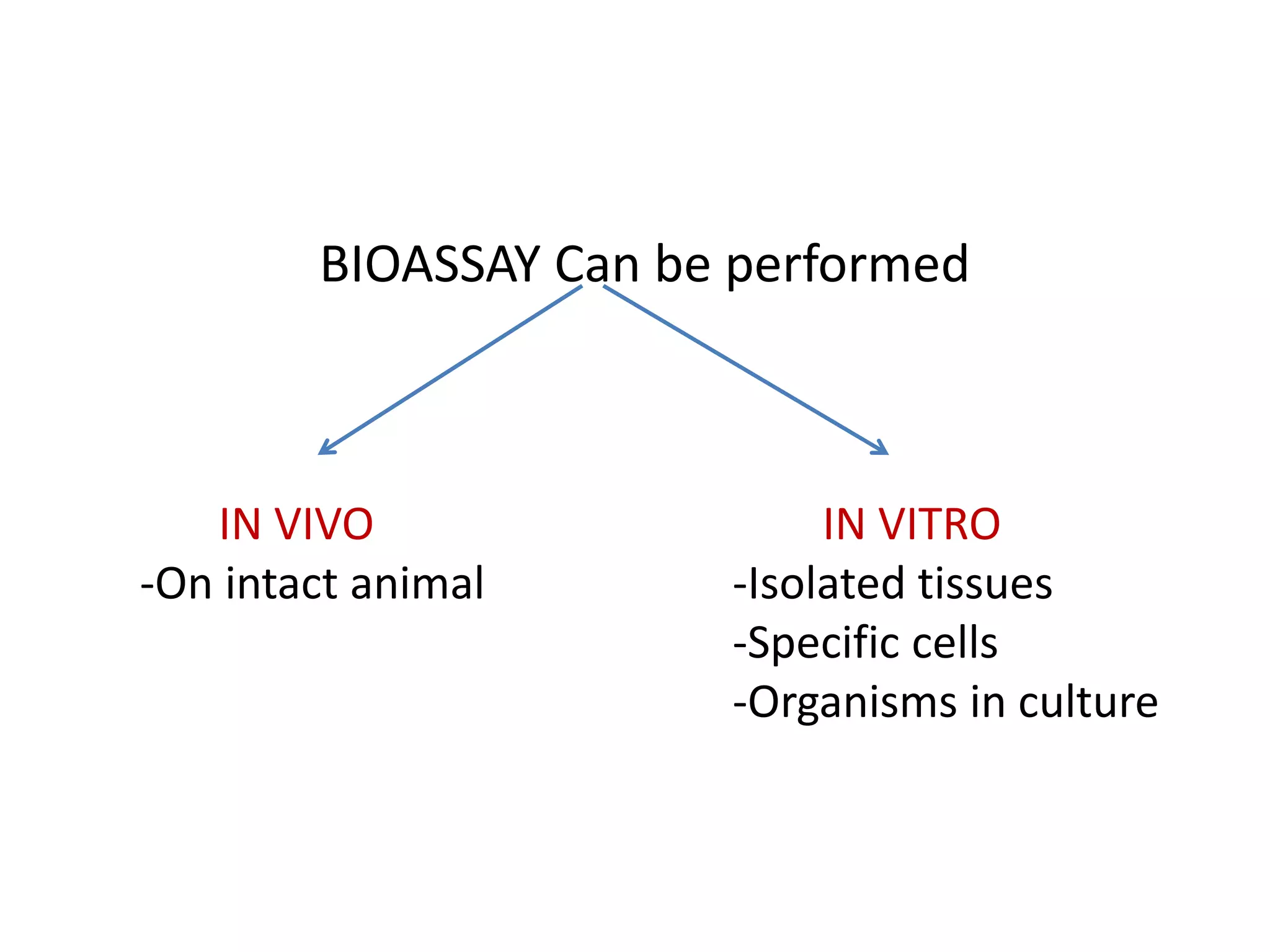
BIOASSAY Can be performed
IN VIVO
-On intact animal
IN VITRO
-Isolated tissues
-Specific cells
-Organisms in culture
Advantages of isolated tissue experiments over
intact animal experiments
Several preparations can be obtained from a
single animal.
Small amount of the test material is required.
Cheap, less time consuming.
Interference due to pharmacokinetic factors
and compensatory reflexes is avoided.
Assembly for recording contraction of isolated
tissue
Organ Bath:
• Rudolph Magnus was first to design organ bath.
Outer organ bath: made up of perplex with electrical
thermostat and stirrer for uniform temperature.
Inner organ bath: made of glass , capacity of bath is
30ml.
Assembly for recording contraction of isolated tissue
• Lever:
Simple lever is used.
Stylus
Magnification and Adjustment
Magnification for Frog rectus is 5-10
Fast contracting- low
Slow contracting- high
BA
A
B
Role of Aeration / Aeration tube
1). Provides oxygen/ air to mounted tissue.
2). Allows uniform distribution of drug in organ bath
through bubbles.
3). Areation tube helps in mounting tissue in organ
bath.
Aeration – 30-40 bubbles / min (air)
Assembly of instruments for bioassay
Mariottes Bottle
Sherringtons starling drum
Simple writing lever
Aeration tube
Inner Organ bath
Outer Organ bath
Kymograph
1 gm weight is added
Writing lever
Assembly of instruments for bioassay
Dissection and mounting the tissue
Procedure:
 A pithed frog is laid on its dorsal surface in a dissection tray.
 The skin of the abdomen cut to expose the whole abdomen.
 The rectus muscle is identified, and the border of the muscle
dissected out from adjacent abdominal wall.
 A thread is passed with the help of needle through the pubic
attachment of muscle and tied ,muscle is cut.
 The upper end of muscle i.e, xiphisternum part also tied and cut.
 The lower end of the muscle is tied to aeration tube at ‘s’ bent.
Pithing and Dissection of Frog
Dissection and mounting the tissue
 Before mounting the tissue make sure the blood vessels are
removed.
 Aeration tube with mounted tissue is placed in inner organ bath
filled with PSS.
 The upper end of muscle is tied to lever with thread.
 A load of 1gm is attached to the other side of lever at same
distance as that of tissue from the fulcrum. This helps the muscle
to relax in between contraction.
 Tissue is aerated with air i.e 30-40 bubbles /min. and allowed to
relax for 30- 45 min before recording responses.
Mounting the tissue
Acetyl choline Dilutions
 Stock solution- 1 mg/ml Acetylcholine(1000μg/ml)
The dilutions are made as follows-
1 ml stock soln. +9 ml distilled water= 1/10 dilution(100 μg/ml)
1 ml 1/10 dilution +9 ml distilled water= 1/100 dilution(10 μg/ml)
1 ml 1/100dilution +9 ml distilled water= 1/1000 dilution(1μg/ml)
Recording cycle
 Base line:30 seconds(s) (start drum & allow to run freely)
 Contractions: 90 s (contact period of Ach with tissue)
 Relaxation: 3 minutes (tissue washed 2-3 times after 90
sec contact period)
 Total cycle is 5 mins
 Soon after contraction of 90 secs the weight of 1gm is
lowered down to allow muscle to relax slowly, until lever
comes to base line.
 The contractions are recorded with each dose of solution
till ceiling effect is obtained i.e no further increase in
height of contraction with subsequent doses.
Recording cycle
 After the ceiling effect is obtained with standard Ach
solution, the procedure is repeated with the test
solution(unknown strength of Ach) in different dilutions.
 The further experiment is done by Multiple point assay
i.e. 2+1 assay
Sensitivity of Rectus muscle can
be increased by adding
Physostigmine(0.5μg/ml)/ Alcohol to perfusion
fluid
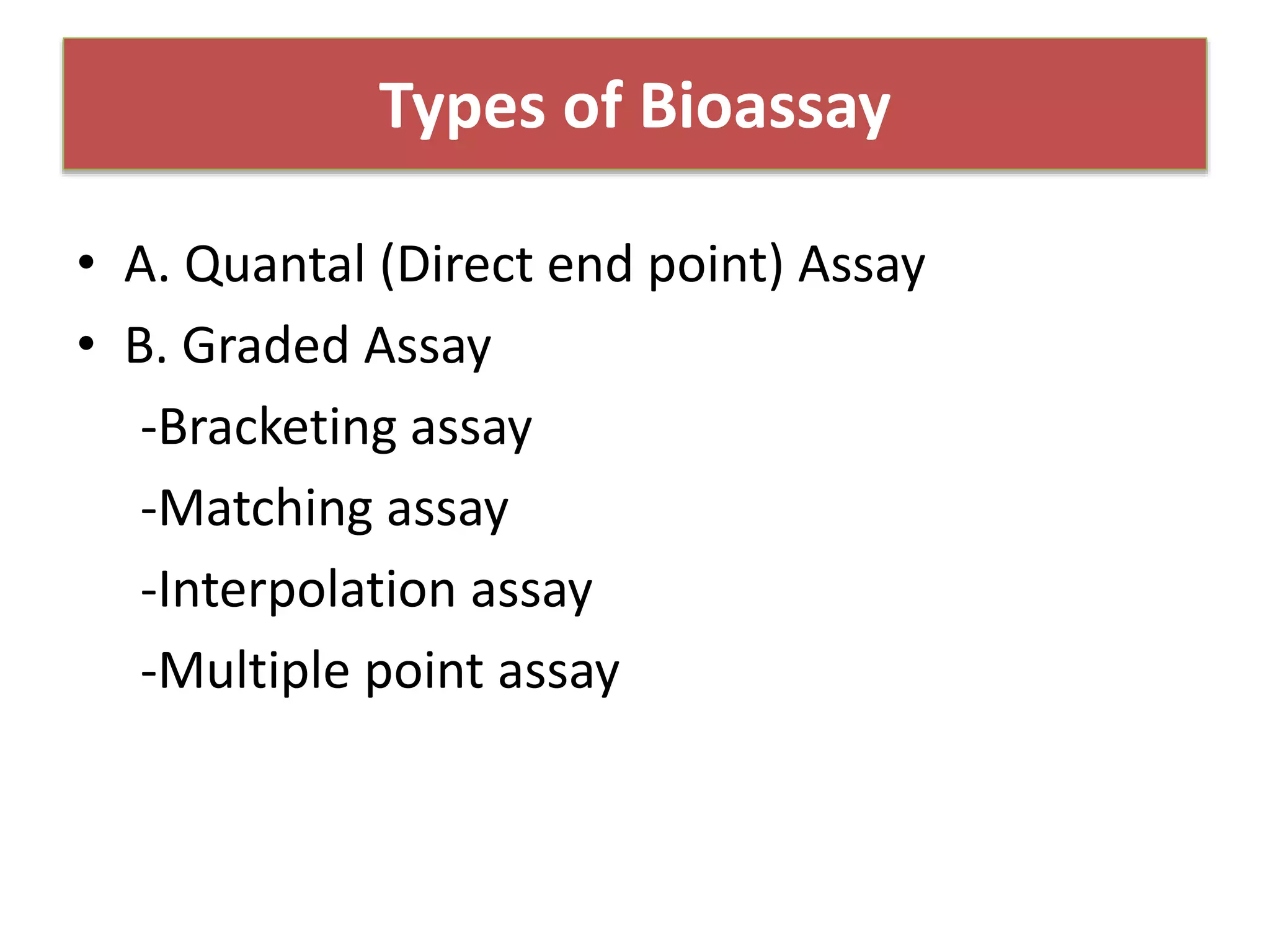
Types of Bioassay
• A. Quantal (Direct end point) Assay
• B. Graded Assay
-Bracketing assay
-Matching assay
-Interpolation assay
-Multiple point assay
Quantal response (All or none assay)
• In this assay, dose of standard and unknown
which provide predetermined ‘all or none’
response, then their potency ratios compared.
Ex: Digitalis induced cardiac arrest in cats, insulin
induced hypoglycemic convulsions in mice.
Quantal response (All or none assay)
Graded response assay
Multiple Point Assay
• Bracketing and Matching assay methods are
not ideal because lack of accuracy, sensitivity
• So , to minimize those errors multiple point
assays preferred (3,4 or 6 point assays)
0.2 100
25.612.86.43.21.6 51.20.80.4 10
U
400
200 40
U
20
U
80
U
16
U
32
U
64
U
S2S1
S1
S1
S1S2
S2
S2
t
t
t
t
2+1 Bioassay of Ach on Isolated Frog
Rectus Muscle
S2S1
T
6
Dose response curve
Test 1/10
10 U
80 U40 U20 U
Test SS
64 U32 U16 U
Dose response curve of test solution
in graded doses
Latin square
S1 S2 t
t S1 S2
S2 S1 t
X
Calculations
Response Height of
contraction
(mm)
Mean height
(mm)
Dose (ml)
1 2 3
S1 34 32 37 35.2 0.1
S2 67 65 80 72.7 0.2
T 42 42 43 40.7 0.32
Dose ratio(d) = = = 2
S1
S2 0.2
0.1
• From data obtained log potency ratio (M) is calculated from the
formula:
M = × log d
M = × log 2
M = × 0.301 = 0.047
Calculations
T – S1
S2 – S1
41 - 35
73 - 35
6
38
• From M ,the strength of the unknown can be calculated –
Strength of = × antilog of M
test solution
= × 1.114
= 0.348125 mg/ml
= 348 μg/ml
The given concentration was 300 μg/ml , so the error is 16%
Percentage error(%)= × 100
Calculations
S1
t
0.1
0.32
ACT
ACT - OCT
Calculation
DRUG DOSE (μg) RESPONSE (mm) LOG DOSE
2 0 0.30103
4 0 0.60206
8 0 0.90309
16 4 1.20412
32 8 1.50515
64 24 1.80618
128 30 2.10721
256 40 2.40824
512 42 2.70927
1024 45 3.0103
2048 45 3.31133
Dose Response Curve
-10
0
10
20
30
40
50
0 500 1000 1500 2000 2500
RESPONSE (mm)
DOSE (μg)
RESPONSE(mm)
Calculation of ED50
LDR CURVES OF 2 DRUGS WITH
DIFFERENT POTENCY
EFFICACY & POTENCY
FREQUENCY DISTRIBUTION CURVE
Therapeutic Index
ED50 LD50
Certain Safety Factor
Therapeutic window
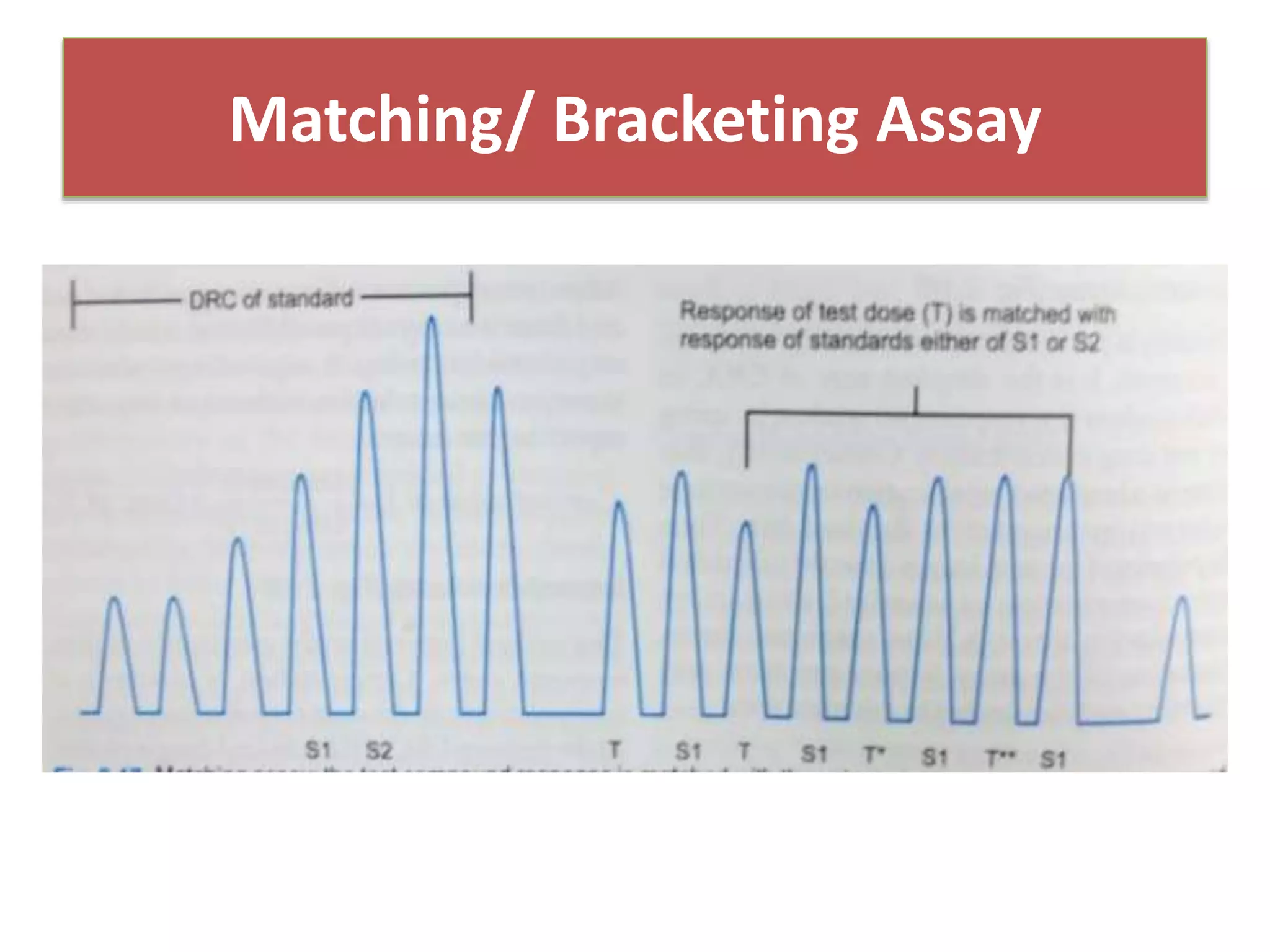
Matching/ Bracketing Assay
Matching/Bracketing Assay
Advantage :
 Faster
 Can be completed when amount of test drug
available is small
 Does not involve complicated calculations
Disadvantage:
 Match is subjective
 Exact match may not always be possible
Interpolation method
Thank You

Bioassay

  • 1.
    Bioassay & DRC DrNaser Ashraf Tadvi Associate Professor
  • 2.
    Assay • Analysis doneto determine the presence of a substance & amount of that substance (Known or unknown) in biological fluids is known as Assay. • Determines Activity and potency of drug
  • 3.
    Types of Assays •Biological Method (Bioassay) • Physico-chemical methods – Chromatography, spectrophotometry • Radioimmunoassay • Microbiological methods
  • 4.
    Bioassay • Measurement ofthe concentration or potency of a drug from magnitude of its main biological effect Main Pharmacological effect of drug Compared with Pharmacological effect of standard drug Potency ratios are compared quantitatively
  • 5.
    Indications(Uses) of Bioassay •Measure pharmacological activity of new/ chemically undefined substance • Measure concentration of known substance in tissue extract or body fluid e.g Ach, histamine • Measure ED50 / LD50 of a drug • Biological standardization of natural drugs which cannot be obtained in chemically pure form e.g Vasopressin, oxytocin
  • 6.
    Parameters recorded • Bloodpressure (Dogs and cats): Sympathomimetics • Ach: contraction of rabbit duodenum or frog rectus abdominis • Skeletal muscle relaxants: rabbit head drop method • Histamine: Guinea pig ileum • Serotonin on rat colon
  • 7.
    Principles of Bioassay •Experimental conditions should be constant • Standard should be in pure form and known conc. Should be available • Unknown and standard drug should have same mode of action and pharmacological effects • Use a specified pharmacological technique like rectus muscle preparation for Ach • System should be insensitive to other drugs
  • 8.
    Characteristics of agood bioassay • Sensitivity - ability to detect smallest concentration • Specificity – the response which is being measured should specific. • Reproducibility - same observations using different instrument and operator, over longer time periods. • Stability – sensitivity of preparation should be constant. • Availability – the particular tissue should be easily available
  • 9.
    BIOASSAY Can beperformed IN VIVO -On intact animal IN VITRO -Isolated tissues -Specific cells -Organisms in culture
  • 10.
    Advantages of isolatedtissue experiments over intact animal experiments Several preparations can be obtained from a single animal. Small amount of the test material is required. Cheap, less time consuming. Interference due to pharmacokinetic factors and compensatory reflexes is avoided.
  • 11.
    Assembly for recordingcontraction of isolated tissue Organ Bath: • Rudolph Magnus was first to design organ bath. Outer organ bath: made up of perplex with electrical thermostat and stirrer for uniform temperature. Inner organ bath: made of glass , capacity of bath is 30ml.
  • 12.
    Assembly for recordingcontraction of isolated tissue • Lever: Simple lever is used. Stylus
  • 13.
    Magnification and Adjustment Magnificationfor Frog rectus is 5-10 Fast contracting- low Slow contracting- high BA A B
  • 14.
    Role of Aeration/ Aeration tube 1). Provides oxygen/ air to mounted tissue. 2). Allows uniform distribution of drug in organ bath through bubbles. 3). Areation tube helps in mounting tissue in organ bath. Aeration – 30-40 bubbles / min (air)
  • 15.
    Assembly of instrumentsfor bioassay Mariottes Bottle Sherringtons starling drum Simple writing lever Aeration tube Inner Organ bath Outer Organ bath Kymograph
  • 16.
    1 gm weightis added Writing lever Assembly of instruments for bioassay
  • 17.
    Dissection and mountingthe tissue Procedure:  A pithed frog is laid on its dorsal surface in a dissection tray.  The skin of the abdomen cut to expose the whole abdomen.  The rectus muscle is identified, and the border of the muscle dissected out from adjacent abdominal wall.  A thread is passed with the help of needle through the pubic attachment of muscle and tied ,muscle is cut.  The upper end of muscle i.e, xiphisternum part also tied and cut.  The lower end of the muscle is tied to aeration tube at ‘s’ bent.
  • 18.
  • 19.
    Dissection and mountingthe tissue  Before mounting the tissue make sure the blood vessels are removed.  Aeration tube with mounted tissue is placed in inner organ bath filled with PSS.  The upper end of muscle is tied to lever with thread.  A load of 1gm is attached to the other side of lever at same distance as that of tissue from the fulcrum. This helps the muscle to relax in between contraction.  Tissue is aerated with air i.e 30-40 bubbles /min. and allowed to relax for 30- 45 min before recording responses.
  • 20.
  • 21.
    Acetyl choline Dilutions Stock solution- 1 mg/ml Acetylcholine(1000μg/ml) The dilutions are made as follows- 1 ml stock soln. +9 ml distilled water= 1/10 dilution(100 μg/ml) 1 ml 1/10 dilution +9 ml distilled water= 1/100 dilution(10 μg/ml) 1 ml 1/100dilution +9 ml distilled water= 1/1000 dilution(1μg/ml)
  • 22.
    Recording cycle  Baseline:30 seconds(s) (start drum & allow to run freely)  Contractions: 90 s (contact period of Ach with tissue)  Relaxation: 3 minutes (tissue washed 2-3 times after 90 sec contact period)  Total cycle is 5 mins  Soon after contraction of 90 secs the weight of 1gm is lowered down to allow muscle to relax slowly, until lever comes to base line.  The contractions are recorded with each dose of solution till ceiling effect is obtained i.e no further increase in height of contraction with subsequent doses.
  • 23.
    Recording cycle  Afterthe ceiling effect is obtained with standard Ach solution, the procedure is repeated with the test solution(unknown strength of Ach) in different dilutions.  The further experiment is done by Multiple point assay i.e. 2+1 assay Sensitivity of Rectus muscle can be increased by adding Physostigmine(0.5μg/ml)/ Alcohol to perfusion fluid
  • 24.
    Types of Bioassay •A. Quantal (Direct end point) Assay • B. Graded Assay -Bracketing assay -Matching assay -Interpolation assay -Multiple point assay
  • 25.
    Quantal response (Allor none assay) • In this assay, dose of standard and unknown which provide predetermined ‘all or none’ response, then their potency ratios compared. Ex: Digitalis induced cardiac arrest in cats, insulin induced hypoglycemic convulsions in mice.
  • 26.
    Quantal response (Allor none assay)
  • 27.
  • 28.
    Multiple Point Assay •Bracketing and Matching assay methods are not ideal because lack of accuracy, sensitivity • So , to minimize those errors multiple point assays preferred (3,4 or 6 point assays)
  • 29.
    0.2 100 25.612.86.43.21.6 51.20.80.410 U 400 200 40 U 20 U 80 U 16 U 32 U 64 U S2S1 S1 S1 S1S2 S2 S2 t t t t 2+1 Bioassay of Ach on Isolated Frog Rectus Muscle S2S1 T
  • 30.
  • 31.
    Test 1/10 10 U 80U40 U20 U Test SS 64 U32 U16 U Dose response curve of test solution in graded doses
  • 32.
    Latin square S1 S2t t S1 S2 S2 S1 t X
  • 33.
    Calculations Response Height of contraction (mm) Meanheight (mm) Dose (ml) 1 2 3 S1 34 32 37 35.2 0.1 S2 67 65 80 72.7 0.2 T 42 42 43 40.7 0.32 Dose ratio(d) = = = 2 S1 S2 0.2 0.1
  • 34.
    • From dataobtained log potency ratio (M) is calculated from the formula: M = × log d M = × log 2 M = × 0.301 = 0.047 Calculations T – S1 S2 – S1 41 - 35 73 - 35 6 38
  • 35.
    • From M,the strength of the unknown can be calculated – Strength of = × antilog of M test solution = × 1.114 = 0.348125 mg/ml = 348 μg/ml The given concentration was 300 μg/ml , so the error is 16% Percentage error(%)= × 100 Calculations S1 t 0.1 0.32 ACT ACT - OCT
  • 36.
    Calculation DRUG DOSE (μg)RESPONSE (mm) LOG DOSE 2 0 0.30103 4 0 0.60206 8 0 0.90309 16 4 1.20412 32 8 1.50515 64 24 1.80618 128 30 2.10721 256 40 2.40824 512 42 2.70927 1024 45 3.0103 2048 45 3.31133
  • 37.
    Dose Response Curve -10 0 10 20 30 40 50 0500 1000 1500 2000 2500 RESPONSE (mm) DOSE (μg) RESPONSE(mm)
  • 38.
  • 39.
    LDR CURVES OF2 DRUGS WITH DIFFERENT POTENCY
  • 40.
  • 41.
  • 42.
  • 43.
  • 44.
  • 45.
  • 46.
  • 47.
    Matching/Bracketing Assay Advantage : Faster  Can be completed when amount of test drug available is small  Does not involve complicated calculations Disadvantage:  Match is subjective  Exact match may not always be possible
  • 48.
  • 49.
  • 50.

Editor's Notes

  • #5 Examples ach , histamine
  • #7 Blood glucose lowering responses in rabbit
  • #8 Constant tissue bath temperature, oxygenation, use of standard perfusion fluid, maintenance of time sequence Comparison of main pharmacological effect Unknown and standard drug should have same mode of action and pharmacological effects so that the drc runs parallel and potency ratios can be compared conveniently
  • #9 Minimize errors due to biological variations by using animals of same species, sex, weight, and if isolated tissue is used should be sensitive and number of animals should be large enough for applying statistics
  • #19 Procedure: A pithed frog is laid on its dorsal surface in a dissection tray. The skin of the abdomen cut to expose the whole abdomen. The rectus muscle is identified and the border of the muscle dissected out from adjacent abdominal wall. A thread is passed with the help of needle through the pubic attachment of muscle and tied ,muscle is cut. The upper end of muscle i.e xiphisternum part also tied and cut. The lower end of the muscle is tied to aeration tube at ‘s’ bent.
  • #37 Add cc/U taken in syringe
  • #43 TI=LD50/ED50
  • #44 CSF=LD1/ED99