PRESENTATION ON BIOASSAY AND
ITS TYPES
Presented by: Guided by:
Deepraj Singh Rautela Dr. Saumya Das
M. pharm. (pharmacology) Professor
HOD pharmacology
BIOASSAY
 Bioassay = bio + assay, (bio = living ) (assay = to test)
Assay : an assay is an investigative (analytic) procedure in laboratory for
qualitatively assessing or quantitatively measuring the presence or amount or
functional activity of a target entity (the analyte) which can be a drug or
biochemical substance or organic sample.
Bioassay : Bioassay is defined as the estimation of the potency of an active
principle in a unit quantity of preparation or detection and measurement of
the concentration of the substance in a preparation using biological methods
(ie. observation of pharmacological effects on living tissues, microorganisms
or immune cells or animal).
OR
Procedure to estimate, potency or nature of substance using living organism
Bioassay can be done by :
•In vivo : Done on intact animal. ex- bioassay of insulin using mouse.
•In vitro : Done on isolated tissues, specified cells. ex- histamine in ileum of
guinea pig.
Principle of bioassay
 The basic principle of bioassay is to compare the test substance with
the International Standard preparation of the same and to find out
how much test substance is required to produce the same biological
effect, as produced by the standard.
 The standards are internationally accepted samples of drugs
maintained and recommended by the Expert Committee of the
Biological Standardization ofW.H.O.
 In India, standard drugs are maintained in Government institutions
like Central Drug Research Institute (Lucknow),Central Drug
Laboratory (Calcutta) etc.
 one should keep uniform experimental conditions and assure the
reproducibility of the responses.
Importance of bioassay
 Bioassay is the only method of assay if
I. Active principle of drug is unknown or cannot be isolated, e.g.
insulin, posterior pituitary extract etc.
II. Chemical method is either not available or if available, it is too
complex and insensitive or requires higher dose e.g. insulin,
acetylcholine.
III. Chemical composition is not known, e.g. long acting thyroid
stimulants.
IV. Chemical composition of drug differs but have the same
pharmacological action and vice-versa, e.g. cardiac glycosides,
catecholamines etc.
V. Moreover, even if chemical methods are available and the results
of bioassay conflict with those of the chemical assay, the bioassay
is relied upon and not the chemical assay. since it is the assessment
on living organism.
VI. From the clinical point of view, bioassay may help in the diagnosis
of various conditions, e.g. gonadotrophins for pregnancy.
Types of bioassay
 Bioassay can be classified into following types:
Graded bioassay Quantal bioassay
interpolation
matching/
bracketing
Multiple point
LD50 determination
Direct end point
assay
Cummulative
DRC
GRADED BIOASSAY
Graded bioassay
Graded response means that the response is proportional to the dose and
response may lie between no response and the maximum response.
Graded Response Assay: In these assays, as the dose increases there is an
equivalent rise in response.The potency is estimated by comparing theTest
sample responses with the standard response curve.
Example: Acetyl-choline producing contraction in the muscle of frog rectus
abdominis.
METHODOLOGY FOR GRADED BIOASSAY
1. Checking of apparatus for proper functioning
2. Prepare Physiological Salt Solution
3. Arrange the instrument and adjust the water bath.
4. Balance the lever
5. Tissue selection
6. Surgical process and collection of required tissue.
7. Tissue attachment to the water bath
8. Relaxation time given to the tissue
9. Prepare the standard drug (serial dilution)
10. Select lowest possible measurable conc.
11. Prepare DRC for the standard drug
12. Prepare DRC for the test drug (serial dilution)
13. Select an assay method (3 point or 4 point assay)
14. Calculation
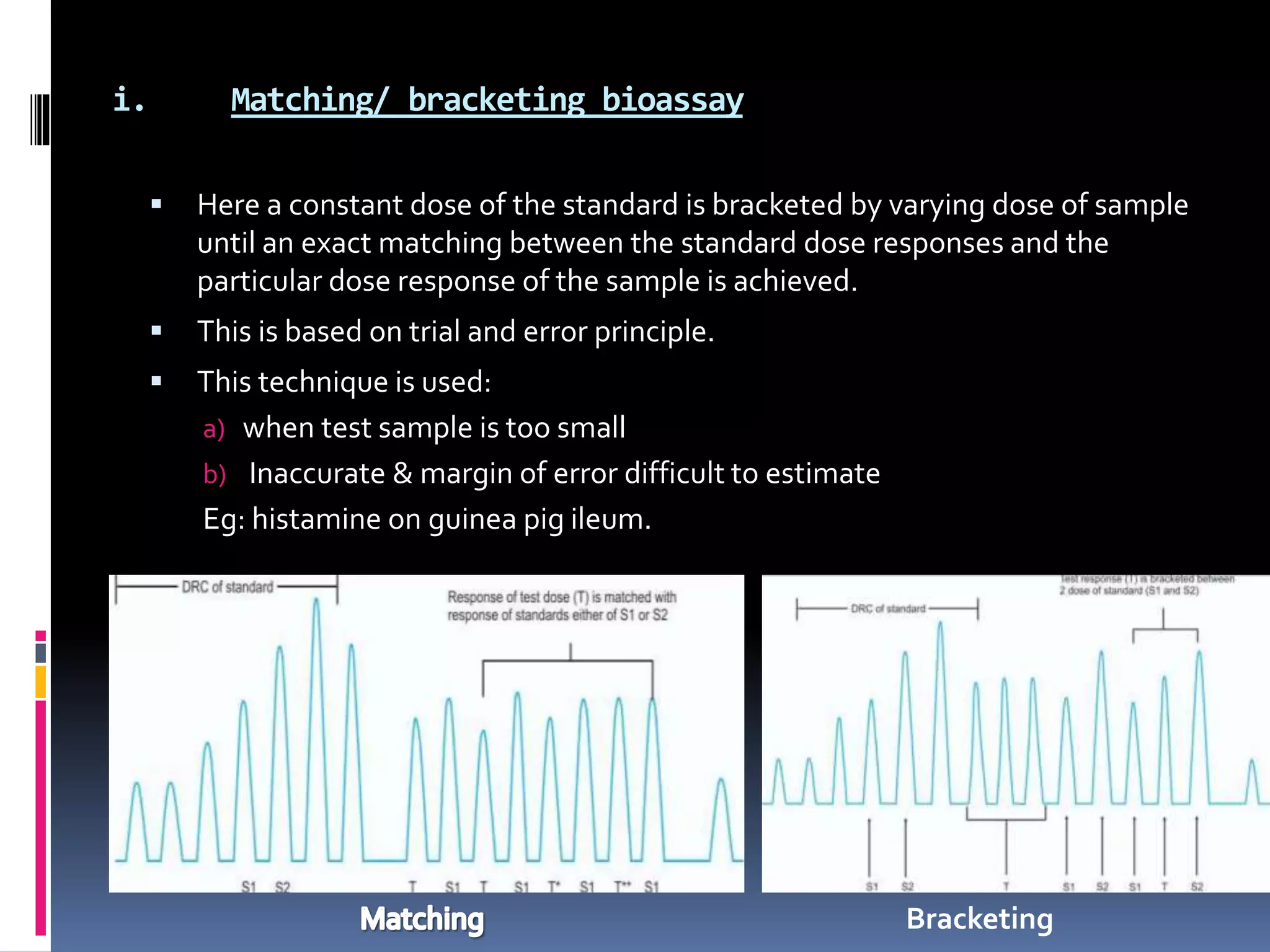
i. Matching/ bracketing bioassay
 Here a constant dose of the standard is bracketed by varying dose of sample
until an exact matching between the standard dose responses and the
particular dose response of the sample is achieved.
 This is based on trial and error principle.
 This technique is used:
a) when test sample is too small
b) Inaccurate & margin of error difficult to estimate
Eg: histamine on guinea pig ileum.
Bracketing
ii. Interpolation bioassay
 This is a simplest form of graded response assay and involves no statistical data
and any calculations. In this assay the dose response curve is first obtained from
different doses of standard solution.The concentration of unknown is then read
from the standard graph.
 Interpolation method of bioassay is less time consuming and yet reliable
compare to matching type of bioassay.
 If the linearity of curve is good, one can do very accurate estimation of the test
substance unknown sample.
Procedure
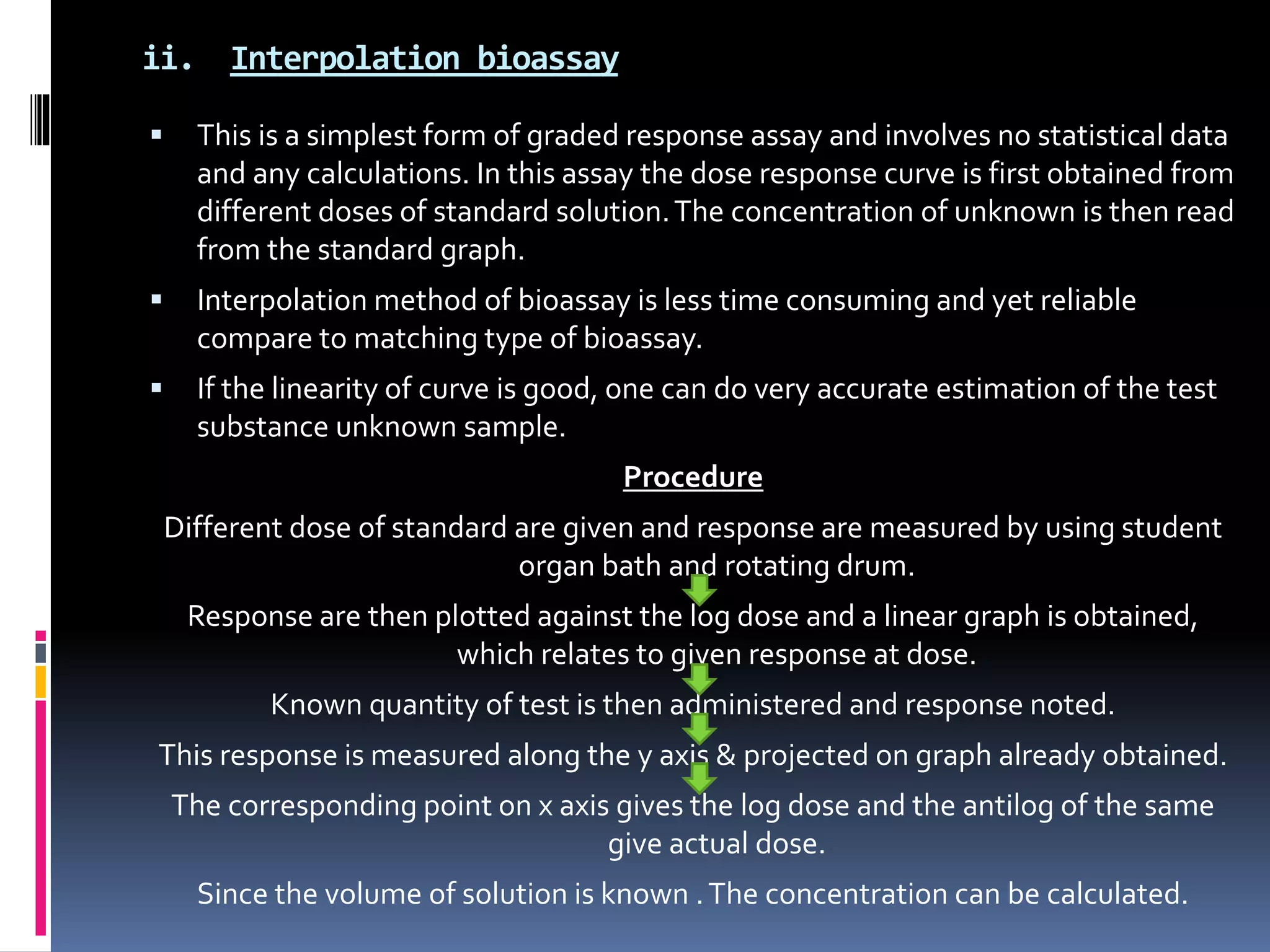
Different dose of standard are given and response are measured by using student
organ bath and rotating drum.
Response are then plotted against the log dose and a linear graph is obtained,
which relates to given response at dose.
Known quantity of test is then administered and response noted.
This response is measured along the y axis & projected on graph already obtained.
The corresponding point on x axis gives the log dose and the antilog of the same
give actual dose.
Since the volume of solution is known .The concentration can be calculated.
Concentration of test is read from standard plot of log dose curve.
iii. Multiple point bioassay
 In this method responses are taken several time and the mean of each is taken.
 The chances of error can be minimized with this method.
 Multiple point assay include:
a) 3 point bioassay
b) 4 point bioassay
c) 6 point bioassay
 The sequence of responses is followed as per the Latin square method of
randomization in order to avoid any bias.
 3 point bioassay
 In 3 point assay method 2 doses of the standard and 1 dose of the test are used.
 The mean responses are calculated and plotted against log-dose and amount of
standard producing the same response as produced by the test is determined
graphically as well as mathematically:
Conc. of Unknown =
n1=Lower Standard dose n2= Higher Standard dose t=Test dose
S1=Response of n1 S2 = Response of n2 T= Response of test (t)
Cs=Concentration of standard
CS
n
n
S
S
S
T
anti
t
n














1
2
log
1
2
1
log
1
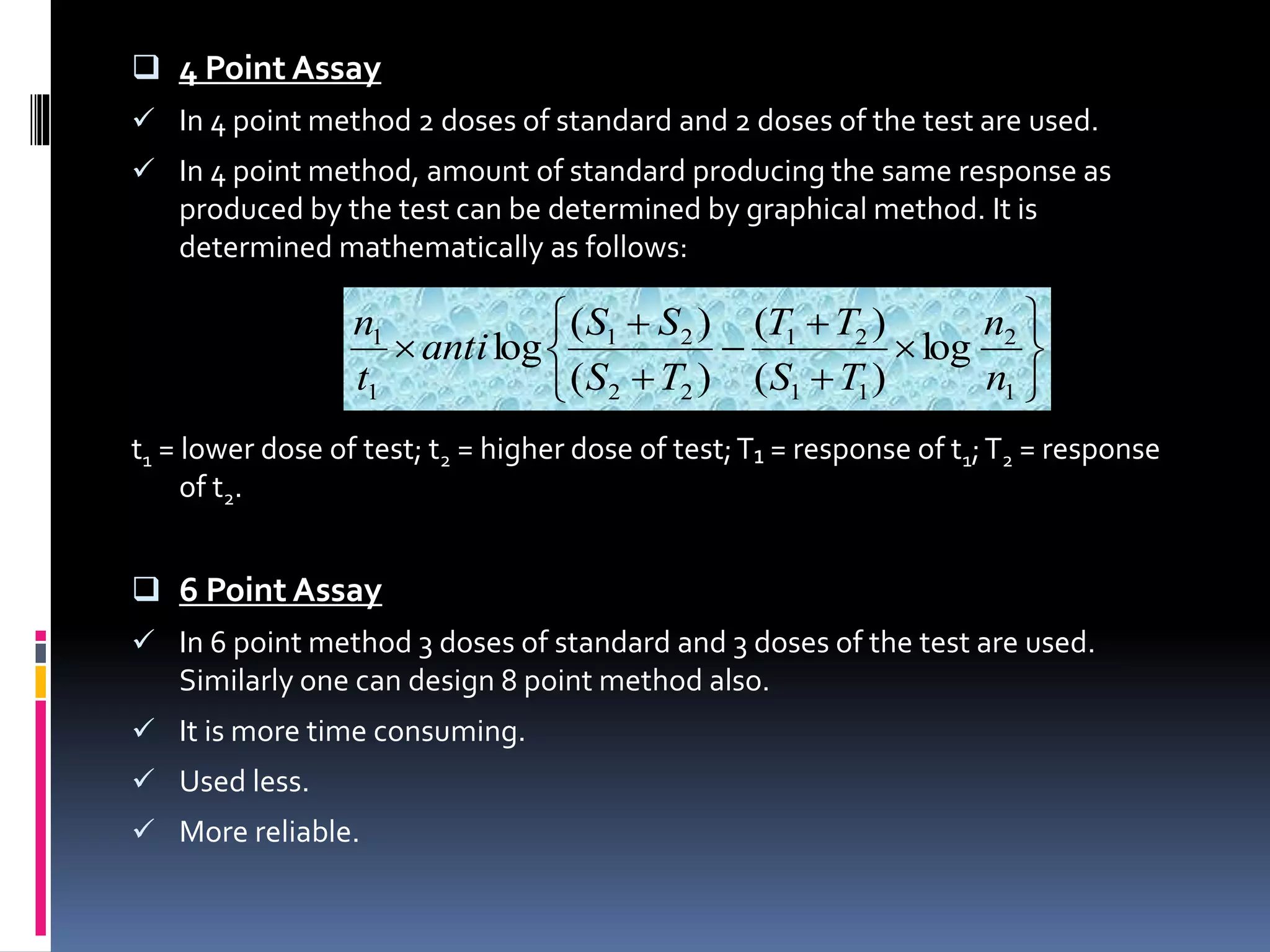
 4 Point Assay
 In 4 point method 2 doses of standard and 2 doses of the test are used.
 In 4 point method, amount of standard producing the same response as
produced by the test can be determined by graphical method. It is
determined mathematically as follows:
t1 = lower dose of test; t2 = higher dose of test;T₁ = response of t1;T2 = response
of t2.
 6 Point Assay
 In 6 point method 3 doses of standard and 3 doses of the test are used.
Similarly one can design 8 point method also.
 It is more time consuming.
 Used less.
 More reliable.













1
2
1
1
2
1
2
2
2
1
1
1
log
)
(
)
(
)
(
)
(
log
n
n
T
S
T
T
T
S
S
S
anti
t
n
iv. Cumulative dose response curve
 The concentration of drug is gradually increased in the bath fluid without
washing out the preceding doses.
 The process of increasing dose is done till the ceiling effect can be seen.
 The dose response curve is plotted.
Cumulative DRC
QUANTAL BIOASSAY
Quantal bioassay
 By quantal it meant that response is in form of all or none , i.e. either
no response or maximum response.
 The drugs producing quantal effect can be bioassayed by end point
method .
 Predetermined response is measured which is produced by
threshold effect.
 Quantal responses are population response based on all-or-nothing
response such as death.
 Example: bioassay of digitalis in cat, insulin induced hypoglycaemic
convulsion in rat.
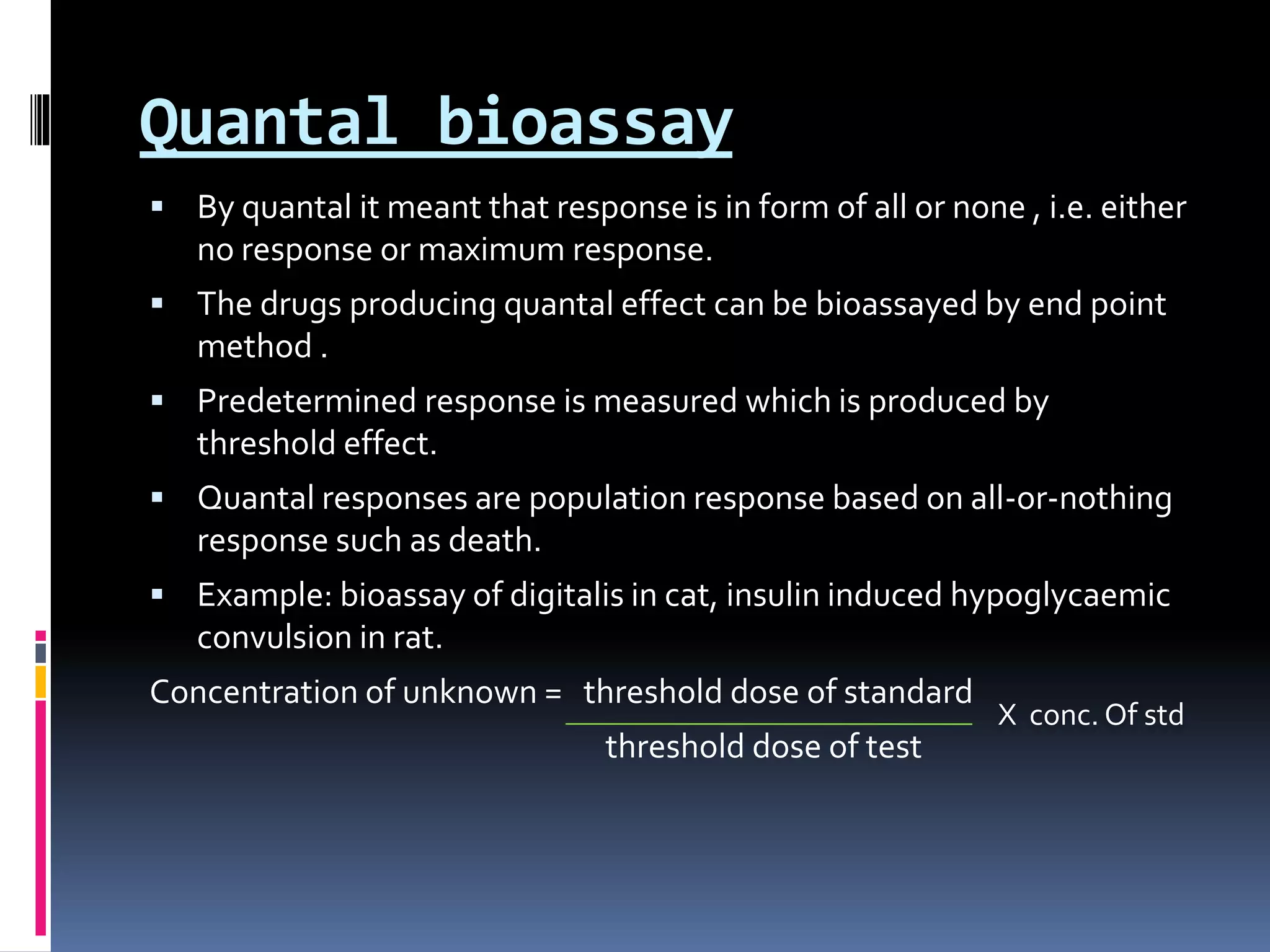
Concentration of unknown = threshold dose of standard
threshold dose of test
X conc. Of std
Errors in bioassays
 Biological errors
1. Loss of tissue activity.
2. Different species/sex/age/weight/health satus.
3. Conditions of laboratory.
4. Housing and handling of animals.
 Methodological errors
1. Lack of standardization of procedure.
2. Set up of apparatus.
3. Tissue isolation/preparation for experiment.
4. Drug preparation or dilution.
Advantages
1. Used when chemical assay is too complex.
2. To test toxicity of new drug.
3. It is simple and faster.
4. Amount of test drug available is small.
5. Does not involve complicated calculation.
Disadvantages
1. It is a time consuming process.
2. Requires skilled staff to carry bioassay.
3. Sensitivity of tissue changes with time.
4. It is less accurate.
5. Exact match of response may not be
available.
Application
 Used to measure pharmacological activity of
new drug substance.
 Estimate potency of natural drug.
 Estimation of LD50 and ED50.
 When active principle of drug is unknown.
 To standardize preparation of impure drug.
References
 Goyal RK. Principle and methods of bioassay, L. M. College Of
Pharmacy, Navrangpura,Ahmedabad. (published on 18.01.2008).
 Element of pharmacology, 15th edition by Dr. R.K. Goyal, page
no.578-582.
 Kumar Sahil. Principle and types of bioassay. Slideshare.net
(accessed on 26.12.2022)
 Renju S, Ravi. Bioassay. Slideshare.net. (accessed on 28.12.2022)
BIOASSAY PPT (DEEPRAJ SINGH RAUTELA).pptx

BIOASSAY PPT (DEEPRAJ SINGH RAUTELA).pptx

  • 1.
    PRESENTATION ON BIOASSAYAND ITS TYPES Presented by: Guided by: Deepraj Singh Rautela Dr. Saumya Das M. pharm. (pharmacology) Professor HOD pharmacology
  • 2.
    BIOASSAY  Bioassay =bio + assay, (bio = living ) (assay = to test) Assay : an assay is an investigative (analytic) procedure in laboratory for qualitatively assessing or quantitatively measuring the presence or amount or functional activity of a target entity (the analyte) which can be a drug or biochemical substance or organic sample. Bioassay : Bioassay is defined as the estimation of the potency of an active principle in a unit quantity of preparation or detection and measurement of the concentration of the substance in a preparation using biological methods (ie. observation of pharmacological effects on living tissues, microorganisms or immune cells or animal). OR Procedure to estimate, potency or nature of substance using living organism Bioassay can be done by : •In vivo : Done on intact animal. ex- bioassay of insulin using mouse. •In vitro : Done on isolated tissues, specified cells. ex- histamine in ileum of guinea pig.
  • 3.
    Principle of bioassay The basic principle of bioassay is to compare the test substance with the International Standard preparation of the same and to find out how much test substance is required to produce the same biological effect, as produced by the standard.  The standards are internationally accepted samples of drugs maintained and recommended by the Expert Committee of the Biological Standardization ofW.H.O.  In India, standard drugs are maintained in Government institutions like Central Drug Research Institute (Lucknow),Central Drug Laboratory (Calcutta) etc.  one should keep uniform experimental conditions and assure the reproducibility of the responses.
  • 4.
    Importance of bioassay Bioassay is the only method of assay if I. Active principle of drug is unknown or cannot be isolated, e.g. insulin, posterior pituitary extract etc. II. Chemical method is either not available or if available, it is too complex and insensitive or requires higher dose e.g. insulin, acetylcholine. III. Chemical composition is not known, e.g. long acting thyroid stimulants. IV. Chemical composition of drug differs but have the same pharmacological action and vice-versa, e.g. cardiac glycosides, catecholamines etc. V. Moreover, even if chemical methods are available and the results of bioassay conflict with those of the chemical assay, the bioassay is relied upon and not the chemical assay. since it is the assessment on living organism. VI. From the clinical point of view, bioassay may help in the diagnosis of various conditions, e.g. gonadotrophins for pregnancy.
  • 5.
    Types of bioassay Bioassay can be classified into following types: Graded bioassay Quantal bioassay interpolation matching/ bracketing Multiple point LD50 determination Direct end point assay Cummulative DRC
  • 6.
  • 7.
    Graded bioassay Graded responsemeans that the response is proportional to the dose and response may lie between no response and the maximum response. Graded Response Assay: In these assays, as the dose increases there is an equivalent rise in response.The potency is estimated by comparing theTest sample responses with the standard response curve. Example: Acetyl-choline producing contraction in the muscle of frog rectus abdominis.
  • 8.
    METHODOLOGY FOR GRADEDBIOASSAY 1. Checking of apparatus for proper functioning 2. Prepare Physiological Salt Solution 3. Arrange the instrument and adjust the water bath. 4. Balance the lever 5. Tissue selection 6. Surgical process and collection of required tissue. 7. Tissue attachment to the water bath 8. Relaxation time given to the tissue 9. Prepare the standard drug (serial dilution) 10. Select lowest possible measurable conc. 11. Prepare DRC for the standard drug 12. Prepare DRC for the test drug (serial dilution) 13. Select an assay method (3 point or 4 point assay) 14. Calculation
  • 9.
    i. Matching/ bracketingbioassay  Here a constant dose of the standard is bracketed by varying dose of sample until an exact matching between the standard dose responses and the particular dose response of the sample is achieved.  This is based on trial and error principle.  This technique is used: a) when test sample is too small b) Inaccurate & margin of error difficult to estimate Eg: histamine on guinea pig ileum. Bracketing
  • 10.
    ii. Interpolation bioassay This is a simplest form of graded response assay and involves no statistical data and any calculations. In this assay the dose response curve is first obtained from different doses of standard solution.The concentration of unknown is then read from the standard graph.  Interpolation method of bioassay is less time consuming and yet reliable compare to matching type of bioassay.  If the linearity of curve is good, one can do very accurate estimation of the test substance unknown sample. Procedure Different dose of standard are given and response are measured by using student organ bath and rotating drum. Response are then plotted against the log dose and a linear graph is obtained, which relates to given response at dose. Known quantity of test is then administered and response noted. This response is measured along the y axis & projected on graph already obtained. The corresponding point on x axis gives the log dose and the antilog of the same give actual dose. Since the volume of solution is known .The concentration can be calculated.
  • 11.
    Concentration of testis read from standard plot of log dose curve.
  • 12.
    iii. Multiple pointbioassay  In this method responses are taken several time and the mean of each is taken.  The chances of error can be minimized with this method.  Multiple point assay include: a) 3 point bioassay b) 4 point bioassay c) 6 point bioassay  The sequence of responses is followed as per the Latin square method of randomization in order to avoid any bias.  3 point bioassay  In 3 point assay method 2 doses of the standard and 1 dose of the test are used.  The mean responses are calculated and plotted against log-dose and amount of standard producing the same response as produced by the test is determined graphically as well as mathematically: Conc. of Unknown = n1=Lower Standard dose n2= Higher Standard dose t=Test dose S1=Response of n1 S2 = Response of n2 T= Response of test (t) Cs=Concentration of standard CS n n S S S T anti t n               1 2 log 1 2 1 log 1
  • 13.
     4 PointAssay  In 4 point method 2 doses of standard and 2 doses of the test are used.  In 4 point method, amount of standard producing the same response as produced by the test can be determined by graphical method. It is determined mathematically as follows: t1 = lower dose of test; t2 = higher dose of test;T₁ = response of t1;T2 = response of t2.  6 Point Assay  In 6 point method 3 doses of standard and 3 doses of the test are used. Similarly one can design 8 point method also.  It is more time consuming.  Used less.  More reliable.              1 2 1 1 2 1 2 2 2 1 1 1 log ) ( ) ( ) ( ) ( log n n T S T T T S S S anti t n
  • 14.
    iv. Cumulative doseresponse curve  The concentration of drug is gradually increased in the bath fluid without washing out the preceding doses.  The process of increasing dose is done till the ceiling effect can be seen.  The dose response curve is plotted. Cumulative DRC
  • 15.
  • 16.
    Quantal bioassay  Byquantal it meant that response is in form of all or none , i.e. either no response or maximum response.  The drugs producing quantal effect can be bioassayed by end point method .  Predetermined response is measured which is produced by threshold effect.  Quantal responses are population response based on all-or-nothing response such as death.  Example: bioassay of digitalis in cat, insulin induced hypoglycaemic convulsion in rat. Concentration of unknown = threshold dose of standard threshold dose of test X conc. Of std
  • 17.
    Errors in bioassays Biological errors 1. Loss of tissue activity. 2. Different species/sex/age/weight/health satus. 3. Conditions of laboratory. 4. Housing and handling of animals.  Methodological errors 1. Lack of standardization of procedure. 2. Set up of apparatus. 3. Tissue isolation/preparation for experiment. 4. Drug preparation or dilution.
  • 18.
    Advantages 1. Used whenchemical assay is too complex. 2. To test toxicity of new drug. 3. It is simple and faster. 4. Amount of test drug available is small. 5. Does not involve complicated calculation.
  • 19.
    Disadvantages 1. It isa time consuming process. 2. Requires skilled staff to carry bioassay. 3. Sensitivity of tissue changes with time. 4. It is less accurate. 5. Exact match of response may not be available.
  • 20.
    Application  Used tomeasure pharmacological activity of new drug substance.  Estimate potency of natural drug.  Estimation of LD50 and ED50.  When active principle of drug is unknown.  To standardize preparation of impure drug.
  • 21.
    References  Goyal RK.Principle and methods of bioassay, L. M. College Of Pharmacy, Navrangpura,Ahmedabad. (published on 18.01.2008).  Element of pharmacology, 15th edition by Dr. R.K. Goyal, page no.578-582.  Kumar Sahil. Principle and types of bioassay. Slideshare.net (accessed on 26.12.2022)  Renju S, Ravi. Bioassay. Slideshare.net. (accessed on 28.12.2022)