Acute Oral Toxicity – Fixed Dose
Procedure
By Prashant Shivgunde
1/12/2015PPS, UDIRT, MUHS1
Contents
1/12/2015PPS, UDIRT, MUHS2
 Introduction
 Initial considerations
 Principle of the test
 Description of the method
 Procedure
 Sighting study
 Main study
 Limit test
 Observations
 Data and reporting
INTRODUCTION
1/12/2015PPS, UDIRT, MUHS3
 OECD Guidelines – Periodically reviewed
 Guideline 420 was adopted in July 1992 as the first
alternative to the conventional acute toxicity test
 Revision was considered timely-
 Differ in harmonised LD50 cut-off values
 testing in one sex (usually females) is now considered sufficient
INTRODUCTION
1/12/2015PPS, UDIRT, MUHS4
 Traditional methods for assessing acute toxicity use death
of animals as an endpoint
 In 1984, BritishToxicology Society suggested new
approach-
 Approach avoided using death of animals as an endpoint, and
relied instead on the observation of clear signs of toxicity at
one of a series of fixed dose levels.
 Statistical properties of the Fixed Dose Procedure have been
evaluated using mathematical models in a series of studies
INTRODUCTION
1/12/2015PPS, UDIRT, MUHS5
 Found way which-
 Uses fewer animals
 Causes less Suffering
 Is reproducible
 Able to rank substances in a similar manner
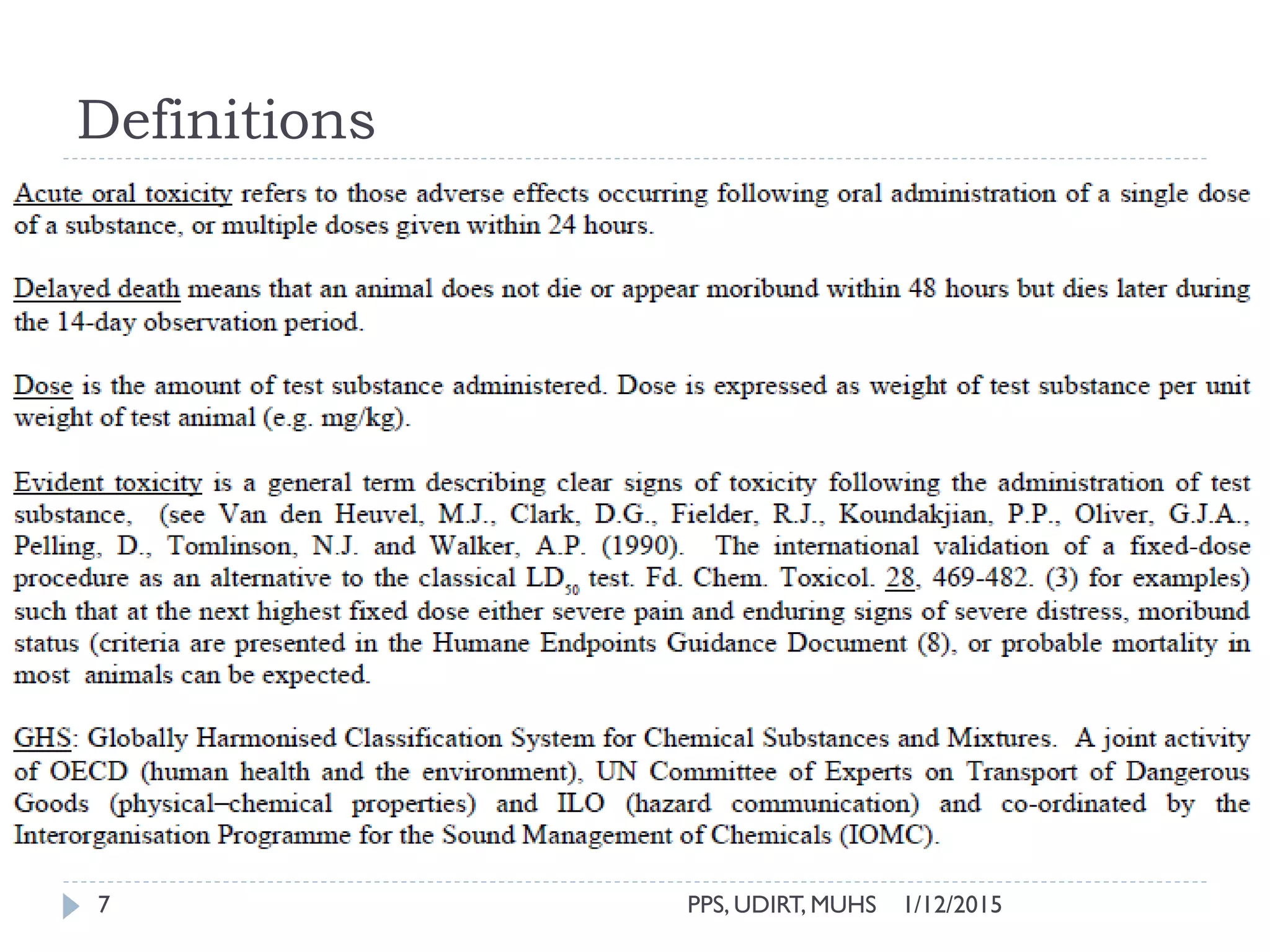
Definitions
1/12/2015PPS, UDIRT, MUHS6
Definitions
1/12/2015PPS, UDIRT, MUHS7
Definitions
1/12/2015PPS, UDIRT, MUHS8
Initial Considerations
1/12/2015PPS, UDIRT, MUHS9
 Use of only moderately toxic doses
 Doses that are known to cause marked pain and distress,
due to corrosive or severely irritant actions, need not be
administered
 Moribund animals, or animals obviously in pain or
showing signs of severe and enduring distress shall be
humanely killed (considered in the interpretation)
Initial Considerations
1/12/2015PPS, UDIRT, MUHS10
 Consider all available information on the test substance
prior to conducting the study
 Identity and chemical structure of the substance;
 Its physico-chemical properties;
 The results of any other in vitro or in vivo toxicity tests on the
substance;
 Toxicological data on structurally related substances; and the
anticipated use(s) of the substance
 Helps to rank and classify according to the Globally
Harmonised System (GHS)
PRINCIPLE OF THE TEST
1/12/2015PPS, UDIRT, MUHS11
 Groups of animals of a single sex are dosed in a stepwise
procedure using the fixed doses of 5, 50, 300 and 2000
mg/kg (exceptionally an additional fixed dose of 5000
mg/kg may be considered)
 The initial dose level is selected on the basis of a sighting
study
 Clinical signs and conditions associated with pain,
suffering, and impending death
PRINCIPLE OF THE TEST
1/12/2015PPS, UDIRT, MUHS12
 Groups of animals may be dosed at higher or lower fixed
doses,
 Depending on the presence or absence of signs of
toxicity or mortality
 Procedure continues until the
 dose causing evident toxicity or no more than one death is
identified,
 or when no effects are seen at the highest dose
 or when deaths occur at the lowest dose.
DESCRIPTION OF THE METHOD
1/12/2015PPS, UDIRT, MUHS13
Selection of animal species
1/12/2015PPS, UDIRT, MUHS14
 Rat is preferred rodent species
 Normally females
 For Males – Adequate Justification
 Healthy young adult animals of commonly used
laboratory strains should be employed
 Females should be nulliparous and non-pregnant
 At the commencement of its dosing, should be between 8
and 12 weeks old weight should fall in an interval within
+ 20 % of the mean weight
Housing and feeding conditions
1/12/2015PPS, UDIRT, MUHS15
 Temperature= 22ºC (+ 3ºC) & relative humidity should
be 50-60%
 Lighting should be artificial
 Feeding= conventional laboratory diets with an unlimited
supply of drinking water
 Group Caging (but No. should not interfere with clear
observations of each animal)
Preparation of animals
1/12/2015PPS, UDIRT, MUHS16
 Randomly selected
 Marked to permit individual identification, and
 Kept in their cages for at least 5 days prior to the start of
dosing
Preparation of doses
1/12/2015PPS, UDIRT, MUHS17
 Test substances should be administered in a constant
volume over the range of doses
 In case of a liquid end product or mixture is to be tested
– use undiluted test substance i.e. at a constant
concentration
 In either case, the maximum dose volume for
administration must not be exceeded
 In rodents maximum vol.
 1 ml/100g of B.W.
 For Aqueous solutions – 2 ml/100g of B.W.
Preparation of doses
1/12/2015PPS, UDIRT, MUHS18
 Order of administration –
 Liquid
 Suspension
 Emulsion
 Vehicles other than water?
 Preparation prior to administration
PROCEDURE
1/12/2015PPS, UDIRT, MUHS19
Administration of doses
1/12/2015PPS, UDIRT, MUHS20
 By gavage using a stomach tube or a suitable intubation
canula (unusual circumstance- fraction of doses)
 Fasted prior to dosing
 Weigh animals and administer the test substance
 Withheld food for a further 3-4 hours in rats or 1-2
hours in mice (in case of fraction of doses?)
Sighting study
1/12/2015PPS, UDIRT, MUHS21
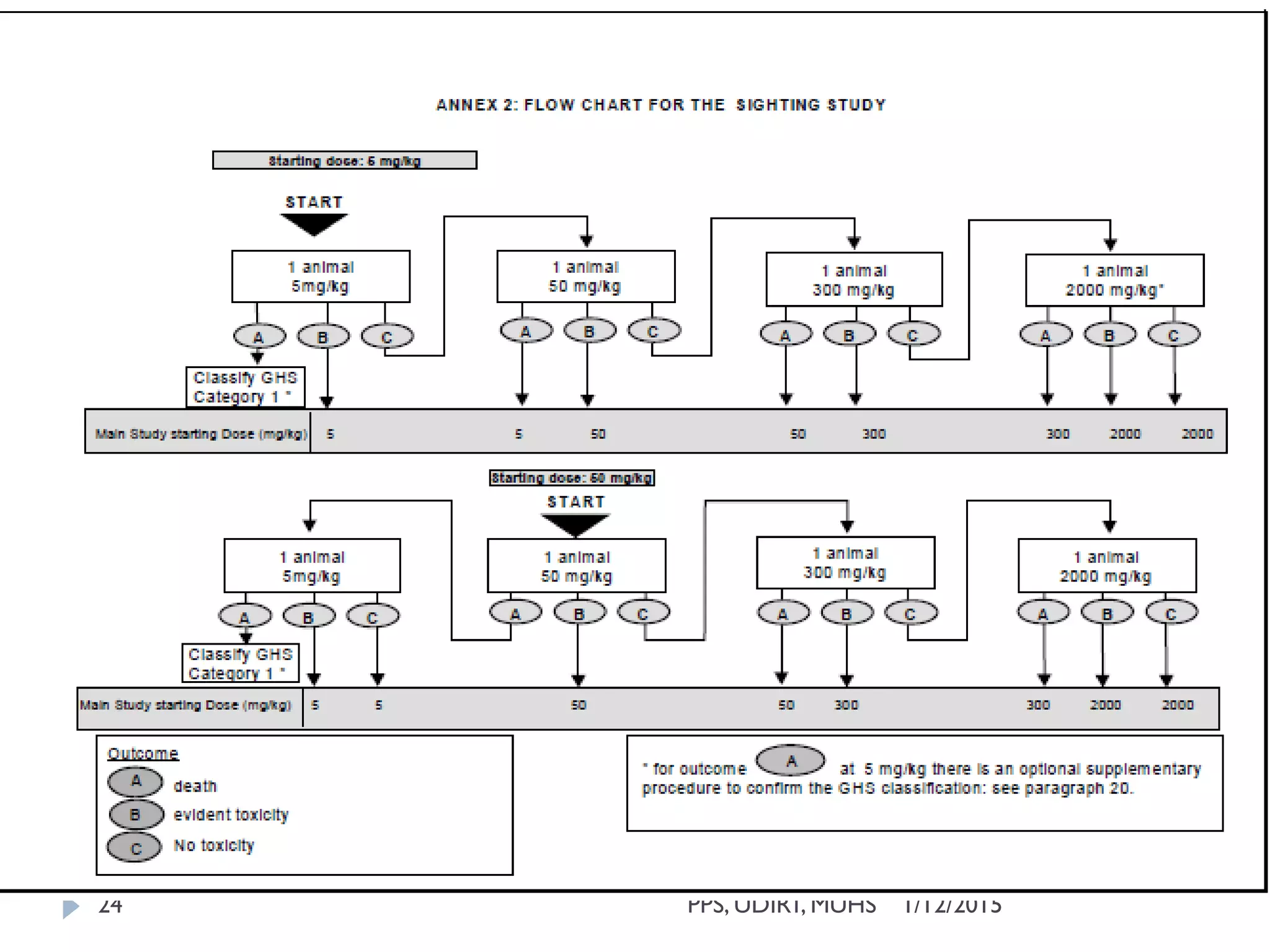
 The purpose of the sighting study is to allow selection of
the appropriate starting dose for the main study.
 Test substance is administered to single animals in a
sequential manner following the flow charts
 The starting dose for the sighting study is selected from
the fixed dose levels of 5, 50, 300 and 2000 mg/kg as a
dose expected to produce evident toxicity
Sighting study
1/12/2015PPS, UDIRT, MUHS22
 Also, evidence from in vivo and in vitro data from the same
chemical and from structurally related chemicals.
 In the absence of such information, the starting dose will
be 300 mg/kg
 At least 24 hours will be allowed between the dosing of
each animal
 Consideration of use of an additional upper fixed dose
level of 5000 mg/kg?
Sighting study
1/12/2015PPS, UDIRT, MUHS23
 In cases where an animal tested at the lowest fixed dose
level (5mg/kg) in the sighting study dies,
 the normal procedure is to terminate the study and assign the
substance to GHS Category 1
 For further confirmation use supplementary procedure
1/12/2015PPS, UDIRT, MUHS24
1/12/2015PPS, UDIRT, MUHS25
Main Study
1/12/2015PPS, UDIRT, MUHS26
Numbers of animals and dose levels
1/12/2015PPS, UDIRT, MUHS27
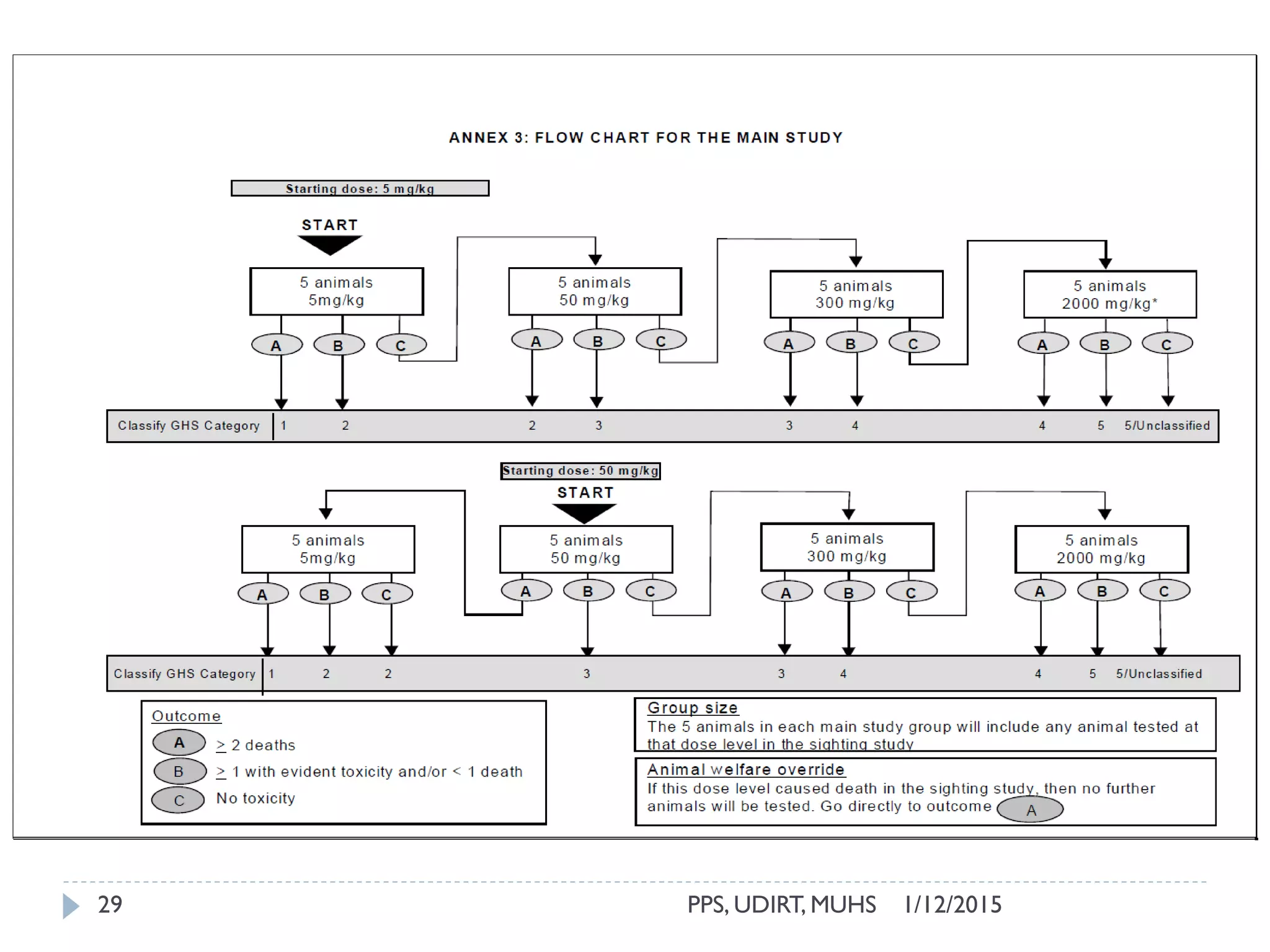
 Select dose from sighting study
 Perform study on a total of five animals of one sex at
each level including animals tested in sighting study
 Time interval between dosing at each level depends on-
 Onset, duration, and severity of toxic signs
 Treatment of animals at the next dose should be delayed
until one is confident of survival of the previously dosed
animals
Numbers of animals and dose levels
1/12/2015PPS, UDIRT, MUHS28
 To check delayedToxicity- A period of 3 or 4 days
between dosing at each dose level is recommended
 In case of inconclusive response
 Time interval may be adjusted as appropriate
 Fixed dose of 5000 mg/kg-
 procedure outlined in Annex 4
1/12/2015PPS, UDIRT, MUHS29
1/12/2015PPS, UDIRT, MUHS30
Limit test
1/12/2015PPS, UDIRT, MUHS31
 Performed when information indicating that the test
material is likely to be nontoxic
 i.e., having toxicity only above regulatory limit doses
 How information about the toxicity of the test material
can be gained?
 Using the normal procedure test will be done.
OBSERVATIONS
1/12/2015PPS, UDIRT, MUHS32
 At least once during the first 30 minutes
 Periodically during the first 24 hours, with special attention
given during the first 4 hours
 Daily thereafter, for a total of 14 days, Except?
 However, the duration of observation is not rigid
 Times at which signs of toxicity appear and disappear are
important, especially if there is a tendency for toxic signs to be
delayed
Observations
1/12/2015PPS, UDIRT, MUHS33
 Should include
 changes in skin and fur, eyes and mucous membranes, and
 respiratory, circulatory, autonomic and central nervous
systems, and somatomotor activity and behaviour pattern.
 Attention should be directed to
 tremors, convulsions, salivation, diarrhoea, lethargy, sleep and
coma
Body Weight
1/12/2015PPS, UDIRT, MUHS34
 Before Administration
 Thereafter weekly
 At end
Pathology
1/12/2015PPS, UDIRT, MUHS35
 ………………should be subjected to gross necropsy.
DATA AND REPORTING
1/12/2015PPS, UDIRT, MUHS36
DATA
1/12/2015PPS, UDIRT, MUHS37
 Should include Individual Animal
 Summarised in tabular form, Showing
 For each test group the number of animals used,
 The number of animals displaying signs of toxicity,
 The number of animals found dead during the test or
killed for humane reasons,
 Time of death of individual animals,
 A description and the time course of toxic effects and
reversibility, and
 Necropsy findings
Test report
1/12/2015PPS, UDIRT, MUHS38
 Test substance:
 Physical nature, purity, and, where relevant, physico-chemical
properties (including isomerisation); identification data, including
CAS number.
 Vehicle (if appropriate):
 justification for choice of vehicle, if other than water.
 Test animals:
 Species/Strain used;
 Microbiological status of the animals, when known;
 Number, age and sex of animals (including, where appropriate, a
rationale for use of males instead of females);
 Source, housing conditions, diet etc
Test report
1/12/2015PPS, UDIRT, MUHS39
 Test conditions:
 Details of test substance formulation, including details of the
physical form of the material administered;
 Details of the administration of the test substance including
dosing volumes and time of dosing;
 Details of food and water quality (including diet type/source,
water source);
 The rationale for the selection of the starting dose
Test report
1/12/2015PPS, UDIRT, MUHS40
 Results:
 Tabulation of response data and dose level for each animal (i.e.
animals showing signs of toxicity including mortality, nature,
severity and duration of effects);
 Tabulation of body weight and body weight changes;
 Individual weights of animals at the day of dosing, in weekly
intervals thereafter, and at time of death or sacrifice;
 Date and time of death if prior to scheduled sacrifice;
 Time course of onset of signs of toxicity and whether these
were reversible for each animal;
 Necropsy findings and histopathological findings for each
animal, if available
Test report
1/12/2015PPS, UDIRT, MUHS41
 Discussion and interpretation of results.
 Conclusions.
Exceptional Testing
Dose > 2000 mg/kg
1/12/2015PPS, UDIRT, MUHS42
Dose > 2000 mg/kg
1/12/2015PPS, UDIRT, MUHS43
 If reliable evidence is already available that indicates the
LD50 to be in the range of Category 5 values;
 Other animal studies or toxic effects in humans indicate a
concern for human health of an acute nature
 Based on mortality incidences while testing schemes of
Annex 3
 Assignment to a more hazardous category is not
warranted
Dose > 2000 mg/kg
1/12/2015PPS, UDIRT, MUHS44
 Reliable information is available indicating significant toxic
effects in humans,
 Any mortality is observed when tested up to category 4 values
by the oral route,
 Where expert judgement confirms significant clinical signs of
toxicity, when tested up to Category 4 values, except for
diarrhoea, piloerection or an ungroomed appearance,
 Where expert judgement confirms reliable information
indicating the potential for significant acute effects from the
other animal studies
TESTING AT DOSES ABOVE 2000 MG/KG
1/12/2015PPS, UDIRT, MUHS45
Sighting Study
1/12/2015PPS, UDIRT, MUHS46
 Annex 2 are extended to include a 5000 mg/kg dose level
5000 mg/kg
A
Second animal to
be tested at 2000
mg/kg
B
Selection of 5000
mg/kg as the main
study starting
dose
C
Selection of 5000
mg/kg as the main
study starting
dose
Main Study
1/12/2015PPS, UDIRT, MUHS47
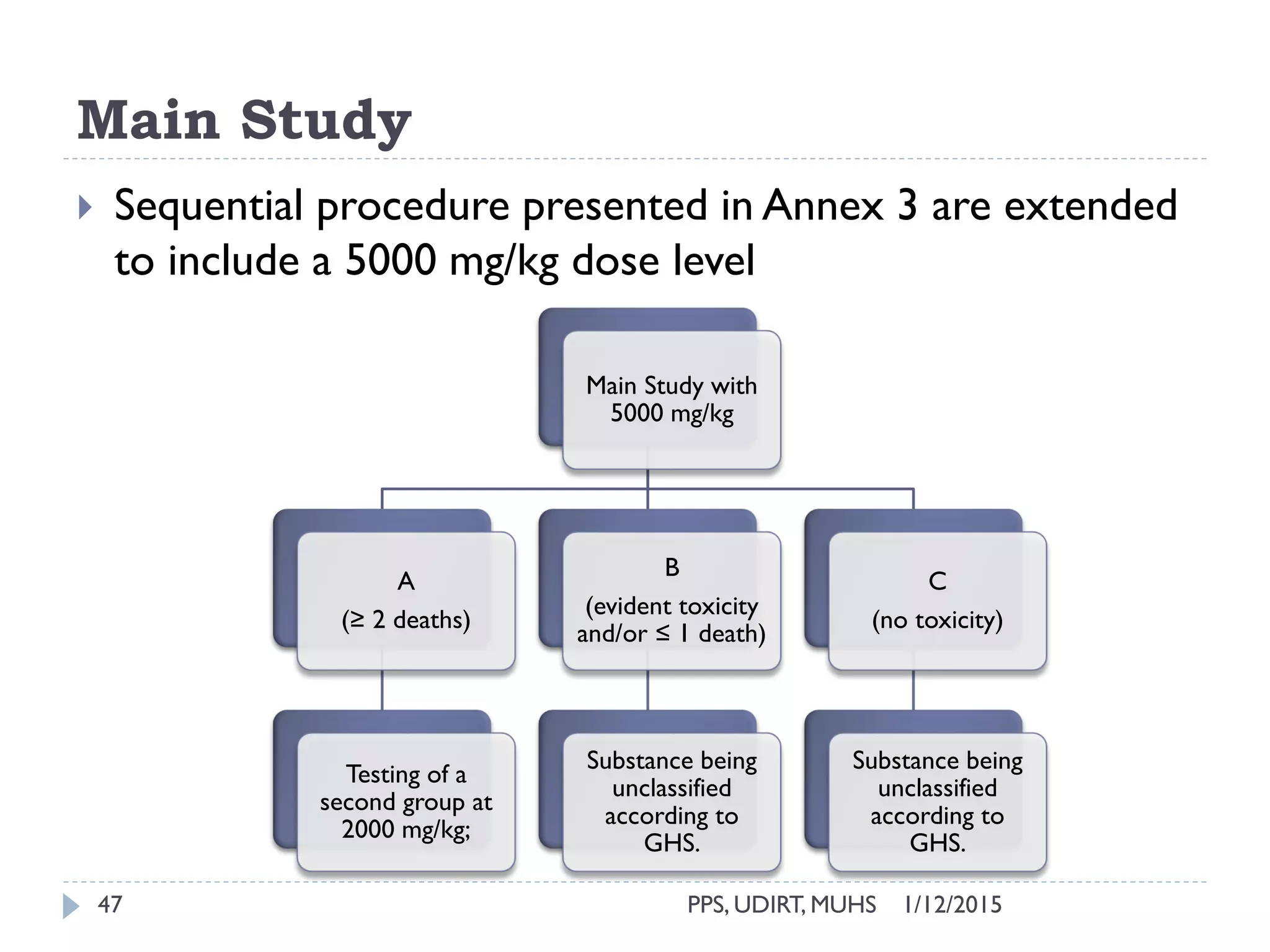
 Sequential procedure presented in Annex 3 are extended
to include a 5000 mg/kg dose level
Main Study with
5000 mg/kg
A
(≥ 2 deaths)
Testing of a
second group at
2000 mg/kg;
B
(evident toxicity
and/or ≤ 1 death)
Substance being
unclassified
according to
GHS.
C
(no toxicity)
Substance being
unclassified
according to
GHS.
Thank You
1/12/2015PPS, UDIRT, MUHS48

OECD Test Guideline 420: Acute Oral Toxicity - Fixed Dose

  • 1.
    Acute Oral Toxicity– Fixed Dose Procedure By Prashant Shivgunde 1/12/2015PPS, UDIRT, MUHS1
  • 2.
    Contents 1/12/2015PPS, UDIRT, MUHS2 Introduction  Initial considerations  Principle of the test  Description of the method  Procedure  Sighting study  Main study  Limit test  Observations  Data and reporting
  • 3.
    INTRODUCTION 1/12/2015PPS, UDIRT, MUHS3 OECD Guidelines – Periodically reviewed  Guideline 420 was adopted in July 1992 as the first alternative to the conventional acute toxicity test  Revision was considered timely-  Differ in harmonised LD50 cut-off values  testing in one sex (usually females) is now considered sufficient
  • 4.
    INTRODUCTION 1/12/2015PPS, UDIRT, MUHS4 Traditional methods for assessing acute toxicity use death of animals as an endpoint  In 1984, BritishToxicology Society suggested new approach-  Approach avoided using death of animals as an endpoint, and relied instead on the observation of clear signs of toxicity at one of a series of fixed dose levels.  Statistical properties of the Fixed Dose Procedure have been evaluated using mathematical models in a series of studies
  • 5.
    INTRODUCTION 1/12/2015PPS, UDIRT, MUHS5 Found way which-  Uses fewer animals  Causes less Suffering  Is reproducible  Able to rank substances in a similar manner
  • 6.
  • 7.
  • 8.
  • 9.
    Initial Considerations 1/12/2015PPS, UDIRT,MUHS9  Use of only moderately toxic doses  Doses that are known to cause marked pain and distress, due to corrosive or severely irritant actions, need not be administered  Moribund animals, or animals obviously in pain or showing signs of severe and enduring distress shall be humanely killed (considered in the interpretation)
  • 10.
    Initial Considerations 1/12/2015PPS, UDIRT,MUHS10  Consider all available information on the test substance prior to conducting the study  Identity and chemical structure of the substance;  Its physico-chemical properties;  The results of any other in vitro or in vivo toxicity tests on the substance;  Toxicological data on structurally related substances; and the anticipated use(s) of the substance  Helps to rank and classify according to the Globally Harmonised System (GHS)
  • 11.
    PRINCIPLE OF THETEST 1/12/2015PPS, UDIRT, MUHS11  Groups of animals of a single sex are dosed in a stepwise procedure using the fixed doses of 5, 50, 300 and 2000 mg/kg (exceptionally an additional fixed dose of 5000 mg/kg may be considered)  The initial dose level is selected on the basis of a sighting study  Clinical signs and conditions associated with pain, suffering, and impending death
  • 12.
    PRINCIPLE OF THETEST 1/12/2015PPS, UDIRT, MUHS12  Groups of animals may be dosed at higher or lower fixed doses,  Depending on the presence or absence of signs of toxicity or mortality  Procedure continues until the  dose causing evident toxicity or no more than one death is identified,  or when no effects are seen at the highest dose  or when deaths occur at the lowest dose.
  • 13.
    DESCRIPTION OF THEMETHOD 1/12/2015PPS, UDIRT, MUHS13
  • 14.
    Selection of animalspecies 1/12/2015PPS, UDIRT, MUHS14  Rat is preferred rodent species  Normally females  For Males – Adequate Justification  Healthy young adult animals of commonly used laboratory strains should be employed  Females should be nulliparous and non-pregnant  At the commencement of its dosing, should be between 8 and 12 weeks old weight should fall in an interval within + 20 % of the mean weight
  • 15.
    Housing and feedingconditions 1/12/2015PPS, UDIRT, MUHS15  Temperature= 22ºC (+ 3ºC) & relative humidity should be 50-60%  Lighting should be artificial  Feeding= conventional laboratory diets with an unlimited supply of drinking water  Group Caging (but No. should not interfere with clear observations of each animal)
  • 16.
    Preparation of animals 1/12/2015PPS,UDIRT, MUHS16  Randomly selected  Marked to permit individual identification, and  Kept in their cages for at least 5 days prior to the start of dosing
  • 17.
    Preparation of doses 1/12/2015PPS,UDIRT, MUHS17  Test substances should be administered in a constant volume over the range of doses  In case of a liquid end product or mixture is to be tested – use undiluted test substance i.e. at a constant concentration  In either case, the maximum dose volume for administration must not be exceeded  In rodents maximum vol.  1 ml/100g of B.W.  For Aqueous solutions – 2 ml/100g of B.W.
  • 18.
    Preparation of doses 1/12/2015PPS,UDIRT, MUHS18  Order of administration –  Liquid  Suspension  Emulsion  Vehicles other than water?  Preparation prior to administration
  • 19.
  • 20.
    Administration of doses 1/12/2015PPS,UDIRT, MUHS20  By gavage using a stomach tube or a suitable intubation canula (unusual circumstance- fraction of doses)  Fasted prior to dosing  Weigh animals and administer the test substance  Withheld food for a further 3-4 hours in rats or 1-2 hours in mice (in case of fraction of doses?)
  • 21.
    Sighting study 1/12/2015PPS, UDIRT,MUHS21  The purpose of the sighting study is to allow selection of the appropriate starting dose for the main study.  Test substance is administered to single animals in a sequential manner following the flow charts  The starting dose for the sighting study is selected from the fixed dose levels of 5, 50, 300 and 2000 mg/kg as a dose expected to produce evident toxicity
  • 22.
    Sighting study 1/12/2015PPS, UDIRT,MUHS22  Also, evidence from in vivo and in vitro data from the same chemical and from structurally related chemicals.  In the absence of such information, the starting dose will be 300 mg/kg  At least 24 hours will be allowed between the dosing of each animal  Consideration of use of an additional upper fixed dose level of 5000 mg/kg?
  • 23.
    Sighting study 1/12/2015PPS, UDIRT,MUHS23  In cases where an animal tested at the lowest fixed dose level (5mg/kg) in the sighting study dies,  the normal procedure is to terminate the study and assign the substance to GHS Category 1  For further confirmation use supplementary procedure
  • 24.
  • 25.
  • 26.
  • 27.
    Numbers of animalsand dose levels 1/12/2015PPS, UDIRT, MUHS27  Select dose from sighting study  Perform study on a total of five animals of one sex at each level including animals tested in sighting study  Time interval between dosing at each level depends on-  Onset, duration, and severity of toxic signs  Treatment of animals at the next dose should be delayed until one is confident of survival of the previously dosed animals
  • 28.
    Numbers of animalsand dose levels 1/12/2015PPS, UDIRT, MUHS28  To check delayedToxicity- A period of 3 or 4 days between dosing at each dose level is recommended  In case of inconclusive response  Time interval may be adjusted as appropriate  Fixed dose of 5000 mg/kg-  procedure outlined in Annex 4
  • 29.
  • 30.
  • 31.
    Limit test 1/12/2015PPS, UDIRT,MUHS31  Performed when information indicating that the test material is likely to be nontoxic  i.e., having toxicity only above regulatory limit doses  How information about the toxicity of the test material can be gained?  Using the normal procedure test will be done.
  • 32.
    OBSERVATIONS 1/12/2015PPS, UDIRT, MUHS32 At least once during the first 30 minutes  Periodically during the first 24 hours, with special attention given during the first 4 hours  Daily thereafter, for a total of 14 days, Except?  However, the duration of observation is not rigid  Times at which signs of toxicity appear and disappear are important, especially if there is a tendency for toxic signs to be delayed
  • 33.
    Observations 1/12/2015PPS, UDIRT, MUHS33 Should include  changes in skin and fur, eyes and mucous membranes, and  respiratory, circulatory, autonomic and central nervous systems, and somatomotor activity and behaviour pattern.  Attention should be directed to  tremors, convulsions, salivation, diarrhoea, lethargy, sleep and coma
  • 34.
    Body Weight 1/12/2015PPS, UDIRT,MUHS34  Before Administration  Thereafter weekly  At end
  • 35.
    Pathology 1/12/2015PPS, UDIRT, MUHS35 ………………should be subjected to gross necropsy.
  • 36.
  • 37.
    DATA 1/12/2015PPS, UDIRT, MUHS37 Should include Individual Animal  Summarised in tabular form, Showing  For each test group the number of animals used,  The number of animals displaying signs of toxicity,  The number of animals found dead during the test or killed for humane reasons,  Time of death of individual animals,  A description and the time course of toxic effects and reversibility, and  Necropsy findings
  • 38.
    Test report 1/12/2015PPS, UDIRT,MUHS38  Test substance:  Physical nature, purity, and, where relevant, physico-chemical properties (including isomerisation); identification data, including CAS number.  Vehicle (if appropriate):  justification for choice of vehicle, if other than water.  Test animals:  Species/Strain used;  Microbiological status of the animals, when known;  Number, age and sex of animals (including, where appropriate, a rationale for use of males instead of females);  Source, housing conditions, diet etc
  • 39.
    Test report 1/12/2015PPS, UDIRT,MUHS39  Test conditions:  Details of test substance formulation, including details of the physical form of the material administered;  Details of the administration of the test substance including dosing volumes and time of dosing;  Details of food and water quality (including diet type/source, water source);  The rationale for the selection of the starting dose
  • 40.
    Test report 1/12/2015PPS, UDIRT,MUHS40  Results:  Tabulation of response data and dose level for each animal (i.e. animals showing signs of toxicity including mortality, nature, severity and duration of effects);  Tabulation of body weight and body weight changes;  Individual weights of animals at the day of dosing, in weekly intervals thereafter, and at time of death or sacrifice;  Date and time of death if prior to scheduled sacrifice;  Time course of onset of signs of toxicity and whether these were reversible for each animal;  Necropsy findings and histopathological findings for each animal, if available
  • 41.
    Test report 1/12/2015PPS, UDIRT,MUHS41  Discussion and interpretation of results.  Conclusions.
  • 42.
    Exceptional Testing Dose >2000 mg/kg 1/12/2015PPS, UDIRT, MUHS42
  • 43.
    Dose > 2000mg/kg 1/12/2015PPS, UDIRT, MUHS43  If reliable evidence is already available that indicates the LD50 to be in the range of Category 5 values;  Other animal studies or toxic effects in humans indicate a concern for human health of an acute nature  Based on mortality incidences while testing schemes of Annex 3  Assignment to a more hazardous category is not warranted
  • 44.
    Dose > 2000mg/kg 1/12/2015PPS, UDIRT, MUHS44  Reliable information is available indicating significant toxic effects in humans,  Any mortality is observed when tested up to category 4 values by the oral route,  Where expert judgement confirms significant clinical signs of toxicity, when tested up to Category 4 values, except for diarrhoea, piloerection or an ungroomed appearance,  Where expert judgement confirms reliable information indicating the potential for significant acute effects from the other animal studies
  • 45.
    TESTING AT DOSESABOVE 2000 MG/KG 1/12/2015PPS, UDIRT, MUHS45
  • 46.
    Sighting Study 1/12/2015PPS, UDIRT,MUHS46  Annex 2 are extended to include a 5000 mg/kg dose level 5000 mg/kg A Second animal to be tested at 2000 mg/kg B Selection of 5000 mg/kg as the main study starting dose C Selection of 5000 mg/kg as the main study starting dose
  • 47.
    Main Study 1/12/2015PPS, UDIRT,MUHS47  Sequential procedure presented in Annex 3 are extended to include a 5000 mg/kg dose level Main Study with 5000 mg/kg A (≥ 2 deaths) Testing of a second group at 2000 mg/kg; B (evident toxicity and/or ≤ 1 death) Substance being unclassified according to GHS. C (no toxicity) Substance being unclassified according to GHS.
  • 48.