
SEMINAR ON 
Screening of 
Antipsychotic Drugs 
Dr Divya Krishnan 
Calicut medical college 
1
Contents 
• Introduction 
• Clinical features of schizophrenia 
• Pathophysiology of schizophrenia 
• Classification of antipsychotics 
• Screening methods for antipsychotics 
• Conclusion 
2
Introduction 
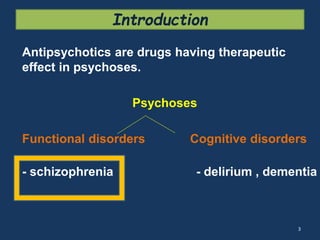
Antipsychotics are drugs having therapeutic 
effect in psychoses. 
Psychoses 
Functional disorders Cognitive disorders 
- schizophrenia - delirium , dementia 
3
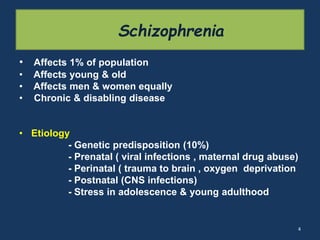
Schizophrenia 
• Affects 1% of population 
• Affects young & old 
• Affects men & women equally 
• Chronic & disabling disease 
• Etiology 
- Genetic predisposition (10%) 
- Prenatal ( viral infections , maternal drug abuse) 
- Perinatal ( trauma to brain , oxygen deprivation 
- Postnatal (CNS infections) 
- Stress in adolescence & young adulthood 
4
Clinical features 
5 
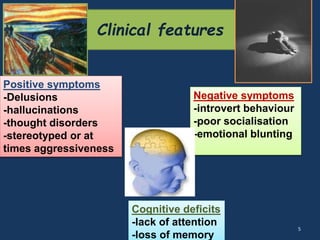
Positive symptoms 
-Delusions 
-hallucinations 
-thought disorders 
-stereotyped or at 
times aggressiveness 
Negative symptoms 
-introvert behaviour 
-poor socialisation 
-emotional blunting 
Cognitive deficits 
-lack of attention 
-loss of memory
Pathophysiology of schizophrenia 
o Neurochemical theories : 
1. Dopamine theory 
2. Serotonin theory 
3. Glutamate theory 
6
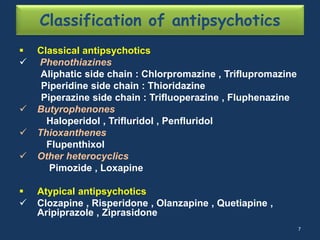
Classification of antipsychotics 
 Classical antipsychotics 
 Phenothiazines 
Aliphatic side chain : Chlorpromazine , Triflupromazine 
Piperidine side chain : Thioridazine 
Piperazine side chain : Trifluoperazine , Fluphenazine 
 Butyrophenones 
Haloperidol , Trifluridol , Penfluridol 
 Thioxanthenes 
Flupenthixol 
 Other heterocyclics 
Pimozide , Loxapine 
 Atypical antipsychotics 
 Clozapine , Risperidone , Olanzapine , Quetiapine , 
Aripiprazole , Ziprasidone 
7
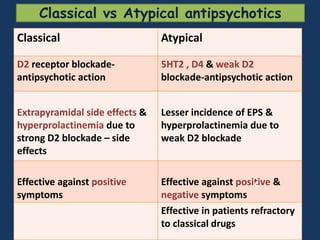
Classical vs Atypical antipsychotics 
Classical Atypical 
D2 receptor blockade-antipsychotic 
action 
5HT2 , D4 & weak D2 
blockade-antipsychotic action 
Extrapyramidal side effects & 
hyperprolactinemia due to 
strong D2 blockade – side 
effects 
Lesser incidence of EPS & 
hyperprolactinemia due to 
weak D2 blockade 
Effective against positive 
symptoms 
Effective against positive C 
& 
negative symptoms 
Effective in patients refractory 
to classical drugs 8
Screening Of antipsychotics 
9
Screening tests 
• Tests designed to exhibit a drug action 
• The specific effect of a test drug is compared to a 
reference drug already known to be clinically 
effective. 
• Screening tests are done in experimental models of 
the disease. 
10
Model 
• Experimental preparation developed to study a 
particular condition in same or different species 
• Typically models are animals that mimic a human 
condition. 
• Rats & mice behavioural models used for screening 
antipsychotics 
- small size , easy to handle 
- sensitive to small doses of drugs 
- easily trained 
- sturdy to long periods of experimentation 
- easily bred 
- cheap 
11
Characteristics of an ideal model 
• Behaviour assessed is relevant to clinical condition 
• Behaviour paradigm used to index the action of 
antipsychotics can be used in rats/mice & humans 
• Model is selective & specific for antipsychotics. 
• Model is able to differentiate between typical & atypical 
antipsychotics 
• Model doesn’t require previous pharmacological 
manipulation to manifest the behavioural index of 
antipsychotic activity 
• Model is able to shed light on the mechanism of action 
of antipsychotics 
12
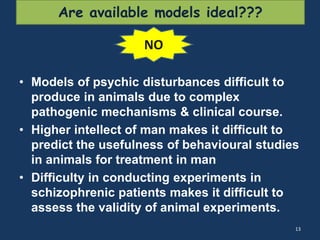
Are available models ideal??? 
• Models of psychic disturbances difficult to 
produce in animals due to complex 
pathogenic mechanisms & clinical course. 
• Higher intellect of man makes it difficult to 
predict the usefulness of behavioural studies 
in animals for treatment in man 
• Difficulty in conducting experiments in 
schizophrenic patients makes it difficult to 
assess the validity of animal experiments. 
13 
NO
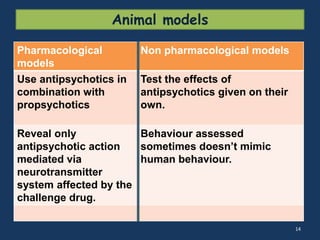
Animal models 
14 
Pharmacological 
models 
Non pharmacological models 
Use antipsychotics in 
combination with 
propsychotics 
Test the effects of 
antipsychotics given on their 
own. 
Reveal only 
antipsychotic action 
mediated via 
neurotransmitter 
system affected by the 
challenge drug. 
Behaviour assessed 
sometimes doesn’t mimic 
human behaviour.
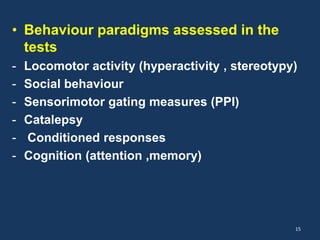
• Behaviour paradigms assessed in the 
tests 
- Locomotor activity (hyperactivity , stereotypy) 
- Social behaviour 
- Sensorimotor gating measures (PPI) 
- Catalepsy 
- Conditioned responses 
- Cognition (attention ,memory) 
15
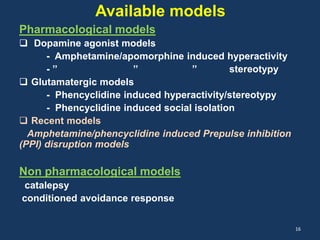
Available models 
Pharmacological models 
 Dopamine agonist models 
- Amphetamine/apomorphine induced hyperactivity 
- ’’ ’’ ’’ stereotypy 
 Glutamatergic models 
- Phencyclidine induced hyperactivity/stereotypy 
- Phencyclidine induced social isolation 
 Recent models 
Amphetamine/phencyclidine induced Prepulse inhibition 
(PPI) disruption models 
Non pharmacological models 
catalepsy 
conditioned avoidance response 
16
Inhibition of Amphetamine induced 
hyperactivity in mice/rats 
17 
• Principle 
-Amphetamine (lower doses) causes increased 
activity in rats/mice due to excessive dopamine 
activity in limbic system. 
-Typical antipsychotics can inhibit this hyperactivity 
by blocking D2 receptors. 
-Atypical antipsychotics weakly or donot inhibit 
this hyperactivity due to weak D2 blockade. 
-Hyperactivity studied with help of actophotometer.
Actophotometer 
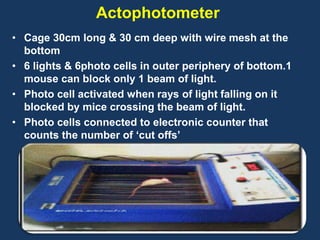
• Cage 30cm long & 30 cm deep with wire mesh at the 
bottom 
• 6 lights & 6photo cells in outer periphery of bottom.1 
mouse can block only 1 beam of light. 
• Photo cell activated when rays of light falling on it 
blocked by mice crossing the beam of light. 
• Photo cells connected to electronic counter that 
counts the number of ‘cut offs’ 
18
• Requirements 
Animal : mice/rats 
Equipments : actophotometer , syringes , 
needles 
Drugs : Saline 
Amphetamine (1.5mg/kg) 
CPZ (3mg/kg) 
Test drug (x mg/kg) 
19
Procedure 
• Weigh animals & divide into 3 groups of 3 
each 
• Inject saline into 1 group (control) , CPZ into 
2nd group & test drug into 3rd group.(i.p 
route) 
• After 30 mins ,inject Amphetamine into all 
groups.(i.p. route) 
• Place each group of animals in 
actophotometer seperately & no. of cut off 
recorded for 10 mins at the interval of 30 
mins. 
20
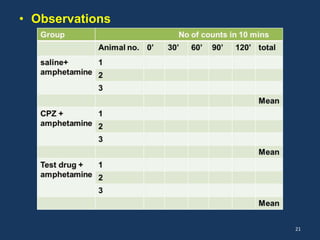
• Observations 
21
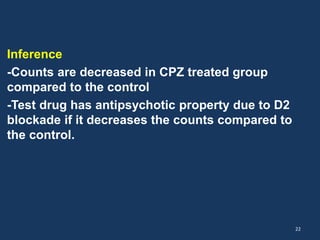
Inference 
-Counts are decreased in CPZ treated group 
compared to the control 
-Test drug has antipsychotic property due to D2 
blockade if it decreases the counts compared to 
the control. 
22
• Drawbacks 
- Hyperactivity is not seen in schizophrenic 
patients…the model doesn’t mimic human 
disease (however dopamine overactivity in 
limbic system is similar in both…hence the 
model is predictive for antipsychotic activity) 
- Screens only antipsychotic activity due to D2 
blockade . Atypical antipsychotics not 
screened in this model. 
23
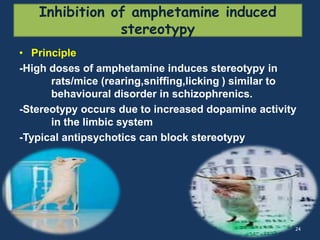
Inhibition of amphetamine induced 
stereotypy 
• Principle 
-High doses of amphetamine induces stereotypy in 
rats/mice (rearing,sniffing,licking ) similar to 
behavioural disorder in schizophrenics. 
-Stereotypy occurs due to increased dopamine activity 
in the limbic system 
-Typical antipsychotics can block stereotypy 
24
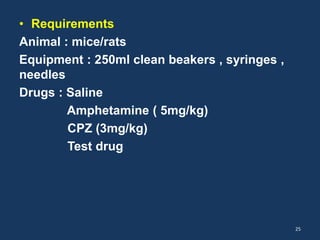
• Requirements 
Animal : mice/rats 
Equipment : 250ml clean beakers , syringes , 
needles 
Drugs : Saline 
Amphetamine ( 5mg/kg) 
CPZ (3mg/kg) 
Test drug 
25
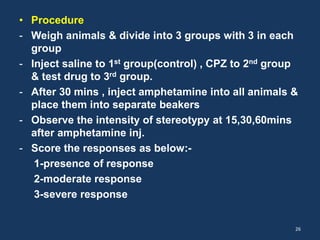
• Procedure 
- Weigh animals & divide into 3 groups with 3 in each 
group 
- Inject saline to 1st group(control) , CPZ to 2nd group 
& test drug to 3rd group. 
- After 30 mins , inject amphetamine into all animals & 
place them into separate beakers 
- Observe the intensity of stereotypy at 15,30,60mins 
after amphetamine inj. 
- Score the responses as below:- 
1-presence of response 
2-moderate response 
3-severe response 
26
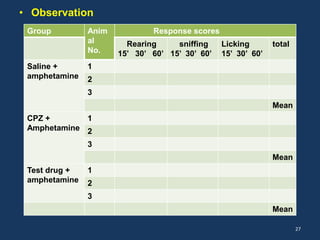
• Observation 
27 
Group Anim 
al 
No. 
Response scores 
Rearing 
15’ 30’ 60’ 
sniffing 
15’ 30’ 60’ 
Licking 
15’ 30’ 60’ 
total 
Saline + 
amphetamine 
1 
2 
3 
Mean 
CPZ + 
Amphetamine 
1 
2 
3 
Mean 
Test drug + 
amphetamine 
1 
2 
3 
Mean
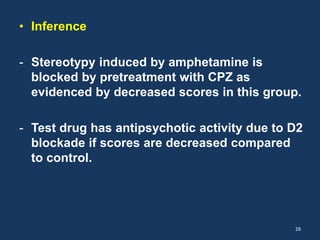
• Inference 
- Stereotypy induced by amphetamine is 
blocked by pretreatment with CPZ as 
evidenced by decreased scores in this group. 
- Test drug has antipsychotic activity due to D2 
blockade if scores are decreased compared 
to control. 
28
• Drawbacks 
- Similar to previous experiment 
- Recent evidence suggests that stereotypy is 
mediated through dopamine over activity in 
nigro-striatal pathways . Hence inhibition of 
stereotypy is more predictive of propensity to 
produce EPS than the antipsychotic activity. 
29
Dopamine agonist models 
2 major drawbacks :- 
30 
Not a model of full 
syndrome.Doesnt 
cover negative 
symptoms or 
cognitive deficits 
Doesn’t screen 
atypical 
antipsychotics
Glutamatergic models 
 Overcomes the 2 drawbacks of dopamine agonist models 
Eg :- 
- Phencyclidine induced hyperactivity/stereotypy 
- Phencyclidine induced social withdrawal 
 Phencyclidine (NMDA antagonist) produces behavioural 
syndrome (positive , negative , cognitive ) in healthy men 
and in rats that mimics schizophrenia 
 Inhibition of PCP induced positive symptoms 
(hyperactivity , stereotypy) & negative symptoms (social 
withdrawal) can be evaluated by separate tests. 
 PCP induced positive & negative symptoms are reversed 
by atypical antipsychotics—important screening models 
for atypical & novel antipychotics. 
31
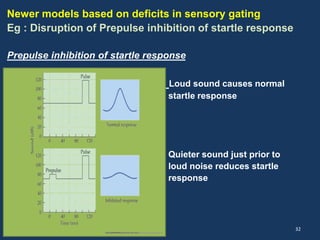
Newer models based on deficits in sensory gating 
Eg : Disruption of Prepulse inhibition of startle response 
Prepulse inhibition of startle response 
Loud sound causes normal 
startle response 
Quieter sound just prior to 
loud noise reduces startle 
response 
32
• PPI model merits 
 Reflex occurs in all mammals 
 Reflex can be measured easily 
 PPI can be disrupted by D2 agonists/NMDA antagonists 
in animals to mimic PPI disruption in schizophrenia. 
 PPI disrupted by D2 agonists reinstated by both typical & 
atypical antipsychotics but that disrupted by 
phencyclidine reinstated by atypical antipsychotics only . 
Hence PPI disruption can be important screening model 
for antipsychotics. 
33
Non pharmacological models 
• Effect on Conditioned avoidance response in 
rats 
• Study of cataleptic activity of antipsychotics 
in rats 
34
Aim 
To study the effect of antipsychotics on condition avoidance 
response 
Principle 
In classical conditioning method , animals trained to act in a 
certain way (climbing a pole) in response to a signal (buzzer) 
to avoid a noxious stimulus . 
Response to the signal is conditioned response while 
response to noxious stimulus is unconditioned response 
Antipsychotics block CR but do not block UR. 
CAR is highly predictive of antipsychotic efficacy 
35 
Conditioned avoidance response (CAR)
36 
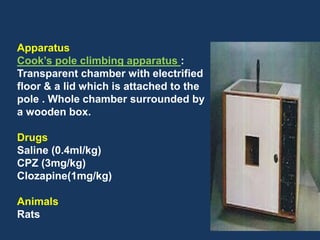
Apparatus 
Cook’s pole climbing apparatus : 
Transparent chamber with electrified 
floor & a lid which is attached to the 
pole . Whole chamber surrounded by 
a wooden box. 
Drugs 
Saline (0.4ml/kg) 
CPZ (3mg/kg) 
Clozapine(1mg/kg) 
Animals 
Rats
Procedure 
• Rats are trained to climb a pole within 30 sec 
when shock is given. 
• The shock is then preceded by a buzzer for 
15 sec .This is done for 2-3 times a day for 8 
days till rats are trained to climb the pole at 
the sound of the buzzer. 
• Trained animals are treated with the drugs 
and CR & UR observed 
37
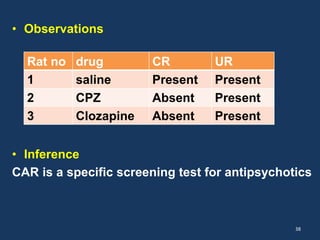
• Observations 
• Inference 
CAR is a specific screening test for antipsychotics 
38 
Rat no drug CR UR 
1 saline Present Present 
2 CPZ Absent Present 
3 Clozapine Absent Present
Study of Catalepsy in rats 
• Aim 
To study cataleptic activity of Haloperidol & 
Clozapine in rats. 
• Principle 
Catalepsy is the long term maintenance of an 
animal in abnormal posture. 
Catalepsy is used as a model to study EPS 
associated with antipsychotic usage in man. 
39
Requirements 
Animal – Rats (150-200g) 
Drugs – Haloperidol & Clozapine(1mg/kg)[dose 
at which they block amphetamine induced 
hyperactivity) 
Equipments - 3cm & 9cm high wooden blocks 
Procedure 
• Weigh & number the rats. 
• Divide the rats into 2 groups with 5 animals 
in each group. 
• Inject Haloperidol into one group & 
Clozapine into second group. 
40
• Observe severity of catalepsy at different time 
intervals in the 2 groups as follows:- 
- Stage Ι : Rat moves normally when placed on 
table (score = 0) 
- Stage II : Rat moves only when pushed (score = 
0.5) 
- Stage III : Rat placed on the table with front 
paws set on a 3cm high block fails to correct 
the posture in 10 secs.(score 0.5 for each 
paw) 
- Stage ΙV : Rat fails to remove its front paws when 
placed on a 9cm block.(score = 1 for each 
paw) 
41
• Observe the onset & severity of catalepsy at 
5,15,30,45,60,90 ,120 mins. 
Observation 
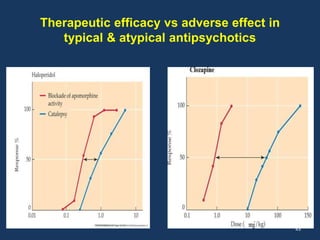
Catalepsy is observed in haloperidol group at 
the dose that inhibits amphetamine induced 
hyperactivity but is absent in clozapine group 
at the dose that inhibits hyperactivity. 
42
Therapeutic efficacy vs adverse effect in 
typical & atypical antipsychotics 
43
Future prospects 
• PCP induced models of cognitive deficits in 
rats 
- Delayed matching or non matching to sample 
indicates deficits in memory 
- Maze based strategy shift task used to depict deficits 
in behaviour flexibility , strategy shifting 
- 5 choice serial reaction time task to show deficits in 
attention 
Reversal of these deficits has been demonstrated by 
some of the atypical antipsychotics 
44
• Developmental models 
- Systemic administration of L-nitroarginine to rat 
neonates produces morphological & post pubertal 
behavioural changes similar to schizophrenia. 
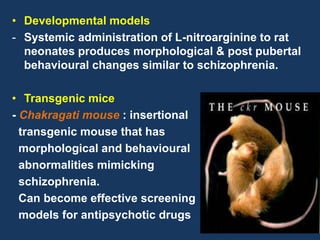
• Transgenic mice 
- Chakragati mouse : insertional 
transgenic mouse that has 
morphological and behavioural 
abnormalities mimicking 
schizophrenia. 
Can become effective screening 
models for antipsychotic drugs 
45
Conclusion 
• PCP induced disruption of PPI & inhibition of 
CAR are the 2 screening tests most widely 
used 
46
Antipsychotic screening- Dr Divya Krishnan

Antipsychotic screening- Dr Divya Krishnan

  • 1.
    SEMINAR ON Screeningof Antipsychotic Drugs Dr Divya Krishnan Calicut medical college 1
  • 2.
    Contents • Introduction • Clinical features of schizophrenia • Pathophysiology of schizophrenia • Classification of antipsychotics • Screening methods for antipsychotics • Conclusion 2
  • 3.
    Introduction Antipsychotics aredrugs having therapeutic effect in psychoses. Psychoses Functional disorders Cognitive disorders - schizophrenia - delirium , dementia 3
  • 4.
    Schizophrenia • Affects1% of population • Affects young & old • Affects men & women equally • Chronic & disabling disease • Etiology - Genetic predisposition (10%) - Prenatal ( viral infections , maternal drug abuse) - Perinatal ( trauma to brain , oxygen deprivation - Postnatal (CNS infections) - Stress in adolescence & young adulthood 4
  • 5.
    Clinical features 5 Positive symptoms -Delusions -hallucinations -thought disorders -stereotyped or at times aggressiveness Negative symptoms -introvert behaviour -poor socialisation -emotional blunting Cognitive deficits -lack of attention -loss of memory
  • 6.
    Pathophysiology of schizophrenia o Neurochemical theories : 1. Dopamine theory 2. Serotonin theory 3. Glutamate theory 6
  • 7.
    Classification of antipsychotics  Classical antipsychotics  Phenothiazines Aliphatic side chain : Chlorpromazine , Triflupromazine Piperidine side chain : Thioridazine Piperazine side chain : Trifluoperazine , Fluphenazine  Butyrophenones Haloperidol , Trifluridol , Penfluridol  Thioxanthenes Flupenthixol  Other heterocyclics Pimozide , Loxapine  Atypical antipsychotics  Clozapine , Risperidone , Olanzapine , Quetiapine , Aripiprazole , Ziprasidone 7
  • 8.
    Classical vs Atypicalantipsychotics Classical Atypical D2 receptor blockade-antipsychotic action 5HT2 , D4 & weak D2 blockade-antipsychotic action Extrapyramidal side effects & hyperprolactinemia due to strong D2 blockade – side effects Lesser incidence of EPS & hyperprolactinemia due to weak D2 blockade Effective against positive symptoms Effective against positive C & negative symptoms Effective in patients refractory to classical drugs 8
  • 9.
  • 10.
    Screening tests •Tests designed to exhibit a drug action • The specific effect of a test drug is compared to a reference drug already known to be clinically effective. • Screening tests are done in experimental models of the disease. 10
  • 11.
    Model • Experimentalpreparation developed to study a particular condition in same or different species • Typically models are animals that mimic a human condition. • Rats & mice behavioural models used for screening antipsychotics - small size , easy to handle - sensitive to small doses of drugs - easily trained - sturdy to long periods of experimentation - easily bred - cheap 11
  • 12.
    Characteristics of anideal model • Behaviour assessed is relevant to clinical condition • Behaviour paradigm used to index the action of antipsychotics can be used in rats/mice & humans • Model is selective & specific for antipsychotics. • Model is able to differentiate between typical & atypical antipsychotics • Model doesn’t require previous pharmacological manipulation to manifest the behavioural index of antipsychotic activity • Model is able to shed light on the mechanism of action of antipsychotics 12
  • 13.
    Are available modelsideal??? • Models of psychic disturbances difficult to produce in animals due to complex pathogenic mechanisms & clinical course. • Higher intellect of man makes it difficult to predict the usefulness of behavioural studies in animals for treatment in man • Difficulty in conducting experiments in schizophrenic patients makes it difficult to assess the validity of animal experiments. 13 NO
  • 14.
    Animal models 14 Pharmacological models Non pharmacological models Use antipsychotics in combination with propsychotics Test the effects of antipsychotics given on their own. Reveal only antipsychotic action mediated via neurotransmitter system affected by the challenge drug. Behaviour assessed sometimes doesn’t mimic human behaviour.
  • 15.
    • Behaviour paradigmsassessed in the tests - Locomotor activity (hyperactivity , stereotypy) - Social behaviour - Sensorimotor gating measures (PPI) - Catalepsy - Conditioned responses - Cognition (attention ,memory) 15
  • 16.
    Available models Pharmacologicalmodels  Dopamine agonist models - Amphetamine/apomorphine induced hyperactivity - ’’ ’’ ’’ stereotypy  Glutamatergic models - Phencyclidine induced hyperactivity/stereotypy - Phencyclidine induced social isolation  Recent models Amphetamine/phencyclidine induced Prepulse inhibition (PPI) disruption models Non pharmacological models catalepsy conditioned avoidance response 16
  • 17.
    Inhibition of Amphetamineinduced hyperactivity in mice/rats 17 • Principle -Amphetamine (lower doses) causes increased activity in rats/mice due to excessive dopamine activity in limbic system. -Typical antipsychotics can inhibit this hyperactivity by blocking D2 receptors. -Atypical antipsychotics weakly or donot inhibit this hyperactivity due to weak D2 blockade. -Hyperactivity studied with help of actophotometer.
  • 18.
    Actophotometer • Cage30cm long & 30 cm deep with wire mesh at the bottom • 6 lights & 6photo cells in outer periphery of bottom.1 mouse can block only 1 beam of light. • Photo cell activated when rays of light falling on it blocked by mice crossing the beam of light. • Photo cells connected to electronic counter that counts the number of ‘cut offs’ 18
  • 19.
    • Requirements Animal: mice/rats Equipments : actophotometer , syringes , needles Drugs : Saline Amphetamine (1.5mg/kg) CPZ (3mg/kg) Test drug (x mg/kg) 19
  • 20.
    Procedure • Weighanimals & divide into 3 groups of 3 each • Inject saline into 1 group (control) , CPZ into 2nd group & test drug into 3rd group.(i.p route) • After 30 mins ,inject Amphetamine into all groups.(i.p. route) • Place each group of animals in actophotometer seperately & no. of cut off recorded for 10 mins at the interval of 30 mins. 20
  • 21.
  • 22.
    Inference -Counts aredecreased in CPZ treated group compared to the control -Test drug has antipsychotic property due to D2 blockade if it decreases the counts compared to the control. 22
  • 23.
    • Drawbacks -Hyperactivity is not seen in schizophrenic patients…the model doesn’t mimic human disease (however dopamine overactivity in limbic system is similar in both…hence the model is predictive for antipsychotic activity) - Screens only antipsychotic activity due to D2 blockade . Atypical antipsychotics not screened in this model. 23
  • 24.
    Inhibition of amphetamineinduced stereotypy • Principle -High doses of amphetamine induces stereotypy in rats/mice (rearing,sniffing,licking ) similar to behavioural disorder in schizophrenics. -Stereotypy occurs due to increased dopamine activity in the limbic system -Typical antipsychotics can block stereotypy 24
  • 25.
    • Requirements Animal: mice/rats Equipment : 250ml clean beakers , syringes , needles Drugs : Saline Amphetamine ( 5mg/kg) CPZ (3mg/kg) Test drug 25
  • 26.
    • Procedure -Weigh animals & divide into 3 groups with 3 in each group - Inject saline to 1st group(control) , CPZ to 2nd group & test drug to 3rd group. - After 30 mins , inject amphetamine into all animals & place them into separate beakers - Observe the intensity of stereotypy at 15,30,60mins after amphetamine inj. - Score the responses as below:- 1-presence of response 2-moderate response 3-severe response 26
  • 27.
    • Observation 27 Group Anim al No. Response scores Rearing 15’ 30’ 60’ sniffing 15’ 30’ 60’ Licking 15’ 30’ 60’ total Saline + amphetamine 1 2 3 Mean CPZ + Amphetamine 1 2 3 Mean Test drug + amphetamine 1 2 3 Mean
  • 28.
    • Inference -Stereotypy induced by amphetamine is blocked by pretreatment with CPZ as evidenced by decreased scores in this group. - Test drug has antipsychotic activity due to D2 blockade if scores are decreased compared to control. 28
  • 29.
    • Drawbacks -Similar to previous experiment - Recent evidence suggests that stereotypy is mediated through dopamine over activity in nigro-striatal pathways . Hence inhibition of stereotypy is more predictive of propensity to produce EPS than the antipsychotic activity. 29
  • 30.
    Dopamine agonist models 2 major drawbacks :- 30 Not a model of full syndrome.Doesnt cover negative symptoms or cognitive deficits Doesn’t screen atypical antipsychotics
  • 31.
    Glutamatergic models Overcomes the 2 drawbacks of dopamine agonist models Eg :- - Phencyclidine induced hyperactivity/stereotypy - Phencyclidine induced social withdrawal  Phencyclidine (NMDA antagonist) produces behavioural syndrome (positive , negative , cognitive ) in healthy men and in rats that mimics schizophrenia  Inhibition of PCP induced positive symptoms (hyperactivity , stereotypy) & negative symptoms (social withdrawal) can be evaluated by separate tests.  PCP induced positive & negative symptoms are reversed by atypical antipsychotics—important screening models for atypical & novel antipychotics. 31
  • 32.
    Newer models basedon deficits in sensory gating Eg : Disruption of Prepulse inhibition of startle response Prepulse inhibition of startle response Loud sound causes normal startle response Quieter sound just prior to loud noise reduces startle response 32
  • 33.
    • PPI modelmerits  Reflex occurs in all mammals  Reflex can be measured easily  PPI can be disrupted by D2 agonists/NMDA antagonists in animals to mimic PPI disruption in schizophrenia.  PPI disrupted by D2 agonists reinstated by both typical & atypical antipsychotics but that disrupted by phencyclidine reinstated by atypical antipsychotics only . Hence PPI disruption can be important screening model for antipsychotics. 33
  • 34.
    Non pharmacological models • Effect on Conditioned avoidance response in rats • Study of cataleptic activity of antipsychotics in rats 34
  • 35.
    Aim To studythe effect of antipsychotics on condition avoidance response Principle In classical conditioning method , animals trained to act in a certain way (climbing a pole) in response to a signal (buzzer) to avoid a noxious stimulus . Response to the signal is conditioned response while response to noxious stimulus is unconditioned response Antipsychotics block CR but do not block UR. CAR is highly predictive of antipsychotic efficacy 35 Conditioned avoidance response (CAR)
  • 36.
    36 Apparatus Cook’spole climbing apparatus : Transparent chamber with electrified floor & a lid which is attached to the pole . Whole chamber surrounded by a wooden box. Drugs Saline (0.4ml/kg) CPZ (3mg/kg) Clozapine(1mg/kg) Animals Rats
  • 37.
    Procedure • Ratsare trained to climb a pole within 30 sec when shock is given. • The shock is then preceded by a buzzer for 15 sec .This is done for 2-3 times a day for 8 days till rats are trained to climb the pole at the sound of the buzzer. • Trained animals are treated with the drugs and CR & UR observed 37
  • 38.
    • Observations •Inference CAR is a specific screening test for antipsychotics 38 Rat no drug CR UR 1 saline Present Present 2 CPZ Absent Present 3 Clozapine Absent Present
  • 39.
    Study of Catalepsyin rats • Aim To study cataleptic activity of Haloperidol & Clozapine in rats. • Principle Catalepsy is the long term maintenance of an animal in abnormal posture. Catalepsy is used as a model to study EPS associated with antipsychotic usage in man. 39
  • 40.
    Requirements Animal –Rats (150-200g) Drugs – Haloperidol & Clozapine(1mg/kg)[dose at which they block amphetamine induced hyperactivity) Equipments - 3cm & 9cm high wooden blocks Procedure • Weigh & number the rats. • Divide the rats into 2 groups with 5 animals in each group. • Inject Haloperidol into one group & Clozapine into second group. 40
  • 41.
    • Observe severityof catalepsy at different time intervals in the 2 groups as follows:- - Stage Ι : Rat moves normally when placed on table (score = 0) - Stage II : Rat moves only when pushed (score = 0.5) - Stage III : Rat placed on the table with front paws set on a 3cm high block fails to correct the posture in 10 secs.(score 0.5 for each paw) - Stage ΙV : Rat fails to remove its front paws when placed on a 9cm block.(score = 1 for each paw) 41
  • 42.
    • Observe theonset & severity of catalepsy at 5,15,30,45,60,90 ,120 mins. Observation Catalepsy is observed in haloperidol group at the dose that inhibits amphetamine induced hyperactivity but is absent in clozapine group at the dose that inhibits hyperactivity. 42
  • 43.
    Therapeutic efficacy vsadverse effect in typical & atypical antipsychotics 43
  • 44.
    Future prospects •PCP induced models of cognitive deficits in rats - Delayed matching or non matching to sample indicates deficits in memory - Maze based strategy shift task used to depict deficits in behaviour flexibility , strategy shifting - 5 choice serial reaction time task to show deficits in attention Reversal of these deficits has been demonstrated by some of the atypical antipsychotics 44
  • 45.
    • Developmental models - Systemic administration of L-nitroarginine to rat neonates produces morphological & post pubertal behavioural changes similar to schizophrenia. • Transgenic mice - Chakragati mouse : insertional transgenic mouse that has morphological and behavioural abnormalities mimicking schizophrenia. Can become effective screening models for antipsychotic drugs 45
  • 46.
    Conclusion • PCPinduced disruption of PPI & inhibition of CAR are the 2 screening tests most widely used 46