EXPERIMENT NO: 03
AIM : To estimate unknown concentration of
acetylcholine solution by bracketing bioassays
using hen’s ileum.
Presented by:
Prof. Mirza Anwar Baig
Dept of Pharmcaology
AIKTC, School of Pharmacy, New Panvel
REQUIREMENTS:
1. Basal tension – 0.5 gm
2. Extra load- 1 gm
3. Animal – Hen’s ileum tissue
4. Drug – Acetylcholine stock solution (10 μg/ml) & test solution.
5. Physiological solution – Tyrode solution
6. Contact time – 90sec
7. Magnification – 5-7 times.
PRINCIPLE:-
o Matching & bracketing method is very useful if the amount of
material is small and if the sensitivity of the tissue is not
steady.
o The results of the assay do not depend on the actual
measurement of response.
o It is decided whether a particular concentration of test
solution is greater or smaller than that produced by the dose
of the standard
Bioassay by Bracketing Method
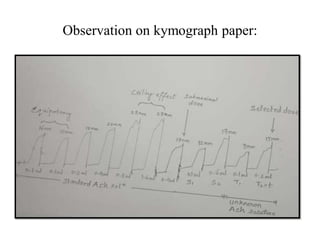
 Performed by selecting two standard doses, which will give a close
bracket on either side of the response produced by the unknown.
 The working dose of standard is first determined in the sensitive part
of dose-response curve, that is, a dose that will approximately
produce 50% of the maximal concentration.
 The dose of the standard drug is kept constant throughout the
experiment, in order to have some idea about the change in the
sensitivity of tissue with time.
 The standard drug is added at fixed intervals but alternating with the
test so that each response produced by a dose of test substance is
bracketed by responses produced by the dose of standard.
 Close bracketing gives more accurate results.
Observation on kymograph paper:
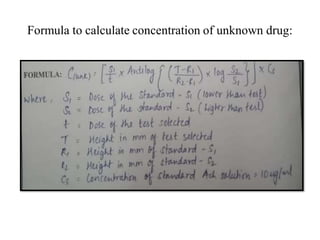
Formula to calculate concentration of unknown drug:
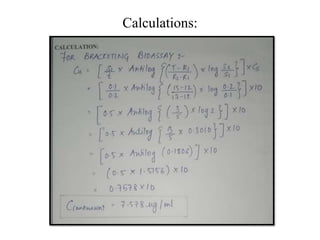
Calculations:
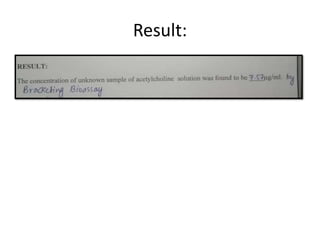
Result:
References:
1. Kulkarni S. K. Handbook of Experimental
Pharmacology, Vallabh Prakashan, New Delhi.
2. Ghosh M.N. Fundamentals of Experimental
Pharmacology Hilton & Company, Kolkata
Thank You

Expt 3 Bracketing bioassay

  • 1.
    EXPERIMENT NO: 03 AIM: To estimate unknown concentration of acetylcholine solution by bracketing bioassays using hen’s ileum. Presented by: Prof. Mirza Anwar Baig Dept of Pharmcaology AIKTC, School of Pharmacy, New Panvel
  • 2.
    REQUIREMENTS: 1. Basal tension– 0.5 gm 2. Extra load- 1 gm 3. Animal – Hen’s ileum tissue 4. Drug – Acetylcholine stock solution (10 μg/ml) & test solution. 5. Physiological solution – Tyrode solution 6. Contact time – 90sec 7. Magnification – 5-7 times.
  • 3.
    PRINCIPLE:- o Matching &bracketing method is very useful if the amount of material is small and if the sensitivity of the tissue is not steady. o The results of the assay do not depend on the actual measurement of response. o It is decided whether a particular concentration of test solution is greater or smaller than that produced by the dose of the standard
  • 4.
    Bioassay by BracketingMethod  Performed by selecting two standard doses, which will give a close bracket on either side of the response produced by the unknown.  The working dose of standard is first determined in the sensitive part of dose-response curve, that is, a dose that will approximately produce 50% of the maximal concentration.  The dose of the standard drug is kept constant throughout the experiment, in order to have some idea about the change in the sensitivity of tissue with time.  The standard drug is added at fixed intervals but alternating with the test so that each response produced by a dose of test substance is bracketed by responses produced by the dose of standard.  Close bracketing gives more accurate results.
  • 5.
  • 6.
    Formula to calculateconcentration of unknown drug:
  • 7.
  • 8.
  • 9.
    References: 1. Kulkarni S.K. Handbook of Experimental Pharmacology, Vallabh Prakashan, New Delhi. 2. Ghosh M.N. Fundamentals of Experimental Pharmacology Hilton & Company, Kolkata
  • 10.