Principles and
Types of Bioassay
DR. SAHIL KUMAR
Outline
Introduction
Indications of Bioassay
Principles of Bioassay
Classification of Bioassay: Graded & Quantal
Bioassay of antagonist
Advantages and Disadvantages of Bioassay
Error in Bioassay
Human Tissue Bioassay
Conclusion
INTRODUCTION
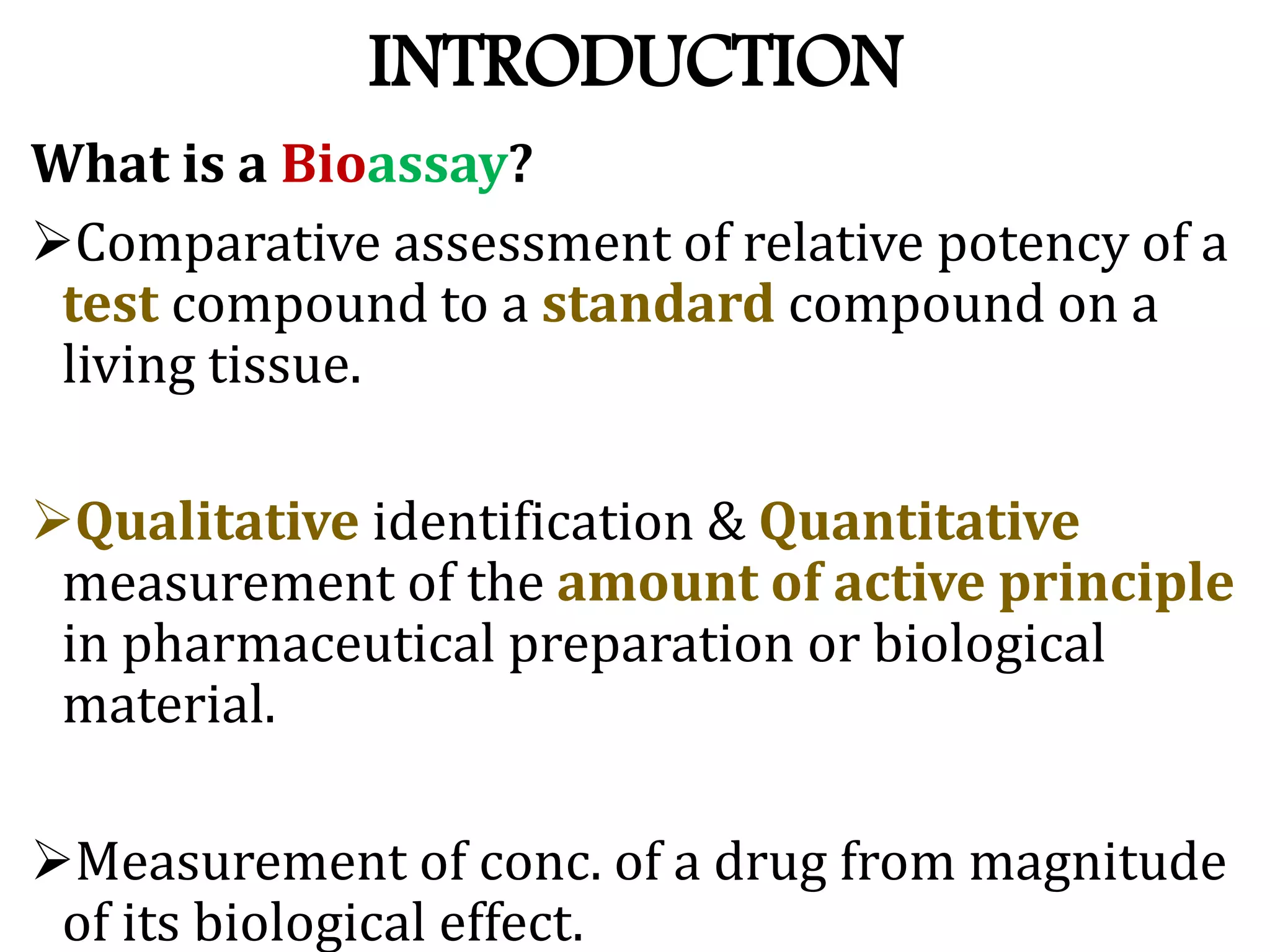
What is a Bioassay?
Comparative assessment of relative potency of a
test compound to a standard compound on a
living tissue.
Qualitative identification & Quantitative
measurement of the amount of active principle
in pharmaceutical preparation or biological
material.
Measurement of conc. of a drug from magnitude
of its biological effect.
Is Bio-standardization same as Bioassay?
Historical aspect: Paul Ehrlich –
Bio-standardization of Diphtheria antitoxin.
INTRODUCTION
INDICATIONS OF BIOASSAY
Active principle unknown.
Active principle cannot be isolated.
To study biological response of new drug.
To ensure purity & potency.
If chemical assay not available/ complex/
insensitive to low doses.
To estimate concentration of endogenous
mediators.
PRINCIPLES OF BIOASSAY
Compare potency of unknown substance
with standard (including assessment of
errors).
Standard & test sample should have same
pharmacological effect & mode of action.
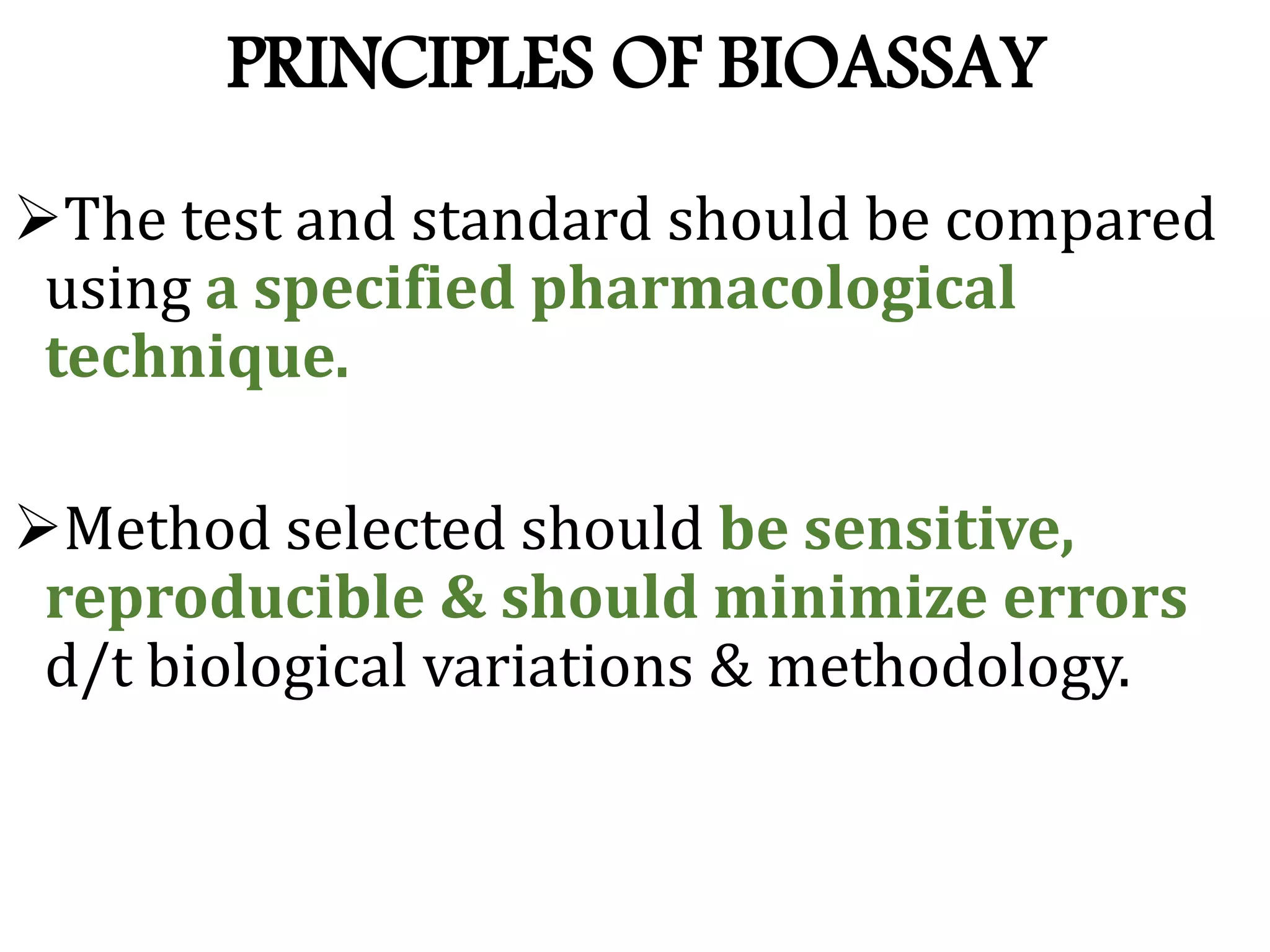
The test and standard should be compared
using a specified pharmacological
technique.
Method selected should be sensitive,
reproducible & should minimize errors
d/t biological variations & methodology.
PRINCIPLES OF BIOASSAY
TYPES OF BIOASSAY
Quantal
Direct end
point assay
(DEPA)
LD50
determination
Graded
Matching
Bracketing
Interpolation
Multiple point
8
GRADED BIOASSAY
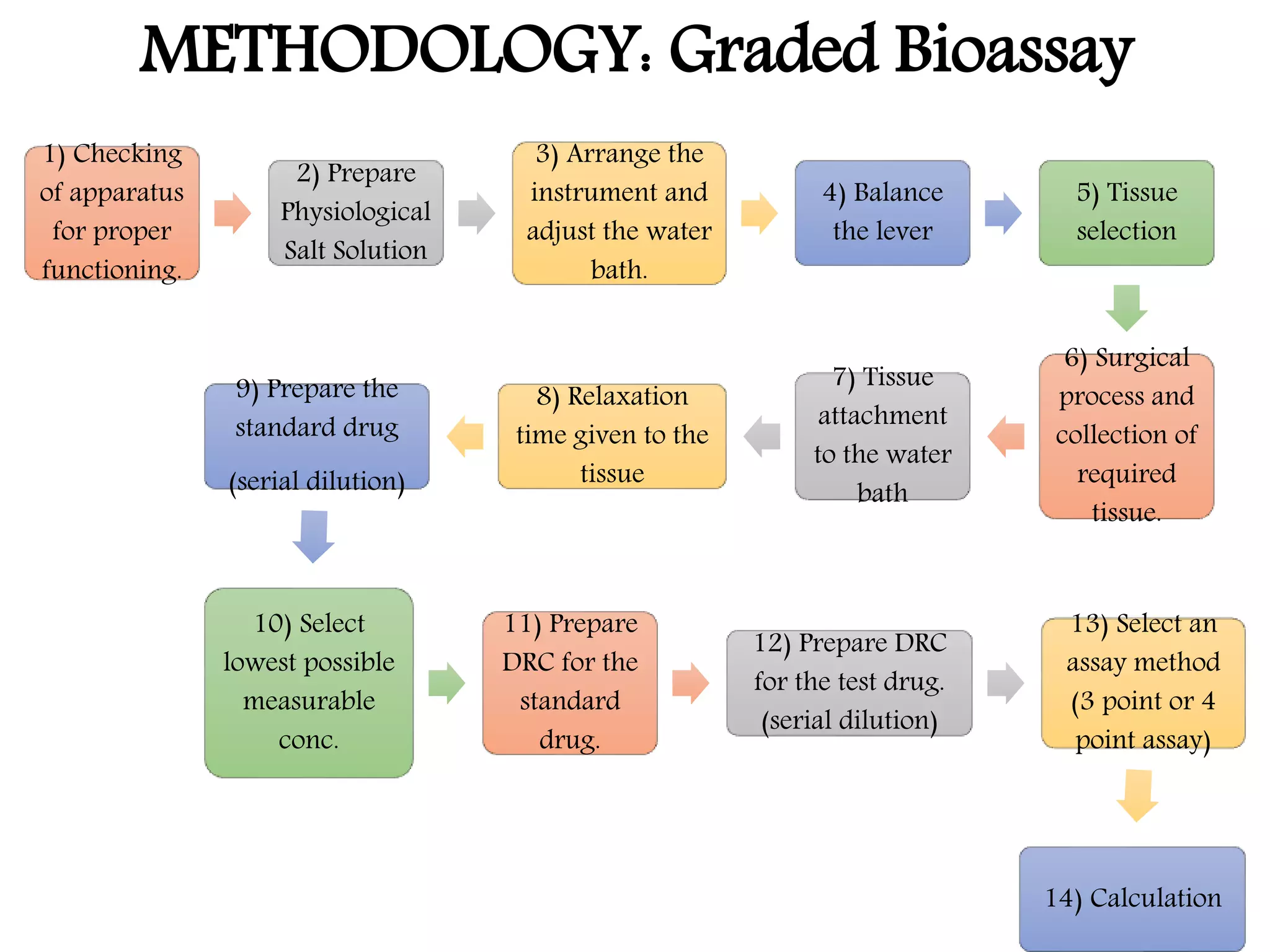
METHODOLOGY: Graded Bioassay
1) Checking
of apparatus
for proper
functioning.
2) Prepare
Physiological
Salt Solution
3) Arrange the
instrument and
adjust the water
bath.
4) Balance
the lever
5) Tissue
selection
6) Surgical
process and
collection of
required
tissue.
7) Tissue
attachment
to the water
bath
8) Relaxation
time given to the
tissue
9) Prepare the
standard drug
(serial dilution)
10) Select
lowest possible
measurable
conc.
11) Prepare
DRC for the
standard
drug.
12) Prepare DRC
for the test drug.
(serial dilution)
13) Select an
assay method
(3 point or 4
point assay)
14) Calculation
Graded Bioassay
Intermittent dose
method
Cumulative dose
method
0.2ml
0.4ml
0.8ml
1.6ml
3.2ml
11
Matching Assay
12
•Adv: Test DRC not reqd., small vol., fast.
•Disadv: Trial & Error method, poor precision.
13
Bracketing Assay
Interpolation Assay
14
Conc. of unknown is read from a standard
plot of a log dose response curve.
Three Point Assay
15
S1 S2
T
S2
T S1
T S1 S2
Three Point Assay
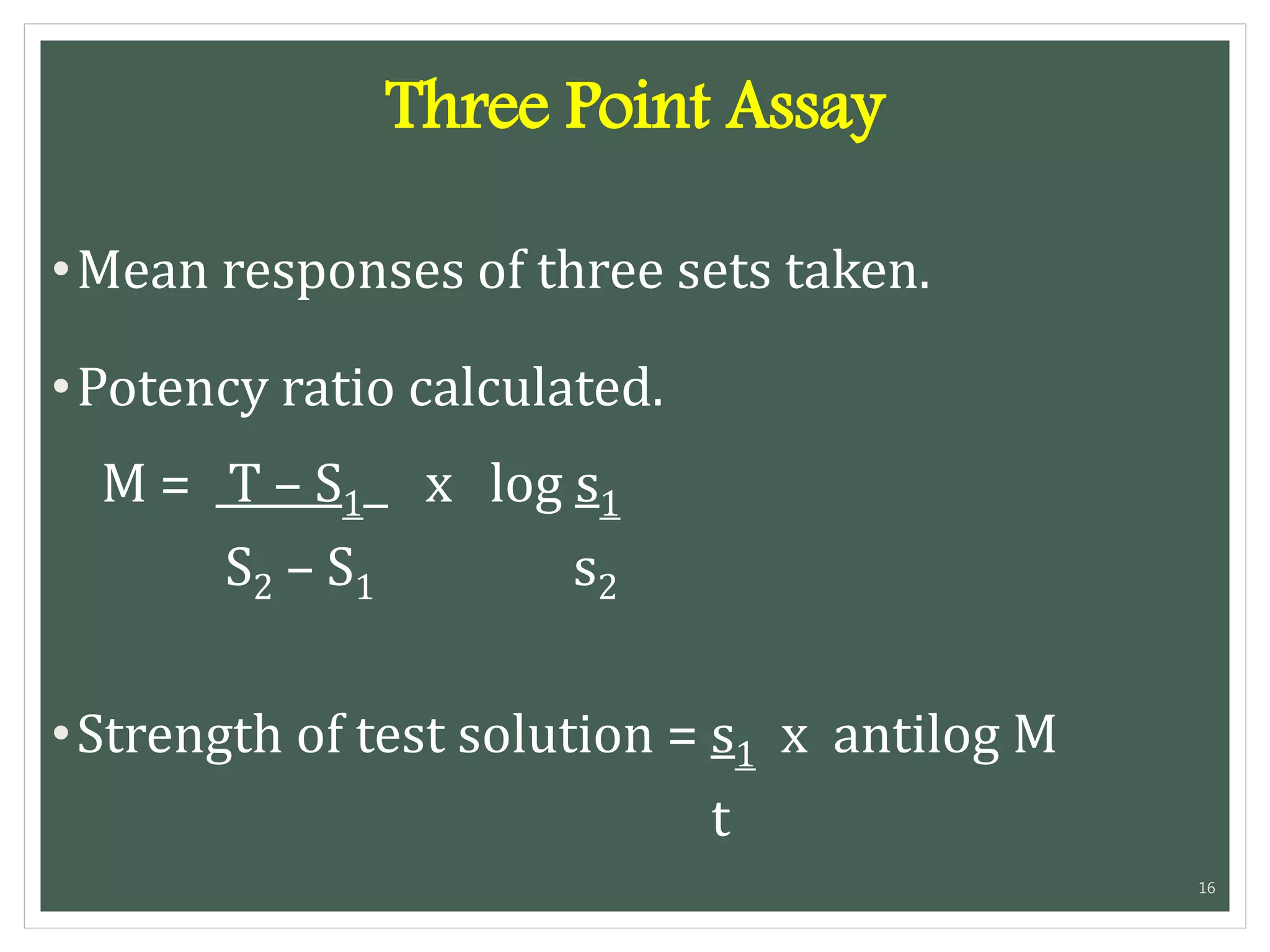
•Mean responses of three sets taken.
•Potency ratio calculated.
M = T – S1 x log s1
S2 – S1 s2
•Strength of test solution = s1 x antilog M
t
16
Four Point Assay
17
S1 S2
T1 T2
S2
T1 T2 S1
T1 T2 S1 S2
T2 S1 S2
T1
18
Four Point Assay
19
M = [T1 – S1 + T2 - S2] x log s2
S2 – S1 + T2 - T1 s1
T (concentration) = s1 x antilog M
t1
Six Point & Eight Point Assay
Multiple point assays:
•Adv: Reduced error, reduced variability.
•Disadv: Lengthy, Large amount of test
sample required.
20
QUANTAL BIOASSAY
22
•Threshold dose producing a required
response is measured on each animal.
•Eg. Bioassay of Digitalis in Cats,
Hypoglycemic convulsions in mice.
•Threshold dose = Period of infusion X Rate.
Direct End-Point Assay
LD50 Determination:
Graphical & Arithmetic methods
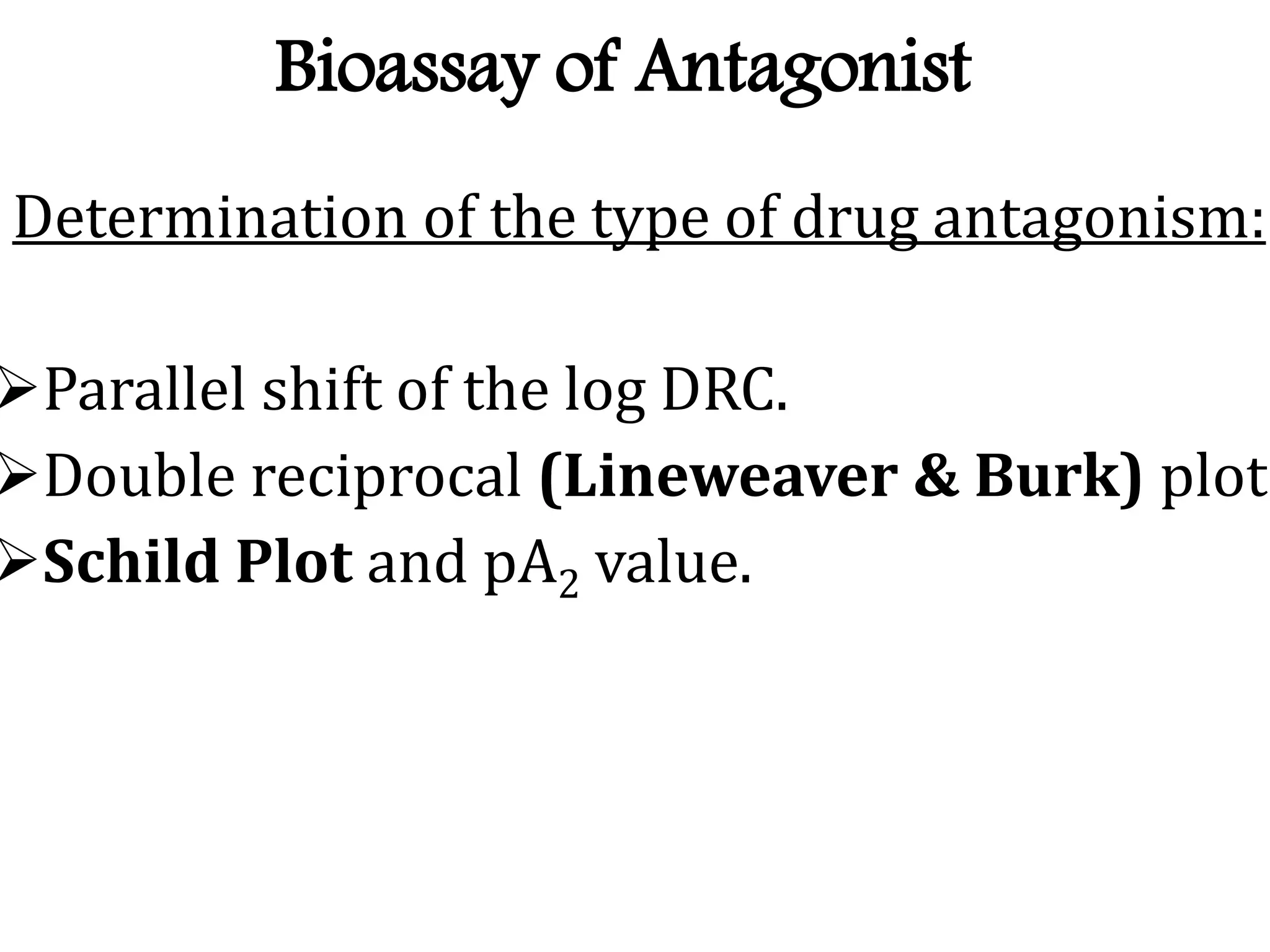
Bioassay of Antagonist
Determination of the type of drug antagonism:
Parallel shift of the log DRC.
Double reciprocal (Lineweaver & Burk) plot
Schild Plot and pA2 value.
Advantages &
Disadvantages
of Bioassay
Advantages
Chemical assay too
complex.
If difference b/w
results; bioassay given
more importance.
Toxicity of new drug.
 Time consuming.
 Requires much skill.
 Biological variations
exist.
Disadvantage
s
Errors in bioassays
Biological variation
• Loss of tissue sensitivity.
• Different species/sex/age/weight/health status.
• Laboratory condition may be variable.
• Housing and handling of animals.
Methodological error
• Lack of standardization of procedure.
• Set-up of apparatus.
• Tissue isolation/preparation for experiment.
• Drug preparation or dilution.
Human Tissue Bioassay
Animal tissues can’t predict accurate outcomes.
Limitations: Ethical, costly, take time, cooperation
of various specialties required, storage.
Vascular tissue: Veins, cardiac blood vessels, large
blood vessels after amputation.
Cardiac tissue: Used fresh, stored at 4◦C,
functional for 2 weeks.
Brain tissue.
Lung tissue.
Thank You

Principles & types of bioassay

  • 1.
    Principles and Types ofBioassay DR. SAHIL KUMAR
  • 2.
    Outline Introduction Indications of Bioassay Principlesof Bioassay Classification of Bioassay: Graded & Quantal Bioassay of antagonist Advantages and Disadvantages of Bioassay Error in Bioassay Human Tissue Bioassay Conclusion
  • 3.
    INTRODUCTION What is aBioassay? Comparative assessment of relative potency of a test compound to a standard compound on a living tissue. Qualitative identification & Quantitative measurement of the amount of active principle in pharmaceutical preparation or biological material. Measurement of conc. of a drug from magnitude of its biological effect.
  • 4.
    Is Bio-standardization sameas Bioassay? Historical aspect: Paul Ehrlich – Bio-standardization of Diphtheria antitoxin. INTRODUCTION
  • 5.
    INDICATIONS OF BIOASSAY Activeprinciple unknown. Active principle cannot be isolated. To study biological response of new drug. To ensure purity & potency. If chemical assay not available/ complex/ insensitive to low doses. To estimate concentration of endogenous mediators.
  • 6.
    PRINCIPLES OF BIOASSAY Comparepotency of unknown substance with standard (including assessment of errors). Standard & test sample should have same pharmacological effect & mode of action.
  • 7.
    The test andstandard should be compared using a specified pharmacological technique. Method selected should be sensitive, reproducible & should minimize errors d/t biological variations & methodology. PRINCIPLES OF BIOASSAY
  • 8.
    TYPES OF BIOASSAY Quantal Directend point assay (DEPA) LD50 determination Graded Matching Bracketing Interpolation Multiple point 8
  • 9.
  • 10.
    METHODOLOGY: Graded Bioassay 1)Checking of apparatus for proper functioning. 2) Prepare Physiological Salt Solution 3) Arrange the instrument and adjust the water bath. 4) Balance the lever 5) Tissue selection 6) Surgical process and collection of required tissue. 7) Tissue attachment to the water bath 8) Relaxation time given to the tissue 9) Prepare the standard drug (serial dilution) 10) Select lowest possible measurable conc. 11) Prepare DRC for the standard drug. 12) Prepare DRC for the test drug. (serial dilution) 13) Select an assay method (3 point or 4 point assay) 14) Calculation
  • 11.
    Graded Bioassay Intermittent dose method Cumulativedose method 0.2ml 0.4ml 0.8ml 1.6ml 3.2ml 11
  • 12.
    Matching Assay 12 •Adv: TestDRC not reqd., small vol., fast. •Disadv: Trial & Error method, poor precision.
  • 13.
  • 14.
    Interpolation Assay 14 Conc. ofunknown is read from a standard plot of a log dose response curve.
  • 15.
    Three Point Assay 15 S1S2 T S2 T S1 T S1 S2
  • 16.
    Three Point Assay •Meanresponses of three sets taken. •Potency ratio calculated. M = T – S1 x log s1 S2 – S1 s2 •Strength of test solution = s1 x antilog M t 16
  • 17.
    Four Point Assay 17 S1S2 T1 T2 S2 T1 T2 S1 T1 T2 S1 S2 T2 S1 S2 T1
  • 18.
  • 19.
    Four Point Assay 19 M= [T1 – S1 + T2 - S2] x log s2 S2 – S1 + T2 - T1 s1 T (concentration) = s1 x antilog M t1 Six Point & Eight Point Assay
  • 20.
    Multiple point assays: •Adv:Reduced error, reduced variability. •Disadv: Lengthy, Large amount of test sample required. 20
  • 21.
  • 22.
    22 •Threshold dose producinga required response is measured on each animal. •Eg. Bioassay of Digitalis in Cats, Hypoglycemic convulsions in mice. •Threshold dose = Period of infusion X Rate. Direct End-Point Assay
  • 23.
  • 24.
    Bioassay of Antagonist Determinationof the type of drug antagonism: Parallel shift of the log DRC. Double reciprocal (Lineweaver & Burk) plot Schild Plot and pA2 value.
  • 25.
  • 26.
    Advantages Chemical assay too complex. Ifdifference b/w results; bioassay given more importance. Toxicity of new drug.  Time consuming.  Requires much skill.  Biological variations exist. Disadvantage s
  • 27.
    Errors in bioassays Biologicalvariation • Loss of tissue sensitivity. • Different species/sex/age/weight/health status. • Laboratory condition may be variable. • Housing and handling of animals. Methodological error • Lack of standardization of procedure. • Set-up of apparatus. • Tissue isolation/preparation for experiment. • Drug preparation or dilution.
  • 28.
    Human Tissue Bioassay Animaltissues can’t predict accurate outcomes. Limitations: Ethical, costly, take time, cooperation of various specialties required, storage. Vascular tissue: Veins, cardiac blood vessels, large blood vessels after amputation. Cardiac tissue: Used fresh, stored at 4◦C, functional for 2 weeks. Brain tissue. Lung tissue.
  • 29.

Editor's Notes

  • #6 Chemical composition of drug is different but has same pharmacological action e.g. cardiac glycosides isolated from diff sources, catecholamines etc.
  • #7 Principle means a fundamental concept.
  • #11 Point # 10) Doses added in geometric progression Different dilutions of drug Doses added till plateau achieved Point # 11) Response is measured with the help of a ruler and percentage of maximal response is found out. Point #13) fixing with Shellac and colophony saturated with methanol.
  • #12 What we usually do in our lab is Intermittent method
  • #27 Advantages & Disadvantages of Bioassay
  • #30 Conclusion