PRECLINICAL SCREENING OF
DRUGS FOR
NEURODEGENERATIVE
DISEASES ( ALZHEIMER)
PRESENTED BY :- Janhavi Yashwant Burade
M.Pharm 1st sem
VBCOP
, AMRAVATI
CONTENT
 Introduction
 In-vitro screening models
 In- vivo screening models
INTRODUCTION
ALZHEIMER’S DISEASE
 Chronic neurodegenerative disorder
 Largest cause of dementia in the elderly
 Fourth leading cause of mortality
 About 27 million patients worldwide
Symptoms of AD is:
Progressive dementia:-
1. Loss of memory
2. Cognitive decline
3. Impairment of judgment
4. Changes in personality
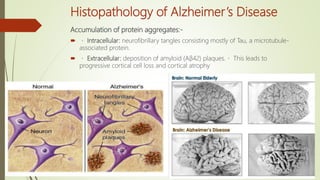
Histopathology of Alzheimer’s Disease
Accumulation of protein aggregates:-
 Intracellular: neurofibrillary tangles consisting mostly of Tau, a microtubule-
associated protein.
 Extracellular: deposition of amyloid (Aβ42) plaques. This leads to
progressive cortical cell loss and cortical atrophy
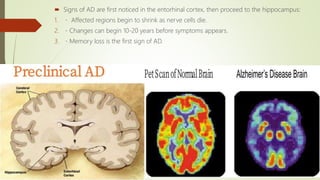
 Signs of AD are first noticed in the entorhinal cortex, then proceed to the hippocampus:
1. Affected regions begin to shrink as nerve cells die.
2. Changes can begin 10-20 years before symptoms appears.
3. Memory loss is the first sign of AD.
Goals Of The Treatment Of AD
 Improve memory
 Improve functional status
 Improve behavioral symptoms
 Slow progression
 Delay or prevent onset
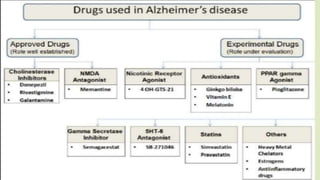
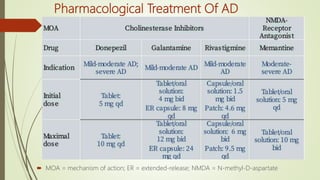
Pharmacological Treatment Of AD
 MOA = mechanism of action; ER = extended-release; NMDA = N-methyl-D-aspartate
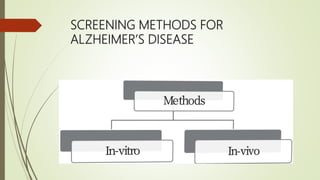
SCREENING METHODS FOR
ALZHEIMER’S DISEASE
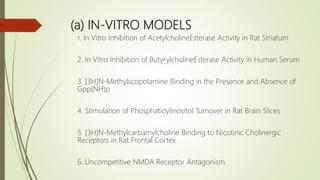
(a) IN-VITRO MODELS
1. In Vitro Inhibition of AcetylcholineEsterase Activity in Rat Striatum
2. In Vitro Inhibition of ButyrylcholineEsterase Activity in Human Serum
3. [3H]N-Methylscopolamine Binding in the Presence and Absence of
Gpp(NH)p
4. Stimulation of Phosphatidylinositol Turnover in Rat Brain Slices
5. [3H]N-Methylcarbamylcholine Binding to Nicotinic Cholinergic
Receptors in Rat Frontal Cortex
6. Uncompetitive NMDA Receptor Antagonism.
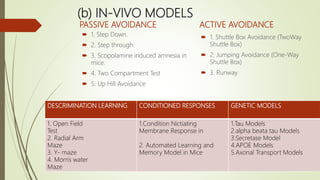
(b) IN-VIVO MODELS
PASSIVE AVOIDANCE
 1. Step Down.
 2. Step through.
 3. Scopolamine induced amnesia in
mice.
 4. Two Compartment Test
 5. Up Hill Avoidance
ACTIVE AVOIDANCE
 1. Shuttle Box Avoidance (TwoWay
Shuttle Box)
 2. Jumping Avoidance (One-Way
Shuttle Box)
 3. Runway
DESCRIMINATION LEARNING CONDITIONED RESPONSES GENETIC MODELS
1. Open Field
Test
2. Radial Arm
Maze
3. Y- maze
4. Morris water
Maze
1.Condition Nictiating
Membrane Response in
2. Automated Learning and
Memory Model in Mice
1.Tau Models
2.alpha beata tau Models
3.Secretase Model
4.APOE Models
5.Axonal Transport Models
IN VITRO MODEL’S
1. In Vitro Inhibition of
AcetylcholineEsterase Activity in Rat
Striatum
Purpose and Rationale:-
 To screen drugs for inhibition of acetylcholine-esterase activity.
 As it is generally accepted that the physiological role of AChE is rapid hydrolysis and
inactivation of Ach.
 Thus, inhibitor of AChE show marked cholinomimetic effects in cholinergically –
innervated effectors organs.
 Recent studies have suggested that AChE inhibitors may be beneficial for the
treatment of AD.
PROCEDURE:-
1.Reagents: -
a. 0.05 M Phosphate buffer, ph 7.2
b. Substrate in buffer(198 mg acetylthiocholine chloride)
c. DTNB in buffer (19.8 mg 5,5-dithiobisnitrobenzoic acid )(0.5mM)
d. A 2mM stock sol. of test drug is made up in a suitable solvent and q.s to
volume with 0.5mM DTNB.Drugs are serially diluted(1:10) such that the finalconc.
in cuvette is 10-4 M and screened for the activity.
2.Tissue Preperation :-
1. RATS ARE DECAPITATED
2. BRAINS ARE RAPIDLY REMOVED, CORPORA SRAITA DISSECTED FREE
3. WEIGHED AND HOMOGENIZED IN 19 VOLUMES (Approx. 7 mg protein/ml)OF
0.05 M NaH2 PO4,ph 7.2.
4. 25μl ALIQUOT OF THIS SUSPENSION IS ADDED TO 1ml OF THE VEHICLE AND
VARIOUS CONCENTRATION OFTEST DRUG ARE PREPARED.
5. REINCUBATED FOR 10 MIN AT 37οC.
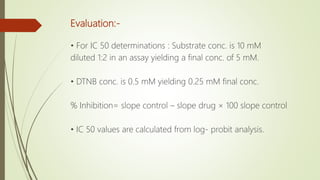
Evaluation:-
• For IC 50 determinations : Substrate conc. is 10 mM
diluted 1:2 in an assay yielding a final conc. of 5 mM.
• DTNB conc. is 0.5 mM yielding 0.25 mM final conc.
% Inhibition= slope control – slope drug × 100 slope control
• IC 50 values are calculated from log- probit analysis.
2. In Vitro Inhibition of
ButyrylcholineEsterase Activity in Human
Serum
Rational & purpose:-
 This method is used in conjuction with the acetylcholine-esterase assay to
determine the enzyme selectivity of various cholinesterase inhibitors.
 Butyrylcholine-esterase preferentially hydrolyses butyrylcholine.
 This enzyme is found in highest amount in serum,but ts physiological role is not
known.
 Ethopropazine and Tetra-Isopropyl Pyrophosphoramide (ISO-OMPA) are
selective inhibitors of butyrylcholinesterase
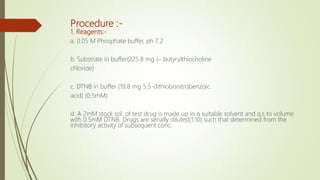
Procedure :-
1. Reagents:-
a. 0.05 M Phosphate buffer, ph 7.2
b. Substrate in buffer(225.8 mg s- butyrylthiocholine
chloride)
c. DTNB in buffer (19.8 mg 5,5-dithiobisnitrobenzoic
acid) (0.5mM)
d. A 2mM stock sol. of test drug is made up in a suitable solvent and q.s to volume
with 0.5mM DTNB. Drugs are serially diluted(1:10) such that determined from the
inhibitory activity of subsequent conc.
2. Enzyme Preparation:-
 A VIAL OF LYOPHILIZED HUMAN SERUM
 RECONSTITUTED IN 3ML OF DISTIILED WATER
 25 ml ALIQUOT OF THIS SUSPENSION
 ADDED TO 1ml OF THE VEHICLE & VARIOUS CONC. OF TEST DRUG ARE
PREPARED
 PRE-INCUBATE FOR 10MIN AT 37οC.
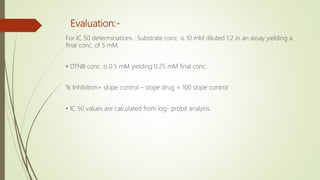
Evaluation:-
For IC 50 determinations : Substrate conc. is 10 mM diluted 1:2 in an assay yielding a
final conc. of 5 mM.
• DTNB conc. is 0.5 mM yielding 0.25 mM final conc.
% Inhibition= slope control – slope drug × 100 slope control
• IC 50 values are calculated from log- probit analysis.
IN-VIVO MODELS
(A) INHIBITORY PASSIVE AVOIDANCE
 One of the most common animal
tests in memory research is the
inhibition to imitate activities or
learned habits.
 The term “passive avoidance” is
usually employed to describe
experiments in which the animal
learns to avoid a noxious event
by suppressing a particular
1.STEP DOWN METHOD
Purpose & Rational:-
 An animal (mouse or rat) in an open field spends most of the time close
to the walls and in the corners.
 When placed on an elevated platform in the center of a rectangular
compartment, it steps down almost immediately to the floor to explore
the enclosure and to approach the wall.
Procedure:-
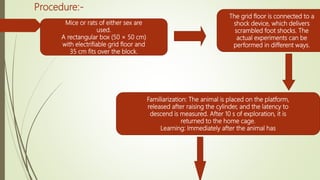
Mice or rats of either sex are
used.
A rectangular box (50 × 50 cm)
with electrifiable grid floor and
35 cm fits over the block.
The grid floor is connected to a
shock device, which delivers
scrambled foot shocks. The
actual experiments can be
performed in different ways.
Familiarization: The animal is placed on the platform,
released after raising the cylinder, and the latency to
descend is measured. After 10 s of exploration, it is
returned to the home cage.
Learning: Immediately after the animal has
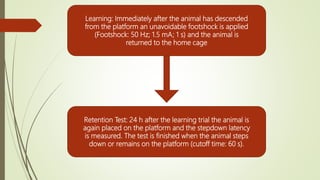
Learning: Immediately after the animal has descended
from the platform an unavoidable footshock is applied
(Footshock: 50 Hz; 1.5 mA; 1 s) and the animal is
returned to the home cage
Retention Test: 24 h after the learning trial the animal is
again placed on the platform and the stepdown latency
is measured. The test is finished when the animal steps
down or remains on the platform (cutoff time: 60 s).
Evaluation:-
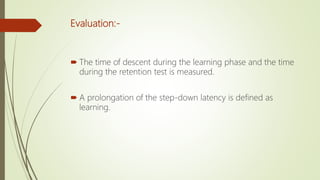
 The time of descent during the learning phase and the time
during the retention test is measured.
 A prolongation of the step-down latency is defined as
learning.
Modification of This Method:-
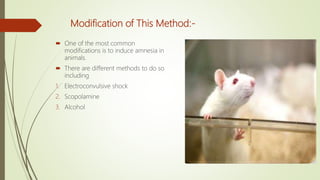
 One of the most common
modifications is to induce amnesia in
animals.
 There are different methods to do so
including
1. Electroconvulsive shock
2. Scopolamine
3. Alcohol
2.STEP THROUGH METHOD
Purpose & Rationale :-
 This test uses normal behavior of mice and rats.
 These animals avoid bright light and prefer dim illumination.
 When placed into a brightly illuminated space connected to a dark enclosure,
they rapidly enter the dark compartment and remain there.
 The standard technique was developed for mice by Jarvik and Kopp (1967) and
modified for rats by King and Glasser (1970)
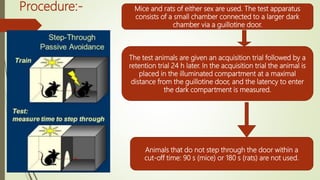
Procedure:- Mice and rats of either sex are used. The test apparatus
consists of a small chamber connected to a larger dark
chamber via a guillotine door.
The test animals are given an acquisition trial followed by a
retention trial 24 h later. In the acquisition trial the animal is
placed in the illuminated compartment at a maximal
distance from the guillotine door, and the latency to enter
the dark compartment is measured.
Animals that do not step through the door within a
cut-off time: 90 s (mice) or 180 s (rats) are not used.
 Immediately after the animal enters the dark compartment,
the door is shut automatically and an unavoidable footshock
(Footshock: 1 mA; 1 s – mice; 1.5 mA; 2 s – rat) is delivered.
 The animal is then quickly removed (within 10 s) from the
apparatus and put back into its home cage.
 The test procedure is repeated with or without drug.
Evaluation:-
 The time to step-through during the learning phase is
measured and the time during the retention test is
measured.
 In this test a prolongation of the stepthrough latencies is
specific to the experimental situation.
 An increase of the step-through latency is defined as
learning.
3.UP HILL AVOIDANCE METHOD
Purpose & Rationale:-
 Many animal species exhibit a negative geotaxis, i. e.
the tendency to orient and move towards the top when
placed on a slanted surface.
 When placed on a tilted platform with head facing
down-hill, rats and mice invariably turn around and
move rapidly up the incline.
Procedure:-
Rats of both sex were used and maintained under
standard conditions. The experimental apparatus is a 50
× 50 cm box with 35 cm high opaque plastic walls.
The box can be inclined at different angles. The
flooconsists of 10 mm diameter stainless steel grid bars
placed 13 mm apart.
To deliver the tail-shock, a tailelectrode is constructed,
consisting of a wire clip connected to a
constantcurrent shock source. The animal is first fitted
with the tail-electrode and then placed onto the grid
with its nose facing down
During baseline-trials the animal’s latency to make a 180° turn and initiate the first
climbing response is measured. Thereafter the animal is returned to its
home cage.
During the experimental trials the latencies are measured and additionally a tail-shock
(1.5 or 2 mA) was administered contingent on the first climbing response after the 180°
turn
Immediately after the shock the animal is placed in its home cage. Retest is performed
24 h later
Evaluation:-
The latencies are measured.
CRITICAL ASSESSMENT OF THE METHOD
 The up-hill avoidance technique promises to provide a useful addition to the
existing arsenal of inhibitory (passive) avoidance methods.
 Its most obvious advantage is that it can be administered to animals debilitated
in sensorymotor coordination by pharmacological or surgical treatments that
would preclude use of other inhibitory (passive)
4.SCOPOLAMINE INDUCED AMNESIA IN
MICE
Purpose & Rationale:-
 The administration of the antimuscarinic agent scopolamine to young human
volunteers produces transient memory deficits.
 Scopolamine has been shown to impair memory retention when given to mice
shortly before training in a dark avoidance task.
 The ability of a range of different cholinergic agonist drugs to reverse the
amnesic effects of scopolamine is now well documented in animals and human
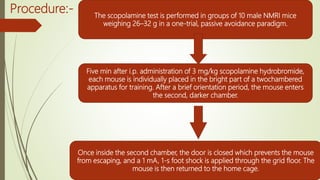
Procedure:- The scopolamine test is performed in groups of 10 male NMRI mice
weighing 26–32 g in a one-trial, passive avoidance paradigm.
Five min after i.p. administration of 3 mg/kg scopolamine hydrobromide,
each mouse is individually placed in the bright part of a twochambered
apparatus for training. After a brief orientation period, the mouse enters
the second, darker chamber.
Once inside the second chamber, the door is closed which prevents the mouse
from escaping, and a 1 mA, 1-s foot shock is applied through the grid floor. The
mouse is then returned to the home cage.
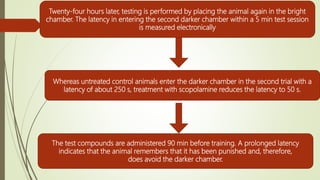
Twenty-four hours later, testing is performed by placing the animal again in the bright
chamber. The latency in entering the second darker chamber within a 5 min test session
is measured electronically
Whereas untreated control animals enter the darker chamber in the second trial with a
latency of about 250 s, treatment with scopolamine reduces the latency to 50 s.
The test compounds are administered 90 min before training. A prolonged latency
indicates that the animal remembers that it has been punished and, therefore,
does avoid the darker chamber.
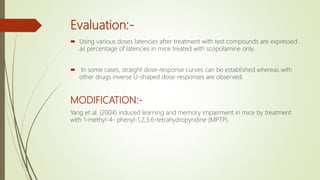
Evaluation:-
 Using various doses latencies after treatment with test compounds are expressed
as percentage of latencies in mice treated with scopolamine only.
 In some cases, straight dose-response curves can be established whereas with
other drugs inverse U-shaped dose-responses are observed.
MODIFICATION:-
Yang et al. (2004) induced learning and memory impairment in mice by treatment
with 1-methyl-4- phenyl-1,2,3,6-tetrahydropyridine (MPTP).
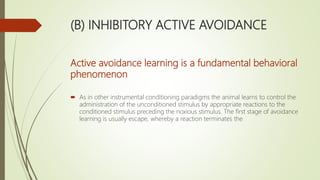
(B) INHIBITORY ACTIVE AVOIDANCE
Active avoidance learning is a fundamental behavioral
phenomenon
 As in other instrumental conditioning paradigms the animal learns to control the
administration of the unconditioned stimulus by appropriate reactions to the
conditioned stimulus preceding the noxious stimulus. The first stage of avoidance
learning is usually escape, whereby a reaction terminates the
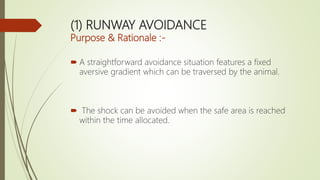
(1) RUNWAY AVOIDANCE
Purpose & Rationale :-
 A straightforward avoidance situation features a fixed
aversive gradient which can be traversed by the animal.
 The shock can be avoided when the safe area is reached
within the time allocated.
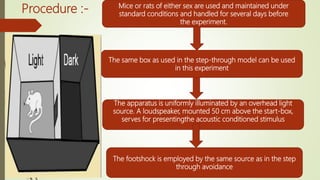
Procedure :- Mice or rats of either sex are used and maintained under
standard conditions and handled for several days before
the experiment.
The same box as used in the step-through model can be used
in this experiment
The apparatus is uniformly illuminated by an overhead light
source. A loudspeaker, mounted 50 cm above the start-box,
serves for presentingthe acoustic conditioned stimulus
The footshock is employed by the same source as in the step
through avoidance
The animal is allowed to explore the whole apparatus for 5 min. The guillotine door is
then closed and the animal is placed into the light starting area.
After 10 s the acoustic CS is applied and the door is simultaneously opened. Shock is
turned on after 5 s. The CS continuous until the animal reaches the safe area. It is left
there for 50–70 s (intertrial interval, ITI) before
returned to the same area again
After 30 s the barrier pushes the animal off the platform onto the grid floor. The
sequence is repeated until the criterion of 10 consecutive avoidances is reached.
Retention is tested on the next day until the animal reachescriterion.
Evaluation:-
 The time the animal needs to reach the safe area on both
days is measured.
 In addition, the number of errors (not reaching the safe
area) is recorded.
DESCRIMINATION
LEARNING
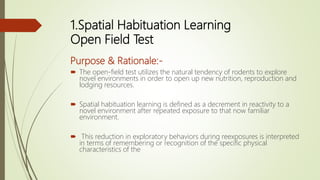
1.Spatial Habituation Learning
Open Field Test
Purpose & Rationale:-
 The open-field test utilizes the natural tendency of rodents to explore
novel environments in order to open up new nutrition, reproduction and
lodging resources.
 Spatial habituation learning is defined as a decrement in reactivity to a
novel environment after repeated exposure to that now familiar
environment.
 This reduction in exploratory behaviors during reexposures is interpreted
in terms of remembering or recognition of the specific physical
characteristics of the
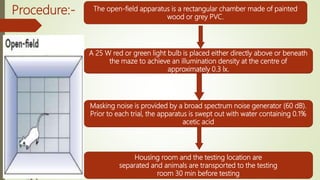
Procedure:- The open-field apparatus is a rectangular chamber made of painted
wood or grey PVC.
A 25 W red or green light bulb is placed either directly above or beneath
the maze to achieve an illumination density at the centre of
approximately 0.3 lx.
Masking noise is provided by a broad spectrum noise generator (60 dB).
Prior to each trial, the apparatus is swept out with water containing 0.1%
acetic acid
Housing room and the testing location are
separated and animals are transported to the testing
room 30 min before testing
The digitized image of the path taken by each animal
is stored.
In aged or hypoactive rodents testing is performed
during the animals dark phase of day
The rodent is placed on the center or in a corner of the
open-field for 5–10 minute sessions (mice: up to 20
min, because of the high basal activity level).
The animals are re-exposed to the openfield 24 and 96
h after the initial trial
Evaluation:-
The exploratory behaviours registered are:
 Rearings or vertical activity: the number of times an animal was standing on its
hind legs with forelegs in the air or against the wall.
 The duration of single rearings as a measure of non-selective attention.
 Locomotion or horizontal activity: the distance in centimeters an animal moved.
2. Y - MAZE
Purpose & Rationale :-
 Measures spatial working memory. It has been designed to make the animal to
learn to discriminate between two arms: one illuminated , without shock and
other non illuminated with shock and learn to reach the correct arm,the
illuminated one.
 These kind of experiments are known as Simultaneous Discrimination Learning.
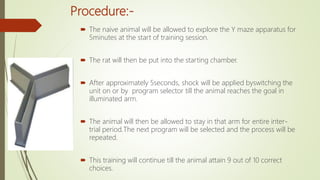
Procedure:-
 The naive animal will be allowed to explore the Y maze apparatus for
5minutes at the start of training session.
 The rat will then be put into the starting chamber.
 After approximately 5seconds, shock will be applied byswitching the
unit on or by program selector till the animal reaches the goal in
illuminated arm.
 The animal will then be allowed to stay in that arm for entire inter-
trial period.The next program will be selected and the process will be
repeated.
 This training will continue till the animal attain 9 out of 10 correct
choices.
Evaluation:-
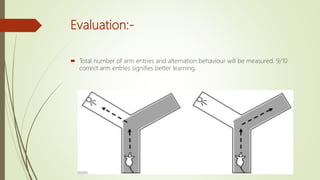
 Total number of arm entries and alternation behaviour will be measured. 9/10
correct arm entries signifies better learning.
3. Spatial Learning in the
Water Maze
Purpose & Rationale:-
 A task was developed where rats learn to swim in a water tank to
find an escape platform hidden under the water (Morris 1984).
 As there are no proximal cues to mark the position of the platform,
the ability to locate it efficiently will depend on the use of a
configuration of the cues outside the tank.
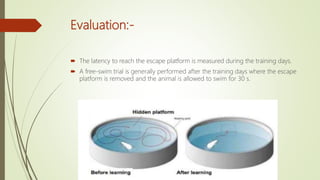
 Learning is reflected on the shorter latencies to escape and the
decrease on the length of the path
Procedure:-
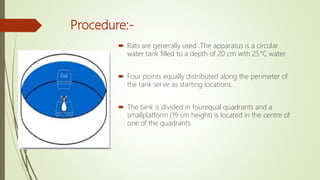
 Rats are generally used .The apparatus is a circular
water tank filled to a depth of 20 cm with 25°C water.
 Four points equally distributed along the perimeter of
the tank serve as starting locations.
 The tank is divided in fourequal quadrants and a
smallplatform (19 cm height) is located in the centre of
one of the quadrants.
Evaluation:-
 The latency to reach the escape platform is measured during the training days.
 A free-swim trial is generally performed after the training days where the escape
platform is removed and the animal is allowed to swim for 30 s.
Preclinical Screening for Alzheimer's