BIOAS
S
AY
An assay is an investigative (analytic) procedure
pharmacology,
medicine,
biology, and molecular
assessing or
in laboratory
environmental
biology for
quantitatively
qualitatively
measuring the presence or
amount or the functional activity of a target
entity (the analyte) which
biochemical
can be
substance or
a drug or
organic sample
Chemical Assay
Immunoassay
Bioassay
Chemical Assay:
It is the study of the separation, identification, and
quantification of the chemical components of natural and
artificial materials.
Immunoassay:
A technique that makes use of the binding between an antigen
and its homologous antibody in order to identify and quantify the
specific antigen or antibody in a sample.
 Comparative assessment of relative potency of a test compound to a
standard compound on a living or biological tissue.
 Quantitative measurement of the amount of active principle or substance in
a pharmaceutical preparation or biological material using a suitable
biological system
Introduced by Paul Ehrlich - biostandardization of Diphtheria antitoxin
Bioassay Chemical Assay
Less Precise
More ti
B
m
ioassay
e consuming
More expensive
Active constituent &
structure not known.
More sensitive
More men power
Required
Difficult to handle
More Precise
Less time consuming
Less expensive
Active constituent &
structure fully
established.
Less sensitive
Less men power
required
Easy to handle
Biological
assay
Bio
metrics
Biological
standadizatio
n
Bio-
standadizati
on
To compare the test substance with the
International Standard preparation of the same
To find out how much test substance is
required to produce the same biological effect,
as produced by the standard
Activity assayed should be the activity of
interest
Standard & test sample - similar pharmacological
effects & mode of action
Both should be compared for their established
pharmacological effect using specified technique
Ex: *Ach – contractile response on frog rectus
abdominis muscle
*Histamine – contractile response on guinea
pig ileum
Problem of biological variation must be
minimized
 Experimental conditions - kept constant
 Animals - same species, sex and weight
 Number of animals - large enough to
minimize error (individual variation)
 Isolated preparations - sensitive
 No chemical method has been developed
 Chemical assay is too complex /not sensitive enough to
measure (ex: insulin)
 To measure the pharmacological activity of new or
chemically undefined substances
 For biological standardization of drugs obtained from
natural sources as these cannot be obtained in pure form.
Eg:
Oxytocin,Vasopressin,Insulin,Heparin..
 To compare the strength of a drug obtained
from various sources due to different
compositions
 Chemicals with similar structure, but different
biological activity
 Chemical structure of the active principle is
unknown
 Chemical structure known; cannot be actively
purified. Eg: Peptide hormones
Sensitivity
Specificity
Repeatability
Reproducibility
Precision
Accuracy
Stability – tissue has to stay “bioassay-
fit
• Intact
animals
Invivo
• Isolated
tissues
Invitro
WHOLE ANIMALS
Nor Adrenaline – Cat
Cardiac Glycosides – Guinea Pig
Insulin – Mice
Estrogens – Ovariectamised Female Rat
ISOLATED TISSUE
Acetyl Choline – Frog Rectus Abdominus muscle
Histamine – Guinea Pig ileum
Adrenaline – Rat uterus
Oxytocin – Rat uterus oestrogen primed
Qualitative bioassay
Is used for assessing the physical effects of a substance that
may not be quantified, such as abnormal development or
deformity.
Eg: Arnold Adolph Berthold's famous experiment on castrated
chickens. This analysis found that by removing the testes of a
chicken, it would not develop into a rooster because the
endocrine signals necessary for this process were not available.
Quantitative bioassays
involve estimation of concentration/potency of a substance by
measurement of the biological response it produces. These
bioassays are typically analyzed using the methods of
biostatistics
1.Direct end point assay (DEPA)
2.Quantal assay (all or none assay)
3.Graded assay :
a) Bracketting assay
b) Matching assay
c) Interpolation assay
d) Multiple point assay ( 3-point, 4point, 6 -
point, 8-point).
Principle: is to measure direct response of dose of standard and
test preparation. The threshold dose required for response is
determined for each experimental unit.
Ratio between these doses estimates the potency of the test
preparation relative to the standard.
Concentration of test= TDS/TDT×CSD
Where, TDS= Threshold dose of standard
TDT= Threshold dose of test
CSD= Concentration of standard drug
Threshold dose of standard = Total period of infusion × rate
of drug administration
Advantage:
Drug effects appear rapidly and are easily recognised
Drug effect is directly proportional to drug dose
Rapid end-point detection.
Disadvantages:
Only toxicity study or high dose study is possible
Dose ranging study cannot be done
 Quantal response – the unknown is compared with the standard with
respect to potency which produces the quantal affect, i.e change is easily
recognised sign or often death.
 In a quantal assay there is use of dose response relationship.
 quantal response to a drug is obtained and percentage of positive
response at each dose is calculated.
 The response in quantal assay is varying, i.e some responses are
irreversible and hence animal used is once and some responses have no
permanent effect and animal can be used in next experiment
 e.g –
 Determination of LD50
 Hypoglycemic convulsion in mice in the assay of insulin
20
 Graded response - In these assays, as the dose
increases there is an equivalent rise in response.
The potency of a test agonist is determined by
comparing its mean response to standard mean
response.
 This process is also known as “analytical dilution
assay”
 GRA is the simplest way of determining potency of a
test drug because it does not require statistical
analysis
standard
Test/unknow
n
DRC & Log DRC
30%
70%
Sigmoid curve
Wide range of doses
can plot
 Rectangular hyperbola
• Potency
• Efficacy
• Slope of curve
Used when test sample is too small.
Comparison of potency between unknown and standard drug is done
by trial and error method.
Response is matched at only one dose
Does not need dose respone curve of test compound
It require most sensitive tissue
Concentration of test= (Dose of standard/ Dose of test)× conc. Of standard
Disadvantage:
Experimental error is not excluded out
There is no sign of parallelism as it lack dose response relationship.
Used when test sample is too small.
Single or few responses is taken by using any test drug
concentration.
This response is bracketed between two responses one
higher and one lower of the standard drug.
The strength of the unknown can be found by simple
interpolation of this bracketted response on dose axis
less accurate,time consuming, troublesome
cannot get exact match of response
quantitative difference b/w test & standard not
obtained
standard
Test/unknow
n
 A log dose-response curve is plotted with the standard,
 Single or few responses of test drug are plotted.
 The dose of test drug which comes at the linear log dose-
response is interpolated from the dose respone plot
100
50
0 x x1
standard
%
R
E
S
P
O
N
S
E
LOG DOSE
Sensitivity of tissue is 1st determined by prior
plotting of a conc-response curve with known
agonist
Dose can be plotted even if it varies over
thousand fold range
Error is normally distributed
Sensitivity of tissue changes with time
Timing of doses not taken into account
Variation in mode of application of drugs
Responses are repeated several times and the
mean of each is taken
Chances of error are minimized
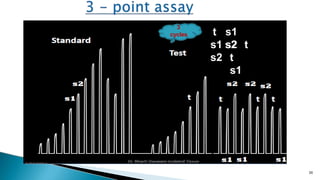
 3 point method - 2 doses of std+1 dose of test
 4 point method - 2 doses of std+2 doses of test
 6 point method - 3 doses of std+3 doses of test
Latin square method of randomization to avoid
any bias
35
36
t s1
s2
s1 s2 t
s2 t
s1
3
cycles
37
%
R
E
S
P
O
N
S
E
T
S2
s1 t s2
LOG DOSE
S1
s1 s2 t
t s1 s2
s2 s1 t
t s2 s1
• Mean responses of these 3 sets plotted
• Log potency ratio (M) =
(T-S1÷ S2-S1)× log d
where, d – dose ratio = s2/s1
• Strength of unknown = s1/t × antilog of M
S1, S2- length of standard dose response selected between
25-75%
T-length of test dose response selected in between of
two standard responses
s2/s1 -standard drug dose which came in contact with tissueand
given the response S1, S2. respectively
t = Test drug dose which came in contact with tissu and given the
response T
39
41
4 - POINT ASSAY
42
%
R
E
S
P
O
N
S
E
T1
S2
s1 s2 t1
LOG DOSE
S1
T2
t2
s1 s2 t1 t2
s2 t1 t2 s1
t1 t2 s1 s2
t2 s1 s2 t1
• Mean responses of 4 sets plotted
• Log potency ratio (M)
(T2-S2)+(T1-S1) × Log d
(S2-S1)+(T2-T1)
where, d-dose ratio = s2/s1
• Strength of unknown =
s1/t1 × antilog of M
44
3+3 dose assay
3 conc each of std & test drug are used
6 sets of experiments using 6 doses in each
set
More time consuming,lesser in use
Reliability is excellent
to measure the pharmacological activity of new/
chemically undefined substances
to investigate the function of endogenous
mediators
to measure drug toxicity and unwanted effects
to measure the conc of drugs and other active
substances in the blood or other body fluids
47
Determination of potency, ED50/LD50 of
drugs
New drug development
Measure clinical effectiveness
48
• Biological variation
• Troublesome
• Time consuming
• Expensive
• Less accurate than physico-chemical
methods
49
Successful tool in estimation & discovery of
biologically active substances
Sensitivity & Specificity – important tool in
pharmacology
bioassay-converted.pptx

bioassay-converted.pptx

  • 1.
  • 2.
    An assay isan investigative (analytic) procedure pharmacology, medicine, biology, and molecular assessing or in laboratory environmental biology for quantitatively qualitatively measuring the presence or amount or the functional activity of a target entity (the analyte) which biochemical can be substance or a drug or organic sample
  • 3.
  • 4.
    Chemical Assay: It isthe study of the separation, identification, and quantification of the chemical components of natural and artificial materials. Immunoassay: A technique that makes use of the binding between an antigen and its homologous antibody in order to identify and quantify the specific antigen or antibody in a sample.
  • 5.
     Comparative assessmentof relative potency of a test compound to a standard compound on a living or biological tissue.  Quantitative measurement of the amount of active principle or substance in a pharmaceutical preparation or biological material using a suitable biological system Introduced by Paul Ehrlich - biostandardization of Diphtheria antitoxin
  • 6.
    Bioassay Chemical Assay LessPrecise More ti B m ioassay e consuming More expensive Active constituent & structure not known. More sensitive More men power Required Difficult to handle More Precise Less time consuming Less expensive Active constituent & structure fully established. Less sensitive Less men power required Easy to handle
  • 7.
  • 8.
    To compare thetest substance with the International Standard preparation of the same To find out how much test substance is required to produce the same biological effect, as produced by the standard Activity assayed should be the activity of interest
  • 9.
    Standard & testsample - similar pharmacological effects & mode of action Both should be compared for their established pharmacological effect using specified technique Ex: *Ach – contractile response on frog rectus abdominis muscle *Histamine – contractile response on guinea pig ileum
  • 10.
    Problem of biologicalvariation must be minimized  Experimental conditions - kept constant  Animals - same species, sex and weight  Number of animals - large enough to minimize error (individual variation)  Isolated preparations - sensitive
  • 11.
     No chemicalmethod has been developed  Chemical assay is too complex /not sensitive enough to measure (ex: insulin)  To measure the pharmacological activity of new or chemically undefined substances  For biological standardization of drugs obtained from natural sources as these cannot be obtained in pure form. Eg: Oxytocin,Vasopressin,Insulin,Heparin..
  • 12.
     To comparethe strength of a drug obtained from various sources due to different compositions  Chemicals with similar structure, but different biological activity  Chemical structure of the active principle is unknown  Chemical structure known; cannot be actively purified. Eg: Peptide hormones
  • 13.
  • 14.
  • 15.
    WHOLE ANIMALS Nor Adrenaline– Cat Cardiac Glycosides – Guinea Pig Insulin – Mice Estrogens – Ovariectamised Female Rat ISOLATED TISSUE Acetyl Choline – Frog Rectus Abdominus muscle Histamine – Guinea Pig ileum Adrenaline – Rat uterus Oxytocin – Rat uterus oestrogen primed
  • 16.
    Qualitative bioassay Is usedfor assessing the physical effects of a substance that may not be quantified, such as abnormal development or deformity. Eg: Arnold Adolph Berthold's famous experiment on castrated chickens. This analysis found that by removing the testes of a chicken, it would not develop into a rooster because the endocrine signals necessary for this process were not available. Quantitative bioassays involve estimation of concentration/potency of a substance by measurement of the biological response it produces. These bioassays are typically analyzed using the methods of biostatistics
  • 17.
    1.Direct end pointassay (DEPA) 2.Quantal assay (all or none assay) 3.Graded assay : a) Bracketting assay b) Matching assay c) Interpolation assay d) Multiple point assay ( 3-point, 4point, 6 - point, 8-point).
  • 18.
    Principle: is tomeasure direct response of dose of standard and test preparation. The threshold dose required for response is determined for each experimental unit. Ratio between these doses estimates the potency of the test preparation relative to the standard. Concentration of test= TDS/TDT×CSD Where, TDS= Threshold dose of standard TDT= Threshold dose of test CSD= Concentration of standard drug Threshold dose of standard = Total period of infusion × rate of drug administration
  • 19.
    Advantage: Drug effects appearrapidly and are easily recognised Drug effect is directly proportional to drug dose Rapid end-point detection. Disadvantages: Only toxicity study or high dose study is possible Dose ranging study cannot be done
  • 20.
     Quantal response– the unknown is compared with the standard with respect to potency which produces the quantal affect, i.e change is easily recognised sign or often death.  In a quantal assay there is use of dose response relationship.  quantal response to a drug is obtained and percentage of positive response at each dose is calculated.  The response in quantal assay is varying, i.e some responses are irreversible and hence animal used is once and some responses have no permanent effect and animal can be used in next experiment  e.g –  Determination of LD50  Hypoglycemic convulsion in mice in the assay of insulin 20
  • 21.
     Graded response- In these assays, as the dose increases there is an equivalent rise in response. The potency of a test agonist is determined by comparing its mean response to standard mean response.  This process is also known as “analytical dilution assay”  GRA is the simplest way of determining potency of a test drug because it does not require statistical analysis
  • 22.
  • 23.
    DRC & LogDRC 30% 70% Sigmoid curve Wide range of doses can plot  Rectangular hyperbola • Potency • Efficacy • Slope of curve
  • 25.
    Used when testsample is too small. Comparison of potency between unknown and standard drug is done by trial and error method. Response is matched at only one dose Does not need dose respone curve of test compound It require most sensitive tissue Concentration of test= (Dose of standard/ Dose of test)× conc. Of standard Disadvantage: Experimental error is not excluded out There is no sign of parallelism as it lack dose response relationship.
  • 26.
    Used when testsample is too small. Single or few responses is taken by using any test drug concentration. This response is bracketed between two responses one higher and one lower of the standard drug. The strength of the unknown can be found by simple interpolation of this bracketted response on dose axis
  • 28.
    less accurate,time consuming,troublesome cannot get exact match of response quantitative difference b/w test & standard not obtained
  • 29.
  • 30.
     A logdose-response curve is plotted with the standard,  Single or few responses of test drug are plotted.  The dose of test drug which comes at the linear log dose- response is interpolated from the dose respone plot
  • 31.
  • 32.
    Sensitivity of tissueis 1st determined by prior plotting of a conc-response curve with known agonist Dose can be plotted even if it varies over thousand fold range Error is normally distributed
  • 33.
    Sensitivity of tissuechanges with time Timing of doses not taken into account Variation in mode of application of drugs
  • 34.
    Responses are repeatedseveral times and the mean of each is taken Chances of error are minimized  3 point method - 2 doses of std+1 dose of test  4 point method - 2 doses of std+2 doses of test  6 point method - 3 doses of std+3 doses of test Latin square method of randomization to avoid any bias 35
  • 35.
    36 t s1 s2 s1 s2t s2 t s1 3 cycles
  • 36.
  • 37.
    s1 s2 t ts1 s2 s2 s1 t t s2 s1
  • 38.
    • Mean responsesof these 3 sets plotted • Log potency ratio (M) = (T-S1÷ S2-S1)× log d where, d – dose ratio = s2/s1 • Strength of unknown = s1/t × antilog of M S1, S2- length of standard dose response selected between 25-75% T-length of test dose response selected in between of two standard responses s2/s1 -standard drug dose which came in contact with tissueand given the response S1, S2. respectively t = Test drug dose which came in contact with tissu and given the response T 39
  • 40.
  • 41.
  • 42.
    s1 s2 t1t2 s2 t1 t2 s1 t1 t2 s1 s2 t2 s1 s2 t1
  • 43.
    • Mean responsesof 4 sets plotted • Log potency ratio (M) (T2-S2)+(T1-S1) × Log d (S2-S1)+(T2-T1) where, d-dose ratio = s2/s1 • Strength of unknown = s1/t1 × antilog of M 44
  • 45.
    3+3 dose assay 3conc each of std & test drug are used 6 sets of experiments using 6 doses in each set More time consuming,lesser in use Reliability is excellent
  • 46.
    to measure thepharmacological activity of new/ chemically undefined substances to investigate the function of endogenous mediators to measure drug toxicity and unwanted effects to measure the conc of drugs and other active substances in the blood or other body fluids 47
  • 47.
    Determination of potency,ED50/LD50 of drugs New drug development Measure clinical effectiveness 48
  • 48.
    • Biological variation •Troublesome • Time consuming • Expensive • Less accurate than physico-chemical methods 49
  • 49.
    Successful tool inestimation & discovery of biologically active substances Sensitivity & Specificity – important tool in pharmacology