BIOASSAY
PRESENTED BY
KAVIYA SANTHAKUMAR
M.PHARM – I yr
BIOASSAY:
• ‘Bio’means living material
‘Assay’ means assessment at Laboratory, i.e. assessment of unknown substance on any living tissue .
• Bioassay is defined as comparative assessment of relative potency of a test compound (T) to a standard
compound (S) on any living animal or biological tissue.
• This procedure is for determining the quantitative relationship between the concentrations (dose) and
magnitude of response.
• A bioassay experiment may be quantal or quantitative, direct or indirect.
a) Qualitative bioassays are used for assessing the physical effects of a substance that may not be
quantified, such as abnormal development or deformity .
b)quantitative bioassay assessed at the laboratory level and the concentration or drug dose can be
evaluated.
IMPORTANT CRITERIA :
*reliability *specificity *accuracy
*sensitivity and * probability
OBJECTIVES :
Bioassays have mainly three main constituents namely, stimulus, subject and response. Through these constituents, one
can make
• Identification of various compounds
• Quantify the screening procedure and
• Commercial production of drugs like anti-biotics .
PRINCIPLES OF BIOASSAY :
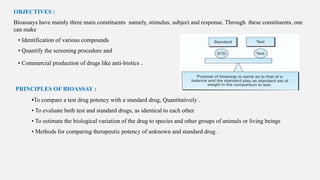
•To compare a test drug potency with a standard drug, Quantitatively .
• To evaluate both test and standard drugs, as identical to each other
• To estimate the biological variation of the drug to species and other groups of animals or living beings
• Methods for comparing therapeutic potency of unknown and standard drug .
ERRORS IN BIOASSAY :
☆ Biological variation
• Loss of tissue sensitivity.
• Different species/sex/age/weight/health status.
• Laboratory condition may be variable.
• Housing and handling of animals.
☆Methodological error
• Lack of standardization of procedure.
• Set-up of apparatus.
• Tissue isolation/preparation for experiment.
• Drug preparation or dilution.
TYPE OF TISSUE :
Preparation of tissues used in the isolated tissue experiments are broadly classified in two ways;
1. According to tissue/muscle obtained:
– Smooth muscle preparation, e.g.: Uterus,tracheal smooth muscle, vas deferens,
aorta, ileum, ascending or descending colon, etc.
-- Skeletal muscle, e.g.: Rectus abdominus muscle, etc.
– Cardiac muscle, e.g.: Frog heart etc.
2. According to response obtained by tissue/ muscle:
– Slow contracting tissue/muscle: For example: Frog rectus abdominus muscle, stomach fundus,
biventer cervicis muscle of chick, guinea pig tracheal smooth muscle, etc.
-- Fast contracting tissue/muscle: For example , Ileum, uterus, ascending and descending colon, etc.
IMPORTANCE / APPLICATIONS OF BIOASSAY:
1. Estimate potency of natural drug, for which chemical method is not known or established
2. Standardization of drugs of natural origin (plant and animal origin) whose structure or origin is unpredictable
3. Screening of new compound for biological activity
4. Estimation of biologically active substance like histamine, acetylcholine, 5-hydroxytryptamine, adrenaline,
bradykinin, substance P,prostaglandins, etc.
5. Estimation of ED50/TD50 and LD50.(Presently instead of LD50, NOAEL or LD10 is preferred).
CLASSIFICATION OF BIOASSAY
Broadly bioassay is classified into three groups namely,
1. Direct end point assay (DEPA)
2. Quantal assay (all or none assay)
3. Graded assay
a. Bracketing assay
b. Matching assay
c. Interpolation assay
d. Multiple point assay (3-point, 4-point, 6-point and 8-point.
1) Direct End-point Assay
In a direct assay, the threshold dose required for response is determined for each experimental unit. The principle
of direct assay is to measure direct response of dose of standard and test preparation. The ratio between these
doses estimates the potency of the test preparation relative to the standard.
In the procedure, the test or standard preparation is infused at a fixed rate into the circulation of animal until a direct
effect is observed in the animal. For example: stopping of heart beating after the continuous administration of
digitalis at the constant rate in the assay of digitalis in cats.
The threshold dose of standard = Total period of infusion × Rate of drug administration
Concentration of test = TDS / TDT ×CSD
Where,
TDS= Threshold dose of standard
TDT = Threshold dose of test
CSD = Concentration of standard drug
2) Quantal assay
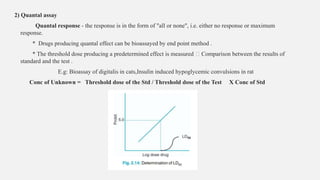
Quantal response - the response is in the form of "all or none", i.e. either no response or maximum
response.
* Drugs producing quantal effect can be bioassayed by end point method .
* The threshold dose producing a predetermined effect is measured Comparison between the results of
standard and the test .
E.g: Bioassay of digitalis in cats,Insulin induced hypoglycemic convulsions in rat
Conc of Unknown = Threshold dose of the Std / Threshold dose of the Test X Conc of Std
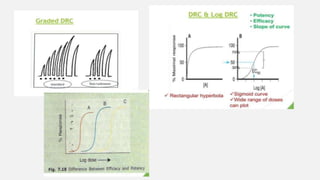
3)Graded assay
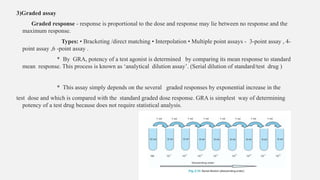
Graded response - response is proportional to the dose and response may lie between no response and the
maximum response.
Types: • Bracketing /direct matching • Interpolation • Multiple point assays - 3-point assay , 4-
point assay ,6 -point assay .
* By GRA, potency of a test agonist is determined by comparing its mean response to standard
mean response. This process is known as ‘analytical dilution assay’. (Serial dilution of standard/test drug )
* This assay simply depends on the several graded responses by exponential increase in the
test dose and which is compared with the standard graded dose response. GRA is simplest way of determining
potency of a test drug because does not require statistical analysis.
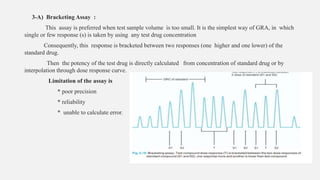
3-A) Bracketing Assay :
This assay is preferred when test sample volume is too small. It is the simplest way of GRA, in which
single or few response (s) is taken by using any test drug concentration
Consequently, this response is bracketed between two responses (one higher and one lower) of the
standard drug.
Then the potency of the test drug is directly calculated from concentration of standard drug or by
interpolation through dose response curve.
Limitation of the assay is
* poor precision
* reliability
* unable to calculate error.
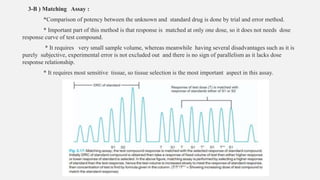
3-B ) Matching Assay :
*Comparison of potency between the unknown and standard drug is done by trial and error method.
* Important part of this method is that response is matched at only one dose, so it does not needs dose
response curve of test compound.
* It requires very small sample volume, whereas meanwhile having several disadvantages such as it is
purely subjective, experimental error is not excluded out and there is no sign of parallelism as it lacks dose
response relationship.
* It requires most sensitive tissue, so tissue selection is the most important aspect in this assay.
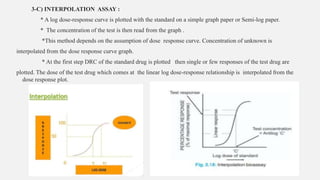
3-C) INTERPOLATION ASSAY :
* A log dose-response curve is plotted with the standard on a simple graph paper or Semi-log paper.
* The concentration of the test is then read from the graph .
*This method depends on the assumption of dose response curve. Concentration of unknown is
interpolated from the dose response curve graph.
* At the first step DRC of the standard drug is plotted then single or few responses of the test drug are
plotted. The dose of the test drug which comes at the linear log dose-response relationship is interpolated from the
dose response plot.
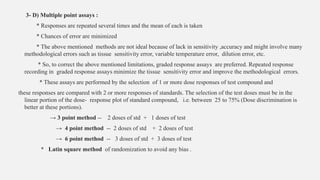
3- D) Multiple point assays :
* Responses are repeated several times and the mean of each is taken
* Chances of error are minimized
* The above mentioned methods are not ideal because of lack in sensitivity ,accuracy and might involve many
methodological errors such as tissue sensitivity error, variable temperature error, dilution error, etc.
* So, to correct the above mentioned limitations, graded response assays are preferred. Repeated response
recording in graded response assays minimize the tissue sensitivity error and improve the methodological errors.
* These assays are performed by the selection of 1 or more dose responses of test compound and
these responses are compared with 2 or more responses of standards. The selection of the test doses must be in the
linear portion of the dose- response plot of standard compound, i.e. between 25 to 75% (Dose discrimination is
better at these portions).
→ 3 point method -- 2 doses of std + 1 doses of test
→ 4 point method -- 2 doses of std + 2 doses of test
→ 6 point method -- 3 doses of std + 3 doses of test
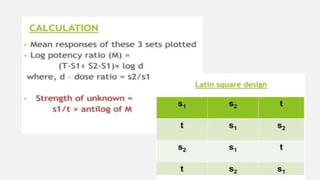
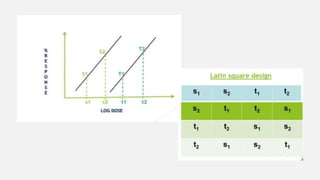
* Latin square method of randomization to avoid any bias .
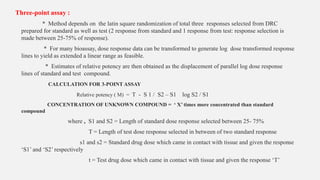
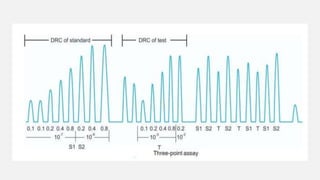
Three-point assay :
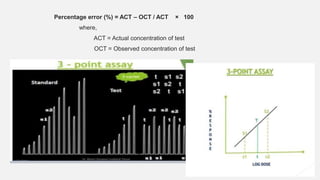
* Method depends on the latin square randomization of total three responses selected from DRC
prepared for standard as well as test (2 response from standard and 1 response from test: response selection is
made between 25-75% of response).
* For many bioassay, dose response data can be transformed to generate log dose transformed response
lines to yield as extended a linear range as feasible.
* Estimates of relative potency are then obtained as the displacement of parallel log dose response
lines of standard and test compound.
CALCULATION FOR 3-POINT ASSAY
Relative potency ( M) = T - S 1 / S2 – S1 log S2 / S1
CONCENTRATION OF UNKNOWN COMPOUND = ‘ X’ times more concentrated than standard
compound
where , S1 and S2 = Length of standard dose response selected between 25- 75%
T = Length of test dose response selected in between of two standard response
s1 and s2 = Standard drug dose which came in contact with tissue and given the response
‘S1’ and ‘S2’ respectively
t = Test drug dose which came in contact with tissue and given the response ‘T’
Percentage error (%) = ACT – OCT / ACT × 100
where,
ACT = Actual concentration of test
OCT = Observed concentration of test
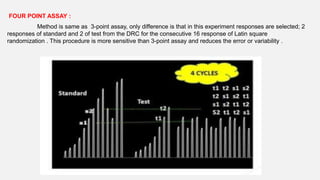
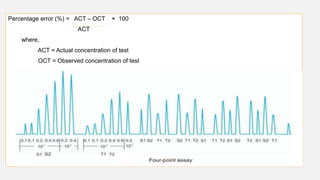
FOUR POINT ASSAY :
Method is same as 3-point assay, only difference is that in this experiment responses are selected; 2
responses of standard and 2 of test from the DRC for the consecutive 16 response of Latin square
randomization . This procedure is more sensitive than 3-point assay and reduces the error or variability .
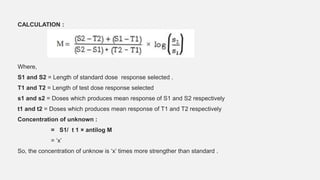
CALCULATION :
Where,
S1 and S2 = Length of standard dose response selected .
T1 and T2 = Length of test dose response selected
s1 and s2 = Doses which produces mean response of S1 and S2 respectively
t1 and t2 = Doses which produces mean response of T1 and T2 respectively
Concentration of unknown :
= S1/ t 1 × antilog M
= ‘x’
So, the concentration of unknow is ‘x’ times more strengther than standard .
Percentage error (%) = ACT – OCT × 100
ACT
where,
ACT = Actual concentration of test
OCT = Observed concentration of test
6-point and 8-point Assay :
These methods of bioassays are generally not adopted for the experiment purpose
because of the time consuming lengthy procedure. The responses obtained for the 6-point is ‘36’
and ‘64’ for 8-point. But, the advantage being reduced error and variability of the procedure over
other methods due to the large number of responses and hence have greater specificity.
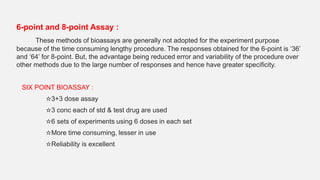
SIX POINT BIOASSAY :
☆3+3 dose assay
☆3 conc each of std & test drug are used
☆6 sets of experiments using 6 doses in each set
☆More time consuming, lesser in use
☆Reliability is excellent
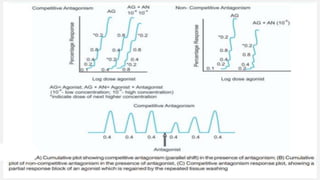
Cumulative Dose Response Curve
●Increase conc of drug in bath fluid step by stepwithout washing out the preceeding doses
●Continue till supramaximal effect is seen
● Dose response curve is plotted
THANK YOU ..

Bioassay.pptx

  • 1.
  • 2.
    BIOASSAY: • ‘Bio’means livingmaterial ‘Assay’ means assessment at Laboratory, i.e. assessment of unknown substance on any living tissue . • Bioassay is defined as comparative assessment of relative potency of a test compound (T) to a standard compound (S) on any living animal or biological tissue. • This procedure is for determining the quantitative relationship between the concentrations (dose) and magnitude of response. • A bioassay experiment may be quantal or quantitative, direct or indirect. a) Qualitative bioassays are used for assessing the physical effects of a substance that may not be quantified, such as abnormal development or deformity . b)quantitative bioassay assessed at the laboratory level and the concentration or drug dose can be evaluated. IMPORTANT CRITERIA : *reliability *specificity *accuracy *sensitivity and * probability
  • 3.
    OBJECTIVES : Bioassays havemainly three main constituents namely, stimulus, subject and response. Through these constituents, one can make • Identification of various compounds • Quantify the screening procedure and • Commercial production of drugs like anti-biotics . PRINCIPLES OF BIOASSAY : •To compare a test drug potency with a standard drug, Quantitatively . • To evaluate both test and standard drugs, as identical to each other • To estimate the biological variation of the drug to species and other groups of animals or living beings • Methods for comparing therapeutic potency of unknown and standard drug .
  • 4.
    ERRORS IN BIOASSAY: ☆ Biological variation • Loss of tissue sensitivity. • Different species/sex/age/weight/health status. • Laboratory condition may be variable. • Housing and handling of animals. ☆Methodological error • Lack of standardization of procedure. • Set-up of apparatus. • Tissue isolation/preparation for experiment. • Drug preparation or dilution.
  • 5.
    TYPE OF TISSUE: Preparation of tissues used in the isolated tissue experiments are broadly classified in two ways; 1. According to tissue/muscle obtained: – Smooth muscle preparation, e.g.: Uterus,tracheal smooth muscle, vas deferens, aorta, ileum, ascending or descending colon, etc. -- Skeletal muscle, e.g.: Rectus abdominus muscle, etc. – Cardiac muscle, e.g.: Frog heart etc. 2. According to response obtained by tissue/ muscle: – Slow contracting tissue/muscle: For example: Frog rectus abdominus muscle, stomach fundus, biventer cervicis muscle of chick, guinea pig tracheal smooth muscle, etc. -- Fast contracting tissue/muscle: For example , Ileum, uterus, ascending and descending colon, etc.
  • 6.
    IMPORTANCE / APPLICATIONSOF BIOASSAY: 1. Estimate potency of natural drug, for which chemical method is not known or established 2. Standardization of drugs of natural origin (plant and animal origin) whose structure or origin is unpredictable 3. Screening of new compound for biological activity 4. Estimation of biologically active substance like histamine, acetylcholine, 5-hydroxytryptamine, adrenaline, bradykinin, substance P,prostaglandins, etc. 5. Estimation of ED50/TD50 and LD50.(Presently instead of LD50, NOAEL or LD10 is preferred). CLASSIFICATION OF BIOASSAY Broadly bioassay is classified into three groups namely, 1. Direct end point assay (DEPA) 2. Quantal assay (all or none assay) 3. Graded assay a. Bracketing assay b. Matching assay c. Interpolation assay d. Multiple point assay (3-point, 4-point, 6-point and 8-point.
  • 7.
    1) Direct End-pointAssay In a direct assay, the threshold dose required for response is determined for each experimental unit. The principle of direct assay is to measure direct response of dose of standard and test preparation. The ratio between these doses estimates the potency of the test preparation relative to the standard. In the procedure, the test or standard preparation is infused at a fixed rate into the circulation of animal until a direct effect is observed in the animal. For example: stopping of heart beating after the continuous administration of digitalis at the constant rate in the assay of digitalis in cats. The threshold dose of standard = Total period of infusion × Rate of drug administration Concentration of test = TDS / TDT ×CSD Where, TDS= Threshold dose of standard TDT = Threshold dose of test CSD = Concentration of standard drug
  • 8.
    2) Quantal assay Quantalresponse - the response is in the form of "all or none", i.e. either no response or maximum response. * Drugs producing quantal effect can be bioassayed by end point method . * The threshold dose producing a predetermined effect is measured Comparison between the results of standard and the test . E.g: Bioassay of digitalis in cats,Insulin induced hypoglycemic convulsions in rat Conc of Unknown = Threshold dose of the Std / Threshold dose of the Test X Conc of Std
  • 9.
    3)Graded assay Graded response- response is proportional to the dose and response may lie between no response and the maximum response. Types: • Bracketing /direct matching • Interpolation • Multiple point assays - 3-point assay , 4- point assay ,6 -point assay . * By GRA, potency of a test agonist is determined by comparing its mean response to standard mean response. This process is known as ‘analytical dilution assay’. (Serial dilution of standard/test drug ) * This assay simply depends on the several graded responses by exponential increase in the test dose and which is compared with the standard graded dose response. GRA is simplest way of determining potency of a test drug because does not require statistical analysis.
  • 11.
    3-A) Bracketing Assay: This assay is preferred when test sample volume is too small. It is the simplest way of GRA, in which single or few response (s) is taken by using any test drug concentration Consequently, this response is bracketed between two responses (one higher and one lower) of the standard drug. Then the potency of the test drug is directly calculated from concentration of standard drug or by interpolation through dose response curve. Limitation of the assay is * poor precision * reliability * unable to calculate error.
  • 12.
    3-B ) MatchingAssay : *Comparison of potency between the unknown and standard drug is done by trial and error method. * Important part of this method is that response is matched at only one dose, so it does not needs dose response curve of test compound. * It requires very small sample volume, whereas meanwhile having several disadvantages such as it is purely subjective, experimental error is not excluded out and there is no sign of parallelism as it lacks dose response relationship. * It requires most sensitive tissue, so tissue selection is the most important aspect in this assay.
  • 13.
    3-C) INTERPOLATION ASSAY: * A log dose-response curve is plotted with the standard on a simple graph paper or Semi-log paper. * The concentration of the test is then read from the graph . *This method depends on the assumption of dose response curve. Concentration of unknown is interpolated from the dose response curve graph. * At the first step DRC of the standard drug is plotted then single or few responses of the test drug are plotted. The dose of the test drug which comes at the linear log dose-response relationship is interpolated from the dose response plot.
  • 14.
    3- D) Multiplepoint assays : * Responses are repeated several times and the mean of each is taken * Chances of error are minimized * The above mentioned methods are not ideal because of lack in sensitivity ,accuracy and might involve many methodological errors such as tissue sensitivity error, variable temperature error, dilution error, etc. * So, to correct the above mentioned limitations, graded response assays are preferred. Repeated response recording in graded response assays minimize the tissue sensitivity error and improve the methodological errors. * These assays are performed by the selection of 1 or more dose responses of test compound and these responses are compared with 2 or more responses of standards. The selection of the test doses must be in the linear portion of the dose- response plot of standard compound, i.e. between 25 to 75% (Dose discrimination is better at these portions). → 3 point method -- 2 doses of std + 1 doses of test → 4 point method -- 2 doses of std + 2 doses of test → 6 point method -- 3 doses of std + 3 doses of test * Latin square method of randomization to avoid any bias .
  • 15.
    Three-point assay : *Method depends on the latin square randomization of total three responses selected from DRC prepared for standard as well as test (2 response from standard and 1 response from test: response selection is made between 25-75% of response). * For many bioassay, dose response data can be transformed to generate log dose transformed response lines to yield as extended a linear range as feasible. * Estimates of relative potency are then obtained as the displacement of parallel log dose response lines of standard and test compound. CALCULATION FOR 3-POINT ASSAY Relative potency ( M) = T - S 1 / S2 – S1 log S2 / S1 CONCENTRATION OF UNKNOWN COMPOUND = ‘ X’ times more concentrated than standard compound where , S1 and S2 = Length of standard dose response selected between 25- 75% T = Length of test dose response selected in between of two standard response s1 and s2 = Standard drug dose which came in contact with tissue and given the response ‘S1’ and ‘S2’ respectively t = Test drug dose which came in contact with tissue and given the response ‘T’
  • 16.
    Percentage error (%)= ACT – OCT / ACT × 100 where, ACT = Actual concentration of test OCT = Observed concentration of test
  • 19.
    FOUR POINT ASSAY: Method is same as 3-point assay, only difference is that in this experiment responses are selected; 2 responses of standard and 2 of test from the DRC for the consecutive 16 response of Latin square randomization . This procedure is more sensitive than 3-point assay and reduces the error or variability .
  • 21.
    CALCULATION : Where, S1 andS2 = Length of standard dose response selected . T1 and T2 = Length of test dose response selected s1 and s2 = Doses which produces mean response of S1 and S2 respectively t1 and t2 = Doses which produces mean response of T1 and T2 respectively Concentration of unknown : = S1/ t 1 × antilog M = ‘x’ So, the concentration of unknow is ‘x’ times more strengther than standard .
  • 22.
    Percentage error (%)= ACT – OCT × 100 ACT where, ACT = Actual concentration of test OCT = Observed concentration of test
  • 23.
    6-point and 8-pointAssay : These methods of bioassays are generally not adopted for the experiment purpose because of the time consuming lengthy procedure. The responses obtained for the 6-point is ‘36’ and ‘64’ for 8-point. But, the advantage being reduced error and variability of the procedure over other methods due to the large number of responses and hence have greater specificity. SIX POINT BIOASSAY : ☆3+3 dose assay ☆3 conc each of std & test drug are used ☆6 sets of experiments using 6 doses in each set ☆More time consuming, lesser in use ☆Reliability is excellent
  • 24.
    Cumulative Dose ResponseCurve ●Increase conc of drug in bath fluid step by stepwithout washing out the preceeding doses ●Continue till supramaximal effect is seen ● Dose response curve is plotted
  • 26.