Presented by:
Ravindra Saroj
(1ST YEAR M. PHARM )
DEPARTMENT OF PHARMACOLOGY
UNDER THE GUIDANCE OF MRS. PUSHPALATA CHOUGULE
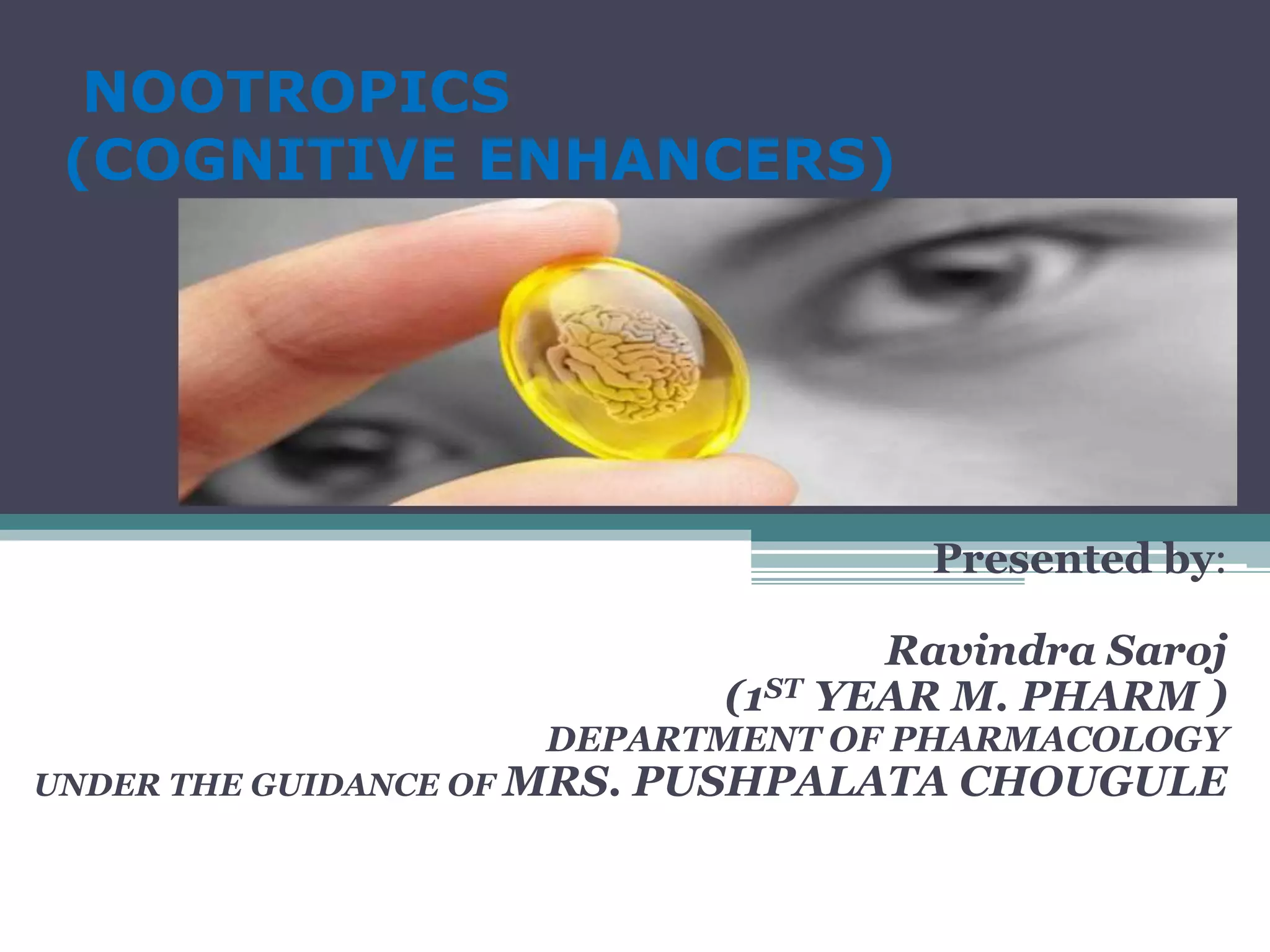
NOOTROPICS
(COGNITIVE ENHANCERS)
Content
 Introduction
Classification
MOA
Screening Methods
Applications
References
NOOTROPICS
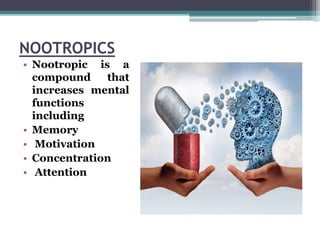
• Nootropic is a
compound that
increases mental
functions
including
• Memory
• Motivation
• Concentration
• Attention
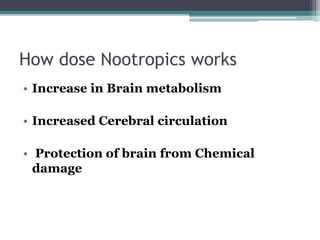
How dose Nootropics works
• Increase in Brain metabolism
• Increased Cerebral circulation
• Protection of brain from Chemical
damage
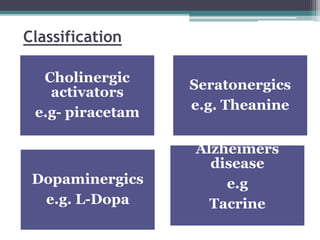
Classification
Cholinergic
activators
e.g- piracetam
Seratonergics
e.g. Theanine
Dopaminergics
e.g. L-Dopa
Alzheimers
disease
e.g
Tacrine
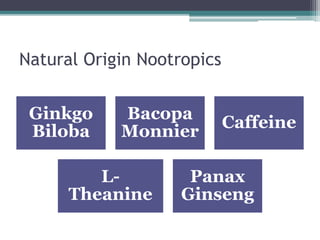
Natural Origin Nootropics
Ginkgo
Biloba
Bacopa
Monnier
Caffeine
L-
Theanine
Panax
Ginseng
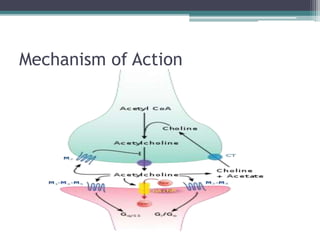
Mechanism of Action
Screening Methods
In Vitro
• inhibition of acetyl cholinesterase activity in rat
striatum
In Vivo
• Avoidance learning
1. Passive Avoidance
2. Active Avoidance
In Vitro
• In vitro inhibition of acetylcholine-
esterase activity in rat striatum
PURPOSE AND RATIONALE
• The purpose of this assay is to screen drugs for
inhibition of acetylcholine-esterase activity.
• Acetylcholinesterase (AChE) which is sometimes
called true or specific cholinesterase, is found in
nerve cells, skeletal muscle, smooth muscle, various
glands and red blood cells .
TISSUE PREPARATION
Male Wistar rats are decapitated & brains rapidly removed, weighed and
homogenized in solvent.
This suspension is added to 1 ml of the vehicle or various concentrations of the test
drug and reincubated for 10 minutes at 37°C.
PROCEDURE
A 2 ml stock solution of the test drug made up in a suitable solvent and q.s.
to volume with 0.50mM DTNB.(dithionitrobenzoic acid )
Drug are serially diluted (1:10) such that the final conc.(in cuvette ) is 10-4
ml and screened for activity.
IC 50 (half maximal inhibitory concentration)values are determined from
the inhibitory activity .
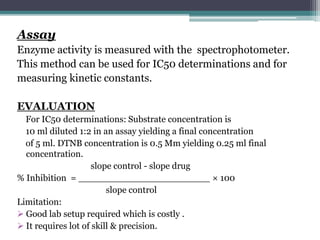
Assay
Enzyme activity is measured with the spectrophotometer.
This method can be used for IC50 determinations and for
measuring kinetic constants.
EVALUATION
For IC50 determinations: Substrate concentration is
10 ml diluted 1:2 in an assay yielding a final concentration
of 5 ml. DTNB concentration is 0.5 Mm yielding 0.25 ml final
concentration.
slope control - slope drug
% Inhibition = _______________________ × 100
slope control
Limitation:
 Good lab setup required which is costly .
 It requires lot of skill & precision.
In Vivo
• Avoidance Learning
Active Avoidance:
• Active performance of a certain response prevent the
dislike stimulus.
Passive Aovidance :
• Withholding a response prevents the dislike outcome.
Passive Avoidance
Training:
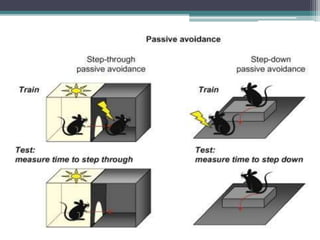
• The testing apparatus is a trough-shaped alley divided into two distinct
compartments that are separated by a sliding door. The white, brightly lit
compartment is free of aversive stimulation whereas the black, dark compartment is
equipped with shock capability.
• The training trial begins by placing the animal in the white compartment facing the
door.
• The door is opened to allow access to the dark compartment
• The latency to enter the dark compartment is recorded.
• When the animal steps into the dark compartment with all four paws, the door is
closed and a 1-2 second foot shock is delivered
• The animal remains in the dark compartment for an additional 10 seconds after the
termination of the aversive stimulus before being removed and placed back into its
home cage.
TEST TRIAL:
• At the time of the test trial (usually 1-7 days after training), the animal is again placed
inside the white compartment and the door is raised to allow access to the dark
compartment.
• The latency to re-enter the dark compartment is recorded; however, there is
noaversive stimulus applied to animal upon re-entry into the dark compartment
during testing.
The apparatus is cleaned with 70% ethanol in between animals.
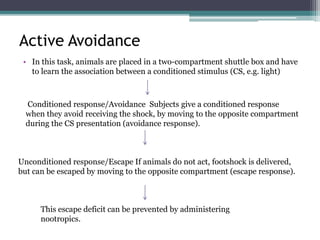
Active Avoidance
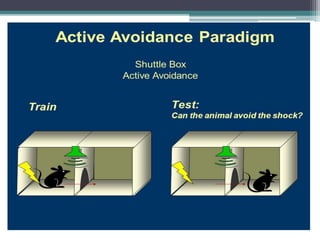
• In this task, animals are placed in a two-compartment shuttle box and have
to learn the association between a conditioned stimulus (CS, e.g. light)
Conditioned response/Avoidance Subjects give a conditioned response
when they avoid receiving the shock, by moving to the opposite compartment
during the CS presentation (avoidance response).
Unconditioned response/Escape If animals do not act, footshock is delivered,
but can be escaped by moving to the opposite compartment (escape response).
This escape deficit can be prevented by administering
nootropics.
EVALUATION
The time the animal need to reach the safe area
on both days is measured.
In additin numbers of errors are recorded.( not
reaching thevsafe area)
Application:
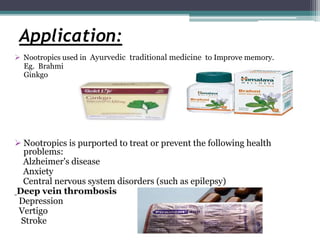
 Nootropics used in Ayurvedic traditional medicine to Improve memory.
Eg. Brahmi
Ginkgo
 Nootropics is purported to treat or prevent the following health
problems:
Alzheimer's disease
Anxiety
Central nervous system disorders (such as epilepsy)
Deep vein thrombosis
Depression
Vertigo
Stroke
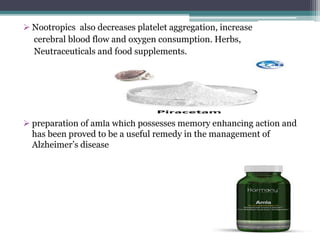
 Nootropics also decreases platelet aggregation, increase
cerebral blood flow and oxygen consumption. Herbs,
Neutraceuticals and food supplements.
 preparation of amla which possesses memory enhancing action and
has been proved to be a useful remedy in the management of
Alzheimer’s disease
REFERENCE
Tripathi .K.D.; CNS stimulants and cognition enhancers.
In: Essentials of medical pharmacology ;Edn no 5, Publis
her: Jaypee brothers EMCA house , New Delhi.
pp: 435 – 442.
 H.Gerhard Vogel and Wolfgang.H.Vogel.Psychotropic a
nd neurotropic activity,In; Drug Discovery and Evaluatio
n, 5th edition,Springer-Verlag Berlein Heidelberg,Germa
ny, pp-496-548.
Thank you

Nootropics (M.Pharm)

  • 1.
    Presented by: Ravindra Saroj (1STYEAR M. PHARM ) DEPARTMENT OF PHARMACOLOGY UNDER THE GUIDANCE OF MRS. PUSHPALATA CHOUGULE NOOTROPICS (COGNITIVE ENHANCERS)
  • 2.
  • 3.
    NOOTROPICS • Nootropic isa compound that increases mental functions including • Memory • Motivation • Concentration • Attention
  • 4.
    How dose Nootropicsworks • Increase in Brain metabolism • Increased Cerebral circulation • Protection of brain from Chemical damage
  • 5.
  • 6.
  • 7.
  • 8.
    Screening Methods In Vitro •inhibition of acetyl cholinesterase activity in rat striatum In Vivo • Avoidance learning 1. Passive Avoidance 2. Active Avoidance
  • 9.
    In Vitro • Invitro inhibition of acetylcholine- esterase activity in rat striatum PURPOSE AND RATIONALE • The purpose of this assay is to screen drugs for inhibition of acetylcholine-esterase activity. • Acetylcholinesterase (AChE) which is sometimes called true or specific cholinesterase, is found in nerve cells, skeletal muscle, smooth muscle, various glands and red blood cells .
  • 10.
    TISSUE PREPARATION Male Wistarrats are decapitated & brains rapidly removed, weighed and homogenized in solvent. This suspension is added to 1 ml of the vehicle or various concentrations of the test drug and reincubated for 10 minutes at 37°C. PROCEDURE A 2 ml stock solution of the test drug made up in a suitable solvent and q.s. to volume with 0.50mM DTNB.(dithionitrobenzoic acid ) Drug are serially diluted (1:10) such that the final conc.(in cuvette ) is 10-4 ml and screened for activity. IC 50 (half maximal inhibitory concentration)values are determined from the inhibitory activity .
  • 11.
    Assay Enzyme activity ismeasured with the spectrophotometer. This method can be used for IC50 determinations and for measuring kinetic constants. EVALUATION For IC50 determinations: Substrate concentration is 10 ml diluted 1:2 in an assay yielding a final concentration of 5 ml. DTNB concentration is 0.5 Mm yielding 0.25 ml final concentration. slope control - slope drug % Inhibition = _______________________ × 100 slope control Limitation:  Good lab setup required which is costly .  It requires lot of skill & precision.
  • 12.
    In Vivo • AvoidanceLearning Active Avoidance: • Active performance of a certain response prevent the dislike stimulus. Passive Aovidance : • Withholding a response prevents the dislike outcome.
  • 13.
    Passive Avoidance Training: • Thetesting apparatus is a trough-shaped alley divided into two distinct compartments that are separated by a sliding door. The white, brightly lit compartment is free of aversive stimulation whereas the black, dark compartment is equipped with shock capability. • The training trial begins by placing the animal in the white compartment facing the door. • The door is opened to allow access to the dark compartment • The latency to enter the dark compartment is recorded. • When the animal steps into the dark compartment with all four paws, the door is closed and a 1-2 second foot shock is delivered
  • 14.
    • The animalremains in the dark compartment for an additional 10 seconds after the termination of the aversive stimulus before being removed and placed back into its home cage. TEST TRIAL: • At the time of the test trial (usually 1-7 days after training), the animal is again placed inside the white compartment and the door is raised to allow access to the dark compartment. • The latency to re-enter the dark compartment is recorded; however, there is noaversive stimulus applied to animal upon re-entry into the dark compartment during testing. The apparatus is cleaned with 70% ethanol in between animals.
  • 16.
    Active Avoidance • Inthis task, animals are placed in a two-compartment shuttle box and have to learn the association between a conditioned stimulus (CS, e.g. light) Conditioned response/Avoidance Subjects give a conditioned response when they avoid receiving the shock, by moving to the opposite compartment during the CS presentation (avoidance response). Unconditioned response/Escape If animals do not act, footshock is delivered, but can be escaped by moving to the opposite compartment (escape response). This escape deficit can be prevented by administering nootropics.
  • 17.
    EVALUATION The time theanimal need to reach the safe area on both days is measured. In additin numbers of errors are recorded.( not reaching thevsafe area)
  • 19.
    Application:  Nootropics usedin Ayurvedic traditional medicine to Improve memory. Eg. Brahmi Ginkgo  Nootropics is purported to treat or prevent the following health problems: Alzheimer's disease Anxiety Central nervous system disorders (such as epilepsy) Deep vein thrombosis Depression Vertigo Stroke
  • 20.
     Nootropics alsodecreases platelet aggregation, increase cerebral blood flow and oxygen consumption. Herbs, Neutraceuticals and food supplements.  preparation of amla which possesses memory enhancing action and has been proved to be a useful remedy in the management of Alzheimer’s disease
  • 21.
    REFERENCE Tripathi .K.D.; CNSstimulants and cognition enhancers. In: Essentials of medical pharmacology ;Edn no 5, Publis her: Jaypee brothers EMCA house , New Delhi. pp: 435 – 442.  H.Gerhard Vogel and Wolfgang.H.Vogel.Psychotropic a nd neurotropic activity,In; Drug Discovery and Evaluatio n, 5th edition,Springer-Verlag Berlein Heidelberg,Germa ny, pp-496-548.
  • 22.