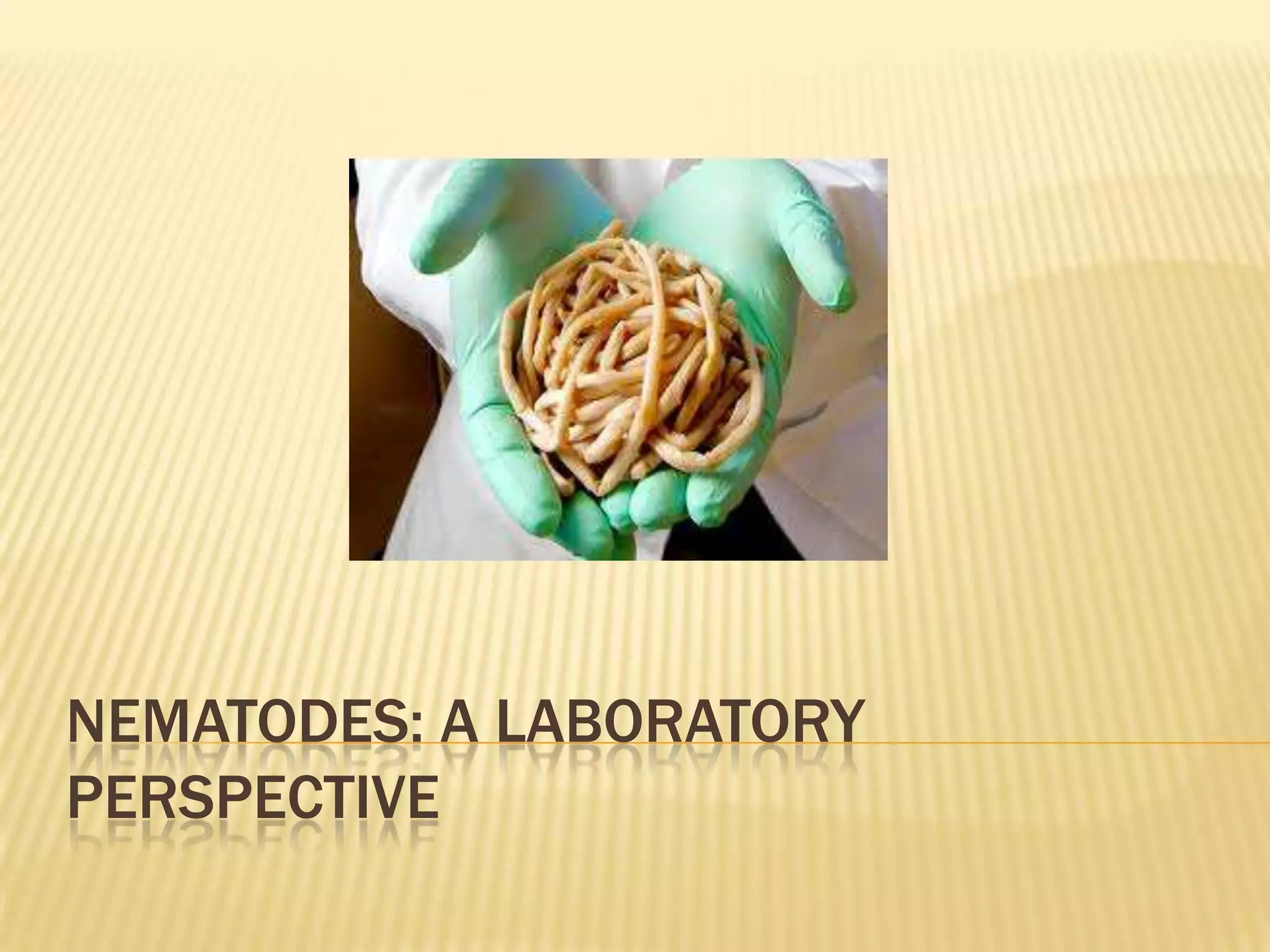
NEMATODES: A LABORATORY
PERSPECTIVE
GENERAL CHARACTERISTICS OF NEMATODES

   They assume three basic morphologic
   forms: Egg, Larvae and Adult worms


   Reproduce sexually with male and
   female worms


   Complete digestive tract and
   complete reproductive systems
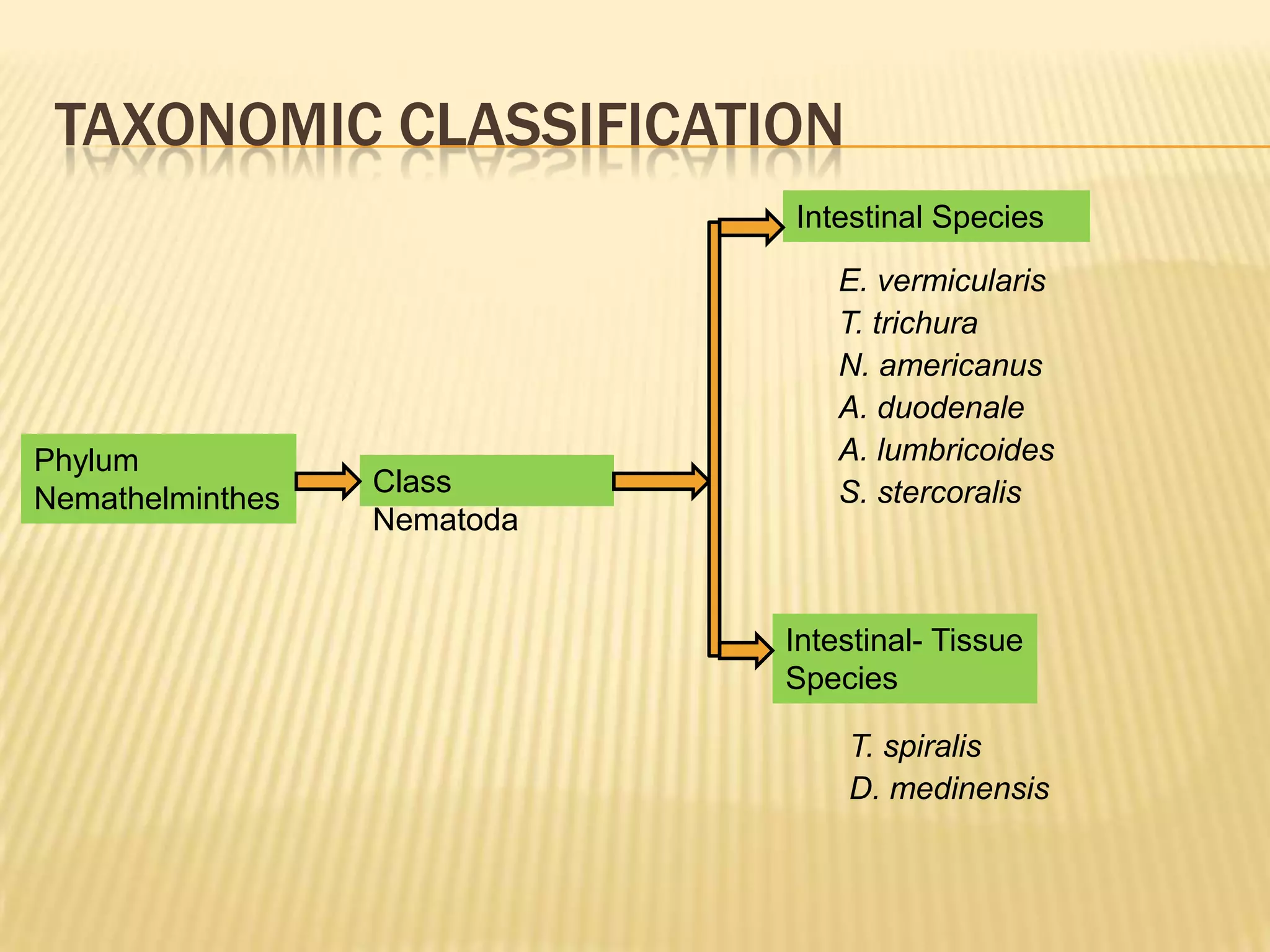
TAXONOMIC CLASSIFICATION
                             Intestinal Species

                                 E. vermicularis
                                 T. trichura
                                 N. americanus
                                 A. duodenale
Phylum                           A. lumbricoides
                  Class          S. stercoralis
Nemathelminthes
                  Nematoda


                             Intestinal- Tissue
                             Species

                                 T. spiralis
                                 D. medinensis
ASCARIS LUMBRICOIDES


                        Ascaris lumbricoides
        Common Name          Giant Intestinal Roundworm
         Infective Stage     Embryonated Egg
             Habitat         Small Intestine
      Mode of Transmission   Ingestion of contaminated food/ water
      Diagnostic Specimen    Feces
ASCARIS LUMBRICOIDES 2


           A. lumbricoides Adult worms
ENTEROBIUS VERMICULARIS


                        Enterobius vermicularis
     Common Name        Pinworm
      Infective Stage   Embryonated Egg
          Habitat       Large Intestine
   Mode of Transmission Ingestion of egg/ autoinfection
   Diagnostic Specimen Feces/ Cellophane Tape prep
TRICHURIS TRICHURA


                             Trichuris trichura
     Common Name        Whipworm
      Infective Stage   Embryonated Egg
          Habitat       Large Intestine
   Mode of Transmission Ingestion of egg via contaminated food/ water
   Diagnostic Specimen Feces
TRICHURIS TRICHURA 2
NECATOR AMERICANUS AND ANCYLOSTOMA
DUODENALE


                 Necator americanus and Ancylostoma duodenale
  Common Name         Hookworm
   Infective Stage    Third Stage Filariform Larvae
       Habitat        Small Intestine
Mode of Transmission Skin Penetration of Infective Larvae
Diagnostic Specimen Feces
HOOKWORMS 2


    A. duodenale   N. americanus
STRONGYLOIDES STERCORALIS


                            Strongyloides stercoralis
   Common Name        Threadworm
    Infective Stage   Third Stage Filariform Larvae
        Habitat       duodenum and upper jejunum
 Mode of Transmission Skin Penetration of Infective Larvae/ autoinfection
 Diagnostic Specimen Feces
TRICHINELLA SPIRALIS


                                  Trichinella spiralis
      Common Name        Trichinia worm
       Infective Stage   Encysted Larvae
           Habitat       Striated muscle tissue
          Mode of
        Transmission    Ingestion of raw/ undercooked contaminated meat
    Diagnostic Specimen skeletal muscle biopsy/ Blood (LDH, Aldolase, CPK, eo ct)
CAPILLARIA PHILIPPINENSIS


                                Capillaria philippinensis
     Common Name          NA
      Infective Stage     Encysted Larvae
          Habitat         Small Intestine
   Mode of Transmission   Ingestion of raw/ undercooked contaminated fish
   Diagnostic Specimen    Feces
THE FILARIAE- GENERAL CHARACTERISTICS
  Two morphologic forms: Adult worms and
  Microfilariae

  Adult worms are usually creamy
  white and assume a filariform shape

  Have both male and female
  forms
  Females lay live microfliariae

  Require arthropod vectors

  Exhibit periodicity
  (Nocturnal/ diurnal)
WUCHERERIA BANCROFTI


                                 Wuchereria bancrofti
    Common Name        Bancroft's Filaria
     Infective Stage   L3 Larva
         Habitat       Lymphatics and blood
  Mode of Transmission Bite from infected mosquito (Culex, Aedes or Anopheles)
  Diagnostic Specimen Giemsa stained smear (collected at night)/ Knott's Technique
BRUGIA MALAYI


                                     Brugia malayi
   Common Name        Malayan Filaria
    Infective Stage   L3 Larva
        Habitat       Lymphatics and Blood
                      Bite from infected mosquito ( Anopheles, Aedes, Mansonia,
 Mode of Transmission Amigeres)
 Diagnostic Specimen Giemsa stained smear (collected at night)/ Knott's Technique
WUCHERERIA BANCROFTI V.S. BRUGIA MALAYI

       Distinguishing         Wuchereria            Brugia malayi
       Characteristics         bancrofti
      Sheath in Giemsa         unstained                 Pink
           Nuclei           Regularly spaced,     Irregularly spaced
                           separately situated     and overlapping
            Tail                  none           Single row of nuclei
                                                 that reach tail’s end
       Terminal Nuclei           None               2 nuclei, which
                                                   bulge the cuticle;
                                                     conspicuously
                                                        placed
     Appearance in Blood    Smoothly curved              Kinky
            film
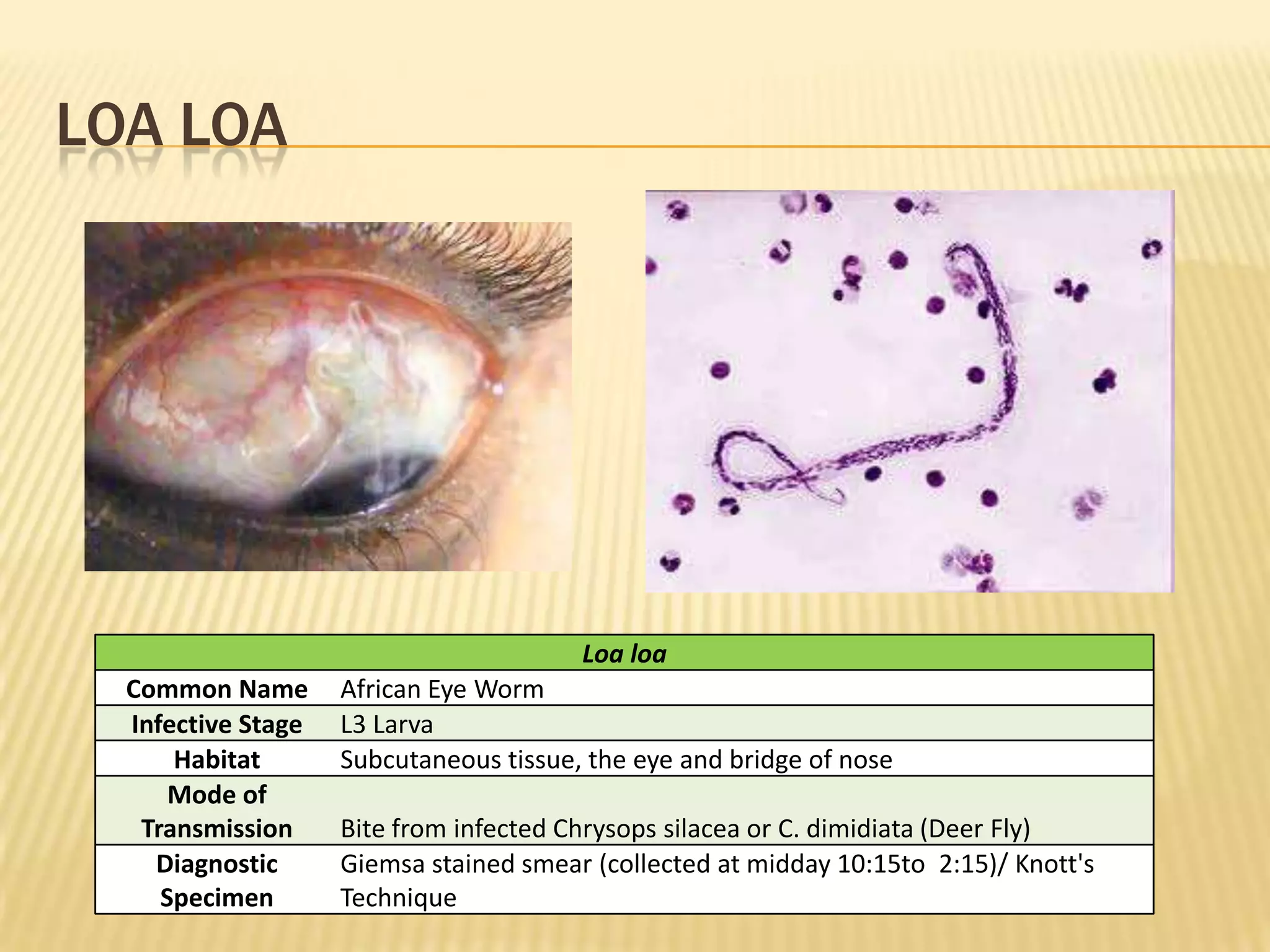
LOA LOA


                                        Loa loa
  Common Name       African Eye Worm
  Infective Stage   L3 Larva
      Habitat       Subcutaneous tissue, the eye and bridge of nose
      Mode of
   Transmission     Bite from infected Chrysops silacea or C. dimidiata (Deer Fly)
    Diagnostic      Giemsa stained smear (collected at midday 10:15to 2:15)/ Knott's
     Specimen       Technique
ONCHOCERCA VOLVULUS


                             Onchocerca volvulus
     Common Name        Blinding Filaria
      Infective Stage   L3 Larva
          Habitat       Subcutaneous tissue, nodules and eyes
   Mode of Transmission Bite from infected Simulium Blackfly
   Diagnostic Specimen Giemsa stained smear of skin snips
MANSONELLA OZZARDI AND MANSONELLA
PERSTANS


                        Mansonella ozzardi and Mansonella perstans
   Common Name Ozzard's Filaria and Perstans Filaria
    Infective Stage   L3 Larva
        Habitat       Blood and various tissue
 Mode of Transmission Bite from infected Simulium Blackfly or Culicoides (sucking midge fly)
 Diagnostic Specimen Fresh Giemsa stained blood smear
Long Quiz next meeting?


                             The End
PART 2: KATO-KATZ, KATO-THICK AND
CONCENTRATION TECHNIQUES
KATO KATZ TECHNIQUE


                      Step 2
     Step 1
KATO-KATZ TECHNIQUE CONT’D


                Step 3
KATO-KATZ TECHNIQUE CONT’D


     Step 4                  Step 5
KATO-KATZ TECHNIQUE CONT’D


               Step 6
KATO-KATZ TECHNIQUE CONT’D


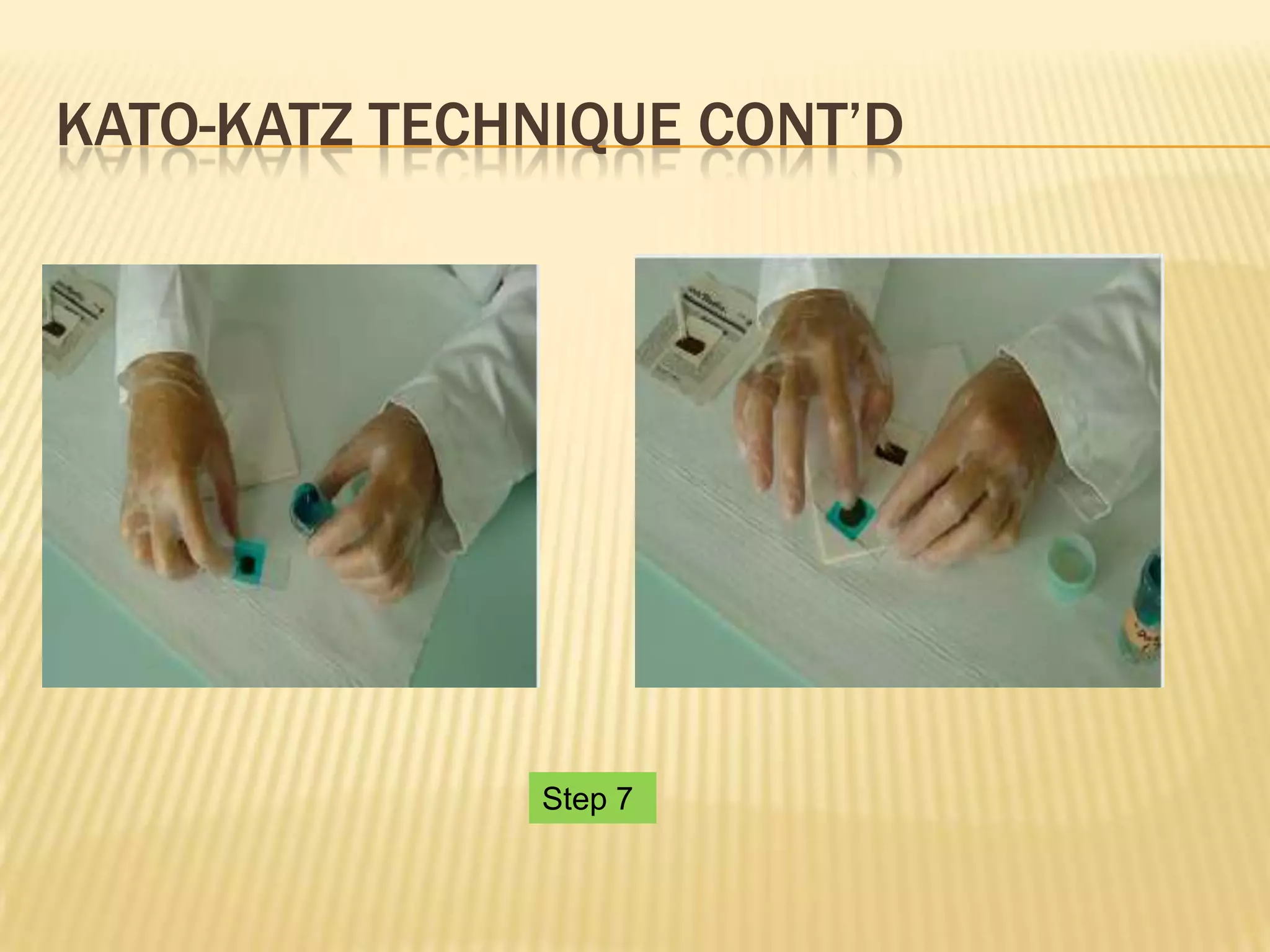
              Step 7
KATO-KATZ TECHNIQUE CONT’D
CONCENTRATION TECHNIQUES


Flotation                         Sedimentation
Techniques                        Techniques
       Acid Ether Concentration       Zinc Sulfate FT
       Technique
                                      Sheather’s Sugar
      Formalin-Ether CT               FT
                                      Brine Flotation T
FORMALIN- ETHER CONCENTRATION TECHNIQUE
(FECT)


                          Ethyl
                          Acetate


                         Plug of debris


                          Formalin


                         Sediment
ACID ETHER CONCENTRATION TECHNIQUE
(AECT)


                          Ethyl
                          Acetate


                         Plug of debris


                          HCl


                         Sediment
ZINC SULFATE FLOTATION TECHNIQUE

                       Floating Material


                          Zinc Sulfate Sol’n
HARADA MORI CULTURE

                      Culture Tube


                        Strip of filter paper


                      Smear of Feces


                       water

Nematodes

  • 1.
  • 2.
    GENERAL CHARACTERISTICS OFNEMATODES They assume three basic morphologic forms: Egg, Larvae and Adult worms Reproduce sexually with male and female worms Complete digestive tract and complete reproductive systems
  • 3.
    TAXONOMIC CLASSIFICATION Intestinal Species E. vermicularis T. trichura N. americanus A. duodenale Phylum A. lumbricoides Class S. stercoralis Nemathelminthes Nematoda Intestinal- Tissue Species T. spiralis D. medinensis
  • 4.
    ASCARIS LUMBRICOIDES Ascaris lumbricoides Common Name Giant Intestinal Roundworm Infective Stage Embryonated Egg Habitat Small Intestine Mode of Transmission Ingestion of contaminated food/ water Diagnostic Specimen Feces
  • 5.
    ASCARIS LUMBRICOIDES 2 A. lumbricoides Adult worms
  • 6.
    ENTEROBIUS VERMICULARIS Enterobius vermicularis Common Name Pinworm Infective Stage Embryonated Egg Habitat Large Intestine Mode of Transmission Ingestion of egg/ autoinfection Diagnostic Specimen Feces/ Cellophane Tape prep
  • 7.
    TRICHURIS TRICHURA Trichuris trichura Common Name Whipworm Infective Stage Embryonated Egg Habitat Large Intestine Mode of Transmission Ingestion of egg via contaminated food/ water Diagnostic Specimen Feces
  • 8.
  • 9.
    NECATOR AMERICANUS ANDANCYLOSTOMA DUODENALE Necator americanus and Ancylostoma duodenale Common Name Hookworm Infective Stage Third Stage Filariform Larvae Habitat Small Intestine Mode of Transmission Skin Penetration of Infective Larvae Diagnostic Specimen Feces
  • 10.
    HOOKWORMS 2 A. duodenale N. americanus
  • 11.
    STRONGYLOIDES STERCORALIS Strongyloides stercoralis Common Name Threadworm Infective Stage Third Stage Filariform Larvae Habitat duodenum and upper jejunum Mode of Transmission Skin Penetration of Infective Larvae/ autoinfection Diagnostic Specimen Feces
  • 12.
    TRICHINELLA SPIRALIS Trichinella spiralis Common Name Trichinia worm Infective Stage Encysted Larvae Habitat Striated muscle tissue Mode of Transmission Ingestion of raw/ undercooked contaminated meat Diagnostic Specimen skeletal muscle biopsy/ Blood (LDH, Aldolase, CPK, eo ct)
  • 13.
    CAPILLARIA PHILIPPINENSIS Capillaria philippinensis Common Name NA Infective Stage Encysted Larvae Habitat Small Intestine Mode of Transmission Ingestion of raw/ undercooked contaminated fish Diagnostic Specimen Feces
  • 14.
    THE FILARIAE- GENERALCHARACTERISTICS Two morphologic forms: Adult worms and Microfilariae Adult worms are usually creamy white and assume a filariform shape Have both male and female forms Females lay live microfliariae Require arthropod vectors Exhibit periodicity (Nocturnal/ diurnal)
  • 15.
    WUCHERERIA BANCROFTI Wuchereria bancrofti Common Name Bancroft's Filaria Infective Stage L3 Larva Habitat Lymphatics and blood Mode of Transmission Bite from infected mosquito (Culex, Aedes or Anopheles) Diagnostic Specimen Giemsa stained smear (collected at night)/ Knott's Technique
  • 16.
    BRUGIA MALAYI Brugia malayi Common Name Malayan Filaria Infective Stage L3 Larva Habitat Lymphatics and Blood Bite from infected mosquito ( Anopheles, Aedes, Mansonia, Mode of Transmission Amigeres) Diagnostic Specimen Giemsa stained smear (collected at night)/ Knott's Technique
  • 17.
    WUCHERERIA BANCROFTI V.S.BRUGIA MALAYI Distinguishing Wuchereria Brugia malayi Characteristics bancrofti Sheath in Giemsa unstained Pink Nuclei Regularly spaced, Irregularly spaced separately situated and overlapping Tail none Single row of nuclei that reach tail’s end Terminal Nuclei None 2 nuclei, which bulge the cuticle; conspicuously placed Appearance in Blood Smoothly curved Kinky film
  • 18.
    LOA LOA Loa loa Common Name African Eye Worm Infective Stage L3 Larva Habitat Subcutaneous tissue, the eye and bridge of nose Mode of Transmission Bite from infected Chrysops silacea or C. dimidiata (Deer Fly) Diagnostic Giemsa stained smear (collected at midday 10:15to 2:15)/ Knott's Specimen Technique
  • 19.
    ONCHOCERCA VOLVULUS Onchocerca volvulus Common Name Blinding Filaria Infective Stage L3 Larva Habitat Subcutaneous tissue, nodules and eyes Mode of Transmission Bite from infected Simulium Blackfly Diagnostic Specimen Giemsa stained smear of skin snips
  • 20.
    MANSONELLA OZZARDI ANDMANSONELLA PERSTANS Mansonella ozzardi and Mansonella perstans Common Name Ozzard's Filaria and Perstans Filaria Infective Stage L3 Larva Habitat Blood and various tissue Mode of Transmission Bite from infected Simulium Blackfly or Culicoides (sucking midge fly) Diagnostic Specimen Fresh Giemsa stained blood smear
  • 21.
    Long Quiz nextmeeting?  The End
  • 22.
    PART 2: KATO-KATZ,KATO-THICK AND CONCENTRATION TECHNIQUES
  • 23.
    KATO KATZ TECHNIQUE Step 2 Step 1
  • 24.
  • 25.
  • 26.
  • 27.
  • 28.
  • 29.
    CONCENTRATION TECHNIQUES Flotation Sedimentation Techniques Techniques Acid Ether Concentration Zinc Sulfate FT Technique Sheather’s Sugar Formalin-Ether CT FT Brine Flotation T
  • 30.
    FORMALIN- ETHER CONCENTRATIONTECHNIQUE (FECT) Ethyl Acetate Plug of debris Formalin Sediment
  • 31.
    ACID ETHER CONCENTRATIONTECHNIQUE (AECT) Ethyl Acetate Plug of debris HCl Sediment
  • 32.
    ZINC SULFATE FLOTATIONTECHNIQUE Floating Material Zinc Sulfate Sol’n
  • 33.
    HARADA MORI CULTURE Culture Tube Strip of filter paper Smear of Feces water