ELECTROCHEMISTRY, ELECTROPHORESIS,
     AND ISOELECTRIC FOCUSING
             Presented by:

           Anthony John Duran
          Angelica Nhoj Gemora
           Denfield Jan Pama
              Siegefred Pue
           Karen Grace Salao
ELECTROCHEMISTRY
ELECTROCHEMISTRY

   Involves measurement of current or voltage

    generated by activity of specific ions.
   Electrical energy          Chemical energy

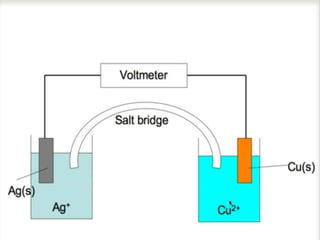
             Copper and silver nitrate
                Cu     AgNO3

       2Ag+(aq) + Cu(s)          2Ag(s) + Cu2+(aq)
2 TYPES OF ELECTROCHEMICAL CELLS
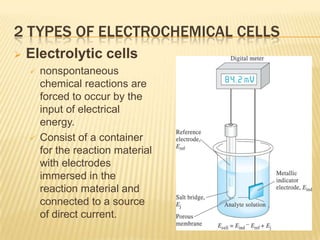
   Electrolytic cells
       nonspontaneous
        chemical reactions are
        forced to occur by the
        input of electrical
        energy.
       Consist of a container
        for the reaction material
        with electrodes
        immersed in the
        reaction material and
        connected to a source
        of direct current.
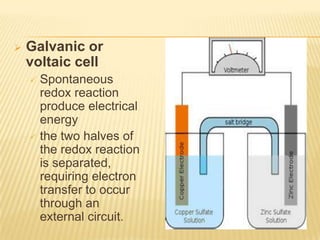
   Galvanic or
    voltaic cell
     Spontaneous
      redox reaction
      produce electrical
      energy
     the two halves of
      the redox reaction
      is separated,
      requiring electron
      transfer to occur
      through an
      external circuit.
   Electrochemistry includes:

       Potentiometry

       Amperometry

       Coulometry
POTENTIOMETRY: GENERAL PRINCIPLES

   Concentration of ions in solution is calculated from
    the measured potential difference between the two
    electrodes.

   This type of system includes at least two
    electrodes, identified as an indicator electrode and
    a reference electrode which act as the cathode and
    anode respectively.
   Each electrode is in contact with either the sample
    (in the case of the “indicator electrode”) or a
    reference solution ( in the case of the “reference
    electrode”).

   This method is made under conditions in which
    essentially zero current is flowing through this
    system.
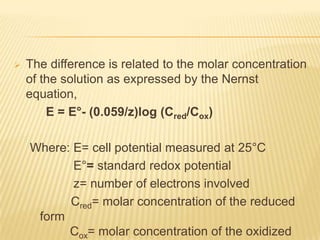
   The difference is related to the molar concentration
    of the solution as expressed by the Nernst
    equation,
        E = E°- (0.059/z)log (Cred/Cox)

    Where: E= cell potential measured at 25°C
           E°= standard redox potential
           z= number of electrons involved
          Cred= molar concentration of the reduced
     form
          Cox= molar concentration of the oxidized
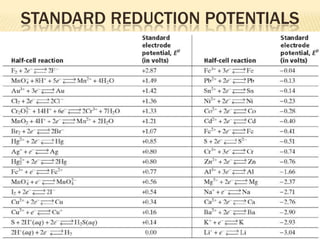
STANDARD REDUCTION POTENTIALS
   System Components

     Liquid Junction
     Reference electrode

     Indicator or measuring electrode

     Readout device (Potentiometer)
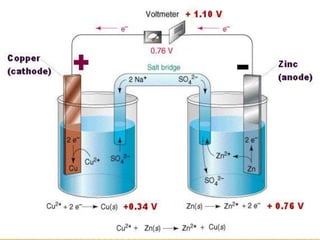
   Liquid junction – also known as a salt bridge are
    required to complete the circuit between the
    reference and without contaminating anything.

Functions:
It allows electrical contact between the two
solutions.
It prevents the mixing of the electrode solutions.

It maintains the electrical neutrality in each half cell
as ions flow into and out of the salt bridge.
   Reference Electrode- is an electrochemical half-cell
    that is used as a fixed reference for the measurement
    of cell potentials.
   A half-cell with an accurately known electrode potential,
    Eref, that is independent of the concentration of the
    analyte or any other ions in the solution
   Always treated as the left-hand electrode

    Examples:
       Normal hydrogen electrode
       Saturated calomel electrode
       Ag-AgCl electrode
REFERENCE ELECTRODES

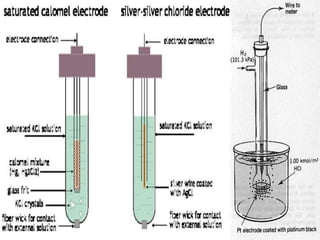
    Calomel electrode- composed of
     mercury/mercurous chloride; It is dependable but
     large, bulky, and affected by temperature.
    Silver/silver chloride- reference electrodes are
     more compact and handle temperature fluctuations
     better -- overall better & faster
    Normal Hydrogen Electrode- consists of a
     platinized platinum electrode in a 1.228N HCl
     solution with hydrogen at atmospheric pressure
     bubbled over the platinum surface.
   Indicator Electrode- also called the measuring
    electrode (platinum wire and carbon rod).
       It is immersed in a solution of the analyte, develops
        a potential, Eind that depends on the activity of the
        analyte.
       Is selective in its response
       It is the other electrochemical half-cell that responds
        to changes in the activity of a particular analyte
        species in a solution.

    Example:
       Ion-Selective Electrodes
ION SELECTIVE ELECTRODE
   Is an indicator electrode that can respond to
    individual types of anions or cations, and is one tool
    that can be utilized for such a task.

    Examples:
          Glass membrane Electrodes

          Gas-sensing Electrodes
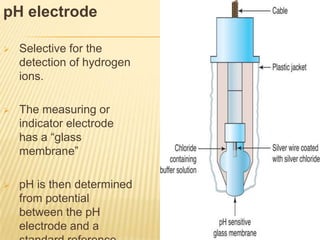
pH electrode

   Selective for the
    detection of hydrogen
    ions.

   The measuring or
    indicator electrode
    has a “glass
    membrane”

   pH is then determined
    from potential
    between the pH
    electrode and a
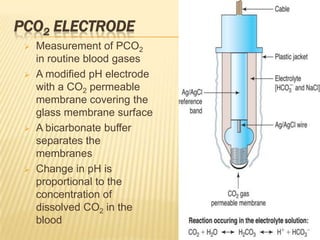
PCO2 ELECTRODE
    Measurement of PCO2
     in routine blood gases
    A modified pH electrode
     with a CO2 permeable
     membrane covering the
     glass membrane surface
    A bicarbonate buffer
     separates the
     membranes
    Change in pH is
     proportional to the
     concentration of
     dissolved CO2 in the
     blood
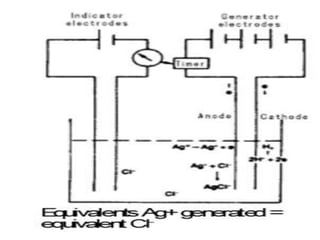
COULOMETRY


   Coulometry is an electrochemical titration
    where the titrant is electrochemically
    generated and the endpoint is detected by
    amperometry.
AMPEROMETRY

   Amperometry- is the measurement of the
    current flow produced by an oxidation-
    reduction reaction.

   A measure of the cell current when the
    potential difference between indicator and
    reference electrodes is controlled.
PRINCIPLE
   In the presence of some conductive buffer. If an electrolytic
    potential is applied to the solution through a working
    electrode, then the measured current depends (in part) on
    the concentration of the analyte. Measurement of this
    current can be used to determine the concentration of the
    analyte directly.
   However, the difficulty is that the measured current depends
    on several other variables, and it is not always possible to
    control all of them adequately. This limits the precision of
    direct amperometry.
   If the potential applied to the working electrode is
    sufficient to reduce the analyte , then the
    concentration of analyte close to the working
    electrode will decrease.

   If the potential applied to the working electrode is
    great enough (an overpotential), then the
    concentration of analyte next to the working
    electrode will depend entirely on the rate of
    diffusion.
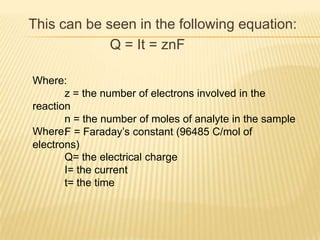
This can be seen in the following equation:
             Q = It = znF

Where:
       z = the number of electrons involved in the
reaction
       n = the number of moles of analyte in the sample
Where: = Faraday’s constant (96485 C/mol of
       F
electrons)
       Q= the electrical charge
       I= the current
       t= the time
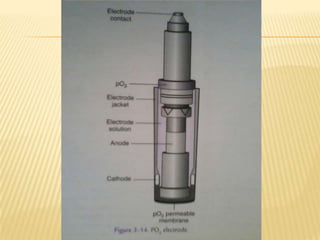
   pO2 Gas Electrodes

       Gas-sensing electrodes that use amperometric
        or current-sensing electrolytic cell as indicator.

       They consist of a gas permeable membrane
        (polypropylene) which allows only dissolved
        oxygen to pass through.
ADVANTAGES
    less hazardous process

    elimination or minimization of polluting
     byproducts requiring disposal

    process simplification so that an otherwise
     multistep chemical route is simplified to one or
     two steps
   use of cheaper more readily available starting
    materials


   the possibility of reaching very high levels of
    product purity and selectivity
DISADVANTAGES
   requires the use of a solvent to solubilize
    the reactants and products

    Water is the ideal solvent but too often organic
    solvents or co-solvents are required

   supporting electrolytes to carry the current are very
    often needed

   Electricity is required in all electrochemical processing
    which may or may not be a critical factor, depending on
    where the process is located.
APPLICATION
   Use of the potential measurements to give direct
    information on the activity, or concentration of an
    analyte in a sample
   pH measurements
   Use of potential measurements to follow the course
    of titration, as occurs in a potentiometric titration.
   Measurement of chloride in body fluids such as
    sweat, urine and CSF.
   Determination of ascorbic acid or vitamin C
INTERFERENCES
   Errors in ISE measurement can result in any ion
    determination if data are not collected for standards and
    samples at approximately the same temperature, since the
    Nernst equation that governs the calibration of potential
    versus concentration is temperature dependent.

   Response of an ISE to a non-analyte or an interferent ion in
    the sample.
   Components in certain sample matrices also can
    change the sensitivity of an electrode by adsorbing
    to its surface, thereby blocking access of the
    analyte.

   Sensitivity of the glass pH electrode may be
    reduced for some electrodes at pH values above 10
    (i.e. sodium error) because of the interference of
    monovalent cations in high concentrations,
    especially Na+.

   In solutions of pH less than 1, low water activities
    also may give rise to measurement error.
ELECTROPHORESIS
ELECTROPHORESIS
   Method of separation and purification

   Involves migration of charged particles in an electric
    field

   It is suitable for the separation and the quantitation of
    proteins in body fluids.

   Is a tool that is used by clinical laboratory
    scientists/medical technologists to separate molecule
    prior to molecule identification.
GENERAL PRINCIPLES
   The electrical field is applied to a solution through
    oppositely charged electrodes placed in the
    solution.

   An ion then travels through the solution toward the
    electrode of opposite charge: positively charged
    particles move to the negatively charged electrode,
    and negatively charged particles migrate to the
    positively charged electrode.
   The separation of analytes by
    electrophoresis has two key requirements:
     There must be a difference in how analytes
      interact with the separation system.
     The bands or peaks for the analytes must be
      sufficiently narrow to allow them to be resolved.


   The sample is separated into bands where
    each band has molecules containing similar
    mobility.
FACTORS INFLUENCING MIGRATION OF
PARTICLES
   Net electric charge of the particle
   Size and shape of the molecules
   Electric field strength
   Nature of the supporting medium
   Temperature of operation
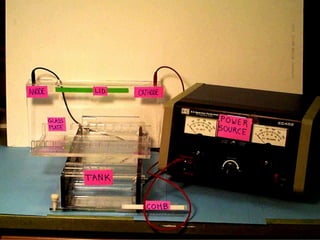
COMPONENTS
   power source with a voltmeter and voltage regulator
   electrophoresis tank that holds the electrophoresis
    buffer
    an anode and a cathode connected with the power
    source
   a glass plate that holds the gel and is submerged into
    the electrophoresis buffer
   a comb which is used to make the sample wells in the
    agar before it solidifies.
TYPES OF ELECTROPHORESIS
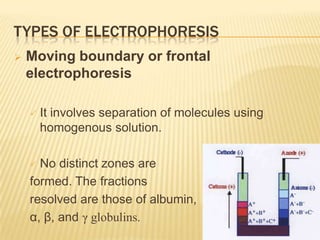
   Moving boundary or frontal
    electrophoresis

       It involves separation of molecules using
        homogenous solution.

     No distinct zones are
    formed. The fractions
    resolved are those of albumin,
    α, β, and γ globulins.
   Zonal electrophoresis

       Involves the use of a support medium.

       The fractions resolved are albumin, α1, α2, β and
        γ globulins.

       The charged particles are placed on a stabilizing
        medium which will contain the proteins after
        migration.
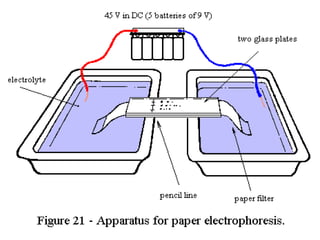
   PAPER ELECTROPHORESIS- It is the form of
    electrophoresis that is carried out on filter paper. This
    technique is useful for separation of small charged
    molecules such as amino acids and small proteins.

    •   FILTER PAPER- It is the stabilizing medium.
    •   APPARATUS- Power pack, electrophoretic cell that
        contains electrodes, buffer reservoirs, support for
        paper, transparent insulating cover.
   GEL ELECTROPHORESIS- It is a technique used
    for the separation of Deoxyribonucleic acid,
    Ribonucleic acid or protein molecules according to
    their size and electrical charge using an electric
    current applied to a gel matrix.
What is a gel?
       Gel is a cross linked polymer whose composition
        and porosity is chosen based on the specific weight
        and porosity of the target molecules.
Types of Gel:
       Agarose gel
       Polyacrylamide gel
   Agarose gels
     Purified agar
     After
      electrophoresis,
      it can be stained
      and read in a
      densitometer
     Long term
      storage
      possible
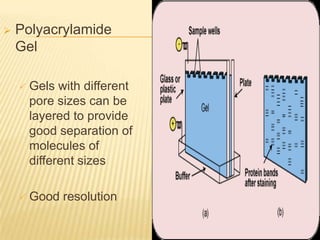
   Polyacrylamide
    Gel

       Gels with different
        pore sizes can be
        layered to provide
        good separation of
        molecules of
        different sizes

       Good resolution
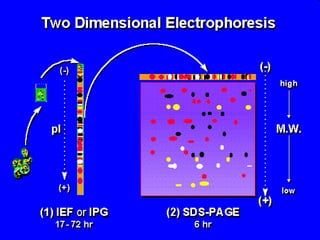
   TWO-DIMENSIONAL ELECTROPHORESIS- the
    standard electrophoretic separation in one direction
    is followed by SDS-PAGE in the perpendicular
    direction.

   This technique combines the technique IEF (first
    dimension), which separates proteins in a mixture
    according to charge (PI), with the size separation
    technique of SDS-PAGE (second dimension).
VIDEO 
PROCEDURE
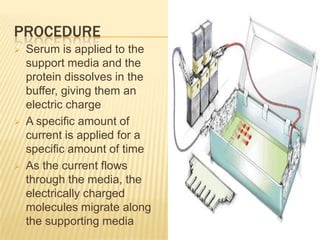
   Serum is applied to the
    support media and the
    protein dissolves in the
    buffer, giving them an
    electric charge
   A specific amount of
    current is applied for a
    specific amount of time
   As the current flows
    through the media, the
    electrically charged
    molecules migrate along
    the supporting media
   The negatively charged protein molecules migrate
    towards the oppositely charged electrode.

   The sample is separated into bands where each band
    has molecules containing similar mobility.

   Once the medium has been stained and the
    background of the medium support has been cleared,
    the electrophoretic pattern can be scanned through a
    densitometer.
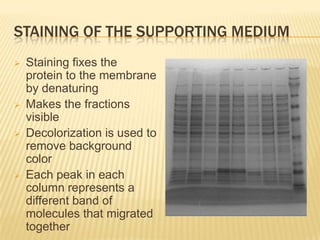
STAINING OF THE SUPPORTING MEDIUM
   Staining fixes the
    protein to the membrane
    by denaturing
   Makes the fractions
    visible
   Decolorization is used to
    remove background
    color
   Each peak in each
    column represents a
    different band of
    molecules that migrated
    together
ADVANTAGES:
   Versatility in Identification
   Accuracy of Results

DISADVANTAGES:
   Toxicity
   Electrophoresis has limited sample analysis
   Electrophoresis measurements are not precise
   Only certain molecules can be visualized
APPLICATION
   Specific protein analysis

   Identification and quantitation of hemoglobin and its subclasses

Identification   of monoclonal proteins in either serum or urine.

Separation    and quantitation of major lipoprotein and lipid classes

Isoenzyme     analysis

Western    blot technique to identify a specific protein.

Southern    blot techniques to identify specific nucleic acid sequence.
INTERFERENCES

  Sample Contamination
  Gel Problems

  Improper Loading

  Electrical Current Problems

  Failed Visualization

  Varied Measuring
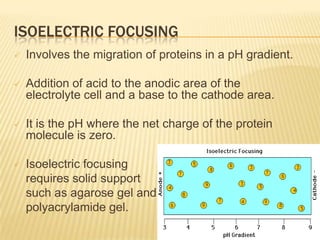
ISOELECTRIC FOCUSING
   Involves the migration of proteins in a pH gradient.

   Addition of acid to the anodic area of the
    electrolyte cell and a base to the cathode area.

   It is the pH where the net charge of the protein
    molecule is zero.

   Isoelectric focusing
    requires solid support
    such as agarose gel and
    polyacrylamide gel.
PRINCIPLES
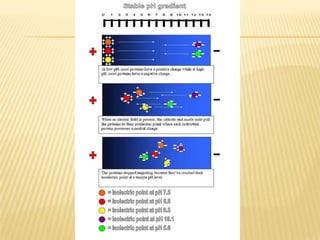
   Protein in a mixture can be precipitated depending
    on its isoeletric point.
   IEF requires stable pH gradient which can be
    formed by using mixture of specially designed
    amphoteric molecules known as ampholytes.
   When electric field is applied, a pH gradient is
    established, that is negatively charged ampholytes
    move towards anode and positively charged
    towards cathode and align themselves according to
    their pIs.
VIDEO 
ADVANTAGES
   IEF offers the following advantages:
      efficient

      economic (no sophisticated equipment required)

      easy (clear, one-dimensional separation
       principle)
      fast

      High capacity and resolution to 0.001 pH unit
       possible
DISADVANTAGE


    A disadvantage of IEF is that minor bands and
     aging bands are also seen and may cause
     confusion in interpretation.
APPLICATIONS

   Useful in measuring serum acid phosphatase isoenzyme.

   Detects oligoclonal immunoglobulin bands in CSF and isoenzyme
    of creatine kinase and alkaline phosphatase in serum.

   Applied in the assay of Acid Phosphatase isoenzyme.

   General characterization of proteins by pI purity determination of
    proteins.

   Discrimination of caseins

   Routine clinical analyses
THANK YOU 

Electrochemistry, electrophoresis, ise

  • 1.
    ELECTROCHEMISTRY, ELECTROPHORESIS, AND ISOELECTRIC FOCUSING Presented by: Anthony John Duran Angelica Nhoj Gemora Denfield Jan Pama Siegefred Pue Karen Grace Salao
  • 2.
  • 3.
    ELECTROCHEMISTRY  Involves measurement of current or voltage generated by activity of specific ions.  Electrical energy Chemical energy Copper and silver nitrate Cu AgNO3 2Ag+(aq) + Cu(s) 2Ag(s) + Cu2+(aq)
  • 6.
    2 TYPES OFELECTROCHEMICAL CELLS  Electrolytic cells  nonspontaneous chemical reactions are forced to occur by the input of electrical energy.  Consist of a container for the reaction material with electrodes immersed in the reaction material and connected to a source of direct current.
  • 7.
    Galvanic or voltaic cell  Spontaneous redox reaction produce electrical energy  the two halves of the redox reaction is separated, requiring electron transfer to occur through an external circuit.
  • 8.
    Electrochemistry includes:  Potentiometry  Amperometry  Coulometry
  • 9.
    POTENTIOMETRY: GENERAL PRINCIPLES  Concentration of ions in solution is calculated from the measured potential difference between the two electrodes.  This type of system includes at least two electrodes, identified as an indicator electrode and a reference electrode which act as the cathode and anode respectively.
  • 10.
    Each electrode is in contact with either the sample (in the case of the “indicator electrode”) or a reference solution ( in the case of the “reference electrode”).  This method is made under conditions in which essentially zero current is flowing through this system.
  • 11.
    The difference is related to the molar concentration of the solution as expressed by the Nernst equation, E = E°- (0.059/z)log (Cred/Cox) Where: E= cell potential measured at 25°C E°= standard redox potential z= number of electrons involved Cred= molar concentration of the reduced form Cox= molar concentration of the oxidized
  • 12.
  • 13.
    System Components  Liquid Junction  Reference electrode  Indicator or measuring electrode  Readout device (Potentiometer)
  • 15.
    Liquid junction – also known as a salt bridge are required to complete the circuit between the reference and without contaminating anything. Functions: It allows electrical contact between the two solutions. It prevents the mixing of the electrode solutions. It maintains the electrical neutrality in each half cell as ions flow into and out of the salt bridge.
  • 16.
    Reference Electrode- is an electrochemical half-cell that is used as a fixed reference for the measurement of cell potentials.  A half-cell with an accurately known electrode potential, Eref, that is independent of the concentration of the analyte or any other ions in the solution  Always treated as the left-hand electrode Examples: Normal hydrogen electrode Saturated calomel electrode Ag-AgCl electrode
  • 17.
    REFERENCE ELECTRODES  Calomel electrode- composed of mercury/mercurous chloride; It is dependable but large, bulky, and affected by temperature.  Silver/silver chloride- reference electrodes are more compact and handle temperature fluctuations better -- overall better & faster  Normal Hydrogen Electrode- consists of a platinized platinum electrode in a 1.228N HCl solution with hydrogen at atmospheric pressure bubbled over the platinum surface.
  • 19.
    Indicator Electrode- also called the measuring electrode (platinum wire and carbon rod).  It is immersed in a solution of the analyte, develops a potential, Eind that depends on the activity of the analyte.  Is selective in its response  It is the other electrochemical half-cell that responds to changes in the activity of a particular analyte species in a solution. Example:  Ion-Selective Electrodes
  • 20.
    ION SELECTIVE ELECTRODE  Is an indicator electrode that can respond to individual types of anions or cations, and is one tool that can be utilized for such a task. Examples:  Glass membrane Electrodes  Gas-sensing Electrodes
  • 21.
    pH electrode  Selective for the detection of hydrogen ions.  The measuring or indicator electrode has a “glass membrane”  pH is then determined from potential between the pH electrode and a
  • 22.
    PCO2 ELECTRODE  Measurement of PCO2 in routine blood gases  A modified pH electrode with a CO2 permeable membrane covering the glass membrane surface  A bicarbonate buffer separates the membranes  Change in pH is proportional to the concentration of dissolved CO2 in the blood
  • 23.
    COULOMETRY  Coulometry is an electrochemical titration where the titrant is electrochemically generated and the endpoint is detected by amperometry.
  • 25.
    AMPEROMETRY  Amperometry- is the measurement of the current flow produced by an oxidation- reduction reaction.  A measure of the cell current when the potential difference between indicator and reference electrodes is controlled.
  • 26.
    PRINCIPLE  In the presence of some conductive buffer. If an electrolytic potential is applied to the solution through a working electrode, then the measured current depends (in part) on the concentration of the analyte. Measurement of this current can be used to determine the concentration of the analyte directly.  However, the difficulty is that the measured current depends on several other variables, and it is not always possible to control all of them adequately. This limits the precision of direct amperometry.
  • 27.
    If the potential applied to the working electrode is sufficient to reduce the analyte , then the concentration of analyte close to the working electrode will decrease.  If the potential applied to the working electrode is great enough (an overpotential), then the concentration of analyte next to the working electrode will depend entirely on the rate of diffusion.
  • 28.
    This can beseen in the following equation: Q = It = znF Where: z = the number of electrons involved in the reaction n = the number of moles of analyte in the sample Where: = Faraday’s constant (96485 C/mol of F electrons) Q= the electrical charge I= the current t= the time
  • 29.
    pO2 Gas Electrodes  Gas-sensing electrodes that use amperometric or current-sensing electrolytic cell as indicator.  They consist of a gas permeable membrane (polypropylene) which allows only dissolved oxygen to pass through.
  • 31.
    ADVANTAGES  less hazardous process  elimination or minimization of polluting byproducts requiring disposal  process simplification so that an otherwise multistep chemical route is simplified to one or two steps
  • 32.
    use of cheaper more readily available starting materials  the possibility of reaching very high levels of product purity and selectivity
  • 33.
    DISADVANTAGES  requires the use of a solvent to solubilize the reactants and products  Water is the ideal solvent but too often organic solvents or co-solvents are required  supporting electrolytes to carry the current are very often needed  Electricity is required in all electrochemical processing which may or may not be a critical factor, depending on where the process is located.
  • 34.
    APPLICATION  Use of the potential measurements to give direct information on the activity, or concentration of an analyte in a sample  pH measurements  Use of potential measurements to follow the course of titration, as occurs in a potentiometric titration.  Measurement of chloride in body fluids such as sweat, urine and CSF.  Determination of ascorbic acid or vitamin C
  • 35.
    INTERFERENCES  Errors in ISE measurement can result in any ion determination if data are not collected for standards and samples at approximately the same temperature, since the Nernst equation that governs the calibration of potential versus concentration is temperature dependent.  Response of an ISE to a non-analyte or an interferent ion in the sample.
  • 36.
    Components in certain sample matrices also can change the sensitivity of an electrode by adsorbing to its surface, thereby blocking access of the analyte.  Sensitivity of the glass pH electrode may be reduced for some electrodes at pH values above 10 (i.e. sodium error) because of the interference of monovalent cations in high concentrations, especially Na+.  In solutions of pH less than 1, low water activities also may give rise to measurement error.
  • 37.
  • 38.
    ELECTROPHORESIS  Method of separation and purification  Involves migration of charged particles in an electric field  It is suitable for the separation and the quantitation of proteins in body fluids.  Is a tool that is used by clinical laboratory scientists/medical technologists to separate molecule prior to molecule identification.
  • 39.
    GENERAL PRINCIPLES  The electrical field is applied to a solution through oppositely charged electrodes placed in the solution.  An ion then travels through the solution toward the electrode of opposite charge: positively charged particles move to the negatively charged electrode, and negatively charged particles migrate to the positively charged electrode.
  • 40.
    The separation of analytes by electrophoresis has two key requirements:  There must be a difference in how analytes interact with the separation system.  The bands or peaks for the analytes must be sufficiently narrow to allow them to be resolved.  The sample is separated into bands where each band has molecules containing similar mobility.
  • 41.
    FACTORS INFLUENCING MIGRATIONOF PARTICLES  Net electric charge of the particle  Size and shape of the molecules  Electric field strength  Nature of the supporting medium  Temperature of operation
  • 43.
    COMPONENTS  power source with a voltmeter and voltage regulator  electrophoresis tank that holds the electrophoresis buffer  an anode and a cathode connected with the power source  a glass plate that holds the gel and is submerged into the electrophoresis buffer  a comb which is used to make the sample wells in the agar before it solidifies.
  • 44.
    TYPES OF ELECTROPHORESIS  Moving boundary or frontal electrophoresis  It involves separation of molecules using homogenous solution.  No distinct zones are formed. The fractions resolved are those of albumin, α, β, and γ globulins.
  • 45.
    Zonal electrophoresis  Involves the use of a support medium.  The fractions resolved are albumin, α1, α2, β and γ globulins.  The charged particles are placed on a stabilizing medium which will contain the proteins after migration.
  • 46.
    PAPER ELECTROPHORESIS- It is the form of electrophoresis that is carried out on filter paper. This technique is useful for separation of small charged molecules such as amino acids and small proteins. • FILTER PAPER- It is the stabilizing medium. • APPARATUS- Power pack, electrophoretic cell that contains electrodes, buffer reservoirs, support for paper, transparent insulating cover.
  • 48.
    GEL ELECTROPHORESIS- It is a technique used for the separation of Deoxyribonucleic acid, Ribonucleic acid or protein molecules according to their size and electrical charge using an electric current applied to a gel matrix. What is a gel?  Gel is a cross linked polymer whose composition and porosity is chosen based on the specific weight and porosity of the target molecules. Types of Gel:  Agarose gel  Polyacrylamide gel
  • 49.
    Agarose gels  Purified agar  After electrophoresis, it can be stained and read in a densitometer  Long term storage possible
  • 50.
    Polyacrylamide Gel  Gels with different pore sizes can be layered to provide good separation of molecules of different sizes  Good resolution
  • 51.
    TWO-DIMENSIONAL ELECTROPHORESIS- the standard electrophoretic separation in one direction is followed by SDS-PAGE in the perpendicular direction.  This technique combines the technique IEF (first dimension), which separates proteins in a mixture according to charge (PI), with the size separation technique of SDS-PAGE (second dimension).
  • 53.
  • 54.
    PROCEDURE  Serum is applied to the support media and the protein dissolves in the buffer, giving them an electric charge  A specific amount of current is applied for a specific amount of time  As the current flows through the media, the electrically charged molecules migrate along the supporting media
  • 55.
    The negatively charged protein molecules migrate towards the oppositely charged electrode.  The sample is separated into bands where each band has molecules containing similar mobility.  Once the medium has been stained and the background of the medium support has been cleared, the electrophoretic pattern can be scanned through a densitometer.
  • 56.
    STAINING OF THESUPPORTING MEDIUM  Staining fixes the protein to the membrane by denaturing  Makes the fractions visible  Decolorization is used to remove background color  Each peak in each column represents a different band of molecules that migrated together
  • 57.
    ADVANTAGES:  Versatility in Identification  Accuracy of Results DISADVANTAGES:  Toxicity  Electrophoresis has limited sample analysis  Electrophoresis measurements are not precise  Only certain molecules can be visualized
  • 58.
    APPLICATION  Specific protein analysis  Identification and quantitation of hemoglobin and its subclasses Identification of monoclonal proteins in either serum or urine. Separation and quantitation of major lipoprotein and lipid classes Isoenzyme analysis Western blot technique to identify a specific protein. Southern blot techniques to identify specific nucleic acid sequence.
  • 59.
    INTERFERENCES  SampleContamination  Gel Problems  Improper Loading  Electrical Current Problems  Failed Visualization  Varied Measuring
  • 60.
  • 61.
    ISOELECTRIC FOCUSING  Involves the migration of proteins in a pH gradient.  Addition of acid to the anodic area of the electrolyte cell and a base to the cathode area.  It is the pH where the net charge of the protein molecule is zero.  Isoelectric focusing requires solid support such as agarose gel and polyacrylamide gel.
  • 62.
    PRINCIPLES  Protein in a mixture can be precipitated depending on its isoeletric point.  IEF requires stable pH gradient which can be formed by using mixture of specially designed amphoteric molecules known as ampholytes.  When electric field is applied, a pH gradient is established, that is negatively charged ampholytes move towards anode and positively charged towards cathode and align themselves according to their pIs.
  • 63.
  • 65.
    ADVANTAGES  IEF offers the following advantages:  efficient  economic (no sophisticated equipment required)  easy (clear, one-dimensional separation principle)  fast  High capacity and resolution to 0.001 pH unit possible
  • 66.
    DISADVANTAGE  A disadvantage of IEF is that minor bands and aging bands are also seen and may cause confusion in interpretation.
  • 67.
    APPLICATIONS  Useful in measuring serum acid phosphatase isoenzyme.  Detects oligoclonal immunoglobulin bands in CSF and isoenzyme of creatine kinase and alkaline phosphatase in serum.  Applied in the assay of Acid Phosphatase isoenzyme.  General characterization of proteins by pI purity determination of proteins.  Discrimination of caseins  Routine clinical analyses
  • 68.