INTESTINAL HELMINTHS &
INTESTINAL PROTOZOA


                  Submitted By :-
                 Dr.Laximan Sawant
                  (L-2011-V-91-M)
IntestInal helmInths
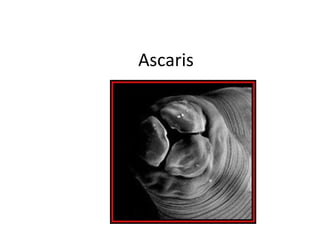
Ascaris
• Ascaris is a genus of parasitic nematode worms known as the 
  "giant intestinal roundworms". 

• One species, A. suum, typically infects pigs, 

• while another, A. lumbricoides, affects human populations, 
  typically in sub-tropical and tropical areas with poor 
  sanitation.
•  A. lumbricoides is the largest intestinal roundworm 
  and is the most common helminth infection of 
  humans worldwide, an infection known as ascariasis.
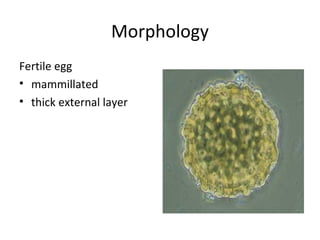
Morphology
Fertile egg
• mammillated 
• thick external layer 
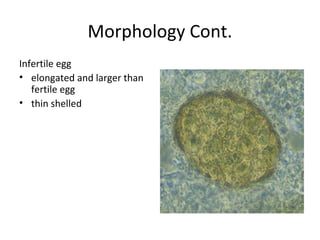
Morphology Cont.
Infertile egg
• elongated and larger than 
   fertile egg 
• thin shelled 
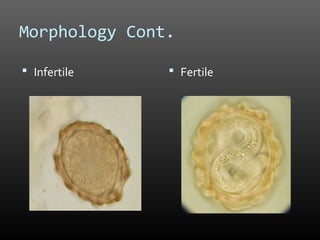
Morphology Cont.

 Infertile     Fertile
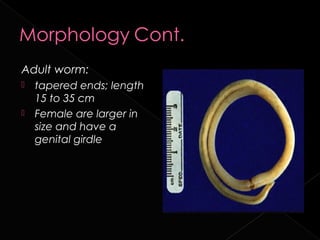
Adult worm:
   tapered ends; length
    15 to 35 cm
   Female are larger in
    size and have a
    genital girdle
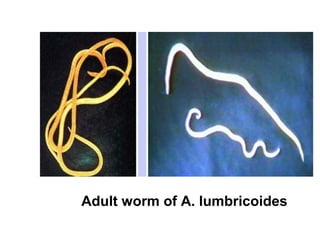
Adult worm of A. lumbricoides
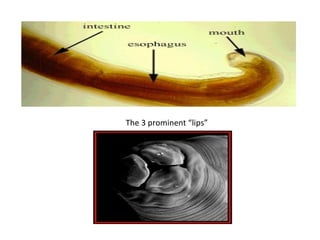
The 3 prominent “lips”
TRANSMISSION
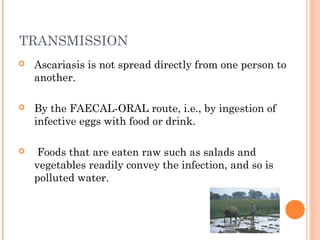
   Ascariasis is not spread directly from one person to
    another.

   By the FAECAL-ORAL route, i.e., by ingestion of
    infective eggs with food or drink.

    Foods that are eaten raw such as salads and
    vegetables readily convey the infection, and so is
    polluted water.
•    There is increasing evidence that dust may
    play an important role in the dissemination of
    ascaris in arid areas.
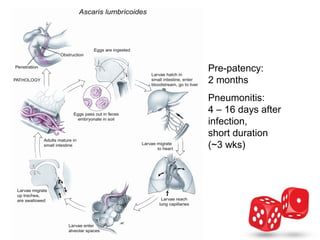
Pre-patency:
2 months
Pneumonitis:
4 – 16 days after
infection,
short duration
(~3 wks)
Symptoms
1. Symptoms associated with larvae migration

• eosinophilic pneumonia, cough (Loeffler's Syndrome)

• Breathing difficulties and fever

• Complications - asthmatic attacks, pulmonary infiltration 
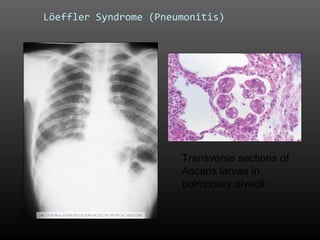
Löeffler Syndrome (Pneumonitis)


                       Transverse sections of
                       Ascaris larvae in
                       pulmonary alveoli
Symptoms Cont.
2. Symptoms associated with adult parasite in the intestine

• Usually asymptomatic

• Abdominal discomfort, nausea in mild cases

• Malnutrition

• Sometimes fatality may occur when mass of worm blocks the 
  intestine
Adult Ascaris
worms migrating in
liver
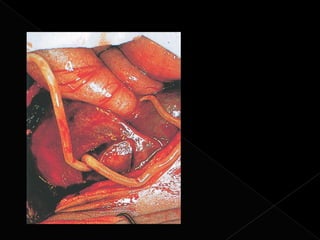
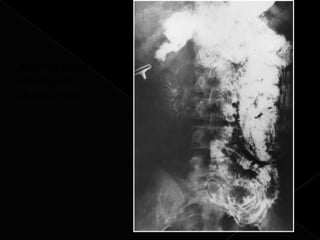
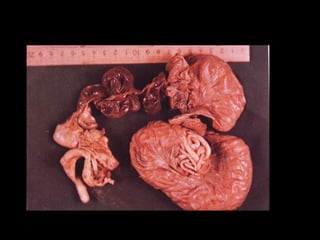
Ascaris causing
intestinal
obstruction.
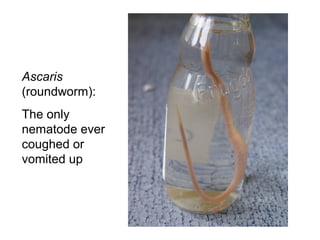
Ascaris
(roundworm):
The only
nematode ever
coughed or
vomited up
Diagnosis

• Stool microscopy :

• Eosinophilia:  eosinophilia can be found, particularly during 
  larval migration through the lungs

• Ultrasound:  ultrasound exams can help to diagnose 
  hepatobiliary or pancreatic ascariasis.  

• Endoscopic Retrograde Cholangiopancreatography (ERCP) :
  A duodenoscope with a snare to extract the worm out of the 
  patient
Treatment
• Mebendazole
• Albendazole
Prevention


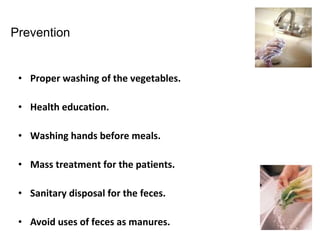
 • Proper washing of the vegetables.

 • Health education.

 • Washing hands before meals.

 • Mass treatment for the patients.

 • Sanitary disposal for the feces.

 • Avoid uses of feces as manures.

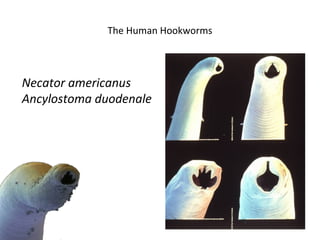
The Human Hookworms


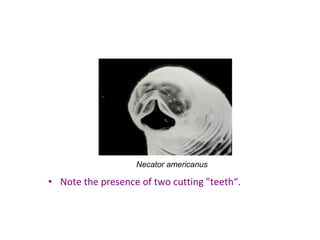
Necator americanus
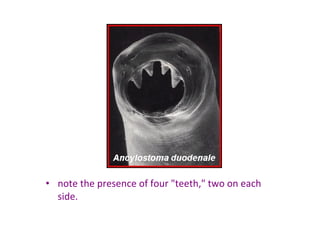
Ancylostoma duodenale
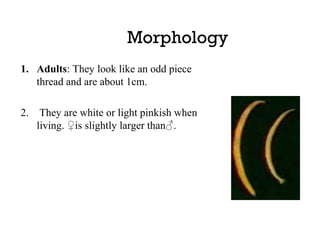
   Morphology
1. Adults: They look like an odd piece
   thread and are about 1cm.

2.    They are white or light pinkish when
     living. ♀is slightly larger than♂.
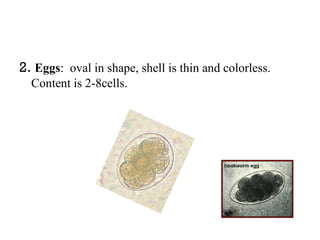
2. Eggs: oval in shape, shell is thin and colorless.
  Content is 2-8cells.
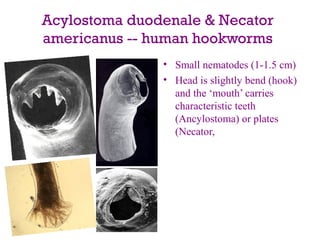
Acylostoma duodenale & Necator
americanus -- human hookworms
               • Small nematodes (1-1.5 cm)
               • Head is slightly bend (hook)
                 and the ‘mouth’ carries
                 characteristic teeth
                 (Ancylostoma) or plates
                 (Necator,
• note the presence of four "teeth," two on each 
  side. 
Necator americanus

• Note the presence of two cutting "teeth“.
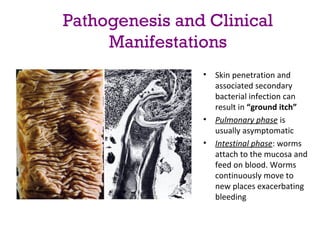
Pathogenesis and Clinical
     Manifestations
                •   Skin penetration and 
                    associated secondary 
                    bacterial infection can 
                    result in “ground itch”
                •   Pulmonary phase is 
                    usually asymptomatic
                •   Intestinal phase: worms 
                    attach to the mucosa and 
                    feed on blood. Worms 
                    continuously move to 
                    new places exacerbating 
                    bleeding
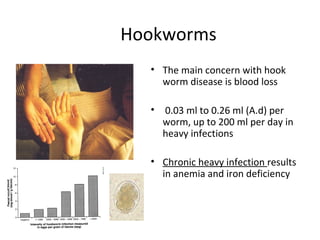
Hookworms
  • The main concern with hook 
    worm disease is blood loss

  •  0.03 ml to 0.26 ml (A.d) per 
    worm, up to 200 ml per day in 
    heavy infections

  • Chronic heavy infection results 
    in anemia and iron deficiency
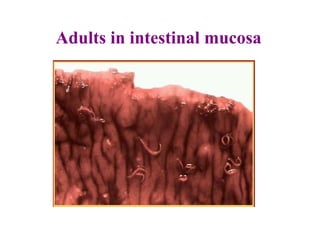
Adults in intestinal mucosa
Diagnosis

       Criterion:
    1. Hemoglobin is lower than 120g/L in man, 110g/L in
       woman.
    2. find hookworm egg

     Method:
 
    1. saturated brine flotation technique
    2. direct fecal smear
    3. culture of larvae
TREATMENT
1.   Albendazole
2.   Mebedazole
Prevention
1. sanitary disposal of night soil
2. individual protection
3. health education
4. cultivate hygienic habits
5. treat the patients and carriers.
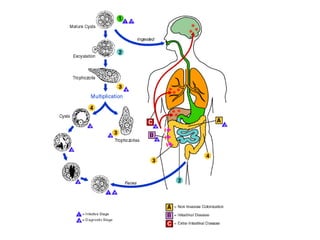
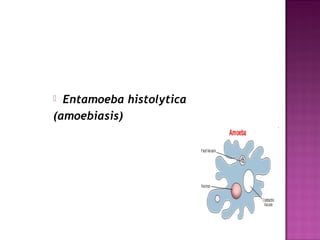
 Entamoeba histolytica
(amoebiasis)
Transmission

• Amoebiasis is usually transmitted by the 
  fecal-oral route,
•  but it can also be transmitted indirectly through 
  contact with dirty hands or objects as well as by 
  anal-oral contact.
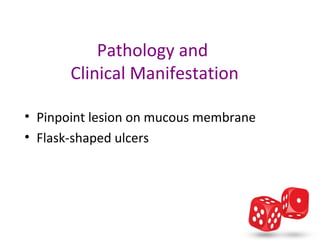
Pathology and 
       Clinical Manifestation

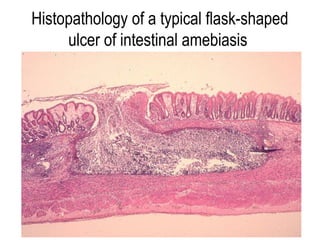
• Pinpoint lesion on mucous membrane
• Flask-shaped ulcers
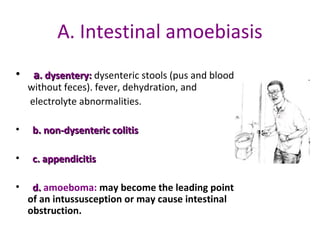
A. Intestinal amoebiasis
•   a. dysentery: dysenteric stools (pus and blood 
       dysentery:
     without feces). fever, dehydration, and
      electrolyte abnormalities. 

•   b. non-dysenteric colitis

•   c. appendicitis

•   d. amoeboma: may become the leading point
  of an intussusception or may cause intestinal
  obstruction.
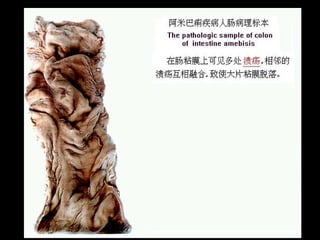
Histopathology of a typical flask-shaped
     ulcer of intestinal amebiasis
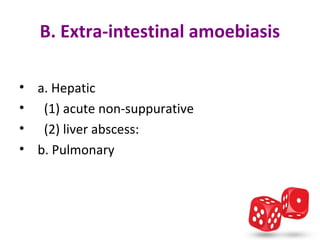
B. Extra-intestinal amoebiasis

•     a. Hepatic 
•       (1) acute non-suppurative
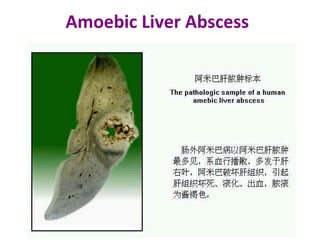
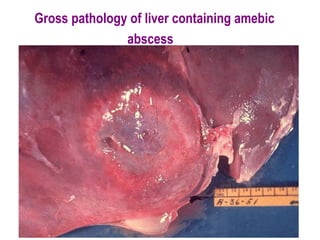
•       (2) liver abscess:
•     b. Pulmonary
Amoebic Liver Abscess
Gross pathology of liver containing amebic
               abscess
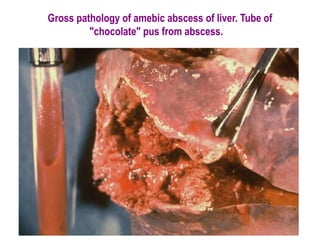
Gross pathology of amebic abscess of liver. Tube of
         "chocolate" pus from abscess. 
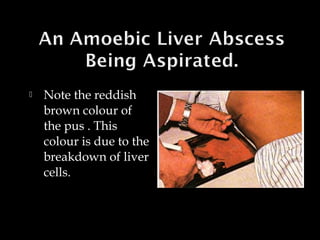
   Note the reddish
    brown colour of
    the pus . This
    colour is due to the
    breakdown of liver
    cells.
Diagnosis

1. Stool examination

2. Serologic studies: indirect hemagglutination, skin
   tests, ELISA and latex agglutination.

3. Tissue examination: biopsy, aspiration
Treatment and Prevention

• Treatment:
• Diodoquin-carriers
• Metronidazole-dysentery, liver abscess
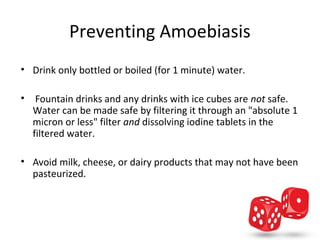
Preventing Amoebiasis
• Drink only bottled or boiled (for 1 minute) water.

•  Fountain drinks and any drinks with ice cubes are not safe. 
  Water can be made safe by filtering it through an "absolute 1 
  micron or less" filter and dissolving iodine tablets in the 
  filtered water. 

• Avoid milk, cheese, or dairy products that may not have been 
  pasteurized. 
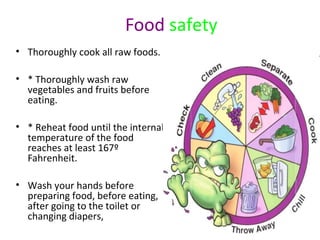
Food safety
• Thoroughly cook all raw foods. 

• * Thoroughly wash raw 
  vegetables and fruits before 
  eating. 

• * Reheat food until the internal 
  temperature of the food 
  reaches at least 167º 
  Fahrenheit.

• Wash your hands before 
  preparing food, before eating, 
  after going to the toilet or 
  changing diapers, 
 
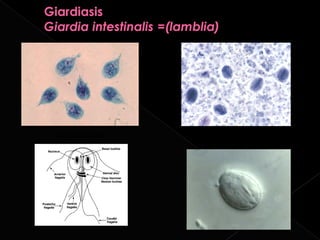
Trophozoites   Cysts
Epidemiology


    Distribution
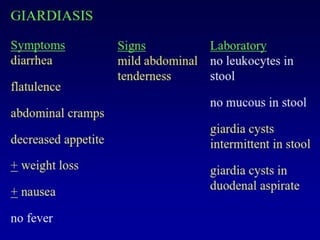
Worldwide distribution, endemic and epidemic.

Traveler diarrhea

Patients with variable immunodeficiency are
increasingly susceptible to infection with Giardia.
Epidemiology
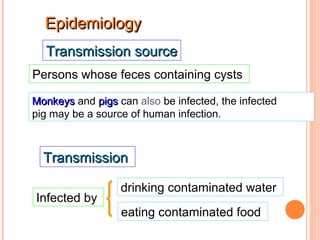
  Transmission source
Persons whose feces containing cysts

Monkeys and pigs can also be infected, the infected
pig may be a source of human infection.


  Transmission

                  drinking contaminated water
Infected by
                  eating contaminated food
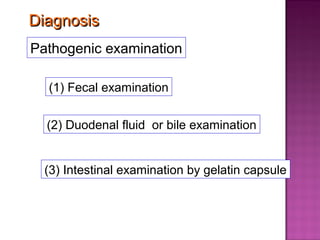
Diagnosis
Pathogenic examination

  (1) Fecal examination


  (2) Duodenal fluid or bile examination


  (3) Intestinal examination by gelatin capsule
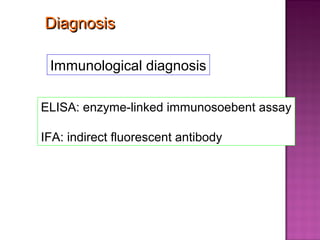
Diagnosis

 Immunological diagnosis

ELISA: enzyme-linked immunosoebent assay

IFA: indirect fluorescent antibody
Cysts have strong resistance

Cysts can keep alive 10 or more days in feces


      Cysts are often waterborne, either by taking
      inadequately treated municipal water supplies
      of contaminated river or stream

     Giardiasis is more common in travelers,
     Immunodeficiency persons
Prevention and control

Treat the patients and cyst carriers

 Metronidazole
 Tinidazole


Treatment of the drinking water

  Suspect water should be boiled or adequately
  filtered to remove the infective cysts before
  drinking.
CRYPTOSPORIDIUM
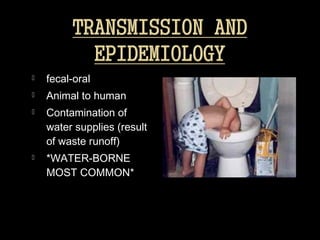
   fecal-oral
   Animal to human
   Contamination of
    water supplies (result
    of waste runoff)
   *WATER-BORNE
    MOST COMMON*
         COMMON
SYMPTOMS
• Immunocompetent              • Immunocompromised 
  – Mild self-limiting           – 50 or more stools per 
    enterocolitis (watery          day
    bloodless diarrhea,          – Dehydration (fatigue, 
    abdominal pain, nausea,        abdominal cramping, 
    vomiting, and fever)           and nausea)
                                 – Common in AIDS 
                                   patients
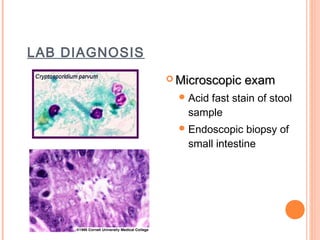
LAB DIAGNOSIS
                 Microscopic    exam
                   Acid
                       fast stain of stool
                   sample
                   Endoscopic  biopsy of
                   small intestine
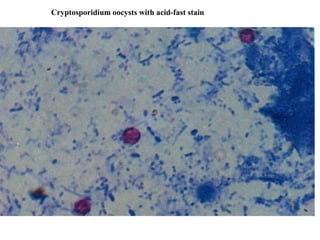
Cryptosporidium oocysts with acid-fast stain
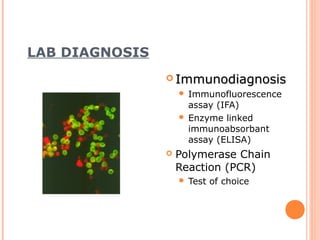
LAB DIAGNOSIS
                 Immunodiagnosis
                     Immunofluorescence
                      assay (IFA)
                     Enzyme linked
                      immunoabsorbant
                      assay (ELISA)
                   Polymerase Chain
                    Reaction (PCR)
                       Test of choice
• Infectious agents are the OOCYSTS
• In immunocompromised patients ID50 is about 10
     to 30 oocysts
      
TREATMENT
• Immunocompetent            • Immunocompromised
   – Self-limiting              – Cocktail therapy -used
                                  to treat symptoms but
   – Usually symptoms
                                  NOT THE DISEASE
     subside within 10
                                – Drugs include: letrazuril,
     days                         azithromycin, paramycin,
                                  and hyperimmune bovine
                                  colostral
                                  immunoglobulin


          *The only immunity is previous exposure and
             extent of this immunity is not known.*
PREVENTION
• Wash hands
• Wash fruits and
  vegetables
• Avoid untreated water
• Treat contaminated
  water
• MAINTAIN PROPER
  HYGIENE!!
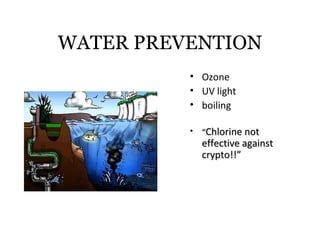
WATER PREVENTION
          • Ozone
          • UV light
          • boiling

          •   “Chlorine not 
              effective against 
              crypto!!”
CONTROL OF PROTOZOA IN
DRINKING WATER
     Multiple barrier approach:
       Filtration
       Chemical  inactivation- ozone, combination of
        disinfectants
       Medium-pressure ultraviolet light (UV)
     Monitoring:
       Presence     of protozoa in raw water

INTESTINAL HELMINTHS & INTESTINAL PROTOZOA