HELMINTHS Sorokhan V.D., MD., PhD.
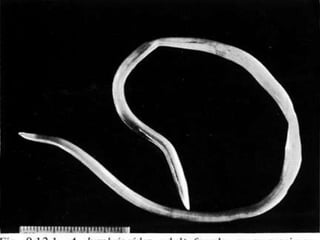
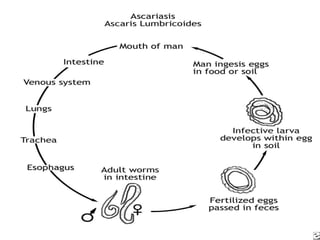
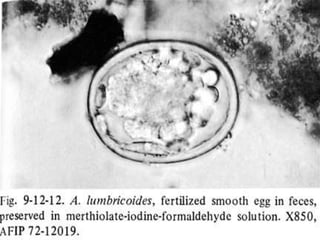
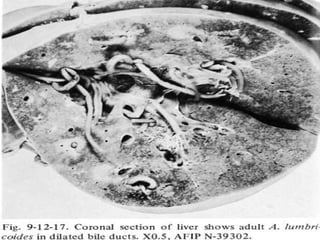
Ascariasis Introduction Ascariasis is the most common helminthic infection, with an estimated worldwide prevalence of 25% (0.8-1.22 billion people).  Pathophysiology Adult  A lumbricoides  are white or yellow and 15-35 cm long. They live 10-24 months in the jejunum and middle ileum of the intestine. Each day, female  A lumbricoides  produce 240,000 eggs, which are fertilized by nearby male worms. Eggs may remain viable in soil for up to 17 months.
Clinical History Early symptoms of ascariasis, during the initial lung migration, include cough, dyspnea, wheezing, and chest pain. Abdominal pain, distension, colic, nausea, anorexia, and intermittent diarrhea may be manifestations of partial or complete intestinal obstruction by adult worms.
Physical Rales, wheezes, and tachypnea may develop during pulmonary migration, particularly in persons with a high worm burden. Abdominal tenderness, especially in the right upper quadrant, hypogastrium, or right lower quadrant, may suggest complications of ascariasis.
Differential Diagnoses Biliary Colic Colonic Obstruction Pancreatitis, Acute Pneumonia, Community-Acquired
Workup Laboratory Studies Stool examination for ova and parasites.  Ascaris  larvae may be observed in microscopic wet preparations of sputum during the pulmonary migration phase.  CBC counts show eosinophilia during the tissue migration phase of the infection.  Serological tests are not clinically useful for ascariasis.
Treatment Medical Care Because of the risk of complications, patients with ascariasis who have other concomitant helminthic infections should always undergo treatment for ascariasis first. Medical therapy is usually not indicated during active pulmonary infection because dying larvae are considered a higher risk for significant pneumonitis. Pulmonary symptoms may be ameliorated with inhaled bronchodilator therapy or corticosteroids, if necessary.
Surgical Care Recommended criteria for surgical exploration include the following:  Passage of blood per rectum  Multiple air fluid levels on abdominal radiographs  An ill child with abdominal distension and rebound tenderness  Unsatisfactory response to conservative therapy  Appendicitis and primary peritonitis  Hepatobiliary disease  Pancreatic pseudocyst
Medication Albendazole (Albenza)  400 mg PO single dose Mebendazole (Vermox)  500 mg PO once or 100 mg PO bid for 3 d Pyrantel pamoate (Pin-Rid, Reese's Pinworm Medicine)  11 mg/kg PO to maximum of 1 g


Filariasis Filariasis is a disease group affecting humans and animals caused by nematode parasites of the order Filariidae, commonly called filariae. Filarial parasites may be classified according to the habitat of the adult worms in the vertebral host. The cutaneous group includes  Loa loa, Onchocerca volvulus,  and  Mansonella streptocerca.  The lymphatic group includes  Wuchereria bancrofti, Brugia malayi,  and  Brugia timori.  The body-cavity group includes  Mansonella perstans  and  Mansonella ozzardi.
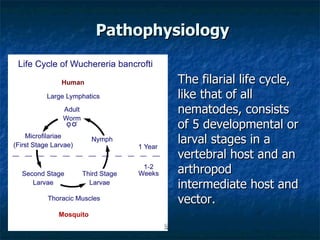
Pathophysiology The filarial life cycle, like that of all nematodes, consists of 5 developmental or larval stages in a vertebral host and an arthropod intermediate host and vector.
Clinical History Symptoms of filariasis are species-dependent and body-site–dependent and can be acute or chronic in nature.  Lymphatic filariasis  The symptoms of lymphatic filariasis predominantly result from the presence of adult worms residing in the lymphatics.  The clinical course is broadly divided into asymptomatic microfilaremia, acute phases of adenolymphangitis (ADL), and chronic irreversible lymphedema.
Physical Lymphatic filariasis  Acute manifestations of lymphatic filariasis is characterized by episodic attacks of fever associated with inflammation of the inguinal lymph nodes, testis, spermatic cord, lymphedema, or a combination of these. Skin exfoliation of the affected body part usually occurs with resolution of an episode. Repeated episodes of inflammation and lymphedema lead to lymphatic damage, chronic swelling, and elephantiasis of the legs, arms, scrotum, vulva, and breasts
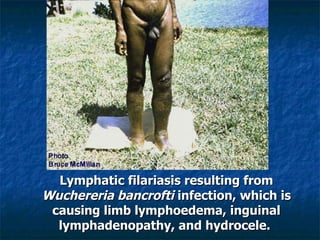
Lymphatic filariasis resulting from  Wuchereria bancrofti  infection, which is causing limb lymphoedema, inguinal lymphadenopathy, and hydrocele.
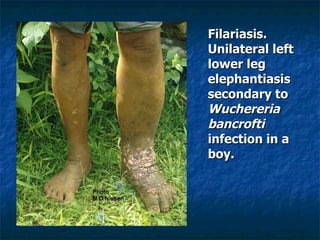
Filariasis. Unilateral left lower leg elephantiasis secondary to  Wuchereria bancrofti  infection in a boy.
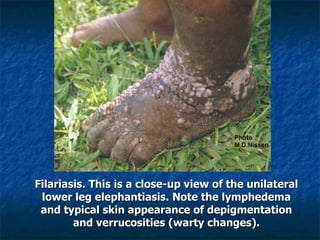
Filariasis. This is a close-up view of the unilateral lower leg elephantiasis. Note the lymphedema and typical skin appearance of depigmentation and verrucosities (warty changes).
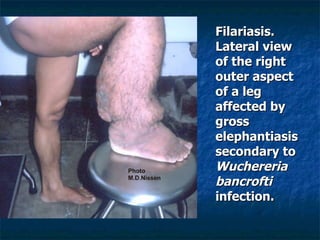
Filariasis. Lateral view of the right outer aspect of a leg affected by gross elephantiasis secondary to  Wuchereria bancrofti  infection.
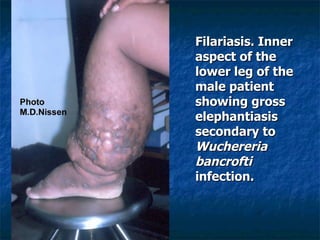
Filariasis. Inner aspect of the lower leg of the male patient showing gross elephantiasis secondary to  Wuchereria bancrofti  infection.
Filariasis. Unilateral left hydrocele and testicular enlargement secondary to  Wuchereria bancrofti  infection in a man who also was positive for microfilariae.
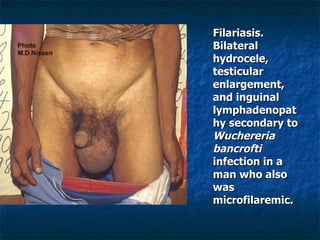
Filariasis. Bilateral hydrocele, testicular enlargement, and inguinal lymphadenopathy secondary to  Wuchereria bancrofti  infection in a man who also was microfilaremic.
Differential Diagnoses Angioedema ,  Milroy Disease ,  Asthma ,  Scrotal Trauma ,  Hodgkin Disease ,  Testicular Trauma ,  Hydrocele ,  Nonseminomatous   Testicular Tumors ,  Leprosy ,  Lymphedema ,  Non-Hodgkin   Lymphoma .
Workup Laboratory Studies Detection of microfilariae in blood  Detection of microfilariae in skin  Detection of microfilariae in the eye.  Detection of filarial antigen.  Detection of filarial antibodies.  Urine examination and microscopy.  Complete blood cell count.
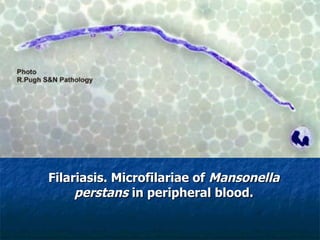
Filariasis. Microfilariae of  Mansonella perstans  in peripheral blood.
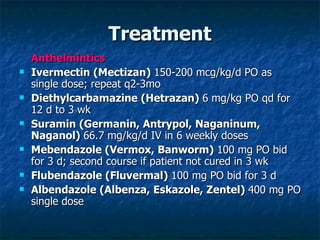
Treatment Anthelmintics Ivermectin (Mectizan)  150-200 mcg/kg/d PO as single dose; repeat q2-3mo Diethylcarbamazine (Hetrazan)  6 mg/kg PO qd for 12 d to 3 wk Suramin (Germanin, Antrypol, Naganinum, Naganol)  66.7 mg/kg/d IV in 6 weekly doses Mebendazole (Vermox, Banworm)  100 mg PO bid for 3 d; second course if patient not cured in 3 wk Flubendazole (Fluvermal)  100 mg PO bid for 3 d Albendazole (Albenza, Eskazole, Zentel)  400 mg PO single dose
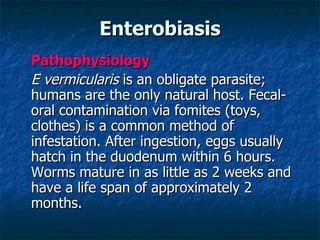
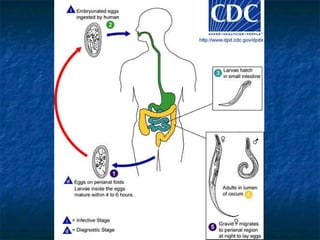
Enterobiasis Pathophysiology E vermicularis  is an obligate parasite; humans are the only natural host. Fecal-oral contamination via fomites (toys, clothes) is a common method of infestation. After ingestion, eggs usually hatch in the duodenum within 6 hours. Worms mature in as little as 2 weeks and have a life span of approximately 2 months.
 
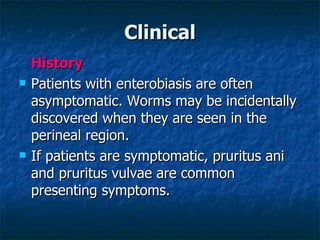
Clinical History Patients with enterobiasis are often asymptomatic. Worms may be incidentally discovered when they are seen in the perineal region.  If patients are symptomatic, pruritus ani and pruritus vulvae are common presenting symptoms.
Physical Patients often have excoriation or erythema of the perineum, vulvae, or both, but infestation can occur without these signs.
Differential Diagnoses Appendicitis Ascariasis Cervicitis Contact Dermatitis Giardiasis
Workup Laboratory Studies Diagnosis is made by identifying eggs under the low-power lens of microscope. Dilute sodium hydroxide or toluene should be added to the slide.
Treatment Anthelmintics Pyrantel (Antiminth, Pin-Rid, Pin-X)  11 mg/kg PO once; not to exceed 1 g; repeat treatment in 2 wk Mebendazole (Vermox)  100 mg PO once; repeat treatment in 2 wk Albendazole (Albenza)  400 mg PO as single dose; repeat in 2 wk if necessary

Lecture nematodes

  • 1.
  • 2.
    Ascariasis Introduction Ascariasisis the most common helminthic infection, with an estimated worldwide prevalence of 25% (0.8-1.22 billion people). Pathophysiology Adult A lumbricoides are white or yellow and 15-35 cm long. They live 10-24 months in the jejunum and middle ileum of the intestine. Each day, female A lumbricoides produce 240,000 eggs, which are fertilized by nearby male worms. Eggs may remain viable in soil for up to 17 months.
  • 3.
    Clinical History Earlysymptoms of ascariasis, during the initial lung migration, include cough, dyspnea, wheezing, and chest pain. Abdominal pain, distension, colic, nausea, anorexia, and intermittent diarrhea may be manifestations of partial or complete intestinal obstruction by adult worms.
  • 4.
    Physical Rales, wheezes,and tachypnea may develop during pulmonary migration, particularly in persons with a high worm burden. Abdominal tenderness, especially in the right upper quadrant, hypogastrium, or right lower quadrant, may suggest complications of ascariasis.
  • 5.
    Differential Diagnoses BiliaryColic Colonic Obstruction Pancreatitis, Acute Pneumonia, Community-Acquired
  • 6.
    Workup Laboratory StudiesStool examination for ova and parasites. Ascaris larvae may be observed in microscopic wet preparations of sputum during the pulmonary migration phase. CBC counts show eosinophilia during the tissue migration phase of the infection. Serological tests are not clinically useful for ascariasis.
  • 7.
    Treatment Medical CareBecause of the risk of complications, patients with ascariasis who have other concomitant helminthic infections should always undergo treatment for ascariasis first. Medical therapy is usually not indicated during active pulmonary infection because dying larvae are considered a higher risk for significant pneumonitis. Pulmonary symptoms may be ameliorated with inhaled bronchodilator therapy or corticosteroids, if necessary.
  • 8.
    Surgical Care Recommendedcriteria for surgical exploration include the following: Passage of blood per rectum Multiple air fluid levels on abdominal radiographs An ill child with abdominal distension and rebound tenderness Unsatisfactory response to conservative therapy Appendicitis and primary peritonitis Hepatobiliary disease Pancreatic pseudocyst
  • 9.
    Medication Albendazole (Albenza) 400 mg PO single dose Mebendazole (Vermox) 500 mg PO once or 100 mg PO bid for 3 d Pyrantel pamoate (Pin-Rid, Reese's Pinworm Medicine) 11 mg/kg PO to maximum of 1 g
  • 10.
  • 11.
  • 12.
  • 13.
  • 14.
    Filariasis Filariasis isa disease group affecting humans and animals caused by nematode parasites of the order Filariidae, commonly called filariae. Filarial parasites may be classified according to the habitat of the adult worms in the vertebral host. The cutaneous group includes Loa loa, Onchocerca volvulus, and Mansonella streptocerca. The lymphatic group includes Wuchereria bancrofti, Brugia malayi, and Brugia timori. The body-cavity group includes Mansonella perstans and Mansonella ozzardi.
  • 15.
    Pathophysiology The filariallife cycle, like that of all nematodes, consists of 5 developmental or larval stages in a vertebral host and an arthropod intermediate host and vector.
  • 16.
    Clinical History Symptomsof filariasis are species-dependent and body-site–dependent and can be acute or chronic in nature. Lymphatic filariasis The symptoms of lymphatic filariasis predominantly result from the presence of adult worms residing in the lymphatics. The clinical course is broadly divided into asymptomatic microfilaremia, acute phases of adenolymphangitis (ADL), and chronic irreversible lymphedema.
  • 17.
    Physical Lymphatic filariasis Acute manifestations of lymphatic filariasis is characterized by episodic attacks of fever associated with inflammation of the inguinal lymph nodes, testis, spermatic cord, lymphedema, or a combination of these. Skin exfoliation of the affected body part usually occurs with resolution of an episode. Repeated episodes of inflammation and lymphedema lead to lymphatic damage, chronic swelling, and elephantiasis of the legs, arms, scrotum, vulva, and breasts
  • 18.
    Lymphatic filariasis resultingfrom Wuchereria bancrofti infection, which is causing limb lymphoedema, inguinal lymphadenopathy, and hydrocele.
  • 19.
    Filariasis. Unilateral leftlower leg elephantiasis secondary to Wuchereria bancrofti infection in a boy.
  • 20.
    Filariasis. This isa close-up view of the unilateral lower leg elephantiasis. Note the lymphedema and typical skin appearance of depigmentation and verrucosities (warty changes).
  • 21.
    Filariasis. Lateral viewof the right outer aspect of a leg affected by gross elephantiasis secondary to Wuchereria bancrofti infection.
  • 22.
    Filariasis. Inner aspectof the lower leg of the male patient showing gross elephantiasis secondary to Wuchereria bancrofti infection.
  • 23.
    Filariasis. Unilateral lefthydrocele and testicular enlargement secondary to Wuchereria bancrofti infection in a man who also was positive for microfilariae.
  • 24.
    Filariasis. Bilateral hydrocele,testicular enlargement, and inguinal lymphadenopathy secondary to Wuchereria bancrofti infection in a man who also was microfilaremic.
  • 25.
    Differential Diagnoses Angioedema, Milroy Disease , Asthma , Scrotal Trauma , Hodgkin Disease , Testicular Trauma , Hydrocele , Nonseminomatous Testicular Tumors , Leprosy , Lymphedema , Non-Hodgkin Lymphoma .
  • 26.
    Workup Laboratory StudiesDetection of microfilariae in blood Detection of microfilariae in skin Detection of microfilariae in the eye. Detection of filarial antigen. Detection of filarial antibodies. Urine examination and microscopy. Complete blood cell count.
  • 27.
    Filariasis. Microfilariae of Mansonella perstans in peripheral blood.
  • 28.
    Treatment Anthelmintics Ivermectin(Mectizan) 150-200 mcg/kg/d PO as single dose; repeat q2-3mo Diethylcarbamazine (Hetrazan) 6 mg/kg PO qd for 12 d to 3 wk Suramin (Germanin, Antrypol, Naganinum, Naganol) 66.7 mg/kg/d IV in 6 weekly doses Mebendazole (Vermox, Banworm) 100 mg PO bid for 3 d; second course if patient not cured in 3 wk Flubendazole (Fluvermal) 100 mg PO bid for 3 d Albendazole (Albenza, Eskazole, Zentel) 400 mg PO single dose
  • 29.
    Enterobiasis Pathophysiology Evermicularis is an obligate parasite; humans are the only natural host. Fecal-oral contamination via fomites (toys, clothes) is a common method of infestation. After ingestion, eggs usually hatch in the duodenum within 6 hours. Worms mature in as little as 2 weeks and have a life span of approximately 2 months.
  • 30.
  • 31.
    Clinical History Patientswith enterobiasis are often asymptomatic. Worms may be incidentally discovered when they are seen in the perineal region. If patients are symptomatic, pruritus ani and pruritus vulvae are common presenting symptoms.
  • 32.
    Physical Patients oftenhave excoriation or erythema of the perineum, vulvae, or both, but infestation can occur without these signs.
  • 33.
    Differential Diagnoses AppendicitisAscariasis Cervicitis Contact Dermatitis Giardiasis
  • 34.
    Workup Laboratory StudiesDiagnosis is made by identifying eggs under the low-power lens of microscope. Dilute sodium hydroxide or toluene should be added to the slide.
  • 35.
    Treatment Anthelmintics Pyrantel(Antiminth, Pin-Rid, Pin-X) 11 mg/kg PO once; not to exceed 1 g; repeat treatment in 2 wk Mebendazole (Vermox) 100 mg PO once; repeat treatment in 2 wk Albendazole (Albenza) 400 mg PO as single dose; repeat in 2 wk if necessary