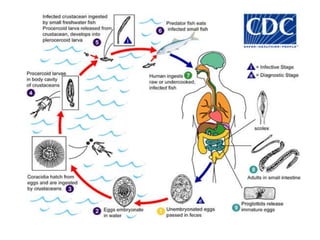
This document summarizes the morphology, life cycle, pathogenesis, treatment, and control of Diphyllobothrium latum, the fish tapeworm. It notes that D. latum has a scolex lacking hooks and suckers, with proglottids possessing a central rosette-shaped uterus. It can reach lengths of 2-12 meters with thousands of proglottids. Its life cycle involves eggs passing from the definitive host (dogs, cats, humans) and infecting copepods and fish as intermediate hosts. Humans can become infected by eating contaminated fish and may experience anemia. Treatment involves the drug praziquantel, while control focuses on proper fish handling and prevention of sewage contamination


![[Micro] cestodes](https://cdn.slidesharecdn.com/ss_thumbnails/nvpl1fbyq2ofjfsbmped-signature-2127a2ca5368c7fdfd023e8d90dde3fc0b9fe7d91346a4189562c9f63dc0d19d-poli-150819190753-lva1-app6892-thumbnail.jpg?width=640&height=640&fit=bounds)


