Immunology
Lymphoid organs
Sr. sarupya
Mercy college palakkad
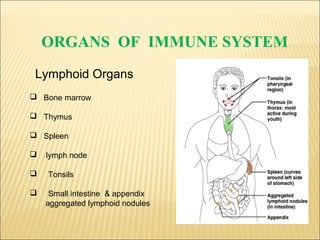
ORGANS OF IMMUNE SYSTEM
 Bone marrow
 Thymus
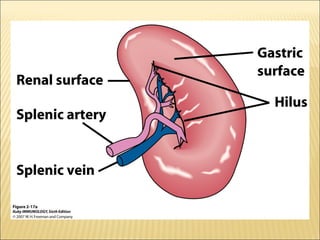
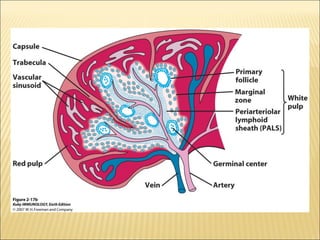
 Spleen
 lymph node
 Tonsils
 Small intestine & appendix
aggregated lymphoid nodules
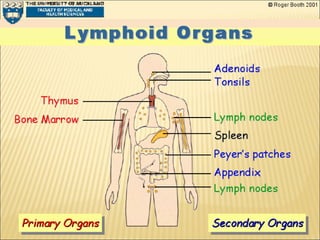
Lymphoid Organs
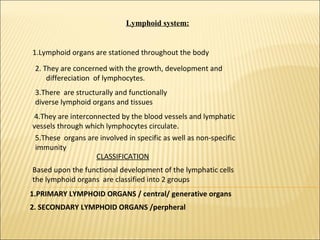
Lymphoid system:
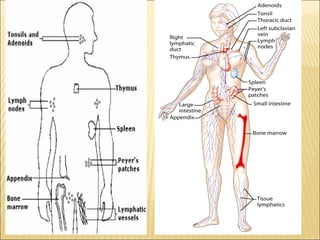
1.Lymphoid organs are stationed throughout the body
2. They are concerned with the growth, development and
differeciation of lymphocytes.
3.There are structurally and functionally
diverse lymphoid organs and tissues
4.They are interconnected by the blood vessels and lymphatic
vessels through which lymphocytes circulate.
5.These organs are involved in specific as well as non-specific
immunity
CLASSIFICATION
Based upon the functional development of the lymphatic cells
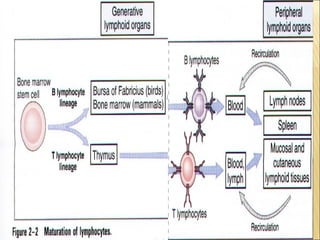
the lymphoid organs are classified into 2 groups
1.PRIMARY LYMPHOID ORGANS / central/ generative organs
2. SECONDARY LYMPHOID ORGANS /perpheral
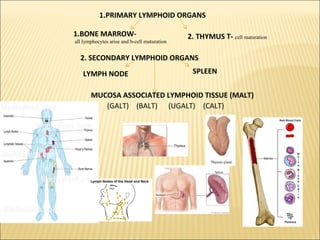
1.PRIMARY LYMPHOID ORGANS
1.BONE MARROW-
all lymphocytes arise and b-cell maturation
2. THYMUS T- cell maturation
2. SECONDARY LYMPHOID ORGANS
LYMPH NODE SPLEEN
MUCOSA ASSOCIATED LYMPHOID TISSUE (MALT)
(GALT) (BALT) (UGALT) (CALT)
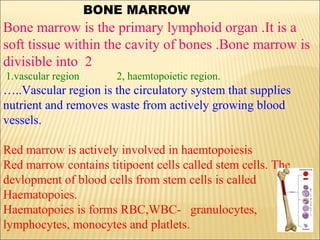
Bone marrow is the primary lymphoid organ .It is a
soft tissue within the cavity of bones .Bone marrow is
divisible into 2
1.vascular region 2, haemtopoietic region.
…..Vascular region is the circulatory system that supplies
nutrient and removes waste from actively growing blood
vessels.
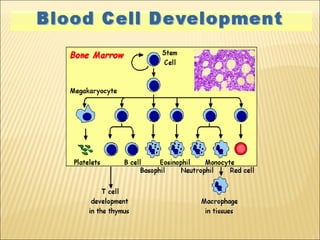
Red marrow is actively involved in haemtopoiesis
Red marrow contains titipoent cells called stem cells. The
devlopment of blood cells from stem cells is called
Haematopoies.
Haematopoies is forms RBC,WBC- granulocytes,
lymphocytes, monocytes and platlets.
BONE MARROW
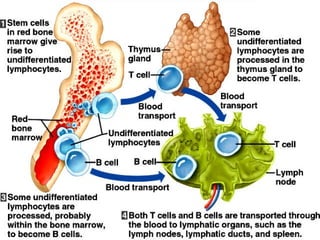
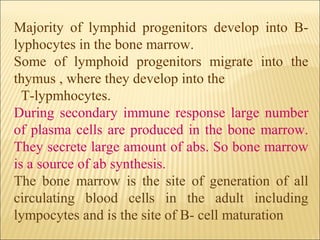
Majority of lymphid progenitors develop into B-
lyphocytes in the bone marrow.
Some of lymphoid progenitors migrate into the
thymus , where they develop into the
T-lypmhocytes.
During secondary immune response large number
of plasma cells are produced in the bone marrow.
They secrete large amount of abs. So bone marrow
is a source of ab synthesis.
The bone marrow is the site of generation of all
circulating blood cells in the adult including
lympocytes and is the site of B- cell maturation
Bone marrow
The bone marrow is the site of generation of all
circulating blood cells in the adult, including
immature lymphocytes, and is the site of B cell
maturation.
Functions of bone marrow
The site of generation of all immunocytes
The site of differentiation and maturation of
immunocytes
The site of immune response of B cell,
specifically in secondary immune response.
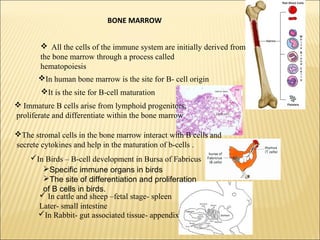
 All the cells of the immune system are initially derived from
the bone marrow through a process called
hematopoiesis
BONE MARROW
In human bone marrow is the site for B- cell origin
It is the site for B-cell maturation
 Immature B cells arise from lymphoid progenitors,
proliferate and differentiate within the bone marrow
The stromal cells in the bone marrow interact with B cells and
secrete cytokines and help in the maturation of b-cells .
In Birds – B-cell development in Bursa of Fabricus
 In cattle and sheep –fetal stage- spleen
Later- small intestine
In Rabbit- gut associated tissue- appendix
Specific immune organs in birds
The site of differentiation and proliferation
of B cells in birds.
THYMUS:
Thymus is the site of T cell differentiation and maturation
It is a bilobed gland, Situated above heart in the thorax region
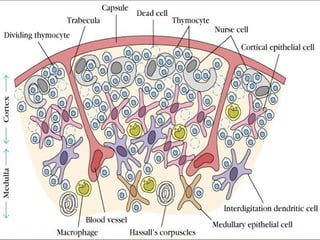
each lobe is encapsulated and it is divided into lobules
which are separated by strands of connective tissue –
called trabeculae
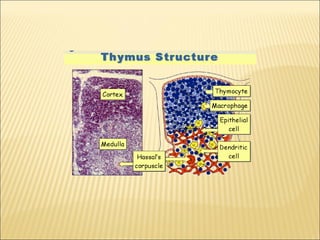
Each lobule contains – lymphocytes & each lobule organized into
2 compartments 1…Outer cortex 2.Inner medulla
Site of T cell
maturation.
Relative Size
Greatest in
Newborn
Absolute Size
Greatest at
Puberty
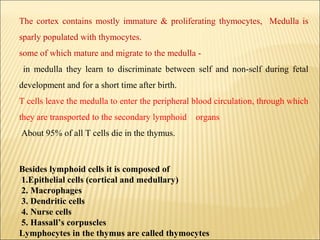
The cortex contains mostly immature & proliferating thymocytes, Medulla is
sparly populated with thymocytes.
some of which mature and migrate to the medulla -
in medulla they learn to discriminate between self and non-self during fetal
development and for a short time after birth.
T cells leave the medulla to enter the peripheral blood circulation, through which
they are transported to the secondary lymphoid organs
About 95% of all T cells die in the thymus.
Besides lymphoid cells it is composed of
1.Epithelial cells (cortical and medullary)
2. Macrophages
3. Dendritic cells
4. Nurse cells
5. Hassall’s corpuscles
Lymphocytes in the thymus are called thymocytes
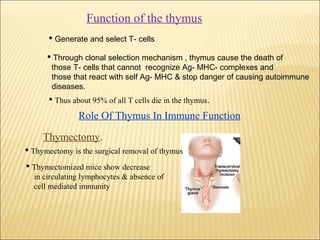
Function of the thymus
 Generate and select T- cells
 Through clonal selection mechanism , thymus cause the death of
those T- cells that cannot recognize Ag- MHC- complexes and
those that react with self Ag- MHC & stop danger of causing autoimmune
diseases.
 Thus about 95% of all T cells die in the thymus.
Role Of Thymus In Immune Function
Thymectomy.
 Thymectomy is the surgical removal of thymus
 Thymectomized mice show decrease
in circulating lymphocytes & absence of
cell mediated immunity
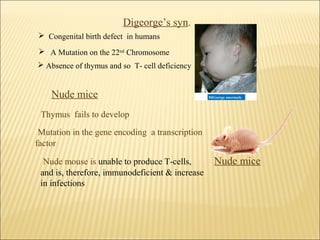
Digeorge’s syn.
 A Mutation on the 22nd
Chromosome
 Absence of thymus and so T- cell deficiency
 Congenital birth defect in humans
Nude mice
Nude mice
Thymus fails to develop
Nude mouse is unable to produce T-cells,
and is, therefore, immunodeficient & increase
in infections
Mutation in the gene encoding a transcription
factor
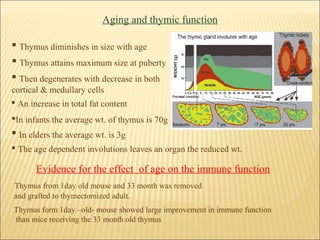
Aging and thymic function
 Thymus diminishes in size with age
 Thymus attains maximum size at puberty
 Then degenerates with decrease in both
cortical & medullary cells
 An increase in total fat content
In infants the average wt. of thymus is 70g
 In elders the average wt. is 3g
 The age dependent involutions leaves an organ the reduced wt.
Evidence for the effect of age on the immune function
Thymus from 1day old mouse and 33 month was removed
and grafted to thymectomized adult.
Thymus form 1day –old- mouse showed large improvement in immune function
than mice receiving the 33 month old thymus
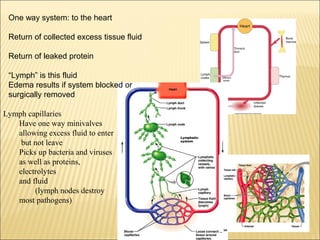
One way system: to the heart
Return of collected excess tissue fluid
Return of leaked protein
“Lymph” is this fluid
Edema results if system blocked or
surgically removed
Lymph capillaries
Have one way minivalves
allowing excess fluid to enter
but not leave
Picks up bacteria and viruses
as well as proteins,
electrolytes
and fluid
(lymph nodes destroy
most pathogens)
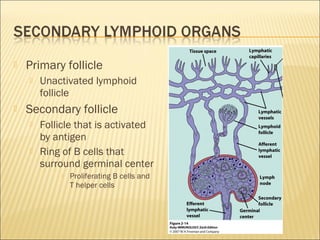
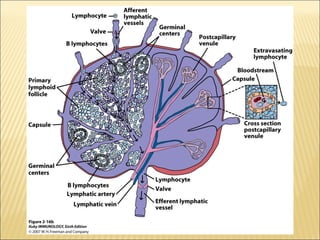
 Primary follicle
 Unactivated lymphoid
follicle
 Secondary follicle
 Follicle that is activated
by antigen
 Ring of B cells that
surround germinal center
 Proliferating B cells and
T helper cells
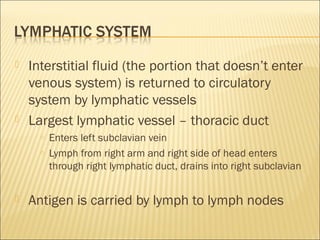
 Interstitial fluid (the portion that doesn’t enter
venous system) is returned to circulatory
system by lymphatic vessels
 Largest lymphatic vessel – thoracic duct
○ Enters left subclavian vein
○ Lymph from right arm and right side of head enters
through right lymphatic duct, drains into right subclavian
 Antigen is carried by lymph to lymph nodes
Lymphoid organs  ppt

Lymphoid organs ppt

  • 1.
  • 2.
    ORGANS OF IMMUNESYSTEM  Bone marrow  Thymus  Spleen  lymph node  Tonsils  Small intestine & appendix aggregated lymphoid nodules Lymphoid Organs
  • 3.
    Lymphoid system: 1.Lymphoid organsare stationed throughout the body 2. They are concerned with the growth, development and differeciation of lymphocytes. 3.There are structurally and functionally diverse lymphoid organs and tissues 4.They are interconnected by the blood vessels and lymphatic vessels through which lymphocytes circulate. 5.These organs are involved in specific as well as non-specific immunity CLASSIFICATION Based upon the functional development of the lymphatic cells the lymphoid organs are classified into 2 groups 1.PRIMARY LYMPHOID ORGANS / central/ generative organs 2. SECONDARY LYMPHOID ORGANS /perpheral
  • 5.
    1.PRIMARY LYMPHOID ORGANS 1.BONEMARROW- all lymphocytes arise and b-cell maturation 2. THYMUS T- cell maturation 2. SECONDARY LYMPHOID ORGANS LYMPH NODE SPLEEN MUCOSA ASSOCIATED LYMPHOID TISSUE (MALT) (GALT) (BALT) (UGALT) (CALT)
  • 7.
    Bone marrow isthe primary lymphoid organ .It is a soft tissue within the cavity of bones .Bone marrow is divisible into 2 1.vascular region 2, haemtopoietic region. …..Vascular region is the circulatory system that supplies nutrient and removes waste from actively growing blood vessels. Red marrow is actively involved in haemtopoiesis Red marrow contains titipoent cells called stem cells. The devlopment of blood cells from stem cells is called Haematopoies. Haematopoies is forms RBC,WBC- granulocytes, lymphocytes, monocytes and platlets. BONE MARROW
  • 10.
    Majority of lymphidprogenitors develop into B- lyphocytes in the bone marrow. Some of lymphoid progenitors migrate into the thymus , where they develop into the T-lypmhocytes. During secondary immune response large number of plasma cells are produced in the bone marrow. They secrete large amount of abs. So bone marrow is a source of ab synthesis. The bone marrow is the site of generation of all circulating blood cells in the adult including lympocytes and is the site of B- cell maturation
  • 11.
    Bone marrow The bonemarrow is the site of generation of all circulating blood cells in the adult, including immature lymphocytes, and is the site of B cell maturation. Functions of bone marrow The site of generation of all immunocytes The site of differentiation and maturation of immunocytes The site of immune response of B cell, specifically in secondary immune response.
  • 12.
     All thecells of the immune system are initially derived from the bone marrow through a process called hematopoiesis BONE MARROW In human bone marrow is the site for B- cell origin It is the site for B-cell maturation  Immature B cells arise from lymphoid progenitors, proliferate and differentiate within the bone marrow The stromal cells in the bone marrow interact with B cells and secrete cytokines and help in the maturation of b-cells . In Birds – B-cell development in Bursa of Fabricus  In cattle and sheep –fetal stage- spleen Later- small intestine In Rabbit- gut associated tissue- appendix Specific immune organs in birds The site of differentiation and proliferation of B cells in birds.
  • 13.
    THYMUS: Thymus is thesite of T cell differentiation and maturation It is a bilobed gland, Situated above heart in the thorax region each lobe is encapsulated and it is divided into lobules which are separated by strands of connective tissue – called trabeculae Each lobule contains – lymphocytes & each lobule organized into 2 compartments 1…Outer cortex 2.Inner medulla Site of T cell maturation. Relative Size Greatest in Newborn Absolute Size Greatest at Puberty
  • 15.
    The cortex containsmostly immature & proliferating thymocytes, Medulla is sparly populated with thymocytes. some of which mature and migrate to the medulla - in medulla they learn to discriminate between self and non-self during fetal development and for a short time after birth. T cells leave the medulla to enter the peripheral blood circulation, through which they are transported to the secondary lymphoid organs About 95% of all T cells die in the thymus. Besides lymphoid cells it is composed of 1.Epithelial cells (cortical and medullary) 2. Macrophages 3. Dendritic cells 4. Nurse cells 5. Hassall’s corpuscles Lymphocytes in the thymus are called thymocytes
  • 17.
    Function of thethymus  Generate and select T- cells  Through clonal selection mechanism , thymus cause the death of those T- cells that cannot recognize Ag- MHC- complexes and those that react with self Ag- MHC & stop danger of causing autoimmune diseases.  Thus about 95% of all T cells die in the thymus. Role Of Thymus In Immune Function Thymectomy.  Thymectomy is the surgical removal of thymus  Thymectomized mice show decrease in circulating lymphocytes & absence of cell mediated immunity
  • 18.
    Digeorge’s syn.  AMutation on the 22nd Chromosome  Absence of thymus and so T- cell deficiency  Congenital birth defect in humans Nude mice Nude mice Thymus fails to develop Nude mouse is unable to produce T-cells, and is, therefore, immunodeficient & increase in infections Mutation in the gene encoding a transcription factor
  • 19.
    Aging and thymicfunction  Thymus diminishes in size with age  Thymus attains maximum size at puberty  Then degenerates with decrease in both cortical & medullary cells  An increase in total fat content In infants the average wt. of thymus is 70g  In elders the average wt. is 3g  The age dependent involutions leaves an organ the reduced wt. Evidence for the effect of age on the immune function Thymus from 1day old mouse and 33 month was removed and grafted to thymectomized adult. Thymus form 1day –old- mouse showed large improvement in immune function than mice receiving the 33 month old thymus
  • 20.
    One way system:to the heart Return of collected excess tissue fluid Return of leaked protein “Lymph” is this fluid Edema results if system blocked or surgically removed Lymph capillaries Have one way minivalves allowing excess fluid to enter but not leave Picks up bacteria and viruses as well as proteins, electrolytes and fluid (lymph nodes destroy most pathogens)
  • 21.
     Primary follicle Unactivated lymphoid follicle  Secondary follicle  Follicle that is activated by antigen  Ring of B cells that surround germinal center  Proliferating B cells and T helper cells
  • 22.
     Interstitial fluid(the portion that doesn’t enter venous system) is returned to circulatory system by lymphatic vessels  Largest lymphatic vessel – thoracic duct ○ Enters left subclavian vein ○ Lymph from right arm and right side of head enters through right lymphatic duct, drains into right subclavian  Antigen is carried by lymph to lymph nodes