
Nausea: is an unpleasant subjective
sensation that most people have
experienced at some point in their lives and
usually recognize as a feeling of impending
vomiting in the epigastrium or throat.
Retching: muscular activity of the abdomen
and thorax, often voluntary, leading to
forced inspiration against a closed mouth
and glottis without oral discharge of gastric
contents (“dry heaves”)
Vomiting: Vomiting is a partially voluntary act
of forcefully expelling gastric or intestinal
content through the mouth.
Regurgitation: effortless return of esophageal
or gastric contents into the mouth
unassociated with nausea or involuntary
muscle contractions.
Rumination: food that is regurgitated in the
postprandial period, re-chewed and then re-
swallowed.
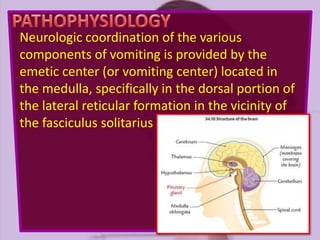
Neurologic coordination of the various
components of vomiting is provided by the
emetic center (or vomiting center) located in
the medulla, specifically in the dorsal portion of
the lateral reticular formation in the vicinity of
the fasciculus solitarius
The afferent neural pathways that carry
activating signals to the emetic center arise
from many locations in the body.
Afferent neural pathways arise from various
sites along the digestive tract—the pharynx,
stomach, and small intestine.
Afferent impulses from these organs are
relayed at the solitary nucleus (nucleus
tractus solitarius) to the emetic center.
Afferent pathways also arise from
nondigestive organs such as the heart.
Pathways from the chemoreceptor trigger
zone (CTZ) located in the area postrema on
the floor of the fourth ventricle activate the
emetic center.
Despite its central location, the CTZ is
outside, at least in part, the blood-brain
barrier and serves primarily as a sensitive
detection apparatus for circulating
endogenous and exogenous molecules that
may activate emesis.
The vomit center receives input from four
major areas the GI tract, the chemoreceptor
trigger zone, the vestibular apparatus, and
the cerebral cortex.
When activated, the emetic center sets into motion, through
neural efferents, the various components of the emetic
sequence.
 First, nausea develops as a result of activation of the
cerebral cortex; the stomach relaxes concomitantly, and
antral and intestinal peristalsis are inhibited.
Second, retching occurs as a result of activation of
spasmodic contractions of the diaphragm and intercostal
muscles combined with closure of the glottis.
Third, the act of vomiting occurs when somatic and visceral
components are activated simultaneously.
The components include brisk contraction of
the diaphragm and abdominal muscles,
relaxation of the lower esophageal sphincter,
and a forceful retrograde peristaltic
contraction in the jejunum that pushes
enteric content into the stomach and from
there toward the mouth.
Simultaneously, protective reflexes are
activated. The soft palate is raised to prevent
gastric content from entering the
nasopharynx, respiration is inhibited
momentarily, and the glottis is closed to
prevent pulmonary aspiration, which is a
potentially serious complication of vomiting.
• Certain clinical features may be characteristic of
specific causes of vomiting.
• Nausea and vomiting that occur in the morning or
with an empty stomach are characteristic of
vomiting produced by direct activation of the
emetic center or CTZ.
• This type of emesis is most typical of pregnancy,
drugs, toxins (e.g., alcohol abuse), or metabolic
disorders (diabetes mellitus, uremia).
• Pseudovomitus, in which totally undigested food
that has not been exposed to gastric juice is
expelled, may occur in long-standing achalasia or
with a large Zenker's diverticulum.
• Bilious vomiting is commonly seen after
multiple vomiting episodes occur in close
succession because of retrograde entry of
intestinal material into the stomach. It is
also characteristic of patients with a
surgical enterogastric anastomosis, in
whom the gastric contents normally
include bile-stained enteric refluxate.
Vomitus with a feculent odor suggests
intestinal obstruction, ileus associated with
peritonitis.
Vomiting that develops abruptly without
preceding nausea or retching (projectile
vomiting) is characteristic of, but not specific
for, direct stimulation of the emetic center, as
may occur with intracerebral lesions (tumor,
abscess) or increased intracranial pressure.
• Vomiting that occurs outside the immediate
postprandial period and that is characterized
by evacuation of retained and partially
digested food is typical of slowly developing
gastric outlet obstruction or gastroparesis.
• Mechanical obstruction
• Gastric outlet obstruction
• Small bowel obstruction
• Motility disorders.
• Chronic intestinal pseudo-obstruction.
• Gastroparesis.
• Acute appendicitis
• Acute cholecystitis
• Acute hepatitis.
• Acute mesenteric ischemia.
• Crohn's disease.
• Gastric and duodenal ulcer disease.
• Pancreatitis and pancreatic neoplasms.
• Peritonitis and peritoneal carcinomatosis.
• Retroperitoneal and mesenteric pathology.
• SUPERIOR MESENTERIC ARTERY SYNDROME.
• Acute gastroenteritis.
• Viral
• Bacterial
• Nongastrointestinal (systemic) infections
• Acute intermittent porphyria
• Addison's disease
• Diabetic ketoacidosis
• Diabetes mellitus
• Hyperparathyroidism/hypercalcemia.
• Hyperthyroidism
• Hyponatremia
• Hypoparathyroidism
• Pregnancy.
• Demyelinating disorders
• Disorders of the autonomic system
• Hydrocephalus
• Intracerebral lesions with edema Abscess
• Hemorrhage
• Infarction
• Neoplasm
• Labyrinthine disorders
• Meningitis
• Migraine headaches
• Otitis media
• Seizure disorders
•
• Anxiety and depression
• Cardiac disease
• Congestive heart failure
• Myocardial infarction, ischemia
• Collagen vascular disorders Scleroderma
• Systemic lupus erythematosus
• Eating disorders
• Ethanol abuse
• Hypervitaminosis A
• Intense pain
• Paraneoplastic syndrome
• Postoperative state
• Postvagotomy
• Radiation therapy
• Starvation
• Cancer chemotherapy
– e.g. cisplatin
• Analgesics
– e.g. opiates, NSAIDs
• Anti-arrythmics
– e.g., digoxin, quinidine
• Antibiotics
– e.g., erythromycin
• Oral contraceptives
• Metformin
• Anti-parkinsonians
– e.g., bromcryptine, L-DOPA
• Anti-convulsants
– e.g., phenytoin, carbamazepine
• Anti-hypertensives
• Theophylline
• Anesthetic agents
• Nutritional
– adults: weight loss; kids: failure to gain weight.
• Cutaneous (petechia, purpura)
• Orophayngeal (dental, sore throat)
• Esophagitis/ esophageal hematoma
• GE Junctional: M-W tears; rupture (Boorhaave’s)
• Metabolic: electrolyte, acid-base, water
• Renal: prerenal azotemia; ATN;
hypokalemic nephropathy
Metabolic alkalosis
retention of HCO3
- + volume-
contraction
Hypokalemia
renal K+ losses + GI K+ loss +
oral K+ intake
Hypochloremia
gastric chloride losses
Hyponatremia
free water retention due to
volume contraction
Note: Patients with uremia or Addison’s disease may have normal or even
high serum K+ despite vomiting
How long?
Relationship to meals?
Contents of vomitus?
Associated symptoms
pain in the chest or abdomen, fever,
myalgias, diarrhea, vertigo, dizziness,
headache, focal neurological symptoms,
jaundice, weight loss
Diabetes?
When was last menstrual period?
Vital signs
BP and pulse tilt test
Cardiopulmonary exam
Abdominal exam
Rectal exam
Neurological exam
including funduscopic
exam (papilledema)
• Electrolytes, glucose, BUN/creatinine
• Calcium, albumin, total serum proteins
• CBC
• LFTs
• Pregnancy test
• Urinalysis
• Serum lipase amylase
• Plain abdominal films
• Abdominal sono or CT.
• Head CT or MRI if severe headache, papill-
edema, marked hypertension, altered
mental status, or focal neurological findings
• EGD or upper GI to separate GOO or high
duodenal obstruction from gastroparesis
• Radiopaque marker emptying studies or
radionuclide scintigraphy, esp. if diabetic.
1. Treat complications regardless of cause
e.g., replace salt, water, potassium losses
2. Identify and treat underlying cause,
whenever possible
3. Provide temporary symptomatic relief of
the symptoms
4. Use preventive measures when vomiting is
likely to occur (e.g., cancer chemotherapy,
parenteral opiate administration)
• Antihistamines, e.g., meclizine.
– esp. for vestibular disorders
• Anticholinergics, e.g., scopolamine.
– esp. for vestibular and GI disorders
• Dopamine antagonists, e.g.,metoclopramide or
prochlorperazine.
– esp. for GI disorders
• Selective serotonin-3 (5HT3) RAs, e.g.,
odansetron, granisetron, dolasetron
– esp. to prevent chemotherapy-induced
nausea/vomiting
Multiple mechanisms of action:
• Promethazine (Phenergan)
– dopamine antagonist
– H1 antihistamine
– anticholinergic
– CNS sedative
– prevention of opiate-induced nausea and vomiting
• Hydroxyzine.
– H1 antihistamine
– anticholinergic
– CNS sedation
– prevention of opiate-induced nausea and vomiting
• Dexamethasone.
– along with other anti-emetics for prevention
of cancer chemotherapy-induced emesis.
• Nausea and vomiting are features of many GI and non-GI
diseases and disorders.
• Regardless of its cause, treatment of nausea and vomiting
should initially focus on replacing volume and electrolyte
deficits. Later on, nutritional deficits must be addressed.
• Regardless of its cause, nausea and vomiting can cause several
life-threatening GI and non-GI complications.
• Elucidation of the cause is often possible, and treatment of the
underlying cause will usually be successful.
• Effective symptomatic therapies for nausea and vomiting are
available when the cause is unclear or when the treatment of
the underlying cause takes time to work.
Vomiting

Vomiting

  • 2.
    Nausea: is anunpleasant subjective sensation that most people have experienced at some point in their lives and usually recognize as a feeling of impending vomiting in the epigastrium or throat. Retching: muscular activity of the abdomen and thorax, often voluntary, leading to forced inspiration against a closed mouth and glottis without oral discharge of gastric contents (“dry heaves”)
  • 3.
    Vomiting: Vomiting isa partially voluntary act of forcefully expelling gastric or intestinal content through the mouth. Regurgitation: effortless return of esophageal or gastric contents into the mouth unassociated with nausea or involuntary muscle contractions. Rumination: food that is regurgitated in the postprandial period, re-chewed and then re- swallowed.
  • 4.
    Neurologic coordination ofthe various components of vomiting is provided by the emetic center (or vomiting center) located in the medulla, specifically in the dorsal portion of the lateral reticular formation in the vicinity of the fasciculus solitarius
  • 5.
    The afferent neuralpathways that carry activating signals to the emetic center arise from many locations in the body. Afferent neural pathways arise from various sites along the digestive tract—the pharynx, stomach, and small intestine.
  • 6.
    Afferent impulses fromthese organs are relayed at the solitary nucleus (nucleus tractus solitarius) to the emetic center. Afferent pathways also arise from nondigestive organs such as the heart. Pathways from the chemoreceptor trigger zone (CTZ) located in the area postrema on the floor of the fourth ventricle activate the emetic center.
  • 7.
    Despite its centrallocation, the CTZ is outside, at least in part, the blood-brain barrier and serves primarily as a sensitive detection apparatus for circulating endogenous and exogenous molecules that may activate emesis. The vomit center receives input from four major areas the GI tract, the chemoreceptor trigger zone, the vestibular apparatus, and the cerebral cortex.
  • 8.
    When activated, theemetic center sets into motion, through neural efferents, the various components of the emetic sequence.  First, nausea develops as a result of activation of the cerebral cortex; the stomach relaxes concomitantly, and antral and intestinal peristalsis are inhibited. Second, retching occurs as a result of activation of spasmodic contractions of the diaphragm and intercostal muscles combined with closure of the glottis. Third, the act of vomiting occurs when somatic and visceral components are activated simultaneously.
  • 10.
    The components includebrisk contraction of the diaphragm and abdominal muscles, relaxation of the lower esophageal sphincter, and a forceful retrograde peristaltic contraction in the jejunum that pushes enteric content into the stomach and from there toward the mouth.
  • 11.
    Simultaneously, protective reflexesare activated. The soft palate is raised to prevent gastric content from entering the nasopharynx, respiration is inhibited momentarily, and the glottis is closed to prevent pulmonary aspiration, which is a potentially serious complication of vomiting.
  • 13.
    • Certain clinicalfeatures may be characteristic of specific causes of vomiting. • Nausea and vomiting that occur in the morning or with an empty stomach are characteristic of vomiting produced by direct activation of the emetic center or CTZ. • This type of emesis is most typical of pregnancy, drugs, toxins (e.g., alcohol abuse), or metabolic disorders (diabetes mellitus, uremia).
  • 14.
    • Pseudovomitus, inwhich totally undigested food that has not been exposed to gastric juice is expelled, may occur in long-standing achalasia or with a large Zenker's diverticulum.
  • 15.
    • Bilious vomitingis commonly seen after multiple vomiting episodes occur in close succession because of retrograde entry of intestinal material into the stomach. It is also characteristic of patients with a surgical enterogastric anastomosis, in whom the gastric contents normally include bile-stained enteric refluxate.
  • 16.
    Vomitus with afeculent odor suggests intestinal obstruction, ileus associated with peritonitis. Vomiting that develops abruptly without preceding nausea or retching (projectile vomiting) is characteristic of, but not specific for, direct stimulation of the emetic center, as may occur with intracerebral lesions (tumor, abscess) or increased intracranial pressure.
  • 17.
    • Vomiting thatoccurs outside the immediate postprandial period and that is characterized by evacuation of retained and partially digested food is typical of slowly developing gastric outlet obstruction or gastroparesis.
  • 19.
    • Mechanical obstruction •Gastric outlet obstruction • Small bowel obstruction • Motility disorders. • Chronic intestinal pseudo-obstruction. • Gastroparesis.
  • 20.
    • Acute appendicitis •Acute cholecystitis • Acute hepatitis. • Acute mesenteric ischemia. • Crohn's disease. • Gastric and duodenal ulcer disease. • Pancreatitis and pancreatic neoplasms. • Peritonitis and peritoneal carcinomatosis. • Retroperitoneal and mesenteric pathology. • SUPERIOR MESENTERIC ARTERY SYNDROME.
  • 21.
    • Acute gastroenteritis. •Viral • Bacterial • Nongastrointestinal (systemic) infections
  • 22.
    • Acute intermittentporphyria • Addison's disease • Diabetic ketoacidosis • Diabetes mellitus • Hyperparathyroidism/hypercalcemia. • Hyperthyroidism • Hyponatremia • Hypoparathyroidism • Pregnancy.
  • 23.
    • Demyelinating disorders •Disorders of the autonomic system • Hydrocephalus • Intracerebral lesions with edema Abscess • Hemorrhage • Infarction • Neoplasm • Labyrinthine disorders • Meningitis • Migraine headaches • Otitis media • Seizure disorders •
  • 24.
    • Anxiety anddepression • Cardiac disease • Congestive heart failure • Myocardial infarction, ischemia • Collagen vascular disorders Scleroderma • Systemic lupus erythematosus • Eating disorders • Ethanol abuse • Hypervitaminosis A • Intense pain • Paraneoplastic syndrome • Postoperative state • Postvagotomy • Radiation therapy • Starvation
  • 27.
    • Cancer chemotherapy –e.g. cisplatin • Analgesics – e.g. opiates, NSAIDs • Anti-arrythmics – e.g., digoxin, quinidine • Antibiotics – e.g., erythromycin • Oral contraceptives • Metformin • Anti-parkinsonians – e.g., bromcryptine, L-DOPA • Anti-convulsants – e.g., phenytoin, carbamazepine • Anti-hypertensives • Theophylline • Anesthetic agents
  • 29.
    • Nutritional – adults:weight loss; kids: failure to gain weight. • Cutaneous (petechia, purpura) • Orophayngeal (dental, sore throat) • Esophagitis/ esophageal hematoma • GE Junctional: M-W tears; rupture (Boorhaave’s) • Metabolic: electrolyte, acid-base, water • Renal: prerenal azotemia; ATN; hypokalemic nephropathy
  • 30.
    Metabolic alkalosis retention ofHCO3 - + volume- contraction Hypokalemia renal K+ losses + GI K+ loss + oral K+ intake Hypochloremia gastric chloride losses Hyponatremia free water retention due to volume contraction Note: Patients with uremia or Addison’s disease may have normal or even high serum K+ despite vomiting
  • 35.
    How long? Relationship tomeals? Contents of vomitus? Associated symptoms pain in the chest or abdomen, fever, myalgias, diarrhea, vertigo, dizziness, headache, focal neurological symptoms, jaundice, weight loss Diabetes? When was last menstrual period?
  • 36.
    Vital signs BP andpulse tilt test Cardiopulmonary exam Abdominal exam Rectal exam Neurological exam including funduscopic exam (papilledema)
  • 37.
    • Electrolytes, glucose,BUN/creatinine • Calcium, albumin, total serum proteins • CBC • LFTs • Pregnancy test • Urinalysis • Serum lipase amylase
  • 38.
    • Plain abdominalfilms • Abdominal sono or CT. • Head CT or MRI if severe headache, papill- edema, marked hypertension, altered mental status, or focal neurological findings • EGD or upper GI to separate GOO or high duodenal obstruction from gastroparesis • Radiopaque marker emptying studies or radionuclide scintigraphy, esp. if diabetic.
  • 39.
    1. Treat complicationsregardless of cause e.g., replace salt, water, potassium losses 2. Identify and treat underlying cause, whenever possible 3. Provide temporary symptomatic relief of the symptoms 4. Use preventive measures when vomiting is likely to occur (e.g., cancer chemotherapy, parenteral opiate administration)
  • 40.
    • Antihistamines, e.g.,meclizine. – esp. for vestibular disorders • Anticholinergics, e.g., scopolamine. – esp. for vestibular and GI disorders • Dopamine antagonists, e.g.,metoclopramide or prochlorperazine. – esp. for GI disorders • Selective serotonin-3 (5HT3) RAs, e.g., odansetron, granisetron, dolasetron – esp. to prevent chemotherapy-induced nausea/vomiting
  • 41.
    Multiple mechanisms ofaction: • Promethazine (Phenergan) – dopamine antagonist – H1 antihistamine – anticholinergic – CNS sedative – prevention of opiate-induced nausea and vomiting • Hydroxyzine. – H1 antihistamine – anticholinergic – CNS sedation – prevention of opiate-induced nausea and vomiting
  • 42.
    • Dexamethasone. – alongwith other anti-emetics for prevention of cancer chemotherapy-induced emesis.
  • 43.
    • Nausea andvomiting are features of many GI and non-GI diseases and disorders. • Regardless of its cause, treatment of nausea and vomiting should initially focus on replacing volume and electrolyte deficits. Later on, nutritional deficits must be addressed. • Regardless of its cause, nausea and vomiting can cause several life-threatening GI and non-GI complications. • Elucidation of the cause is often possible, and treatment of the underlying cause will usually be successful. • Effective symptomatic therapies for nausea and vomiting are available when the cause is unclear or when the treatment of the underlying cause takes time to work.