Nausea & Vomiting
Dr.Raghavendra S.Hegde
D.Pharm., B.Pharm., Pharm.D., R.Ph(KSPC)
Lecturer, Dept of Pharmacy Practice
H.S.K College of Pharmacy,Bagalkot
Emetics
• Emetics are agents that induce and produce the vomiting by
stimulation of vomiting center present in medulla oblongata.
Those agents are mainly used in poison case and taken orally
over dose.
Nausea & Vomiting
 Nausea is an unpleasant sensation which is subjective and is
different from one person to another person.
 A person suffering from nausea also face
 Pallor
 Increased respiratory rate
 salivation.
 Retching :Rythmatic synchronized contractions of the
diaphragm , abdominal and intercostal muscles against a
closed glottis causing the intra abdominal and decrease the
intra thoracic pressure causing the gastric contents to go up
through the esophagus.
 Vomiting is the process, emesis or throwing out, expulsion of
stomach contents via esophagus and mouth.
Etiology
 Hyperparathyroidism
 Pregnancy
 Cardiovascular,
 Neurological,
 Drug withdrawal syndrome,
 Operative procedures,
 Radiation therapy,
 Injection of noxious substances, drugs (opiates and general
anesthetics) cause nausea.
PATHOPHYSIOLOGY
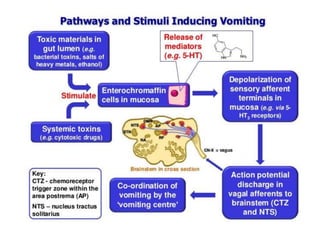
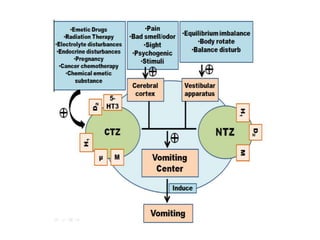
• Vomiting involves a vomiting centre seen in medulla
oblongata, the main part of brain with nucleus tractus
solitarius (NTS) and chemoreceptor trigger zone (CTZ).
• When NTS and CTZ are activated, they send impulses to the
vomiting centre and results in vomiting.
• NTS and CTZ can be activated by GI tract, blood vessels,
through cortex by smell, pain, sight, psychological stimuli,
motion sickness, ototoxic drugs etc..
• When the vomiting centre is stimulated, the efferent impulses
are sent to the salivary, vasomotor and respiratory centres,
they are activated and cause vomiting.
• Some neurochemical transmitters (dopaminergic, histaminic,
5HT, cholinergic, substance P) are also involved in vomiting,
when they receive the stimulus, they activate the receptors
and cause vomiting
PATHOPHYSIOLOGY
• Vomiting centre in brain receives signals from vestibular
apparatus, GI tract, cerebral cortex, thalamus, and
chemoreceptor trigger zone (CTZ). Neurotransmitters involved
in vomiting are dopaminergic receptors, histaminic receptors
and 5 hydroxytryptamine.
• The medicines used for nausea and vomiting act against one
of these receptors.
• There are six groups of antiemetics available anticholinergics,
antihistamines, neuroleptics, D2 blockers, prokinetics and 5
HT3 receptor antagonists.
PATHOPHYSIOLOGY
Pathogenesis of Vomiting Occurring / How to
produce emesis or Vomiting
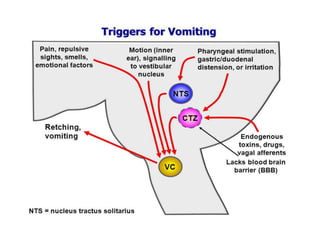
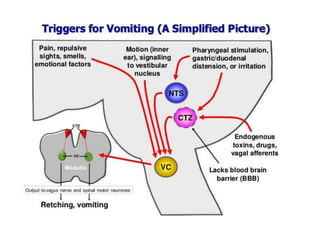
• Multiple pathways are involved in induce vomiting.
• Vomiting center is present in medulla oblongata that received
the impulse and induces vomiting.
• Chemoreceptor trigger zone (CTZ) and
• Nucleus tractus solitarius (NTS) send the impulse to Vomiting
Center for cause vomiting.
Vomiting center is received impulse in various way,
these are follows:
1) Chemoreceptor trigger zone:
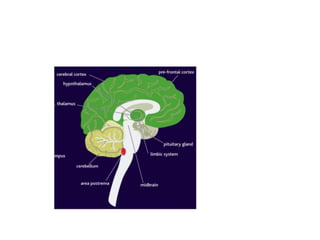
• CTZ is located in the area postrema near to vomiting center in
medulla oblongata.
• CTZ is outside of blood brain barrier.
• Many poisons and drugs are present in blood, which can
entered CTZ and stimulate it (CTZ).
• That can generate the impulse and send to the vomiting center
and vomiting induces.
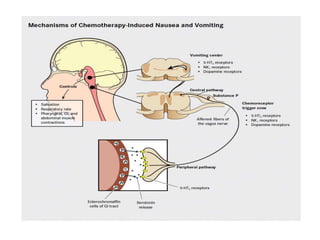
• Chemo word comes from chemotherapy, which mainly induces
vomiting due to chemotherapy.
• CTZ express various receptors eg. Dopamine D2receptor,
Histamine H1 receptor, serotonin 5-HT3 receptor, opioid µ
receptor and cholinergic M receptor.
2) Nucleus Tractus Solitarius (NTS):
 NTS received the impulse from gastrointestinal tract (GIT),
throat and other viscera.
 NTS send impulse to vomiting center and induce vomiting.
 NTS is located near vomiting center in medulla oblongata.
 NTS express a variety of receptor such as: serotonin 5-HT3
receptor, dopamine D2 receptor, cholinergic M receptor and
histamine H1 receptor.
3) Vestibular Apparatus:
 Vestibular apparatus generate impulse when equilibrium
imbalance or body rotate or balance disturb.
 Than these impulse which generated in the vestibular
apparatus send to the vomiting center and vomiting induce.
Cause vomiting due to motion sickness.
4) Cerebral Cortex:
• Cerebral cortex can induce vomiting due to pain, bad
smell/odor, sight, psychogenic stimuli.
• Cerebral cortex is higher center to direct simulate the
vomiting center and cause vomiting.
• Vomiting is triggered by afferent impulses to the vomiting
center, a nucleus of cells in the medulla.
• Impulses are received from sensory centers, such as the
chemoreceptor trigger zone (CTZ), cerebral cortex, and
visceral afferents from the pharynx and GI tract.
• When excited, afferent impulses are integrated by the
vomiting center, resulting in efferent impulses to the
salivation center, respiratory center, and the pharyngeal,
gastrointestinal (GI), and abdominal muscles, leading to
vomiting.
Management of nausea and vomiting
• Management of nausea and vomiting should be first started
by
• Non pharmacological treatment
• By dietary and psychological changes.
• Pharmacological treatment includes first line drugs like
• Antacids, which act locally in stomach and relieve nausea
and vomiting
• H2 receptor antagonists like cimetidine, ranitidine reduce
acid secretions
• Proton pump inhibitors like omeprazole, rabeprazole
• Anticholinergic drugs like scopolamine, antihistamines like
diphenhydramine
• Prokinetic drugs like domperidone, cisapride
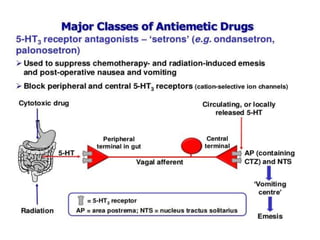
• 5HT3 receptor antagonists like ondansetron
• Adjuvant antiemetics, hyoscine and dicyclomine are
antimuscarinic agents, act against cholinergic receptors, and
are used in nausea caused by motion sickness and vestibular
apparatus disturbances.
• Antihistaminic drugs like cyclizine, doxylamine,
diphenhydramine, cinnarizine, and promethazine block the
H1 receptors, and are used for motion sickness, morning
sickness and postoperative emesis, with sedation as the main
side effect.
Management of nausea and vomiting
• Neuroleptics are D2 blockers, chlorpromazine and
haloperidol act against dopaminergic receptors and are
useful for nausea caused by cancer and opiate medicines.
• Prochlorperazine is a potent antiemetic and should be used
only when the reason is known.
• They are highly effective in vertigo and cancer related
vomiting.
• Muscle dystonia and extrapyramidal side effects are
commonly seen.
Management of nausea and vomiting
• Prokinetic agents like metoclopramide acts in the gut, and
domperidone works on CTZ , and speeds up the gastric
emptying.
• Domperidone and cisapride promote gastric emptying by
enhancing propulsive motility.
• ADVERSE EFFECTS are muscle dystonia.
• 5 HT3 antagonists like ondansetron act on serotonin and
controls nausea caused by chemotherapy, and widely used in
post operative prevention of emesis.
Management of nausea and vomiting
• Dexamethasone has a wide range of action and is used in
nausea.
• Dicyclomine has antispasmodic, and antiemetic properties
which is used in motion sickness and morning sickness.
• Dexamethasone and diazepam act as adjuvants in order to
enhance the action.
• Granisetron is 15 times more potent than ondansetron.
Dexamethasone, diazepam, lorazepam are adjuvant
antiemetics.
Management of nausea and vomiting
Role of Pharmacist
• Pharmacist should interfere
• If patient complaints about blood in vomiting
• Infrequent urination
• Severe abdominal pain
• Stiffness in neck and immediately these patients are to be
referred to doctor.

Nausea & Vomiting

  • 1.
    Nausea & Vomiting Dr.RaghavendraS.Hegde D.Pharm., B.Pharm., Pharm.D., R.Ph(KSPC) Lecturer, Dept of Pharmacy Practice H.S.K College of Pharmacy,Bagalkot
  • 2.
    Emetics • Emetics areagents that induce and produce the vomiting by stimulation of vomiting center present in medulla oblongata. Those agents are mainly used in poison case and taken orally over dose.
  • 3.
    Nausea & Vomiting Nausea is an unpleasant sensation which is subjective and is different from one person to another person.  A person suffering from nausea also face  Pallor  Increased respiratory rate  salivation.  Retching :Rythmatic synchronized contractions of the diaphragm , abdominal and intercostal muscles against a closed glottis causing the intra abdominal and decrease the intra thoracic pressure causing the gastric contents to go up through the esophagus.  Vomiting is the process, emesis or throwing out, expulsion of stomach contents via esophagus and mouth.
  • 4.
    Etiology  Hyperparathyroidism  Pregnancy Cardiovascular,  Neurological,  Drug withdrawal syndrome,  Operative procedures,  Radiation therapy,  Injection of noxious substances, drugs (opiates and general anesthetics) cause nausea.
  • 9.
    PATHOPHYSIOLOGY • Vomiting involvesa vomiting centre seen in medulla oblongata, the main part of brain with nucleus tractus solitarius (NTS) and chemoreceptor trigger zone (CTZ). • When NTS and CTZ are activated, they send impulses to the vomiting centre and results in vomiting. • NTS and CTZ can be activated by GI tract, blood vessels, through cortex by smell, pain, sight, psychological stimuli, motion sickness, ototoxic drugs etc..
  • 10.
    • When thevomiting centre is stimulated, the efferent impulses are sent to the salivary, vasomotor and respiratory centres, they are activated and cause vomiting. • Some neurochemical transmitters (dopaminergic, histaminic, 5HT, cholinergic, substance P) are also involved in vomiting, when they receive the stimulus, they activate the receptors and cause vomiting PATHOPHYSIOLOGY
  • 11.
    • Vomiting centrein brain receives signals from vestibular apparatus, GI tract, cerebral cortex, thalamus, and chemoreceptor trigger zone (CTZ). Neurotransmitters involved in vomiting are dopaminergic receptors, histaminic receptors and 5 hydroxytryptamine. • The medicines used for nausea and vomiting act against one of these receptors. • There are six groups of antiemetics available anticholinergics, antihistamines, neuroleptics, D2 blockers, prokinetics and 5 HT3 receptor antagonists. PATHOPHYSIOLOGY
  • 12.
    Pathogenesis of VomitingOccurring / How to produce emesis or Vomiting • Multiple pathways are involved in induce vomiting. • Vomiting center is present in medulla oblongata that received the impulse and induces vomiting. • Chemoreceptor trigger zone (CTZ) and • Nucleus tractus solitarius (NTS) send the impulse to Vomiting Center for cause vomiting.
  • 14.
    Vomiting center isreceived impulse in various way, these are follows: 1) Chemoreceptor trigger zone: • CTZ is located in the area postrema near to vomiting center in medulla oblongata. • CTZ is outside of blood brain barrier. • Many poisons and drugs are present in blood, which can entered CTZ and stimulate it (CTZ). • That can generate the impulse and send to the vomiting center and vomiting induces. • Chemo word comes from chemotherapy, which mainly induces vomiting due to chemotherapy. • CTZ express various receptors eg. Dopamine D2receptor, Histamine H1 receptor, serotonin 5-HT3 receptor, opioid µ receptor and cholinergic M receptor.
  • 15.
    2) Nucleus TractusSolitarius (NTS):  NTS received the impulse from gastrointestinal tract (GIT), throat and other viscera.  NTS send impulse to vomiting center and induce vomiting.  NTS is located near vomiting center in medulla oblongata.  NTS express a variety of receptor such as: serotonin 5-HT3 receptor, dopamine D2 receptor, cholinergic M receptor and histamine H1 receptor.
  • 16.
    3) Vestibular Apparatus: Vestibular apparatus generate impulse when equilibrium imbalance or body rotate or balance disturb.  Than these impulse which generated in the vestibular apparatus send to the vomiting center and vomiting induce. Cause vomiting due to motion sickness.
  • 17.
    4) Cerebral Cortex: •Cerebral cortex can induce vomiting due to pain, bad smell/odor, sight, psychogenic stimuli. • Cerebral cortex is higher center to direct simulate the vomiting center and cause vomiting.
  • 20.
    • Vomiting istriggered by afferent impulses to the vomiting center, a nucleus of cells in the medulla. • Impulses are received from sensory centers, such as the chemoreceptor trigger zone (CTZ), cerebral cortex, and visceral afferents from the pharynx and GI tract. • When excited, afferent impulses are integrated by the vomiting center, resulting in efferent impulses to the salivation center, respiratory center, and the pharyngeal, gastrointestinal (GI), and abdominal muscles, leading to vomiting.
  • 21.
    Management of nauseaand vomiting • Management of nausea and vomiting should be first started by • Non pharmacological treatment • By dietary and psychological changes. • Pharmacological treatment includes first line drugs like • Antacids, which act locally in stomach and relieve nausea and vomiting • H2 receptor antagonists like cimetidine, ranitidine reduce acid secretions • Proton pump inhibitors like omeprazole, rabeprazole • Anticholinergic drugs like scopolamine, antihistamines like diphenhydramine • Prokinetic drugs like domperidone, cisapride • 5HT3 receptor antagonists like ondansetron
  • 22.
    • Adjuvant antiemetics,hyoscine and dicyclomine are antimuscarinic agents, act against cholinergic receptors, and are used in nausea caused by motion sickness and vestibular apparatus disturbances. • Antihistaminic drugs like cyclizine, doxylamine, diphenhydramine, cinnarizine, and promethazine block the H1 receptors, and are used for motion sickness, morning sickness and postoperative emesis, with sedation as the main side effect. Management of nausea and vomiting
  • 23.
    • Neuroleptics areD2 blockers, chlorpromazine and haloperidol act against dopaminergic receptors and are useful for nausea caused by cancer and opiate medicines. • Prochlorperazine is a potent antiemetic and should be used only when the reason is known. • They are highly effective in vertigo and cancer related vomiting. • Muscle dystonia and extrapyramidal side effects are commonly seen. Management of nausea and vomiting
  • 24.
    • Prokinetic agentslike metoclopramide acts in the gut, and domperidone works on CTZ , and speeds up the gastric emptying. • Domperidone and cisapride promote gastric emptying by enhancing propulsive motility. • ADVERSE EFFECTS are muscle dystonia. • 5 HT3 antagonists like ondansetron act on serotonin and controls nausea caused by chemotherapy, and widely used in post operative prevention of emesis. Management of nausea and vomiting
  • 25.
    • Dexamethasone hasa wide range of action and is used in nausea. • Dicyclomine has antispasmodic, and antiemetic properties which is used in motion sickness and morning sickness. • Dexamethasone and diazepam act as adjuvants in order to enhance the action. • Granisetron is 15 times more potent than ondansetron. Dexamethasone, diazepam, lorazepam are adjuvant antiemetics. Management of nausea and vomiting
  • 26.
    Role of Pharmacist •Pharmacist should interfere • If patient complaints about blood in vomiting • Infrequent urination • Severe abdominal pain • Stiffness in neck and immediately these patients are to be referred to doctor.