
Done by :
Mohammed A Qazzaz
Croup
Croup is a common respiratory illness
responsible for up to 15 percent of
emergency department visits due to
respiratory disease in children in the
United States.
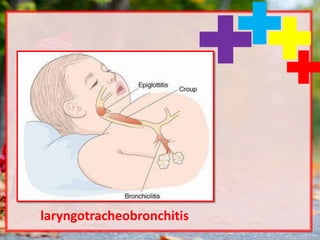
Croup is a syndrome that includes spasmodic
croup (recurrent croup), laryngotracheitis (viral
croup), laryngotracheobronchitis, and
laryngotracheobronchopneumonitis.
however, recurrent and viral croup account for
most cases.
laryngotracheobronchitis
Epidemiology :
More common in boys.
Age 6 - 36 months.
Peaks second year of life.
Fall season.
 It has been reported occasionally in adolescents
and rarely in adults.
Etiology:
ETIOLOGY FREQUENCY SEVERITY PEAK INCIDENCE
Parainfluenza virus
types 1 to 3 (type 1 is
most common)
Frequent
50 to 75 percent
Variable (usually
severe with type 3
virus)
Winter and spring
Enterovirus Occasional to frequent Usually mild Fall
Human bocavirus Occasional to frequent Usually mild Spring and fall
Influenza A and B
viruses
Occasional to frequent Variable (severe with
influenza A virus)
Winter
Respiratory syncytial
virus
Occasional to frequent Mild to moderate Winter
Rhinovirus Occasional to frequent Usually mild Fall
Adenovirus Occasional Mild to moderate Winter
Measles Rare Moderate to severe During measles
epidemics
•Measles has been reported rarely in patients with croup
where the population is inadequately vaccinated.
•Bacterial causes are also rare and include diphtheria
and Mycoplasma pneumoniae.
•Allergic factors may play a role in recurrent croup, with the
child becoming sensitized to viral antigens.
•Another cause of recurrent croup is gastroesophageal reflux.
An uncontrolled study of 47 patients with recurrent croup
found that treatment of reflux improved respiratory symptoms.
Etiology con.
Clinical Course and Presentation :
Viral croup symptoms usually start like
an upper respiratory tract infection
•low-grade fever.
•coryza
•barking cough
•various degrees of respiratory distress.
(nasal flaring, respiratory retractions, stridor).
symptoms subside quickly with resolution of the
cough usually within two days, although the cough
may persist for up to one week.
Symptoms can increase and decrease in the same
child, becoming worse at night and when the child
is agitated.
Symptoms also vary from child to child based on
host factors, such as immunity and the anatomy of
the subglottic space.
Symptoms are NOT croup:
•high-grade fever
• toxic appearance;
•expiratory wheezing,
•drooling,
•voice loss,
• difficulty swallowing.
• Croup rarely occurs in children younger than three months.
Many children with croup may come to the emergency
department because symptoms begin abruptly, causing
parental concern.
Croup is a benign condition with a
low mortality rate.
Studies of children presenting to the emergency
department with croup symptoms showed that 85
percent had mild croup, and only 1 to 8 percent
needed hospital admission.
Less than 3 percent of children with croup who were
admitted to the hospital were intubated.
Diagnosis:
DIFFERENTIAL DIAGNOSIS
•Recurrent croup.
•Bacterial tracheitis .
•Acute epiglottitis.
•foreign body aspiration.
•peritonsillar abscess.
•retropharyngeal abscess.
•Angioedema.
Bacterial tracheitis may result from a secondary
infection and usually leads to a more toxic appearance.
with higher fever and worse respiratory symptoms
than croup.
Bacterial tracheitis does not respond to usual croup
treatment. Intravenous antibiotics are needed, and
intubation may become necessary.
Acute epiglottitis typically leads to a more toxic
appearance than croup.
The classic presentation of epiglottitis is an anxious
child with a sore throat who is drooling and sitting or
leaning forward.
the characteristic barking cough of croup is typically
absent.
CONDITION HISTORY PHYSICAL EXAMINATION WORKUP COMMON ETIOLOGIES
Angioedema Detailed questioning to
identify the offending antigen
Swelling of face and neck Epicutaneous skin testing or
radioallergosorbent testing
may be performed later
Allergic reaction
Bacterial tracheitis Mild to moderate
presentation, then rapid
decomposition in three to
seven days
High-grade fever, toxic
appearance, copious
secretions, productive cough,
retractions; no drooling or
odynophagia
Lateral neck radiography may
be helpful, bacterial culture of
tracheal secretions after
intubation, WBC count
(elevated)
Staphylococcus
aureus,Haemophilus
influenzae, group A
streptococci
Epiglottitis Rapid onset of symptoms, sore
throat, muffled voice, drooling
High-grade fever, toxic
appearance, child sitting or
leaning forward
Lateral neck radiography if
clinical diagnosis unclear, WBC
count (elevated)
H. influenzae, group A β-
hemolytic streptococcus
Foreign body aspiration Sudden onset, history of
choking
Stridor CT, bronchoscopy Foreign body
Laryngotracheitis (viral croup) Barking cough, coryza Low-grade fever, nasal flaring,
respiratory retractions, stridor
Generally not indicated Parainfluenza virus types 1 to
3, influenza, respiratory
syncytial virus
Peritonsillar abscess Dysphagia, throat pain that is
more severe on affected side
Inferior and medial
displacement of the tonsil,
contralateral deviation of the
uvula, erythema and exudates
on the tonsil
CT with intravenous contrast
media
Gram-positive organisms
(including β-lactamase
producing), gram-negative
organisms, anaerobes
Retropharyngeal abscess Fever, odynophagia,
dysphagia, neck pain
Drooling, stridor, neck mass,
nuchal rigidity
Lateral neck radiography
(widening of the
retropharyngeal soft tissues);
CT with intravenous contrast
media is helpful
Gram-positive organisms
(including β-lactamase
producing), gram-negative
organisms, anaerobes
Spasmodic croup (recurrent
croup)
Usually recurrent, short
duration, barking cough
Afebrile, less retractions and
nasal flaring
Generally not indicated, but
bronchoscopy (especially in
children younger than three
years) and endoscopy may be
considered
Same as viral croup, with
possible allergic component or
gastroesophageal reflux
A retrospective study of patients with croup, epiglottitis, and
bacterial tracheitis showed the increasing importance of
considering bacterial tracheitis in the differential diagnosis of
severe respiratory illness.
Immunization against Haemophilus influenzae type b has
contributed to the decreased incidence of epiglottitis.
and the early use of corticosteroids has decreased the incidence
of respiratory distress in patients with croup.
HISTORY AND PHYSICAL EXAMINATION:
The diagnosis of croup is based on clinical assessment.
Abrupt onset of barking cough, hoarseness, and inspiratory
stridor.
Physical examination:
•low-grade fever
•absence of wheezing.
Diagnosis also involves closely assessing the severity of croup by
evaluating respiratory status and rate, retractions, stridor, heart
rate, use of accessory muscles, and mental status.
oximetry can also be used to assess the severity of disease.
DIAGNOSTIC TESTING:
Laboratory and imaging evaluation are not essential,
but may be used to rule out other illnesses in selected
patients with an atypical or severe presentation.
Steeple sign
In croup
epiglottitis
(thickened
epiglottis)
Thumb sign
retropharyngeal
abscess
(widening of the
retropharyngeal
soft tissues)
Bronchoscopy may be needed in patients with recurrent
croup, especially those younger than three years.
In a series of 30 patients who underwent endoscopy for
recurrent croup, one-third had airway disorders such as
subglottic edema, stenosis, or cyst.
Management
GENERAL CARE
•Keeping a symptomatic child calm by avoiding distressing
procedures is important because agitation may worsen
airway obstruction
•Positioning comfortable… no particular position has been
shown to be more beneficial in the assessment.
•Oxygen and•Heliox, (a helium-oxygen mixture)
•Cold air is beneficial
CORTICOSTEROIDS
Corticosteroid therapy benefits patients with croup presumably by
decreasing edema in the laryngeal mucosa, and is usually effective
within six hours of treatment.
Corticosteroid therapy decreases the need for additional medical
care, hospital stays, and intubation rates and duration.
A recent randomized controlled trial found that a single dose of an
oral corticosteroid benefited children with mild croup. Therefore,
corticosteroids should be considered even for mild illness.
•Dexamethasone is the recommended corticosteroid for
treatment of croup because of its longer half-life (a single dose
provides anti-inflammatory effects over the usual symptom
duration of 72 hours).
•Doses of 0.15 to 0.60 mg per kg.
•Higher dose of 0.60 mg per kg (maximal dose: 20 mg) was
more effective in patients with severe croup.
•Single dose
•Oral = intramuscular, both are superior to inhaled does.
•Intravenous is best.
No adverse effects have been associated with
appropriate corticosteroid therapy in patients with
croup. The risks of single-dose corticosteroids are very
low, but should be considered in children with diabetes
mellitus, children exposed to varicella virus, and
children at risk of bacterial superinfection (i.e., those
who are immunocompromised) or have gastrointestinal
bleeding.
The recommended dose is 0.05 mL per kg (maximal dose: 0.5
mL) of racemic epinephrine 2.25% .
0.25–0.75 ml of a 2.25% solution in 2.0 ml normal saline.
Or
0.5 mL per kg (maximal dose: 5 mL) of L-epinephrine 1:1,000 via
nebulizer, which may be available in clinical settings along with
other resuscitation supplies.
EPINEPHRINE:
therapeutic benefit usually occurs within the first 30 minutes.
adverse effects (e.g., tachycardia, hypertension) are thought to
be less with racemic epinephrine
Croup

Croup

  • 1.
    Done by : MohammedA Qazzaz Croup
  • 2.
    Croup is acommon respiratory illness responsible for up to 15 percent of emergency department visits due to respiratory disease in children in the United States.
  • 3.
    Croup is asyndrome that includes spasmodic croup (recurrent croup), laryngotracheitis (viral croup), laryngotracheobronchitis, and laryngotracheobronchopneumonitis. however, recurrent and viral croup account for most cases.
  • 4.
  • 5.
    Epidemiology : More commonin boys. Age 6 - 36 months. Peaks second year of life. Fall season.  It has been reported occasionally in adolescents and rarely in adults.
  • 6.
    Etiology: ETIOLOGY FREQUENCY SEVERITYPEAK INCIDENCE Parainfluenza virus types 1 to 3 (type 1 is most common) Frequent 50 to 75 percent Variable (usually severe with type 3 virus) Winter and spring Enterovirus Occasional to frequent Usually mild Fall Human bocavirus Occasional to frequent Usually mild Spring and fall Influenza A and B viruses Occasional to frequent Variable (severe with influenza A virus) Winter Respiratory syncytial virus Occasional to frequent Mild to moderate Winter Rhinovirus Occasional to frequent Usually mild Fall Adenovirus Occasional Mild to moderate Winter Measles Rare Moderate to severe During measles epidemics
  • 7.
    •Measles has beenreported rarely in patients with croup where the population is inadequately vaccinated. •Bacterial causes are also rare and include diphtheria and Mycoplasma pneumoniae. •Allergic factors may play a role in recurrent croup, with the child becoming sensitized to viral antigens. •Another cause of recurrent croup is gastroesophageal reflux. An uncontrolled study of 47 patients with recurrent croup found that treatment of reflux improved respiratory symptoms. Etiology con.
  • 8.
    Clinical Course andPresentation : Viral croup symptoms usually start like an upper respiratory tract infection •low-grade fever. •coryza •barking cough •various degrees of respiratory distress. (nasal flaring, respiratory retractions, stridor).
  • 10.
    symptoms subside quicklywith resolution of the cough usually within two days, although the cough may persist for up to one week. Symptoms can increase and decrease in the same child, becoming worse at night and when the child is agitated. Symptoms also vary from child to child based on host factors, such as immunity and the anatomy of the subglottic space.
  • 11.
    Symptoms are NOTcroup: •high-grade fever • toxic appearance; •expiratory wheezing, •drooling, •voice loss, • difficulty swallowing. • Croup rarely occurs in children younger than three months. Many children with croup may come to the emergency department because symptoms begin abruptly, causing parental concern. Croup is a benign condition with a low mortality rate.
  • 12.
    Studies of childrenpresenting to the emergency department with croup symptoms showed that 85 percent had mild croup, and only 1 to 8 percent needed hospital admission. Less than 3 percent of children with croup who were admitted to the hospital were intubated.
  • 13.
    Diagnosis: DIFFERENTIAL DIAGNOSIS •Recurrent croup. •Bacterialtracheitis . •Acute epiglottitis. •foreign body aspiration. •peritonsillar abscess. •retropharyngeal abscess. •Angioedema.
  • 14.
    Bacterial tracheitis mayresult from a secondary infection and usually leads to a more toxic appearance. with higher fever and worse respiratory symptoms than croup. Bacterial tracheitis does not respond to usual croup treatment. Intravenous antibiotics are needed, and intubation may become necessary.
  • 15.
    Acute epiglottitis typicallyleads to a more toxic appearance than croup. The classic presentation of epiglottitis is an anxious child with a sore throat who is drooling and sitting or leaning forward. the characteristic barking cough of croup is typically absent.
  • 16.
    CONDITION HISTORY PHYSICALEXAMINATION WORKUP COMMON ETIOLOGIES Angioedema Detailed questioning to identify the offending antigen Swelling of face and neck Epicutaneous skin testing or radioallergosorbent testing may be performed later Allergic reaction Bacterial tracheitis Mild to moderate presentation, then rapid decomposition in three to seven days High-grade fever, toxic appearance, copious secretions, productive cough, retractions; no drooling or odynophagia Lateral neck radiography may be helpful, bacterial culture of tracheal secretions after intubation, WBC count (elevated) Staphylococcus aureus,Haemophilus influenzae, group A streptococci Epiglottitis Rapid onset of symptoms, sore throat, muffled voice, drooling High-grade fever, toxic appearance, child sitting or leaning forward Lateral neck radiography if clinical diagnosis unclear, WBC count (elevated) H. influenzae, group A β- hemolytic streptococcus Foreign body aspiration Sudden onset, history of choking Stridor CT, bronchoscopy Foreign body Laryngotracheitis (viral croup) Barking cough, coryza Low-grade fever, nasal flaring, respiratory retractions, stridor Generally not indicated Parainfluenza virus types 1 to 3, influenza, respiratory syncytial virus Peritonsillar abscess Dysphagia, throat pain that is more severe on affected side Inferior and medial displacement of the tonsil, contralateral deviation of the uvula, erythema and exudates on the tonsil CT with intravenous contrast media Gram-positive organisms (including β-lactamase producing), gram-negative organisms, anaerobes Retropharyngeal abscess Fever, odynophagia, dysphagia, neck pain Drooling, stridor, neck mass, nuchal rigidity Lateral neck radiography (widening of the retropharyngeal soft tissues); CT with intravenous contrast media is helpful Gram-positive organisms (including β-lactamase producing), gram-negative organisms, anaerobes Spasmodic croup (recurrent croup) Usually recurrent, short duration, barking cough Afebrile, less retractions and nasal flaring Generally not indicated, but bronchoscopy (especially in children younger than three years) and endoscopy may be considered Same as viral croup, with possible allergic component or gastroesophageal reflux
  • 17.
    A retrospective studyof patients with croup, epiglottitis, and bacterial tracheitis showed the increasing importance of considering bacterial tracheitis in the differential diagnosis of severe respiratory illness. Immunization against Haemophilus influenzae type b has contributed to the decreased incidence of epiglottitis. and the early use of corticosteroids has decreased the incidence of respiratory distress in patients with croup.
  • 18.
    HISTORY AND PHYSICALEXAMINATION: The diagnosis of croup is based on clinical assessment. Abrupt onset of barking cough, hoarseness, and inspiratory stridor. Physical examination: •low-grade fever •absence of wheezing. Diagnosis also involves closely assessing the severity of croup by evaluating respiratory status and rate, retractions, stridor, heart rate, use of accessory muscles, and mental status. oximetry can also be used to assess the severity of disease.
  • 19.
    DIAGNOSTIC TESTING: Laboratory andimaging evaluation are not essential, but may be used to rule out other illnesses in selected patients with an atypical or severe presentation.
  • 20.
  • 21.
  • 22.
  • 24.
    Bronchoscopy may beneeded in patients with recurrent croup, especially those younger than three years. In a series of 30 patients who underwent endoscopy for recurrent croup, one-third had airway disorders such as subglottic edema, stenosis, or cyst.
  • 25.
    Management GENERAL CARE •Keeping asymptomatic child calm by avoiding distressing procedures is important because agitation may worsen airway obstruction •Positioning comfortable… no particular position has been shown to be more beneficial in the assessment. •Oxygen and•Heliox, (a helium-oxygen mixture) •Cold air is beneficial
  • 27.
    CORTICOSTEROIDS Corticosteroid therapy benefitspatients with croup presumably by decreasing edema in the laryngeal mucosa, and is usually effective within six hours of treatment. Corticosteroid therapy decreases the need for additional medical care, hospital stays, and intubation rates and duration. A recent randomized controlled trial found that a single dose of an oral corticosteroid benefited children with mild croup. Therefore, corticosteroids should be considered even for mild illness.
  • 28.
    •Dexamethasone is therecommended corticosteroid for treatment of croup because of its longer half-life (a single dose provides anti-inflammatory effects over the usual symptom duration of 72 hours). •Doses of 0.15 to 0.60 mg per kg. •Higher dose of 0.60 mg per kg (maximal dose: 20 mg) was more effective in patients with severe croup. •Single dose •Oral = intramuscular, both are superior to inhaled does. •Intravenous is best.
  • 29.
    No adverse effectshave been associated with appropriate corticosteroid therapy in patients with croup. The risks of single-dose corticosteroids are very low, but should be considered in children with diabetes mellitus, children exposed to varicella virus, and children at risk of bacterial superinfection (i.e., those who are immunocompromised) or have gastrointestinal bleeding.
  • 30.
    The recommended doseis 0.05 mL per kg (maximal dose: 0.5 mL) of racemic epinephrine 2.25% . 0.25–0.75 ml of a 2.25% solution in 2.0 ml normal saline. Or 0.5 mL per kg (maximal dose: 5 mL) of L-epinephrine 1:1,000 via nebulizer, which may be available in clinical settings along with other resuscitation supplies. EPINEPHRINE:
  • 31.
    therapeutic benefit usuallyoccurs within the first 30 minutes. adverse effects (e.g., tachycardia, hypertension) are thought to be less with racemic epinephrine