






Nasogastric tube insertion & removal1
ObjectivesDiscuss nasogastric tube insertion and removal procedure.Describe the types of NG tubes used in the procedure.Demonstrate the correct procedure in performing nasogastric tube insertion and removal procedure.Perform the procedures through return -  demonstration correctly.2
3
According to American Gastroenterologic  AssociationNG tube has other diagnostic and therapeutic applications, especially in
assessing and treating upper GI bleeding,
collecting gastric contents for analysis,
performing gastric lavage,
aspirating gastric secretions,  &
administering medications & nutrients.4
5
Types of NG Tubes6
7
8
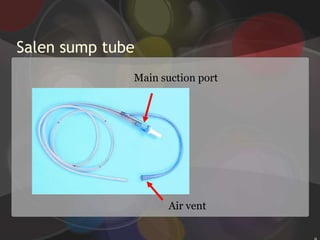
Salen sump tube Main suction portAir vent9
10
equipmentInsertion of NG tube11
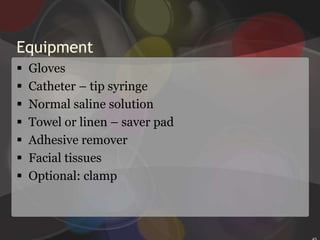
EquipmentTube (usually #12, #14, #16 or #18 French for a normal adult)
Towel or linen – saver pad
Facial tissues
Emesis basin
Penlight
1 “ or 2” hypoallergenic tape
Gloves
Water – soluble lubricant
Cup or glass of water with straw (if appropriate)12
EquipmentpH  test strip
Tongue blade
Catheter – tip or bulb syringe or irrigation set
Safety pin
Ordered suction equipment
Optional: metal clamp, alcohol pad, warm water, large basin or plastic container, rubber band13
Preparation of equipment14
Preparation of equipmentInspect the NG tube for defects, such as rough edges or partially closed lumens.
Then check the tube’s patency by flushing it water.
To ease insertion, increase a stiff tube’s flexibility by coiling it around your gloved fingers for a few seconds or by dipping it into warm water.15
Implementation16
Whether you’re inserting or removing an NG tube be sure to …Provide privacy.
Wash hands.
Put on gloves before inserting the tube.
Check the physician’s order to determine the type of tube that should be inserted.17
Inserting an ng tube18
Inserting an NG tubeConfirm the patient’s identity using two patient identifiers according to facility policy.Explain the procedure to the patient to ease anxiety and promote cooperation. Inform her that she may experience some nasal discomfort, that she may gag, and that her eyes may water.
Emphasize that swallowing will ease the tube’s advancement. 19
Inserting an NG tubeAgree on a signal that the patient can use if she wants you to stop briefly during the procedure.Gather and prepare all necessary equipment.Help the patient into high – Fowler’s position unless contraindicated.Stand at the patient’s right side if you’re right – handed or at her left side if you’re left – handed to ease insertion.20
Inserting an NG tubeDrape the towel or linen – saver pad over the patient’s chest to protect her gown and bed linens from spills.Have the patient gently blow her nose to clear her nostrils. Place the facial tissues and emesis basin well within the patient’s reach.Help the patient face forward with her neck in a neutral position.21
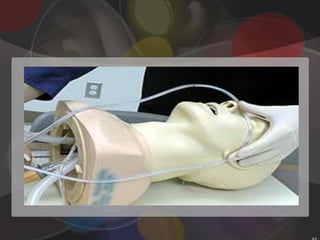
Inserting an NG tubeTo determine how long the NG tube must be to reach the stomach, hold the end of the tube at the tip of the patient’s nose. Extend the tube to the patient’s earlobe and then down to the xiphoid process.22
23
Inserting an NG tubeMark this distance on the tubing with tape, or note the marking already on the tube. (Average measurements for an adult range from 22” to 26” [56 to 66 cm].)  It may be necessary to add 2” (5.1 cm) to this measurement in tall individuals to ensure entry into the stomach.To determine which nostril will allow easier access, use a penlight and inspect for a deviated septum or other abnormalities.  Ask the patient if she ever had nasal surgery or a nasal injury.24
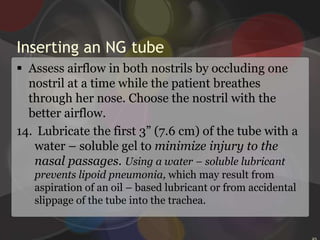
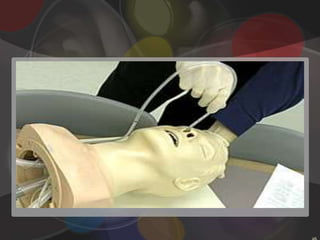
Inserting an NG tubeAssess airflow in both nostrils by occluding one nostril at a time while the patient breathes through her nose. Choose the nostril with the better airflow. Lubricate the first 3” (7.6 cm) of the tube with a water – soluble gel to minimize injury to the nasal passages. Using a water – soluble lubricant prevents lipoid pneumonia, which may result from aspiration of an oil – based lubricant or from accidental slippage of the tube into the trachea.25
26
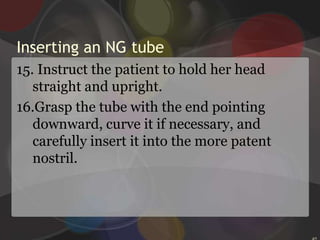
Inserting an NG tube Instruct the patient to hold her head straight and upright.Grasp the tube with the end pointing downward, curve it if necessary, and carefully insert it into the more patent nostril.27
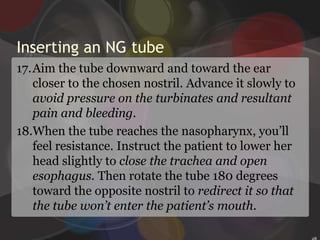
Inserting an NG tubeAim the tube downward and toward the ear closer to the chosen nostril. Advance it slowly to avoid pressure on the turbinates and resultant pain and bleeding.When the tube reaches the nasopharynx, you’ll feel resistance. Instruct the patient to lower her head slightly to close the trachea and open esophagus. Then rotate the tube 180 degrees toward the opposite nostril to redirect it so that the tube won’t enter the patient’s mouth.28
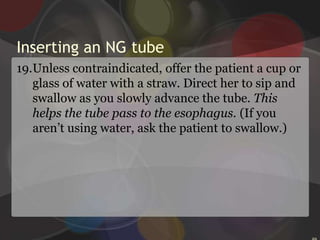
Inserting an NG tubeUnless contraindicated, offer the patient a cup or glass of water with a straw. Direct her to sip and swallow as you slowly advance the tube. This helps the tube pass to the esophagus. (If you aren’t using water, ask the patient to swallow.)29
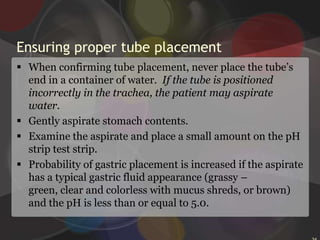
Ensuring proper tube placement30
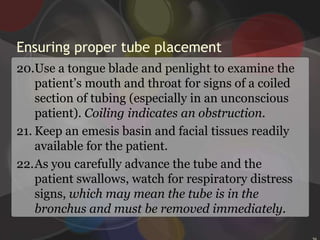
Ensuring proper tube placementUse a tongue blade and penlight to examine the patient’s mouth and throat for signs of a coiled section of tubing (especially in an unconscious patient). Coiling indicates an obstruction.Keep an emesis basin and facial tissues readily available for the patient.As you carefully advance the tube and the patient swallows, watch for respiratory distress signs, which may mean the tube is in the bronchus and must be removed immediately.31
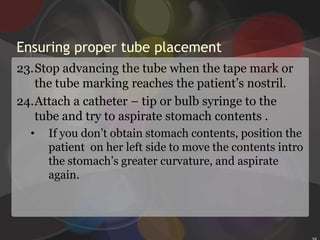
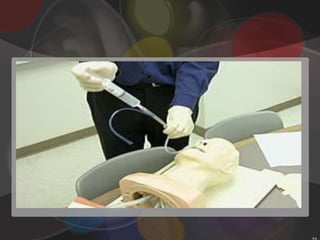
Ensuring proper tube placementStop advancing the tube when the tape mark or the tube marking reaches the patient’s nostril.Attach a catheter – tip or bulb syringe to the tube and try to aspirate stomach contents .If you don’t obtain stomach contents, position the patient  on her left side to move the contents intro the stomach’s greater curvature, and aspirate again.32

Nasogastric Tube Insertion

  • 1.
  • 2.
    ObjectivesDiscuss nasogastric tubeinsertion and removal procedure.Describe the types of NG tubes used in the procedure.Demonstrate the correct procedure in performing nasogastric tube insertion and removal procedure.Perform the procedures through return - demonstration correctly.2
  • 3.
  • 4.
    According to AmericanGastroenterologic AssociationNG tube has other diagnostic and therapeutic applications, especially in
  • 5.
    assessing and treatingupper GI bleeding,
  • 6.
  • 7.
  • 8.
  • 9.
  • 10.
  • 11.
  • 12.
  • 13.
  • 14.
    Salen sump tubeMain suction portAir vent9
  • 15.
  • 16.
  • 17.
    EquipmentTube (usually #12,#14, #16 or #18 French for a normal adult)
  • 18.
    Towel or linen– saver pad
  • 19.
  • 20.
  • 21.
  • 22.
    1 “ or2” hypoallergenic tape
  • 23.
  • 24.
  • 25.
    Cup or glassof water with straw (if appropriate)12
  • 26.
  • 27.
  • 28.
    Catheter – tipor bulb syringe or irrigation set
  • 29.
  • 30.
  • 31.
    Optional: metal clamp,alcohol pad, warm water, large basin or plastic container, rubber band13
  • 32.
  • 33.
    Preparation of equipmentInspectthe NG tube for defects, such as rough edges or partially closed lumens.
  • 34.
    Then check thetube’s patency by flushing it water.
  • 35.
    To ease insertion,increase a stiff tube’s flexibility by coiling it around your gloved fingers for a few seconds or by dipping it into warm water.15
  • 36.
  • 37.
    Whether you’re insertingor removing an NG tube be sure to …Provide privacy.
  • 38.
  • 39.
    Put on glovesbefore inserting the tube.
  • 40.
    Check the physician’sorder to determine the type of tube that should be inserted.17
  • 41.
  • 42.
    Inserting an NGtubeConfirm the patient’s identity using two patient identifiers according to facility policy.Explain the procedure to the patient to ease anxiety and promote cooperation. Inform her that she may experience some nasal discomfort, that she may gag, and that her eyes may water.
  • 43.
    Emphasize that swallowingwill ease the tube’s advancement. 19
  • 44.
    Inserting an NGtubeAgree on a signal that the patient can use if she wants you to stop briefly during the procedure.Gather and prepare all necessary equipment.Help the patient into high – Fowler’s position unless contraindicated.Stand at the patient’s right side if you’re right – handed or at her left side if you’re left – handed to ease insertion.20
  • 45.
    Inserting an NGtubeDrape the towel or linen – saver pad over the patient’s chest to protect her gown and bed linens from spills.Have the patient gently blow her nose to clear her nostrils. Place the facial tissues and emesis basin well within the patient’s reach.Help the patient face forward with her neck in a neutral position.21
  • 46.
    Inserting an NGtubeTo determine how long the NG tube must be to reach the stomach, hold the end of the tube at the tip of the patient’s nose. Extend the tube to the patient’s earlobe and then down to the xiphoid process.22
  • 47.
  • 48.
    Inserting an NGtubeMark this distance on the tubing with tape, or note the marking already on the tube. (Average measurements for an adult range from 22” to 26” [56 to 66 cm].) It may be necessary to add 2” (5.1 cm) to this measurement in tall individuals to ensure entry into the stomach.To determine which nostril will allow easier access, use a penlight and inspect for a deviated septum or other abnormalities. Ask the patient if she ever had nasal surgery or a nasal injury.24
  • 49.
    Inserting an NGtubeAssess airflow in both nostrils by occluding one nostril at a time while the patient breathes through her nose. Choose the nostril with the better airflow. Lubricate the first 3” (7.6 cm) of the tube with a water – soluble gel to minimize injury to the nasal passages. Using a water – soluble lubricant prevents lipoid pneumonia, which may result from aspiration of an oil – based lubricant or from accidental slippage of the tube into the trachea.25
  • 50.
  • 51.
    Inserting an NGtube Instruct the patient to hold her head straight and upright.Grasp the tube with the end pointing downward, curve it if necessary, and carefully insert it into the more patent nostril.27
  • 52.
    Inserting an NGtubeAim the tube downward and toward the ear closer to the chosen nostril. Advance it slowly to avoid pressure on the turbinates and resultant pain and bleeding.When the tube reaches the nasopharynx, you’ll feel resistance. Instruct the patient to lower her head slightly to close the trachea and open esophagus. Then rotate the tube 180 degrees toward the opposite nostril to redirect it so that the tube won’t enter the patient’s mouth.28
  • 53.
    Inserting an NGtubeUnless contraindicated, offer the patient a cup or glass of water with a straw. Direct her to sip and swallow as you slowly advance the tube. This helps the tube pass to the esophagus. (If you aren’t using water, ask the patient to swallow.)29
  • 54.
  • 55.
    Ensuring proper tubeplacementUse a tongue blade and penlight to examine the patient’s mouth and throat for signs of a coiled section of tubing (especially in an unconscious patient). Coiling indicates an obstruction.Keep an emesis basin and facial tissues readily available for the patient.As you carefully advance the tube and the patient swallows, watch for respiratory distress signs, which may mean the tube is in the bronchus and must be removed immediately.31
  • 56.
    Ensuring proper tubeplacementStop advancing the tube when the tape mark or the tube marking reaches the patient’s nostril.Attach a catheter – tip or bulb syringe to the tube and try to aspirate stomach contents .If you don’t obtain stomach contents, position the patient on her left side to move the contents intro the stomach’s greater curvature, and aspirate again.32

Editor's Notes

  • #4 According to AmericanGastroenterologic Association
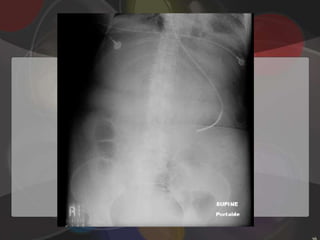
  • #6 Inserting an NG tube requires close observation of the patient and verification of proper placement. Removing the tube requires careful handling to prevent injury or aspiration.The tube must be inserted with extra care in a pregnant patient and in one with an increased risk of complications.Most NG tubes have a radiopaque marker or strip at the distal end so that the tube position can be verified by X –ray. If the position cant be confirmed, the physician may order fluoroscopy to verify placement.
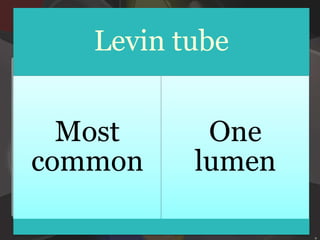
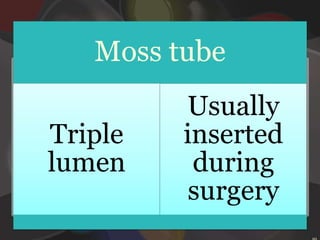
  • #8 The most common NG tubes are the Levin tube, which has one lumen and the Salen sump tube, which has two lumens, one for suction and drainage and one for ventilation. Air flows through the vent lumen continuously. This protects the delicate gastric mucosa by preventing a vacuum from forming should the tube adhere to the stomach lining. The Moss tube, which has a triple lumen, is usually inserted during surgery.
  • #9 The most common NG tubes are the Levin tube, which has one lumen and the Salen sump tube, which has two lumens, one for suction and drainage and one for ventilation. Air flows through the vent lumen continuously. This protects the delicate gastric mucosa by preventing a vacuum from forming should the tube adhere to the stomach lining. The Moss tube, which has a triple lumen, is usually inserted during surgery.
  • #11 The Moss tube, which has a triple lumen, is usually inserted during surgery.
  • #23 According to the fundamentals of science