Definition
It is the insertion of a tube into the oesophagus and
stomach through the nose
It is defined as the passage of single or double lumen
tube through the nose or mouth to stomach for the purpose
of the drainage, instillation, decompression, lavage or
performance of diagnostic tests.
Purpose
• To feed the patient with fluids when oral intake is not
possible
• To dilute and remove consumed poison
• To instill ice cold solution to control gastric bleeding
• To prevent stress on operated site by decompressing
• To relive vomiting and distension
• To collect gastric juice for diagnostic puposes
• Safety
• Therapeutic effectiveness
• Comfort
• Use resources
• Good workmanship
• Individuality
• Anatomy and physiology
• Microbiology
• Nutrition
• Pharmacology
• Physics
• Chemistry
• Psychology
• Sociology
Principles
• Nursing principles –Scientific principles
Indications
• Patient who cannot eat (GIT functioning normally)
– Comatose patient
– Mechanically ventilated
• Patient who will not eat
– Patients who refuse to eat
• Elderly
• Disoriented patients
– Patients who cannot maintain adequate oral nutrition
• Patients with infection, trauma, cancer etc.
– Surgery
Contraindications
• Gastric surgery
• Ulcers
• Tracheoesophageal fistula
• Oesophageal surgery
• Polyps in nose , recent nasal surgery, facial surgery
• Deviated nasal septum
• Patient on anticoagulant therapy
General instructions
• Remove the dentures ( to prevent it from dislodging and blocking the
respiratory tract)
• A rubber tube may be placed in a bowl of ice to cool and stiffen
• Lubricate the tube
• While removing the tube, pinch the tube and pull it out gently and
quickly (so that the fluid may not trickle down the pharynx )
• During introduction of the tube never use force (it may cause injury
to mucus membrane)
• Watch the complications (nausea, vomiting, distension, diarrhea,
aspiration, pneumonia etc.)
Articles Purposes
A try containing
Mackintosh with towel
To protect the bed and linen
A Ryle’s tube (8-12 Fr ) in a bowl containing
cold water
To make the tube hard and easy for insertion
Cotton tipped applicator, Saline or soda
bicarbonate solution
To clean nostrils
Lubricant (liquid paraffin or glycerine)
To prevent friction between mucus membrane
and tube
Adhesive plasters and scissor Fix the tube in position
A bowl of water, stethoscope, syringe (10-20cc)
To test the location of tube
A kidney tray and a paper bag To collect waste
Ryle’s tube
• Flexible rubber or synthetic material
• Transperant or opaque
• Length : 36-50 inches
• Gastrostomy tube: 12-15 inches
• The lumen is measured by French (Fr)
• When no is lower the inside diameter of tube
will be smaller
Ryle’s tube
• Parts
– Tip
• Drainage port / lateral eyes
• Radio opacity ……..radio opaque line/strip
– Body
• Markings:
• 50cm---stomach
• 60cm---pylorus
• 70cm---duodenum
– Base
Polyurethane NG tube (Viasys Corflo), 8 Fr × 36 in (91 cm).
Preliminary assessment
Check
– Doctors order for any specific instruction
– Patient ability to follow instructions
– General condition of the patient
– Articles available in the unit
Preparation of patient and unit
• Explain the sequence of procedure
• Arrange the articles at the bed side
• Provide privacy
• Provide comfortable position (fowler’s position , comatose
patient semi-fowlers position)
• Place the mackintosh and towel across the chest
• Remove the dentures
• Give mouth wash and help him to clean the teeth
• Clean nostrils
Procedure
Method to confirm NG tube in the stomach
• Aspirate: attach the syringe to the end of NG tube and
aspirate small amount of gastric content
• Immerse distal end of tube into bowl of water and check
for air bubbles
• Auscultate : attach syringe to free end of the tube, place
diaphragm of stethescope over left hypochondrium .inject
10 ml of air and auscultate abdomen for gushing sound.
• X ray
After care
• Offer a mouth wash . Clean the face and hands and dry
them
• Remove the mackintosh and towel
• Make the patient comfortable in bed
• Take all articles to the utility room discard the waste,
clean it and replace it in a proper place
• Wash hands
• Record the procedure
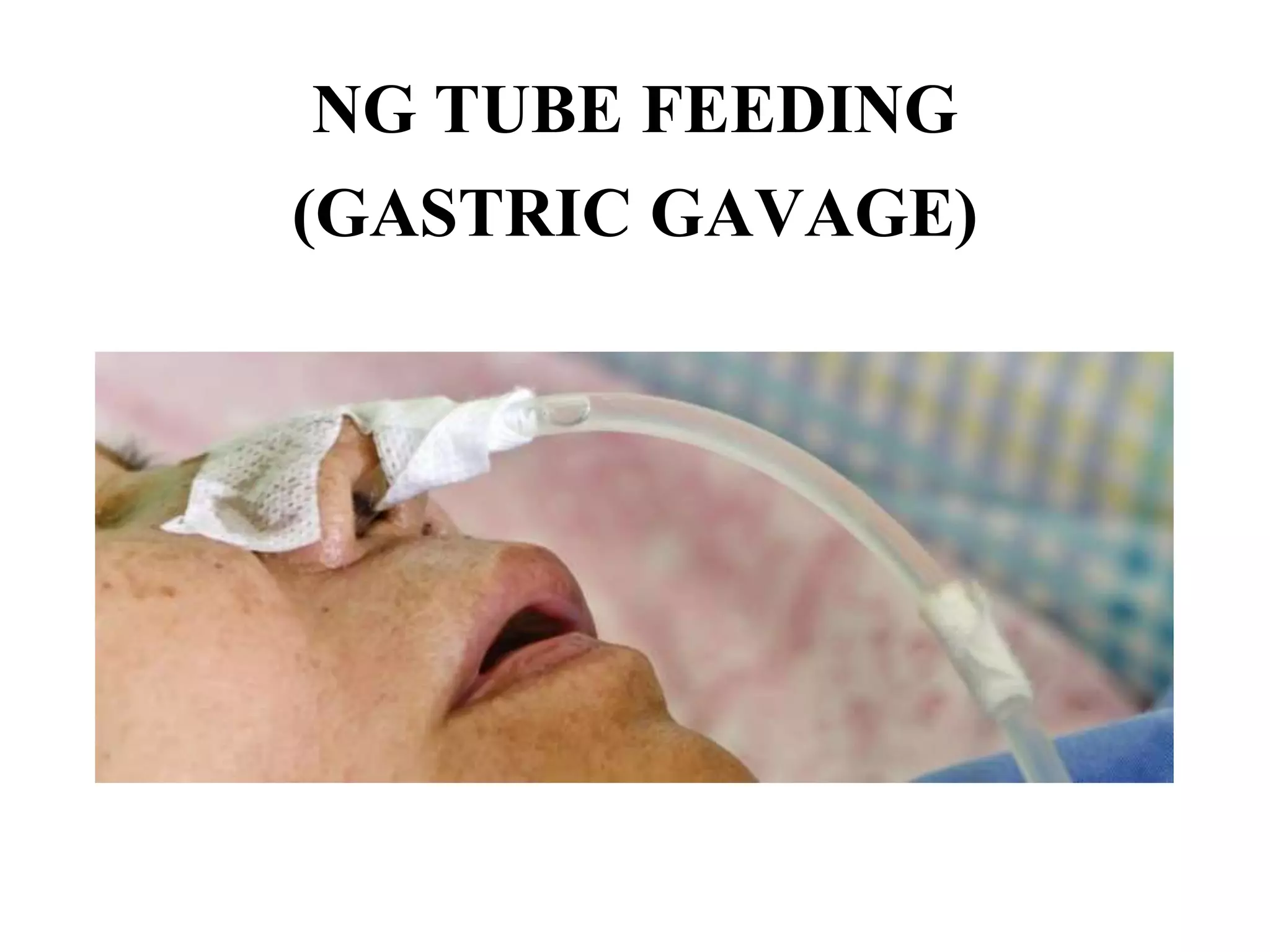
NG TUBE FEEDING
(GASTRIC GAVAGE)
Definition
Nasogastric tube feeding is given through tube which
is inserted through patient’s nose into stomach when
patient is unable to take food orally
It is a process of giving liquid nutrients or
medications through a tube into the stomach when the oral
intake is inadequate or impossible
Gastric gavage
it is an artificial method of giving fluids & nutrients
through a tube, that has passed into the oesophagus and
stomach through the nose, mouth or through the opening
made on the abdominal wall, when oral intake is
inadequate or impossible
Indications
• Unconscious
• Client with psychosis
• Swallowing difficulties
• Chronic infections
• Anorexia nervosa
Advantages
• An adequate amount of all types of nutrients including
distasteful foods & medications can be supplied
• Large amount of fluids can given with safety
• It can be continued weeks with out any danger
• The stomach may be aspirated at any time of desired
• Overloading of the stomach can be prevented by drip
method
Principles
• A thorough knowledge of the anatomy and physiology of
digestive tract and respiratory tract, ensures safe
induction of the tube
• Microorganisms enter the body through food and drink
• Mental and physical preparation of the patient facilitate
introduction of the tube
• Systematic ways of working adds to the comfort and
safety of the client and help in the economy of material,
time and energy
Preliminary assessment
• Identify the correct patient
• Check the doctor’s order
• Check the level of consciousness
• Check whether feed is ready at hand
• Articles available in the unit
Preparation of patient and environment
• Explain the sequence of procedure
• Provide adequate privacy
• Position (sitting or semi fowlers)
• Place mackintosh and towel around the neck
• Arrange the articles at the bed side locker
• Clean the mouth by providing mouthwash
Articles
• A tray containing
– Mackintosh and towel
– 50cc syringe/ feeding tube and 5cc syringe
– Stethoscope
– Bowel with water
– Adhesive with scissors
– Feeds and water
– Ounce glass
– Kidney tray
Procedure
 Wash hands
 Place towel around the neck
 Ensure the tube is in the stomach
 Remove plunger from syringe…………..Pinch tube to prevent air
entry……….Remove spigot….connect syringe to the tube.
 Keep syringe about 12 inches above patients head.
 Start feed with small measured amount of water and allow feed to follow
slowly and steadily through tube in such a way, that air does not enter
tube
 Do not force fluid, allow to flow by gravity
 At end of feed flush tube by pouring small measured amount of water
…..remove syringe and replace spigot
After care
• Remove towel
• Place the patient in comfortable position
• Replace the articles to utility room, clean it and replace it
• Record the procedure in nurses record and intake out
put chart.
Gastrostomy feeding
Jejunostomy feeding
Gastrostomy feeding :feeding is given through an
artificial opening made surgically into the stomach
through the abdominal wall for feeding purpose when the
patient is not able to swallow through oesophagus.
Jejunostomy feeding :
Jejunostomy is the surgical creation of an opening
(stoma) through the skin at the front of the abdomen and
the wall of the jejunum(part of the small intestine)
• A jejunostomy is an alternative to a gastrostomy .
• The advantage over a gastrostomy is its low risk of aspiration
due to its distal placement
• Doubt
• Discussion
THANK YOU

Nasogastric intubation

  • 2.
    Definition It is theinsertion of a tube into the oesophagus and stomach through the nose It is defined as the passage of single or double lumen tube through the nose or mouth to stomach for the purpose of the drainage, instillation, decompression, lavage or performance of diagnostic tests.
  • 3.
    Purpose • To feedthe patient with fluids when oral intake is not possible • To dilute and remove consumed poison • To instill ice cold solution to control gastric bleeding • To prevent stress on operated site by decompressing • To relive vomiting and distension • To collect gastric juice for diagnostic puposes
  • 4.
    • Safety • Therapeuticeffectiveness • Comfort • Use resources • Good workmanship • Individuality • Anatomy and physiology • Microbiology • Nutrition • Pharmacology • Physics • Chemistry • Psychology • Sociology Principles • Nursing principles –Scientific principles
  • 5.
    Indications • Patient whocannot eat (GIT functioning normally) – Comatose patient – Mechanically ventilated • Patient who will not eat – Patients who refuse to eat • Elderly • Disoriented patients – Patients who cannot maintain adequate oral nutrition • Patients with infection, trauma, cancer etc. – Surgery
  • 6.
    Contraindications • Gastric surgery •Ulcers • Tracheoesophageal fistula • Oesophageal surgery • Polyps in nose , recent nasal surgery, facial surgery • Deviated nasal septum • Patient on anticoagulant therapy
  • 7.
    General instructions • Removethe dentures ( to prevent it from dislodging and blocking the respiratory tract) • A rubber tube may be placed in a bowl of ice to cool and stiffen • Lubricate the tube • While removing the tube, pinch the tube and pull it out gently and quickly (so that the fluid may not trickle down the pharynx ) • During introduction of the tube never use force (it may cause injury to mucus membrane) • Watch the complications (nausea, vomiting, distension, diarrhea, aspiration, pneumonia etc.)
  • 8.
    Articles Purposes A trycontaining Mackintosh with towel To protect the bed and linen A Ryle’s tube (8-12 Fr ) in a bowl containing cold water To make the tube hard and easy for insertion Cotton tipped applicator, Saline or soda bicarbonate solution To clean nostrils Lubricant (liquid paraffin or glycerine) To prevent friction between mucus membrane and tube Adhesive plasters and scissor Fix the tube in position A bowl of water, stethoscope, syringe (10-20cc) To test the location of tube A kidney tray and a paper bag To collect waste
  • 9.
    Ryle’s tube • Flexiblerubber or synthetic material • Transperant or opaque • Length : 36-50 inches • Gastrostomy tube: 12-15 inches • The lumen is measured by French (Fr) • When no is lower the inside diameter of tube will be smaller
  • 10.
    Ryle’s tube • Parts –Tip • Drainage port / lateral eyes • Radio opacity ……..radio opaque line/strip – Body • Markings: • 50cm---stomach • 60cm---pylorus • 70cm---duodenum – Base
  • 11.
    Polyurethane NG tube(Viasys Corflo), 8 Fr × 36 in (91 cm).
  • 13.
    Preliminary assessment Check – Doctorsorder for any specific instruction – Patient ability to follow instructions – General condition of the patient – Articles available in the unit
  • 14.
    Preparation of patientand unit • Explain the sequence of procedure • Arrange the articles at the bed side • Provide privacy • Provide comfortable position (fowler’s position , comatose patient semi-fowlers position) • Place the mackintosh and towel across the chest • Remove the dentures • Give mouth wash and help him to clean the teeth • Clean nostrils
  • 15.
  • 17.
    Method to confirmNG tube in the stomach • Aspirate: attach the syringe to the end of NG tube and aspirate small amount of gastric content • Immerse distal end of tube into bowl of water and check for air bubbles • Auscultate : attach syringe to free end of the tube, place diaphragm of stethescope over left hypochondrium .inject 10 ml of air and auscultate abdomen for gushing sound. • X ray
  • 18.
    After care • Offera mouth wash . Clean the face and hands and dry them • Remove the mackintosh and towel • Make the patient comfortable in bed • Take all articles to the utility room discard the waste, clean it and replace it in a proper place • Wash hands • Record the procedure
  • 22.
  • 23.
    Definition Nasogastric tube feedingis given through tube which is inserted through patient’s nose into stomach when patient is unable to take food orally It is a process of giving liquid nutrients or medications through a tube into the stomach when the oral intake is inadequate or impossible
  • 24.
    Gastric gavage it isan artificial method of giving fluids & nutrients through a tube, that has passed into the oesophagus and stomach through the nose, mouth or through the opening made on the abdominal wall, when oral intake is inadequate or impossible
  • 25.
    Indications • Unconscious • Clientwith psychosis • Swallowing difficulties • Chronic infections • Anorexia nervosa
  • 26.
    Advantages • An adequateamount of all types of nutrients including distasteful foods & medications can be supplied • Large amount of fluids can given with safety • It can be continued weeks with out any danger • The stomach may be aspirated at any time of desired • Overloading of the stomach can be prevented by drip method
  • 27.
    Principles • A thoroughknowledge of the anatomy and physiology of digestive tract and respiratory tract, ensures safe induction of the tube • Microorganisms enter the body through food and drink • Mental and physical preparation of the patient facilitate introduction of the tube • Systematic ways of working adds to the comfort and safety of the client and help in the economy of material, time and energy
  • 28.
    Preliminary assessment • Identifythe correct patient • Check the doctor’s order • Check the level of consciousness • Check whether feed is ready at hand • Articles available in the unit
  • 29.
    Preparation of patientand environment • Explain the sequence of procedure • Provide adequate privacy • Position (sitting or semi fowlers) • Place mackintosh and towel around the neck • Arrange the articles at the bed side locker • Clean the mouth by providing mouthwash
  • 30.
    Articles • A traycontaining – Mackintosh and towel – 50cc syringe/ feeding tube and 5cc syringe – Stethoscope – Bowel with water – Adhesive with scissors – Feeds and water – Ounce glass – Kidney tray
  • 31.
    Procedure  Wash hands Place towel around the neck  Ensure the tube is in the stomach  Remove plunger from syringe…………..Pinch tube to prevent air entry……….Remove spigot….connect syringe to the tube.  Keep syringe about 12 inches above patients head.  Start feed with small measured amount of water and allow feed to follow slowly and steadily through tube in such a way, that air does not enter tube  Do not force fluid, allow to flow by gravity  At end of feed flush tube by pouring small measured amount of water …..remove syringe and replace spigot
  • 32.
    After care • Removetowel • Place the patient in comfortable position • Replace the articles to utility room, clean it and replace it • Record the procedure in nurses record and intake out put chart.
  • 33.
  • 35.
    Gastrostomy feeding :feedingis given through an artificial opening made surgically into the stomach through the abdominal wall for feeding purpose when the patient is not able to swallow through oesophagus.
  • 36.
    Jejunostomy feeding : Jejunostomyis the surgical creation of an opening (stoma) through the skin at the front of the abdomen and the wall of the jejunum(part of the small intestine) • A jejunostomy is an alternative to a gastrostomy . • The advantage over a gastrostomy is its low risk of aspiration due to its distal placement
  • 38.
  • 39.