INTRAVENOUS THERAPY
PREPARATION AND ADMINISTRATION
GIDEON MAXWELL AMOAH
BSc. PUBLIC HEALTH (EDUCATION)
DIP. EDUCATION, DIP. (NURSING), RGN
 Intravenous simply is defined as ‘within a Vein’.
 Intravenous therapy therefore the administration
of an infusion of liquid substances directly into a
vein.
 It provides a speedy and effective method of
delivering medication, fluids, parenteral nutrition
and blood products.
 It can be intermittent or continuous
Steps to take before carrying out an IV Therapy
 Educate patient on the procedure, purpose,
possible discomfort and potential risks.
 Gather all necessary equipment
 Assess veins for size, straightness and ease of
access.
Uses of IV Therapy
 To correct electrolyte imbalance
 To deliver medications
 For blood transfusions
 As replacement therapy in cases of dehydration
Common Vein sites
 Back of the hand
 Arm
 Foot
 Scalp
 Femoral
 jugular
Nursing assessment/ observation to be made
during intravenous therapy
 Monitor the patient closely for any acute weight
gain or loss
 Keep an accurate record of all intake and output
 Assess for any signs of oedema
 Auscultate the lung sounds (crackles may be
heard for fluid volume overload)
 Notify the doctor if urine output is less than
30mls within 2hours
 Examine the site for swelling, dislodgement of
cannula, extravasation (infiltration) of leakages.
Nursing assessment/ observation to be made
during intravenous therapy cont.
 Observe for any discomfort
 Observe the drip chamber and ensure that it is
not empty
 Observe the flow rate frequently
 Observe for signs of over- infusion such as
dyspnoea, cough and enlargement of cervical
veins. (What will you do if you observe these?)
Commonly used intravenous solutions
 Hypertonic solution
- 5% dextrose in R/L
- 5% Dextrose in N/S
- 5% Dextrose in 0.45% N/S
Have higher osmotic pressure, thus pulls or draws
fluid out of the cell into the extracellular space
thereby increasing intravascular volume.
Commonly used intravenous solutions
 Hypotonic solution
- 0.45% N/S
- 0.33% N/S
Pushes fluid from the vascular space into the cells
because they have lower osmotic pressure.
Commonly used intravenous solutions
 Isotonic solution
- Ringers Lactate
- 5% Dextrose in water
- Normal saline (0.9% NaCl)
Have same osmotic pressure as that found in cells
hence fluid moves equally between all
compartments.
Commonly used intravenous solutions
 Other solutions include:
- 5:4:1 commonly used for Cholera patients
- Badoe’s solution
Calculating the flow rate of an infusion
Flow rate = volume of solution(mls) x drop factor
duration of infusion(mins)
(try some questions in scenarios)
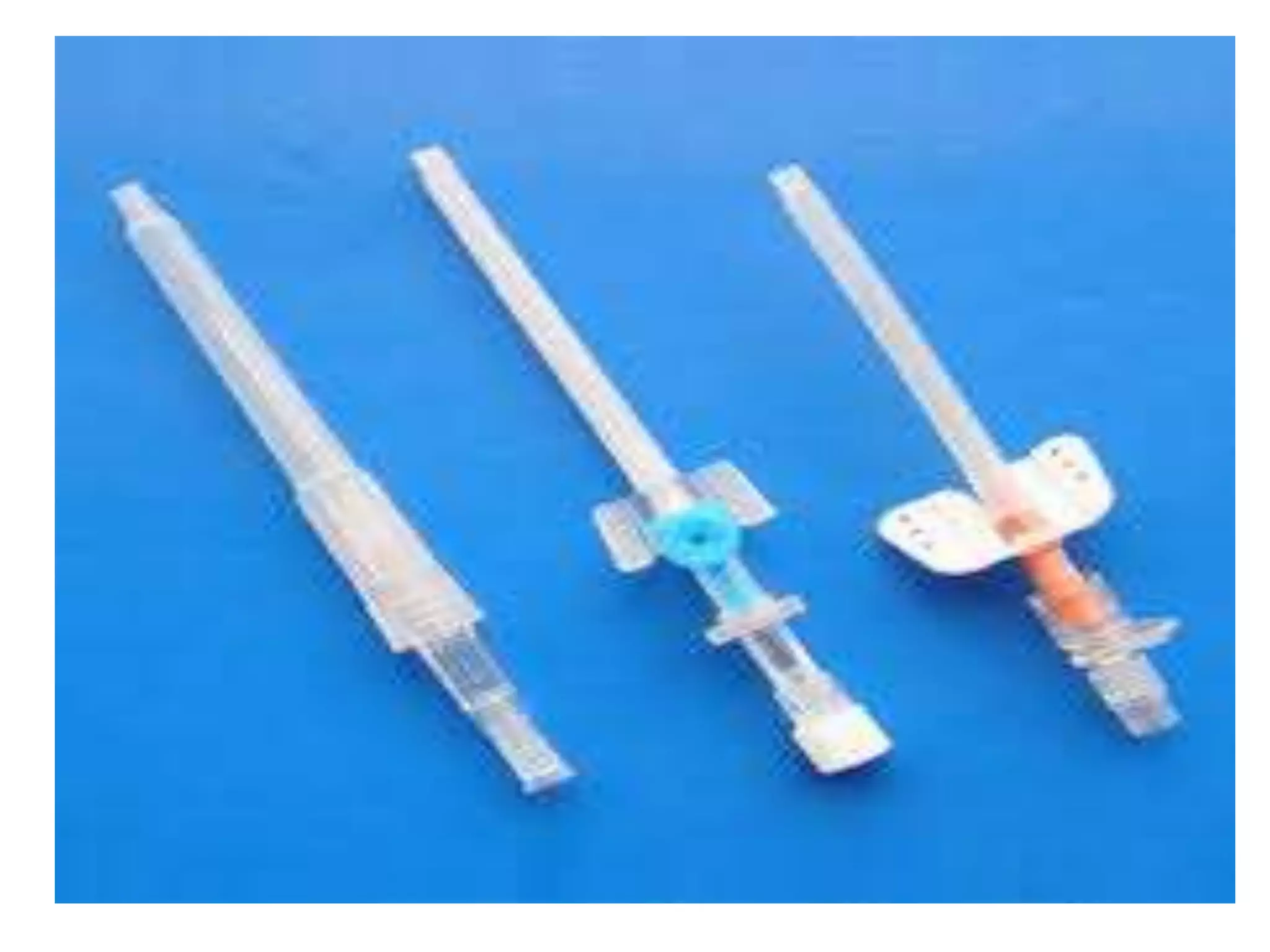
Types of Cannulas used for intravenous therapy
Parts of a Cannula
The 10 Rights of Drug Administration
- Right medication
- Right client
- Right dose
- Right time
- Right route
- Right client education
- Right documentation
- Right to refuse
- Right assessment
- Right evaluation
Types of Intravenous Fluids
Crystalloids
They are aqueous solutions of mineral salts or water
soluble molecules commonly used for rehydration
and electrolyte replacement.
Eg. N/S, R/L, Dextrose Saline
Types of Intravenous Fluids cont.
Colloids
They are large insoluble molecules are used to
replace lost blood, maintain healthy blood pressure
and volume expansion.
Eg. Haemacel, Dextran, hetastarch, Blood etc.
Complications/ Risks of IV Therapy
- Infection
- Phlebitis
- Infiltration/ extravasation
- Fluid overload
- Electrolyte imbalance
- Embolism
- Hypothermia
- Shock
- Nerve damage
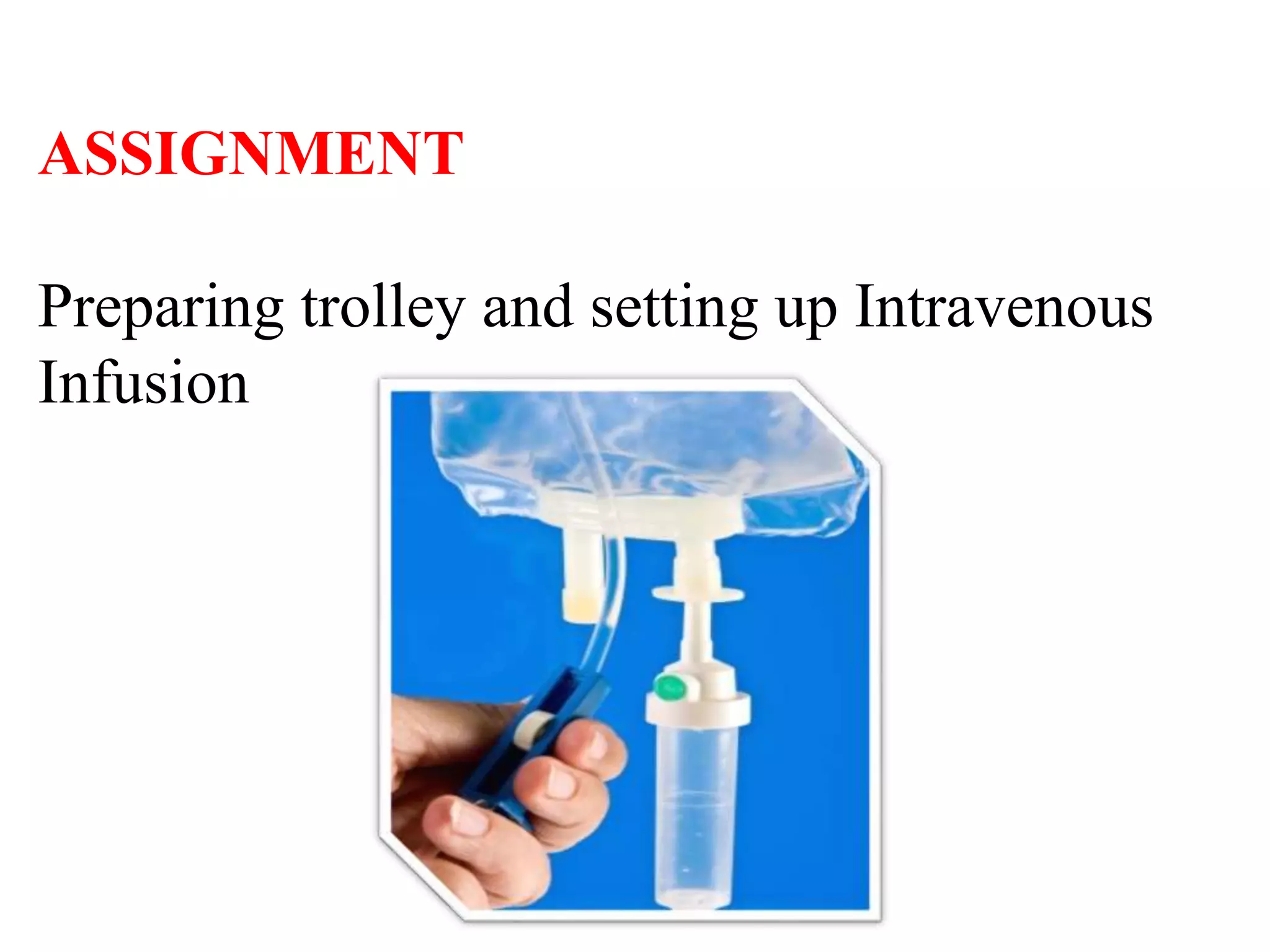
ASSIGNMENT
Preparing trolley and setting up Intravenous
Infusion
GIDEON MAXWELL AMOAH
BSc. PUBLIC HEALTH (EDUCATION)
DIP. EDUCATION, DIP. (NURSING), RGN
ADMINISTERING
BLOOD TRANSFUSION
BLOOD TRANSFUSION
 Is the intravenous administration of whole or
component of blood into direct circulation to
restore blood volume, increase haemoglobin
levels or combat shock
 The transfer of blood or blood products from one
person (donor) into another person’s blood
stream (recipient).
BLOOD TRANSFUSION
 Autologous blood transfusion?
 Heterogeneous (donor) blood transfusion?
Indications of blood transfusion
 To increase blood volume after surgery,
haemorrhage or trauma
 To provide clotting factors (in plasma) for
patients with DIC, haemophilia etc.
 To increase the number of RBC’s in clients with
anaemia
Indications of blood transfusion cont.
 To provide platelets to patients with low platelet
count, especially those on chemotherapy
 To replace lost plasma proteins in severe burns
DISCUSS BLOOD GROUPINGS AND
WHO CAN DONATE TO WHO
• (A, B, AB, O)
• Rhesus + , -
• Universal donor and recipient
Forms of blood transfused include:
 Platelets
 Fresh frozen plasma
 Whole blood
 Packed cells
Nurses responsibilities for safe blood transfusion
 Explain procedure and obtain informed consent
 Never order a blood to be transfused to patient
 Two nurses are required to crosscheck blood for
the right patient, correct blood type, expiry date.
(they must both sign their names in the nurses notes)
 Check patency of IV line
 Check patient’s vital sign and observe any
anomalies.
Nurses responsibilities for safe blood transfusion
 Administer pre medication if prescribed
 Offer bed pan or urinal bowl before
commencement of blood transfusion.
Nurses responsibilities during blood transfusion
 Check vital signs 15minutes after the
commencement of transfusion, after 30 minutes,
then hourly till transfusion is completed.
 Monitor the flow rate
 Observe for signs of transfusion reaction such as
urticaria rash, elevated temperature, shivering
etc. (what will the nurse the nurse when he/she observes this?)
Nurses responsibilities during blood transfusion
 Observe for signs of circulatory overload
 Monitor urine output and report any
abnormalities.
Nurses responsibilities After blood transfusion
 Clip the roller clamp off and flush the
intravenous line with N/S.
 Make patient comfortable in bed
 Discard trolley and used transfusion set
appropriately.
 Document procedure (what does the nurse write?)
 Monitor vital signs one hour after completion to
detect delayed transfusion reactions.
Complications of blood transfusion
 Infection usually with fever
 Embolism
 Circulatory overload
 Hyperthermia
 Coagulopathy
 Urticaria rash
 Pulmonary oedema characterised by dyspnoea
 Hepatitis B
 HIV
 Shock
INTRAVENOUS THERAPY.pptx

INTRAVENOUS THERAPY.pptx

  • 2.
    INTRAVENOUS THERAPY PREPARATION ANDADMINISTRATION GIDEON MAXWELL AMOAH BSc. PUBLIC HEALTH (EDUCATION) DIP. EDUCATION, DIP. (NURSING), RGN
  • 3.
     Intravenous simplyis defined as ‘within a Vein’.  Intravenous therapy therefore the administration of an infusion of liquid substances directly into a vein.  It provides a speedy and effective method of delivering medication, fluids, parenteral nutrition and blood products.  It can be intermittent or continuous
  • 4.
    Steps to takebefore carrying out an IV Therapy  Educate patient on the procedure, purpose, possible discomfort and potential risks.  Gather all necessary equipment  Assess veins for size, straightness and ease of access.
  • 5.
    Uses of IVTherapy  To correct electrolyte imbalance  To deliver medications  For blood transfusions  As replacement therapy in cases of dehydration
  • 6.
    Common Vein sites Back of the hand  Arm  Foot  Scalp  Femoral  jugular
  • 7.
    Nursing assessment/ observationto be made during intravenous therapy  Monitor the patient closely for any acute weight gain or loss  Keep an accurate record of all intake and output  Assess for any signs of oedema  Auscultate the lung sounds (crackles may be heard for fluid volume overload)  Notify the doctor if urine output is less than 30mls within 2hours  Examine the site for swelling, dislodgement of cannula, extravasation (infiltration) of leakages.
  • 8.
    Nursing assessment/ observationto be made during intravenous therapy cont.  Observe for any discomfort  Observe the drip chamber and ensure that it is not empty  Observe the flow rate frequently  Observe for signs of over- infusion such as dyspnoea, cough and enlargement of cervical veins. (What will you do if you observe these?)
  • 9.
    Commonly used intravenoussolutions  Hypertonic solution - 5% dextrose in R/L - 5% Dextrose in N/S - 5% Dextrose in 0.45% N/S Have higher osmotic pressure, thus pulls or draws fluid out of the cell into the extracellular space thereby increasing intravascular volume.
  • 10.
    Commonly used intravenoussolutions  Hypotonic solution - 0.45% N/S - 0.33% N/S Pushes fluid from the vascular space into the cells because they have lower osmotic pressure.
  • 11.
    Commonly used intravenoussolutions  Isotonic solution - Ringers Lactate - 5% Dextrose in water - Normal saline (0.9% NaCl) Have same osmotic pressure as that found in cells hence fluid moves equally between all compartments.
  • 12.
    Commonly used intravenoussolutions  Other solutions include: - 5:4:1 commonly used for Cholera patients - Badoe’s solution
  • 13.
    Calculating the flowrate of an infusion Flow rate = volume of solution(mls) x drop factor duration of infusion(mins) (try some questions in scenarios)
  • 14.
    Types of Cannulasused for intravenous therapy
  • 17.
    Parts of aCannula
  • 19.
    The 10 Rightsof Drug Administration - Right medication - Right client - Right dose - Right time - Right route - Right client education - Right documentation - Right to refuse - Right assessment - Right evaluation
  • 20.
    Types of IntravenousFluids Crystalloids They are aqueous solutions of mineral salts or water soluble molecules commonly used for rehydration and electrolyte replacement. Eg. N/S, R/L, Dextrose Saline
  • 21.
    Types of IntravenousFluids cont. Colloids They are large insoluble molecules are used to replace lost blood, maintain healthy blood pressure and volume expansion. Eg. Haemacel, Dextran, hetastarch, Blood etc.
  • 22.
    Complications/ Risks ofIV Therapy - Infection - Phlebitis - Infiltration/ extravasation - Fluid overload - Electrolyte imbalance - Embolism - Hypothermia - Shock - Nerve damage
  • 23.
    ASSIGNMENT Preparing trolley andsetting up Intravenous Infusion
  • 24.
    GIDEON MAXWELL AMOAH BSc.PUBLIC HEALTH (EDUCATION) DIP. EDUCATION, DIP. (NURSING), RGN
  • 25.
  • 26.
    BLOOD TRANSFUSION  Isthe intravenous administration of whole or component of blood into direct circulation to restore blood volume, increase haemoglobin levels or combat shock  The transfer of blood or blood products from one person (donor) into another person’s blood stream (recipient).
  • 28.
    BLOOD TRANSFUSION  Autologousblood transfusion?  Heterogeneous (donor) blood transfusion?
  • 29.
    Indications of bloodtransfusion  To increase blood volume after surgery, haemorrhage or trauma  To provide clotting factors (in plasma) for patients with DIC, haemophilia etc.  To increase the number of RBC’s in clients with anaemia
  • 30.
    Indications of bloodtransfusion cont.  To provide platelets to patients with low platelet count, especially those on chemotherapy  To replace lost plasma proteins in severe burns
  • 31.
    DISCUSS BLOOD GROUPINGSAND WHO CAN DONATE TO WHO • (A, B, AB, O) • Rhesus + , - • Universal donor and recipient
  • 33.
    Forms of bloodtransfused include:  Platelets  Fresh frozen plasma  Whole blood  Packed cells
  • 34.
    Nurses responsibilities forsafe blood transfusion
  • 35.
    Nurses responsibilities forsafe blood transfusion  Explain procedure and obtain informed consent  Never order a blood to be transfused to patient  Two nurses are required to crosscheck blood for the right patient, correct blood type, expiry date. (they must both sign their names in the nurses notes)  Check patency of IV line  Check patient’s vital sign and observe any anomalies.
  • 38.
    Nurses responsibilities forsafe blood transfusion  Administer pre medication if prescribed  Offer bed pan or urinal bowl before commencement of blood transfusion.
  • 40.
    Nurses responsibilities duringblood transfusion  Check vital signs 15minutes after the commencement of transfusion, after 30 minutes, then hourly till transfusion is completed.  Monitor the flow rate  Observe for signs of transfusion reaction such as urticaria rash, elevated temperature, shivering etc. (what will the nurse the nurse when he/she observes this?)
  • 41.
    Nurses responsibilities duringblood transfusion  Observe for signs of circulatory overload  Monitor urine output and report any abnormalities.
  • 42.
    Nurses responsibilities Afterblood transfusion  Clip the roller clamp off and flush the intravenous line with N/S.  Make patient comfortable in bed  Discard trolley and used transfusion set appropriately.  Document procedure (what does the nurse write?)  Monitor vital signs one hour after completion to detect delayed transfusion reactions.
  • 43.
    Complications of bloodtransfusion  Infection usually with fever  Embolism  Circulatory overload  Hyperthermia  Coagulopathy  Urticaria rash  Pulmonary oedema characterised by dyspnoea  Hepatitis B  HIV  Shock