Urinary Catheterization
Nursing Procedure &
Management
Dr. Anjalatchi Muthukumaran
Vice principal
Era college of Nursing
Era university
Insertion and care
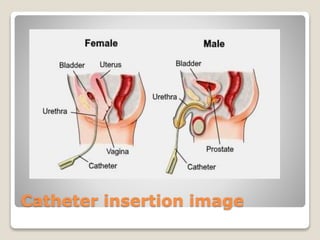
 Urinary Catheterization is the
introduction of a catheter through the
urethra into the bladder for the purpose of
withdrawing urine.
Purposes
 To relieve urinary retention
 To obtain a sterile urine specimen from a
woman
 To measure the amount of residual urine in
the bladder
 To obtain a urine specimen when a specimen
cannot secure satisfactory by other means
 To empty bladder before and
during surgery and before certain diagnostic
examinations
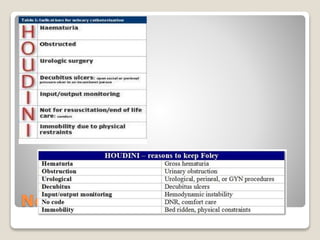
Nemonic
Indication for indwelling catheter
Necessary Equipment for
Catheterization
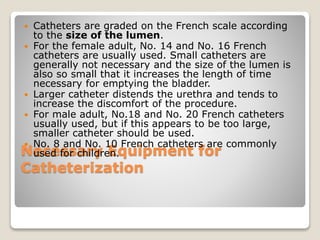
 Catheters are graded on the French scale according
to the size of the lumen.
 For the female adult, No. 14 and No. 16 French
catheters are usually used. Small catheters are
generally not necessary and the size of the lumen is
also so small that it increases the length of time
necessary for emptying the bladder.
 Larger catheter distends the urethra and tends to
increase the discomfort of the procedure.
 For male adult, No.18 and No. 20 French catheters
usually used, but if this appears to be too large,
smaller catheter should be used.
 No. 8 and No. 10 French catheters are commonly
used for children.
Preparation of the Patient
 Adequate exploration. On some
instances, catheterization is the last resort,
use other techniques first for drawing out the
urine before proceeding to catheterization.
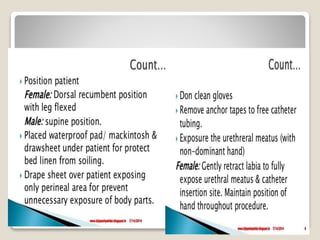
 Position. Dorsal recumbent for the female
and supine for the male using a firm mattress
or treatment table, Sim’s or lateral position
can be an alternate for the female patient
 Provision for privacy
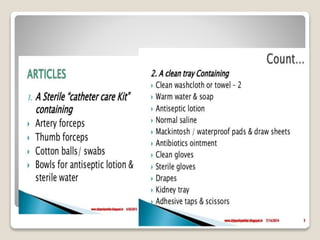
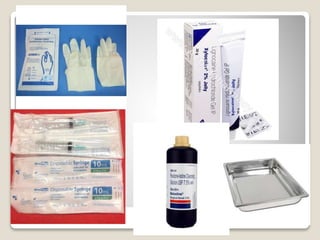
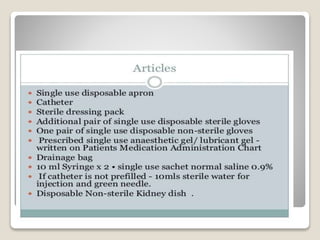
Articles
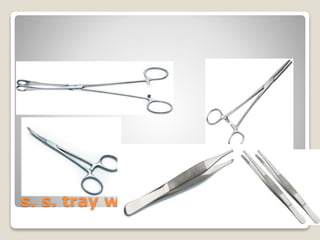
s. s. tray with articles
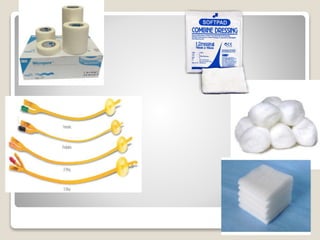
Foleys catheter size
Indication for catheterization
Needed for catheterization
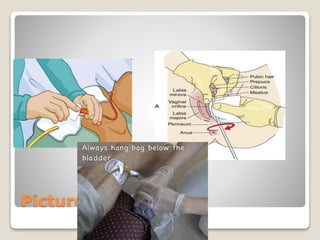
Catheter insertion image
 A catheter to remain in place for the
following purposes:
◦ The gradual decompression of an over distended
bladder
◦ For intermittent bladder drainage
◦ For continuous bladder drainage
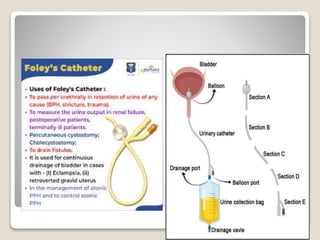
 An indwelling catheter has a balloon which is
inflated after the catheter is inserted into the
bladder. Because the inflated balloon is larger
than the opening to the urethra, the catheter
is retained in the bladder.
Procedure for Insertion
 Inflate the balloon with the prefilled syringe before
inserting the catheter to check for balloon patency.
Aspirate the fluid back into the syringe when it is
determined that the balloon is patent.
 Hold the catheter with one hand and inflate the
balloon according to the manufacturer’s instructions,
as soon as the catheter is in the bladder and urine
has begun to drain from the bladder. Usually 5 ml to
10 ml of sterile water is used
 If the patient complains of pain after the balloon is
inflated, allow it to empty and replace the catheter
with another one. The balloon is probably located in
the urethra and is causing discomfort owing to
distention of the urethra
Continued
Catheter image
Continued
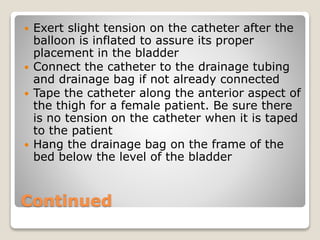
 Exert slight tension on the catheter after the
balloon is inflated to assure its proper
placement in the bladder
 Connect the catheter to the drainage tubing
and drainage bag if not already connected
 Tape the catheter along the anterior aspect of
the thigh for a female patient. Be sure there
is no tension on the catheter when it is taped
to the patient
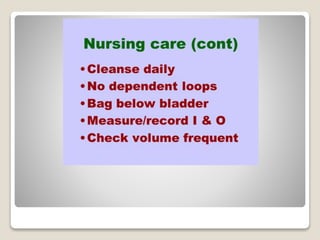
 Hang the drainage bag on the frame of the
bed below the level of the bladder
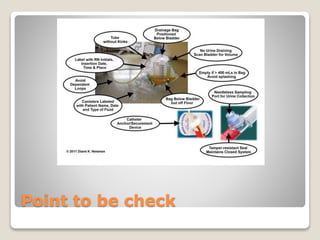
Point to be check
Caring for the Patient with an
Indwelling Catheter
 Be sure to wash hands before and after caring for a
patient with an indwelling catheter
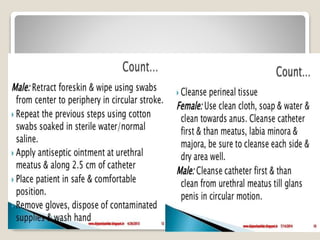
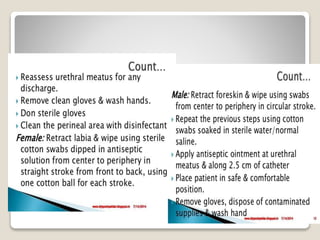
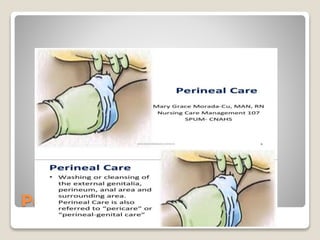
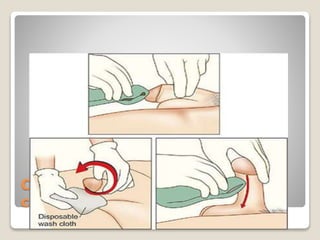
 Clean the perineal area thoroughly, especially around
the meatus, twice a day and after each bowel
movement. This helps prevent organisms for entering
the bladder
 Use soap or detergent and water to clean the perineal
area and rinse the area well
 Make sure that the patient maintains a generous fluid
intake. This helps prevent infection and irrigates the
catheter naturally by increasing urinary output
 Encourage the patient to be up and about as ordered
Picture for image of
Perineal care
Cleaning before the
catheterization
Continued
 Record the patient’s intake and output
 Note the volume and character of urine and record observations
carefully
 Teach the patient the importance of personal hygiene, especially
the importance of careful cleaning after having bowel movement
and thorough washing of hands frequently
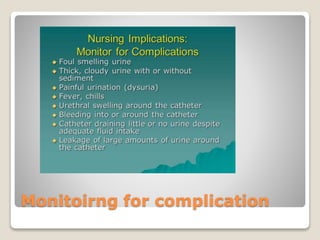
 Report any signs of infection promptly. These include a burning
sensation and irritation at the meatus, cloudy urine, a strong odor
to the urine, an elevated temperature and chills
 Plan to change indwelling catheters only as necessary. The usual
length of time between catheter changes varies and can be
anywhere from 5 days to 2 weeks. The less often a catheter is
changed, the less the likelihood than an infection will develop
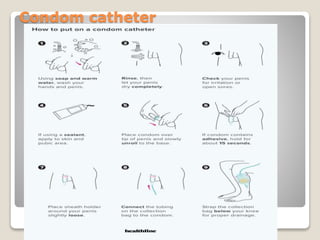
Condom catheter
Removing the Indwelling Catheter
and Aftercare of the Patient
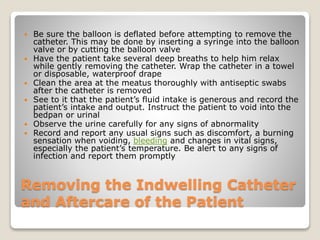
 Be sure the balloon is deflated before attempting to remove the
catheter. This may be done by inserting a syringe into the balloon
valve or by cutting the balloon valve
 Have the patient take several deep breaths to help him relax
while gently removing the catheter. Wrap the catheter in a towel
or disposable, waterproof drape
 Clean the area at the meatus thoroughly with antiseptic swabs
after the catheter is removed
 See to it that the patient’s fluid intake is generous and record the
patient’s intake and output. Instruct the patient to void into the
bedpan or urinal
 Observe the urine carefully for any signs of abnormality
 Record and report any usual signs such as discomfort, a burning
sensation when voiding, bleeding and changes in vital signs,
especially the patient’s temperature. Be alert to any signs of
infection and report them promptly
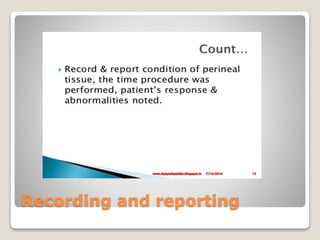
Recording and reporting
Monitoirng for complication
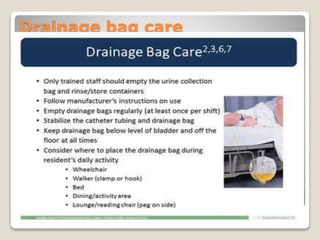
Drainage bag care
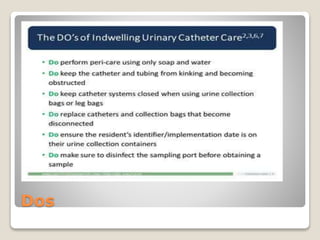
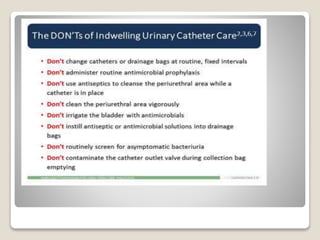
Dos
Check criteria