BLADDER IRRIGATION
BY
Manju Mulamoottil Abraham
Definition
To flush out the urinary bladder with a liquid.
Purposes
Ø To cleans the bladder from decomposed urine, bacteria,
excess of mucus, pus and blood clots.
Ø To maintain the patency of the urinary catheter.
Ø To relieve congestion and pain in case of inflammatory
conditions by the application of heat.
Ø To promote healing.
Ø To prevent the clot formation in case of bladder surgeries.
Ø To prevent and treat infections.
Ø To arrest bleeding.
Solutions used
Ø Normal saline
Ø Presribed medicated solutions
General instructions
Ø Should not be done without written order.
Ø As far as possible, bladder irrigation are to be
avoided.
Ø The safest and most effective means of irrigating
the urinary system is by “internal irrigation”
ØThe fluid should be instilled gently and allowed to
drain back by gravity.
Ø If the fluid flows easily into the bladder but fails to
return, there is a clot over the eye of the catheter
ØIn such situation no more fluid is introduced into
the bladder but try to dislodge the clot by milking
the tubing.
Ø Practice strict aseptic technique. All the
articles that are used for the irrigation must be
sterile.
Ø Wash hand before and after the procedure
Ø Maintain an accurate records of the amount
of fluid used for irrigation and the total amount
of urinary drainage. Subtract the total amount
of fluid used, from the total amount of urinary
drainage to find out the amount of urine
secreted by the kidneys.
Ø Irrigation are carried out until the return
flow is clear.
Ø The color of the drainage should be
checked and recorded.
ØIf bleeding takes place stop the procedure
and inform to the doctor. Record the
procedure on the nurse’s record with date
and time. Recorded procedure should
include- purposes, amount and kind of the
solution used, amount and characteristics
of the drainage from the bladder, result of
irrigation, any complication etc.
Articles required
Sterile Gloves
Towel and mackintosh
Asepto syringe
Sterile drainage tubing and bag in place
Sterile antiseptic swab
Kidney tray
Procedure Preliminary assessment-
Ø Check physician’s order and nursing care plan for
types, amount strength of irrigating fluid and reason
for irrigation.
Ø Explain the procedure to the patient
Ø Provide privacy and drape for the patient
Ø Empty, measure and record the amount and
appearance of urine present in the urine bag
Ø Arrange the articles
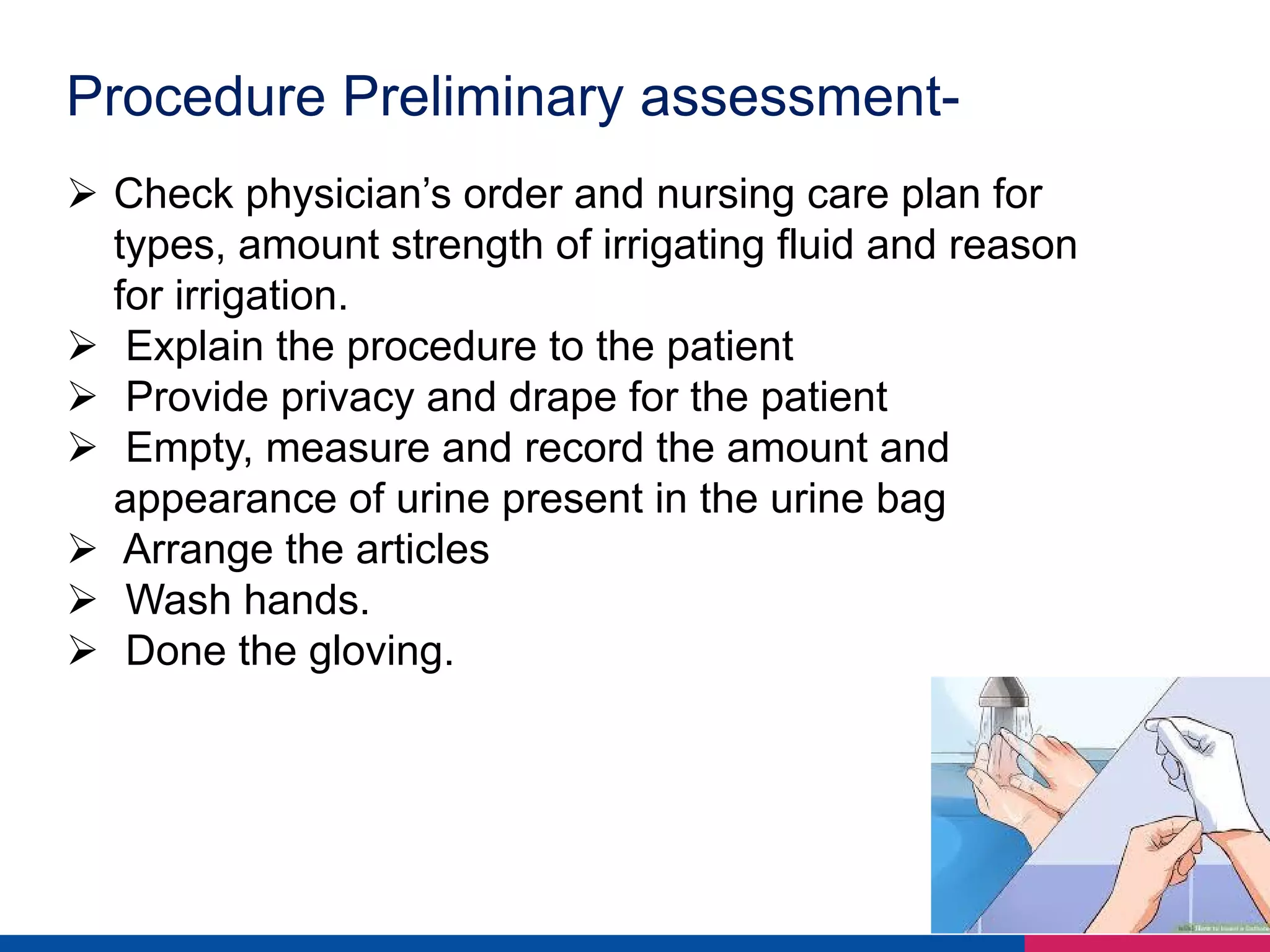
Ø Wash hands.
Ø Done the gloving.
Ø Instill the prescribed amount of irrigant.
Ø If specific amount is not ordered, fillup to 150 ml of
irrigant .
Ø Clamp the irrigant tubing
Ø Wait for the prescribed length of time
Ø Open the clamp monitor the drainage as it flows
into the drainage tube.
Procedure After care-
Ø Tape the catheter securely to the thigh
Ø Assess the patient’s condition and tolerance
of the procedure
Ø Discard all used disposable articles, clean
and replace reusable articles Wash hands
Ø Record procedure in nurse’s record.
•Manju M Abraham

Bladder wash

  • 1.
  • 2.
    Definition To flush outthe urinary bladder with a liquid.
  • 3.
    Purposes Ø To cleansthe bladder from decomposed urine, bacteria, excess of mucus, pus and blood clots. Ø To maintain the patency of the urinary catheter. Ø To relieve congestion and pain in case of inflammatory conditions by the application of heat. Ø To promote healing. Ø To prevent the clot formation in case of bladder surgeries. Ø To prevent and treat infections. Ø To arrest bleeding.
  • 4.
    Solutions used Ø Normalsaline Ø Presribed medicated solutions
  • 5.
    General instructions Ø Shouldnot be done without written order. Ø As far as possible, bladder irrigation are to be avoided. Ø The safest and most effective means of irrigating the urinary system is by “internal irrigation” ØThe fluid should be instilled gently and allowed to drain back by gravity. Ø If the fluid flows easily into the bladder but fails to return, there is a clot over the eye of the catheter ØIn such situation no more fluid is introduced into the bladder but try to dislodge the clot by milking the tubing.
  • 6.
    Ø Practice strictaseptic technique. All the articles that are used for the irrigation must be sterile. Ø Wash hand before and after the procedure Ø Maintain an accurate records of the amount of fluid used for irrigation and the total amount of urinary drainage. Subtract the total amount of fluid used, from the total amount of urinary drainage to find out the amount of urine secreted by the kidneys.
  • 7.
    Ø Irrigation arecarried out until the return flow is clear. Ø The color of the drainage should be checked and recorded. ØIf bleeding takes place stop the procedure and inform to the doctor. Record the procedure on the nurse’s record with date and time. Recorded procedure should include- purposes, amount and kind of the solution used, amount and characteristics of the drainage from the bladder, result of irrigation, any complication etc.
  • 8.
    Articles required Sterile Gloves Toweland mackintosh Asepto syringe Sterile drainage tubing and bag in place Sterile antiseptic swab Kidney tray
  • 9.
    Procedure Preliminary assessment- ØCheck physician’s order and nursing care plan for types, amount strength of irrigating fluid and reason for irrigation. Ø Explain the procedure to the patient Ø Provide privacy and drape for the patient Ø Empty, measure and record the amount and appearance of urine present in the urine bag Ø Arrange the articles Ø Wash hands. Ø Done the gloving.
  • 10.
    Ø Instill theprescribed amount of irrigant. Ø If specific amount is not ordered, fillup to 150 ml of irrigant . Ø Clamp the irrigant tubing Ø Wait for the prescribed length of time Ø Open the clamp monitor the drainage as it flows into the drainage tube.
  • 11.
    Procedure After care- ØTape the catheter securely to the thigh Ø Assess the patient’s condition and tolerance of the procedure Ø Discard all used disposable articles, clean and replace reusable articles Wash hands Ø Record procedure in nurse’s record.
  • 12.