Instructional Design for Multimedia Sanjaya Mishra Definition Architecture Design Implementation
Instructional Design for Multimedia Principles of Multimedia Design Multimedia principle: Use both graphics and words Contiguity principle: Place related words and graphics together Modality principle: Present words as speech rather than on screen text Redundancy principle: Avoid presenting words as narration and text together Coherence principle: Avoid extraneous sound and pictures Personalization principle: Use conversational style and learning agents  Practice principle: Give opportunities for interactions related to authentic events
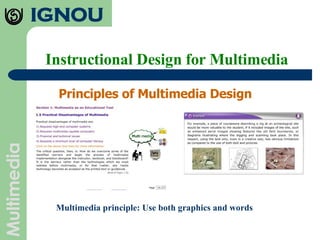
Instructional Design for Multimedia Principles of Multimedia Design Multimedia principle: Use both graphics and words
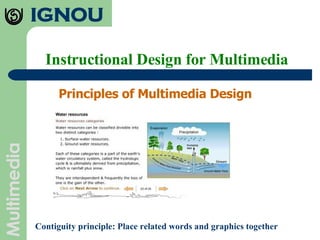
Instructional Design for Multimedia Principles of Multimedia Design Contiguity principle: Place related words and graphics together
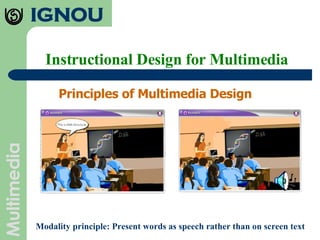
Instructional Design for Multimedia Principles of Multimedia Design Modality principle: Present words as speech rather than on screen text
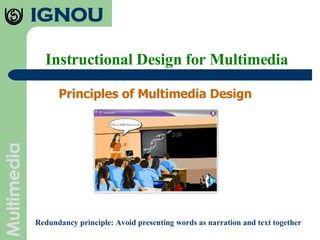
Instructional Design for Multimedia Principles of Multimedia Design Redundancy principle: Avoid presenting words as narration and text together
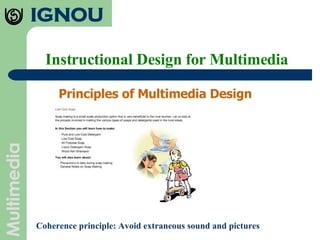
Instructional Design for Multimedia Principles of Multimedia Design Coherence principle: Avoid extraneous sound and pictures
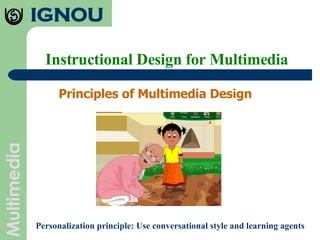
Instructional Design for Multimedia Principles of Multimedia Design Personalization principle: Use conversational style and learning agents
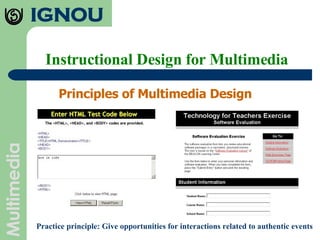
Instructional Design for Multimedia Principles of Multimedia Design Practice principle: Give opportunities for interactions related to authentic events
Instructional Design for Multimedia Instructional Design as a Process Instructional Design is the systematic development of instructional specifications using  learning and instructional theory  to ensure the quality of instruction. It is the entire process of analysis of learning needs and goals and the development of a delivery system to meet those needs. It includes development of instructional materials and activities; and tryout and evaluation of all instruction and learner activities
Instructional Design for Multimedia Instructional Design as a Discipline Instructional Design is that branch of knowledge concerned with  research and theory  about instructional strategies and the process for developing and implementing those strategies.
Instructional Design for Multimedia Instructional Design as a Science Instructional design is the science of creating detailed specifications for the development, implementation, evaluation, and maintenance of situations that  facilitate the learning  of both large and small units of subject matter at all levels of complexity.
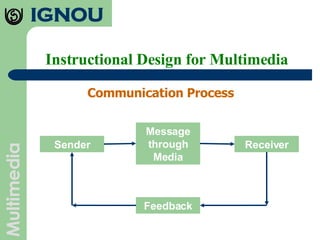
Instructional Design for Multimedia Communication Process Sender Receiver Message through Media Feedback
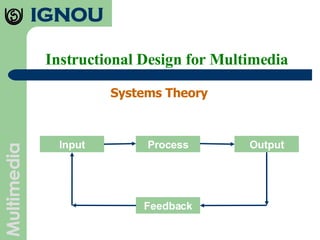
Instructional Design for Multimedia Systems Theory  Input Process Output Feedback
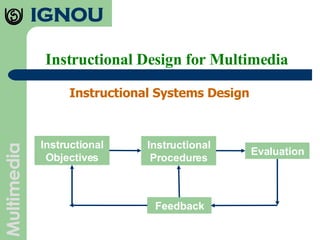
Instructional Design for Multimedia Instructional Systems Design  Instructional Objectives Instructional Procedures Evaluation Feedback
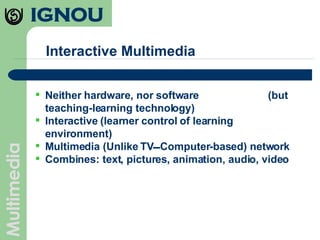
Interactive Multimedia Neither hardware, nor software  (but teaching-learning technology)‏ Interactive (learner control of learning environment)‏ Multimedia (Unlike TV  Computer-based) network Combines: text, pictures, animation, audio, video
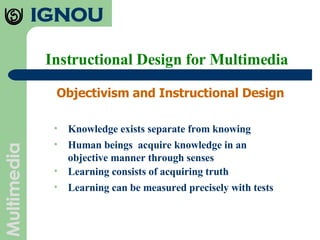
Instructional Design for Multimedia Objectivism and Instructional Design  Knowledge exists separate from knowing Human beings  acquire knowledge in an objective manner through senses Learning consists of acquiring truth Learning can be measured precisely with tests
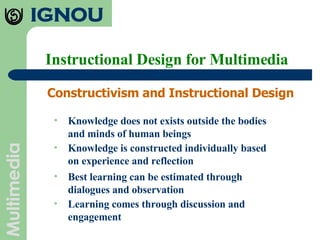
Instructional Design for Multimedia Constructivism and Instructional Design  Knowledge does not exists outside the bodies and minds of human beings Knowledge is constructed individually based on experience and reflection Best learning can be estimated through dialogues and observation Learning comes through discussion and engagement
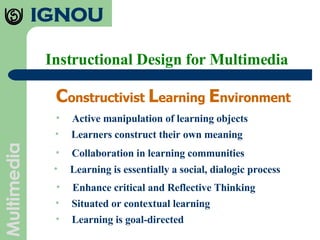
C onstructivist  L earning  E nvironment Instructional Design for Multimedia Active manipulation of learning objects Learners construct their own meaning Collaboration in learning communities Learning is essentially a social, dialogic process Enhance critical and Reflective Thinking Situated or contextual learning Learning is goal-directed
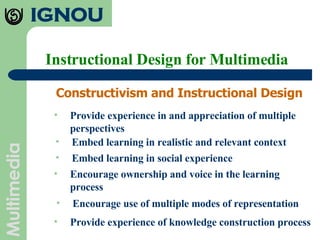
Instructional Design for Multimedia Constructivism and Instructional Design  Provide experience in and appreciation of multiple perspectives Embed learning in realistic and relevant context Embed learning in social experience Encourage ownership and voice in the learning process Encourage use of multiple modes of representation Provide experience of knowledge construction process
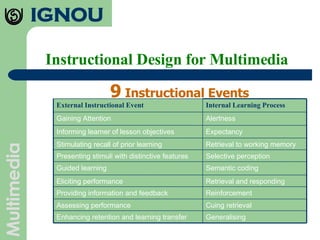
Instructional Design for Multimedia 9  Instructional Events  Generalising Enhancing retention and learning transfer Cuing retrieval Assessing performance Reinforcement Providing information and feedback Retrieval and responding Eliciting performance Semantic coding Guided learning Selective perception Presenting stimuli with distinctive features Retrieval to working memory Stimulating recall of prior learning Expectancy Informing learner of lesson objectives Alertness Gaining Attention Internal Learning Process External Instructional Event
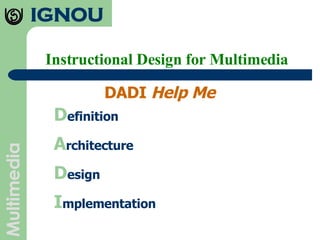
Instructional Design for Multimedia DADI  Help Me D efinition A rchitecture D esign I mplementation
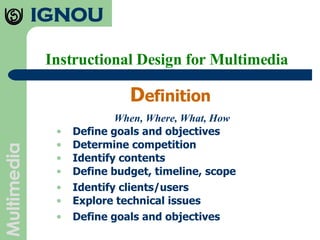
Instructional Design for Multimedia D efinition Define goals and objectives Determine competition Identify contents Define budget, timeline, scope Identify clients/users Explore technical issues Define goals and objectives When, Where, What, How
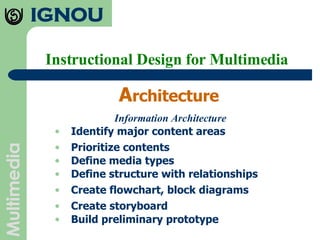
Instructional Design for Multimedia A rchitecture Identify major content areas Information Architecture Prioritize contents Define media types Define structure with relationships Create flowchart, block diagrams Create storyboard Build preliminary prototype
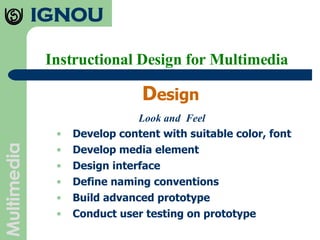
Instructional Design for Multimedia D esign Look and  Feel Develop content with suitable color, font Develop media element Design interface Define naming conventions Build advanced prototype Conduct user testing on prototype
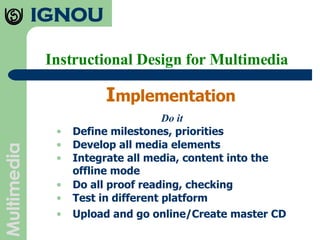
Instructional Design for Multimedia I mplementation Do it Define milestones, priorities Develop all media elements Integrate all media, content into the offline mode Do all proof reading, checking Test in different platform Upload and go online/Create master CD
Instructional Design for Multimedia Your Comments and Questions are welcome Thank You

Instructional Design for Multimedia

  • 1.
    Instructional Design forMultimedia Sanjaya Mishra Definition Architecture Design Implementation
  • 2.
    Instructional Design forMultimedia Principles of Multimedia Design Multimedia principle: Use both graphics and words Contiguity principle: Place related words and graphics together Modality principle: Present words as speech rather than on screen text Redundancy principle: Avoid presenting words as narration and text together Coherence principle: Avoid extraneous sound and pictures Personalization principle: Use conversational style and learning agents Practice principle: Give opportunities for interactions related to authentic events
  • 3.
    Instructional Design forMultimedia Principles of Multimedia Design Multimedia principle: Use both graphics and words
  • 4.
    Instructional Design forMultimedia Principles of Multimedia Design Contiguity principle: Place related words and graphics together
  • 5.
    Instructional Design forMultimedia Principles of Multimedia Design Modality principle: Present words as speech rather than on screen text
  • 6.
    Instructional Design forMultimedia Principles of Multimedia Design Redundancy principle: Avoid presenting words as narration and text together
  • 7.
    Instructional Design forMultimedia Principles of Multimedia Design Coherence principle: Avoid extraneous sound and pictures
  • 8.
    Instructional Design forMultimedia Principles of Multimedia Design Personalization principle: Use conversational style and learning agents
  • 9.
    Instructional Design forMultimedia Principles of Multimedia Design Practice principle: Give opportunities for interactions related to authentic events
  • 10.
    Instructional Design forMultimedia Instructional Design as a Process Instructional Design is the systematic development of instructional specifications using learning and instructional theory to ensure the quality of instruction. It is the entire process of analysis of learning needs and goals and the development of a delivery system to meet those needs. It includes development of instructional materials and activities; and tryout and evaluation of all instruction and learner activities
  • 11.
    Instructional Design forMultimedia Instructional Design as a Discipline Instructional Design is that branch of knowledge concerned with research and theory about instructional strategies and the process for developing and implementing those strategies.
  • 12.
    Instructional Design forMultimedia Instructional Design as a Science Instructional design is the science of creating detailed specifications for the development, implementation, evaluation, and maintenance of situations that facilitate the learning of both large and small units of subject matter at all levels of complexity.
  • 13.
    Instructional Design forMultimedia Communication Process Sender Receiver Message through Media Feedback
  • 14.
    Instructional Design forMultimedia Systems Theory Input Process Output Feedback
  • 15.
    Instructional Design forMultimedia Instructional Systems Design Instructional Objectives Instructional Procedures Evaluation Feedback
  • 16.
    Interactive Multimedia Neitherhardware, nor software (but teaching-learning technology)‏ Interactive (learner control of learning environment)‏ Multimedia (Unlike TV  Computer-based) network Combines: text, pictures, animation, audio, video
  • 17.
    Instructional Design forMultimedia Objectivism and Instructional Design Knowledge exists separate from knowing Human beings acquire knowledge in an objective manner through senses Learning consists of acquiring truth Learning can be measured precisely with tests
  • 18.
    Instructional Design forMultimedia Constructivism and Instructional Design Knowledge does not exists outside the bodies and minds of human beings Knowledge is constructed individually based on experience and reflection Best learning can be estimated through dialogues and observation Learning comes through discussion and engagement
  • 19.
    C onstructivist L earning E nvironment Instructional Design for Multimedia Active manipulation of learning objects Learners construct their own meaning Collaboration in learning communities Learning is essentially a social, dialogic process Enhance critical and Reflective Thinking Situated or contextual learning Learning is goal-directed
  • 20.
    Instructional Design forMultimedia Constructivism and Instructional Design Provide experience in and appreciation of multiple perspectives Embed learning in realistic and relevant context Embed learning in social experience Encourage ownership and voice in the learning process Encourage use of multiple modes of representation Provide experience of knowledge construction process
  • 21.
    Instructional Design forMultimedia 9 Instructional Events Generalising Enhancing retention and learning transfer Cuing retrieval Assessing performance Reinforcement Providing information and feedback Retrieval and responding Eliciting performance Semantic coding Guided learning Selective perception Presenting stimuli with distinctive features Retrieval to working memory Stimulating recall of prior learning Expectancy Informing learner of lesson objectives Alertness Gaining Attention Internal Learning Process External Instructional Event
  • 22.
    Instructional Design forMultimedia DADI Help Me D efinition A rchitecture D esign I mplementation
  • 23.
    Instructional Design forMultimedia D efinition Define goals and objectives Determine competition Identify contents Define budget, timeline, scope Identify clients/users Explore technical issues Define goals and objectives When, Where, What, How
  • 24.
    Instructional Design forMultimedia A rchitecture Identify major content areas Information Architecture Prioritize contents Define media types Define structure with relationships Create flowchart, block diagrams Create storyboard Build preliminary prototype
  • 25.
    Instructional Design forMultimedia D esign Look and Feel Develop content with suitable color, font Develop media element Design interface Define naming conventions Build advanced prototype Conduct user testing on prototype
  • 26.
    Instructional Design forMultimedia I mplementation Do it Define milestones, priorities Develop all media elements Integrate all media, content into the offline mode Do all proof reading, checking Test in different platform Upload and go online/Create master CD
  • 27.
    Instructional Design forMultimedia Your Comments and Questions are welcome Thank You