Ch4: Multimedia Principle
E-Learning and the Science of Instruction : Proven Guidelines for
Consumers and Designers of Multimedia Learning
Clark, Ruth C.
Mayer, Richard E.
Marcus Thompson
What is it?
• The Multimedia principle that people learn
better with word and image instead of just
words
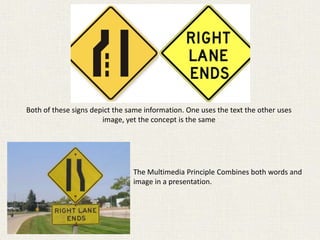
Both of these signs depict the same information. One uses the text the other uses
image, yet the concept is the same
The Multimedia Principle Combines both words and
image in a presentation.
Why?
• The Multimedia Principle works on the idea
that people learn better when they are
engaged in to material. When presented with
the text and image, the mind initiates active
learning that draws connections between the
two. That process of making connections is
the engagement.
Correct Visuals
Decorative images should be used sparingly if at all.
To many decretive images in are only a distraction. For
example, the image on the right would probably be
considered decorative as it does not provide any
information. It’s only relation to the subject of this
presentation is that it has the words active learning is.
If this image was accompanied by a description of
active learning it still would not add to content
This Active Learning graphic provides a visual representation
of how the active learning process moves. It gives you
something more to think about and may even help your
understanding of the process.
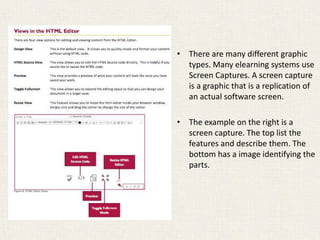
• There are many different graphic
types. Many elearning systems use
Screen Captures. A screen capture
is a graphic that is a replication of
an actual software screen.
• The example on the right is a
screen capture. The top list the
features and describe them. The
bottom has a image identifying the
parts.
Graphics as Interface and organization
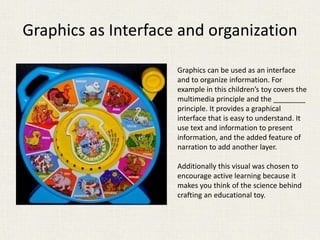
Graphics can be used as an interface
and to organize information. For
example in this children’s toy covers the
multimedia principle and the ________
principle. It provides a graphical
interface that is easy to understand. It
use text and information to present
information, and the added feature of
narration to add another layer.
Additionally this visual was chosen to
encourage active learning because it
makes you think of the science behind
crafting an educational toy.
Types of Images
• Decorative - Visuals added for aesthetic
appeal or for humor
• Representational - Visuals that illustrate the
appearance of an object
• Organizational - Visuals that show qualitative
relationships among content
• Relational - Visuals that summarize
quantitative relationships
• Transformational - Visuals that illustrate
changes in time or over space
• Interpretive - Visuals that make intangible
phenomena visible and concrete
Reasons for the Principle
• Words are the most effective and inexpensive material to
produce. Words can convey information better than graphics
alone.
• We favor a knowledge construction view in which learning is
seen as a process of active sense-making (active learning) and
teaching is seen as an attempt to foster appropriate cognitive
processing in the learner. (Clark & Mayer; P.79)
• Adding graphics to those worse is a good way to activate the
process
Evidence
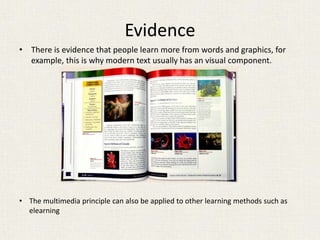
• There is evidence that people learn more from words and graphics, for
example, this is why modern text usually has an visual component.
• The multimedia principle can also be applied to other learning methods such as
elearning
Static or Animated?
• Static images are easier to produce and can be
implimented easier in multiple media
• Animated images my result in a more passive
experience
• Animation (and naration) may overload the
brain process when absorbing new
information
• Diagrams are easier to review
What we don’t know
• We are still unsure what situations are best for
animations, studies suggest they work well for
teaching manual task
• What are the long term effects of using
graphics?
• What are the long term benefits in investing
resources to generate graphics
Sources
• University of Hardvard 12 Learning Principles
• Chapter 4: e-Learning and the Science of
Instruction; Ruth Colvin Clark • Richard E.
Mayer (p69)
• Marcus Thompson Multimedia Blog

Marcus Thompson Multimedia Principle

  • 1.
    Ch4: Multimedia Principle E-Learningand the Science of Instruction : Proven Guidelines for Consumers and Designers of Multimedia Learning Clark, Ruth C. Mayer, Richard E. Marcus Thompson
  • 2.
    What is it? •The Multimedia principle that people learn better with word and image instead of just words
  • 3.
    Both of thesesigns depict the same information. One uses the text the other uses image, yet the concept is the same The Multimedia Principle Combines both words and image in a presentation.
  • 4.
    Why? • The MultimediaPrinciple works on the idea that people learn better when they are engaged in to material. When presented with the text and image, the mind initiates active learning that draws connections between the two. That process of making connections is the engagement.
  • 5.
    Correct Visuals Decorative imagesshould be used sparingly if at all. To many decretive images in are only a distraction. For example, the image on the right would probably be considered decorative as it does not provide any information. It’s only relation to the subject of this presentation is that it has the words active learning is. If this image was accompanied by a description of active learning it still would not add to content This Active Learning graphic provides a visual representation of how the active learning process moves. It gives you something more to think about and may even help your understanding of the process.
  • 6.
    • There aremany different graphic types. Many elearning systems use Screen Captures. A screen capture is a graphic that is a replication of an actual software screen. • The example on the right is a screen capture. The top list the features and describe them. The bottom has a image identifying the parts.
  • 7.
    Graphics as Interfaceand organization Graphics can be used as an interface and to organize information. For example in this children’s toy covers the multimedia principle and the ________ principle. It provides a graphical interface that is easy to understand. It use text and information to present information, and the added feature of narration to add another layer. Additionally this visual was chosen to encourage active learning because it makes you think of the science behind crafting an educational toy.
  • 8.
    Types of Images •Decorative - Visuals added for aesthetic appeal or for humor • Representational - Visuals that illustrate the appearance of an object • Organizational - Visuals that show qualitative relationships among content • Relational - Visuals that summarize quantitative relationships
  • 9.
    • Transformational -Visuals that illustrate changes in time or over space • Interpretive - Visuals that make intangible phenomena visible and concrete
  • 10.
    Reasons for thePrinciple • Words are the most effective and inexpensive material to produce. Words can convey information better than graphics alone. • We favor a knowledge construction view in which learning is seen as a process of active sense-making (active learning) and teaching is seen as an attempt to foster appropriate cognitive processing in the learner. (Clark & Mayer; P.79) • Adding graphics to those worse is a good way to activate the process
  • 11.
    Evidence • There isevidence that people learn more from words and graphics, for example, this is why modern text usually has an visual component. • The multimedia principle can also be applied to other learning methods such as elearning
  • 12.
    Static or Animated? •Static images are easier to produce and can be implimented easier in multiple media • Animated images my result in a more passive experience • Animation (and naration) may overload the brain process when absorbing new information • Diagrams are easier to review
  • 13.
    What we don’tknow • We are still unsure what situations are best for animations, studies suggest they work well for teaching manual task • What are the long term effects of using graphics? • What are the long term benefits in investing resources to generate graphics
  • 14.
    Sources • University ofHardvard 12 Learning Principles • Chapter 4: e-Learning and the Science of Instruction; Ruth Colvin Clark • Richard E. Mayer (p69) • Marcus Thompson Multimedia Blog