Podcasting in Education Pam Kemp IT 648 The University of Southern Mississippi
History of Podcasting Original concept developed by former MTV VeeJay, Adam Curry, who dreamed of sending audio files to digital music players Curry then worked with the creator of RSS (Really Simple Syndication) which enables internet text feeds to forward as audio files using RSS instead of text ( Brown, A., & Green, T. 2007)
History of Podcasting Rapid growth since being introduced in 2004 More than 17 million podcasts were downloaded in November 2006—a seven million increase from the 10 million downloaded in April 2006 Growth has been so rapid, The New Oxford American Dictionary identified podcasting as 2005 word of the year  (Madden, M., 2006)
What is Podcasting? Roy and Roy offer a great explanation: “ Podcasting is a process in which digital audio recordings are broadcast over the internet to users who have signed up to receive them....like a traditional radio, only it is a cognitive medium and is available on demand for a specific topic.”  (Roy, A., & Roy, P., 2007, p. 481)
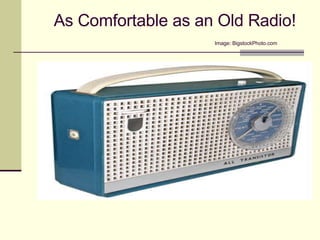
As Comfortable as an Old Radio!   Image: BigstockPhoto.com
Why Podcast? Makes content available to a multitude of learners based upon the learners’ scheduling needs  Users can simply use their computers to access the content if they do not wish to purchase an iPod or MP3 player However, portability, popularity, and multi-tasking are part of the appeal for using MP3 players and iPods with more than 100 million iPods sold as of April 2007 (http://www.apple.com/pr/library/2007/04/09ipod.html)
How to Podcast Some institutions use commercial podcasting programs and services. However, individual uses can create their own podcasts. Below are links to some sites that describe the process of creating your own podcast:  http://www.macdevcenter.com/pub/a/mac/2005/01/25/podcast.html http://www.how-to-podcast-tutorial.com/index.htm
Implications for Education In 2004, Duke University distributed 20 GB iPods to its first year students 15 fall courses and 33 spring courses integrated iPod use into five categories: - Course content dissemination  - Classroom recording - Field recording  - Study support  - File storage and transfer
The Duke Experience: Benefits of iPod Use  Based on class observations, student and faculty focus groups, and surveys: Convenience for faculty and  students through availability of portable digital content Reduced dependence on physical materials
The Duke Experience: Benefits of iPod Use   Location-independent access to digital multimedia course materials, reduced dependence on physical materials Effective, easy-to-use tool for digital recording of interviews, field notes, small group discussions, and self-recording of oral assignments
The Duke Experience: Benefits of iPod Use Greater student engagement and interest in class discussions, labs, field research, and independent projects Enhanced support for individual learning preferences and needs
The Duke Experience: Barriers and Problems Challenges in integrating multiple systems for content storage, access, and sharing with existing technology infrastructure Absence of systems for bulk purchasing or commercial licensing Device limitations
The Duke Experience: Barriers and Problems Recordings of lower quality Lack of awareness or accurate knowledge of iPod functionality and academic applications Limited pre-existing documentation and training resources
Institutional Impacts Increased collaboration among campus technology support groups Outside and vendor interest Collaborations with other universities Catalyst for conversations about technology in education To view the study report:  http://cit.duke.edu/pdf/reports/ipod_initiative_04_05.pdf
Why Podcast ? It reinforces content provided in traditional lecture It makes learning more accessible and is a very useful adjunct for distance learning It stimulates the auditory learner as well as the visual learner It helps students use “dead” time—they can listen to course content while riding a bus or walking across campus
Podcasting is not a Fad The reports mentioned earlier have demonstrated that iPods and other mobile devices are more popular than ever with unlimited potential. iPods are here to stay. Remember, the iPod can be as comfortable and simple as an old transistor radio. You just have to be willing to give it a try!
References Brown, A., & Green, T. (2007). Video podcasting in perspective: The  history, technology, aesthetics, and instructional uses of a new medium.  Journal of Educational Technology Systems, 36 (1), 3-17.  Apple, Inc. (2007, April).  One hundred million iPods sold . Retrieved July 11, 2008, from Apple Corporation Web Site:  http://www.apple.com/pr/library/2007/04/09ipod.html Copley, J. (2007). Audio and video podcasts of lectures for campus-based students: Production and evaluation of student use.  Innovations in Education and Teaching International, 44 (4), 387-399.
References Duke University iPod First Year Experience Final Evaluation Report . (2005, June). Retrieved July 4, 2008, from Duke University Web Site:  http://cit.duke.edu/pdf/reports/ipod_initiative_04_05.pdf Madden, M. (2006, November).  Pew internet project data memo: Re: Podcasting . Retrieved July 11, 2008, from Pew Internet and American Life Project Web Site:  http://www.pewinternet.org/pdfs/PIP_Podcasting.pdf Roy, A., & Roy, P. (2007). Intersection of training and podcasting in adult education.  Australian Journal of Adult Learning, 47 (3), 478-491.
References Yuen, S. (2007).  Ipod in Education . Retrieved July 24, 2007, from  http://blog.yuen.us/ Vess, D. (2006). History to go:  Why iteach with iPods.  The History Teacher, 39 (4), 479-492.

Podcasting In Education

  • 1.
    Podcasting in EducationPam Kemp IT 648 The University of Southern Mississippi
  • 2.
    History of PodcastingOriginal concept developed by former MTV VeeJay, Adam Curry, who dreamed of sending audio files to digital music players Curry then worked with the creator of RSS (Really Simple Syndication) which enables internet text feeds to forward as audio files using RSS instead of text ( Brown, A., & Green, T. 2007)
  • 3.
    History of PodcastingRapid growth since being introduced in 2004 More than 17 million podcasts were downloaded in November 2006—a seven million increase from the 10 million downloaded in April 2006 Growth has been so rapid, The New Oxford American Dictionary identified podcasting as 2005 word of the year (Madden, M., 2006)
  • 4.
    What is Podcasting?Roy and Roy offer a great explanation: “ Podcasting is a process in which digital audio recordings are broadcast over the internet to users who have signed up to receive them....like a traditional radio, only it is a cognitive medium and is available on demand for a specific topic.” (Roy, A., & Roy, P., 2007, p. 481)
  • 5.
    As Comfortable asan Old Radio! Image: BigstockPhoto.com
  • 6.
    Why Podcast? Makescontent available to a multitude of learners based upon the learners’ scheduling needs Users can simply use their computers to access the content if they do not wish to purchase an iPod or MP3 player However, portability, popularity, and multi-tasking are part of the appeal for using MP3 players and iPods with more than 100 million iPods sold as of April 2007 (http://www.apple.com/pr/library/2007/04/09ipod.html)
  • 7.
    How to PodcastSome institutions use commercial podcasting programs and services. However, individual uses can create their own podcasts. Below are links to some sites that describe the process of creating your own podcast: http://www.macdevcenter.com/pub/a/mac/2005/01/25/podcast.html http://www.how-to-podcast-tutorial.com/index.htm
  • 8.
    Implications for EducationIn 2004, Duke University distributed 20 GB iPods to its first year students 15 fall courses and 33 spring courses integrated iPod use into five categories: - Course content dissemination - Classroom recording - Field recording - Study support - File storage and transfer
  • 9.
    The Duke Experience:Benefits of iPod Use Based on class observations, student and faculty focus groups, and surveys: Convenience for faculty and students through availability of portable digital content Reduced dependence on physical materials
  • 10.
    The Duke Experience:Benefits of iPod Use Location-independent access to digital multimedia course materials, reduced dependence on physical materials Effective, easy-to-use tool for digital recording of interviews, field notes, small group discussions, and self-recording of oral assignments
  • 11.
    The Duke Experience:Benefits of iPod Use Greater student engagement and interest in class discussions, labs, field research, and independent projects Enhanced support for individual learning preferences and needs
  • 12.
    The Duke Experience:Barriers and Problems Challenges in integrating multiple systems for content storage, access, and sharing with existing technology infrastructure Absence of systems for bulk purchasing or commercial licensing Device limitations
  • 13.
    The Duke Experience:Barriers and Problems Recordings of lower quality Lack of awareness or accurate knowledge of iPod functionality and academic applications Limited pre-existing documentation and training resources
  • 14.
    Institutional Impacts Increasedcollaboration among campus technology support groups Outside and vendor interest Collaborations with other universities Catalyst for conversations about technology in education To view the study report: http://cit.duke.edu/pdf/reports/ipod_initiative_04_05.pdf
  • 15.
    Why Podcast ?It reinforces content provided in traditional lecture It makes learning more accessible and is a very useful adjunct for distance learning It stimulates the auditory learner as well as the visual learner It helps students use “dead” time—they can listen to course content while riding a bus or walking across campus
  • 16.
    Podcasting is nota Fad The reports mentioned earlier have demonstrated that iPods and other mobile devices are more popular than ever with unlimited potential. iPods are here to stay. Remember, the iPod can be as comfortable and simple as an old transistor radio. You just have to be willing to give it a try!
  • 17.
    References Brown, A.,& Green, T. (2007). Video podcasting in perspective: The history, technology, aesthetics, and instructional uses of a new medium. Journal of Educational Technology Systems, 36 (1), 3-17. Apple, Inc. (2007, April). One hundred million iPods sold . Retrieved July 11, 2008, from Apple Corporation Web Site: http://www.apple.com/pr/library/2007/04/09ipod.html Copley, J. (2007). Audio and video podcasts of lectures for campus-based students: Production and evaluation of student use. Innovations in Education and Teaching International, 44 (4), 387-399.
  • 18.
    References Duke UniversityiPod First Year Experience Final Evaluation Report . (2005, June). Retrieved July 4, 2008, from Duke University Web Site: http://cit.duke.edu/pdf/reports/ipod_initiative_04_05.pdf Madden, M. (2006, November). Pew internet project data memo: Re: Podcasting . Retrieved July 11, 2008, from Pew Internet and American Life Project Web Site: http://www.pewinternet.org/pdfs/PIP_Podcasting.pdf Roy, A., & Roy, P. (2007). Intersection of training and podcasting in adult education. Australian Journal of Adult Learning, 47 (3), 478-491.
  • 19.
    References Yuen, S.(2007). Ipod in Education . Retrieved July 24, 2007, from http://blog.yuen.us/ Vess, D. (2006). History to go: Why iteach with iPods. The History Teacher, 39 (4), 479-492.