Barry Kidd 2010 1
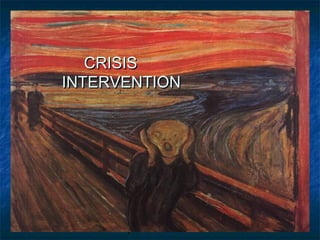
CRISISCRISIS
INTERVENTIONINTERVENTION
Barry Kidd 2010 2
DEFINITION
A crisis is an overwhelming reaction to a
threatening situation in which a person’s usual
problem solving strategies fail to resolve the
situation resulting in a state of disequilibrium.
Barry Kidd 2010 3
TYPES OF CRISISTYPES OF CRISIS
 Developmental (Maturational) Crisis-Developmental (Maturational) Crisis-
predicted times of stress in everyone’s lifepredicted times of stress in everyone’s life
which occurs in response to a transitionwhich occurs in response to a transition
from one stage to another in the life cycle.from one stage to another in the life cycle.
Barry Kidd 2010 4
TYPES OF CRISISTYPES OF CRISIS
(Continuation(Continuation))
 Situational Crisis- occurs in response to aSituational Crisis- occurs in response to a
sudden unexpected event in a person’ssudden unexpected event in a person’s
life. The critical life events revolve aroundlife. The critical life events revolve around
experiences of grief and loss. Forexperiences of grief and loss. For
example loss of a job, divorce, abortion,example loss of a job, divorce, abortion,
death of a love one, severe physical ordeath of a love one, severe physical or
mental illness, etc.mental illness, etc.
Barry Kidd 2010 5
TYPES OF CRISISTYPES OF CRISIS
(Continuation)(Continuation)
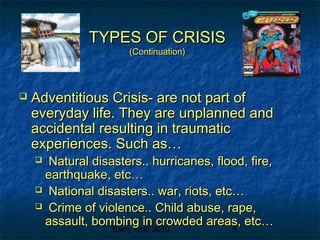
 Adventitious Crisis- are not part ofAdventitious Crisis- are not part of
everyday life. They are unplanned andeveryday life. They are unplanned and
accidental resulting in traumaticaccidental resulting in traumatic
experiences. Such as…experiences. Such as…
 Natural disasters.. hurricanes, flood, fire,Natural disasters.. hurricanes, flood, fire,
earthquake, etc…earthquake, etc…
 National disasters.. war, riots, etc…National disasters.. war, riots, etc…
 Crime of violence.. Child abuse, rape,Crime of violence.. Child abuse, rape,
assault, bombing in crowded areas, etc…assault, bombing in crowded areas, etc…
Barry Kidd 2010 6
CRISIS INTERVENTIONCRISIS INTERVENTION
GENERAL OVERVIEWGENERAL OVERVIEW
Crisis….Crisis….
 Occurs in everyoneOccurs in everyone
 Not necessarily pathological, mayNot necessarily pathological, may
encourage growth and changeencourage growth and change
 Time limited to a brief period, 4-6 weeksTime limited to a brief period, 4-6 weeks
except deathexcept death
 A person’s perception determines theA person’s perception determines the
crisiscrisis
Barry Kidd 2010 7
CRISIS INTERVENTIONCRISIS INTERVENTION
BALANCING FACTORSBALANCING FACTORS
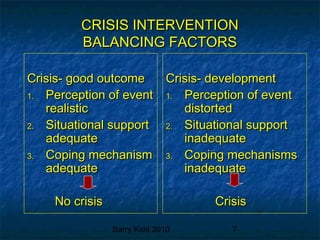
Crisis- good outcomeCrisis- good outcome
1.1. Perception of eventPerception of event
realisticrealistic
2.2. Situational supportSituational support
adequateadequate
3.3. Coping mechanismCoping mechanism
adequateadequate
No crisisNo crisis
Crisis- developmentCrisis- development
1.1. Perception of eventPerception of event
distorteddistorted
2.2. Situational supportSituational support
inadequateinadequate
3.3. Coping mechanismsCoping mechanisms
inadequateinadequate
CrisisCrisis
Barry Kidd 2010 8
PHASES OF CRISISPHASES OF CRISIS
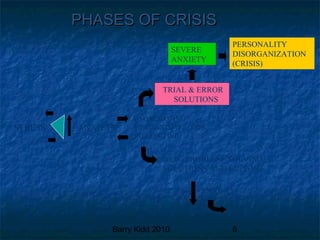
STRESS ANXIETY
USUAL COPING
MECHANISMS
INEFFECTIVE
TRIAL & ERROR
SOLUTIONS
SEVERE
ANXIETY
PERSONALITY
DISORGANIZATION
(CRISIS)
OR
NEW PROBLEM- SOLVING
SOLUTIONS AND SUPPORT
ANXIETY
PRE-CRISIS LEVEL
OF FUNCTIONING
Barry Kidd 2010 9
CRISIS INTERVENTIONCRISIS INTERVENTION
ASSESSMENTASSESSMENT
a.a. Perception of event: What happened that promptedPerception of event: What happened that prompted
you to seek help?; How are you feeling now?; etc.you to seek help?; How are you feeling now?; etc.
b.b. Coping mechanisms: Suicidal?; Plans?; What helpsCoping mechanisms: Suicidal?; Plans?; What helps
you feel better?; etc.you feel better?; etc.
c.c. Support systems: With whom do you live with?;Support systems: With whom do you live with?;
Who is available to help you?; Who is mostWho is available to help you?; Who is most
helpful?; etchelpful?; etc
d.d. Mental status, previous historyMental status, previous history
e.e. Identify client’s strengthsIdentify client’s strengths
f.f. Self-assessment: EMR’s feelingsSelf-assessment: EMR’s feelings
Barry Kidd 2010 10
CRISIS INTERVENTIONCRISIS INTERVENTION
EMR Diagnosis:EMR Diagnosis:
1.1. Risk self directed violenceRisk self directed violence
2.2. Chronic low self esteemChronic low self esteem
3.3. HopelessnessHopelessness
4.4. PowerlessnessPowerlessness
5.5. Severe/Panic levels of anxietySevere/Panic levels of anxiety
6.6. Disturbed thought processDisturbed thought process
7.7. Sleep deprivationSleep deprivation
Barry Kidd 2010 11
CRISIS INTERVENTIONCRISIS INTERVENTION
Planning and outcome identificationPlanning and outcome identification
1.1. Assist the patient in setting realistic goals toAssist the patient in setting realistic goals to
return to the pre-crisis level of functioningreturn to the pre-crisis level of functioning
2.2. Establish desired outcome criteria for theEstablish desired outcome criteria for the
patient using the problem solving approach.patient using the problem solving approach.
Barry Kidd 2010 12
CRISIS INTERVENTIONCRISIS INTERVENTION
ImplementationImplementation
1.1. Assess for any suicidal/ homicidal thoughts or plans.Assess for any suicidal/ homicidal thoughts or plans.
2.2. Take initial steps to make the patient feel safe andTake initial steps to make the patient feel safe and
lower anxiety.lower anxiety.
3.3. Safety- intervene to prevent violence- suicide/ angry,Safety- intervene to prevent violence- suicide/ angry,
aggressive patient.aggressive patient.
4.4. Listen attentively and encourage the patient to discussListen attentively and encourage the patient to discuss
the crisis situation. Facilitate the verbalization ofthe crisis situation. Facilitate the verbalization of
thoughts and feelings.thoughts and feelings.
5.5. Creative and directive approach needed. Initially theCreative and directive approach needed. Initially the
EMR/or other health care persons may make phoneEMR/or other health care persons may make phone
calls (arrange baby-sitters, find shelters, contact socialcalls (arrange baby-sitters, find shelters, contact social
workers, etc.)workers, etc.)
Barry Kidd 2010 13
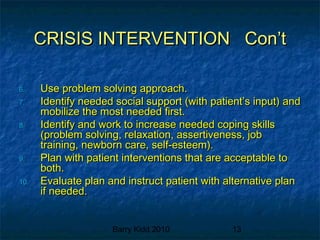
CRISIS INTERVENTION Con’tCRISIS INTERVENTION Con’t
6.6. Use problem solving approach.Use problem solving approach.
7.7. Identify needed social support (with patient’s input) andIdentify needed social support (with patient’s input) and
mobilize the most needed first.mobilize the most needed first.
8.8. Identify and work to increase needed coping skillsIdentify and work to increase needed coping skills
(problem solving, relaxation, assertiveness, job(problem solving, relaxation, assertiveness, job
training, newborn care, self-esteem).training, newborn care, self-esteem).
9.9. Plan with patient interventions that are acceptable toPlan with patient interventions that are acceptable to
both.both.
10.10. Evaluate plan and instruct patient with alternative planEvaluate plan and instruct patient with alternative plan
if needed.if needed.
Barry Kidd 2010 14
QUESTIONSQUESTIONS
Barry Kidd 2010 15

Crisis intervention ppt

  • 1.
    Barry Kidd 20101 CRISISCRISIS INTERVENTIONINTERVENTION
  • 2.
    Barry Kidd 20102 DEFINITION A crisis is an overwhelming reaction to a threatening situation in which a person’s usual problem solving strategies fail to resolve the situation resulting in a state of disequilibrium.
  • 3.
    Barry Kidd 20103 TYPES OF CRISISTYPES OF CRISIS  Developmental (Maturational) Crisis-Developmental (Maturational) Crisis- predicted times of stress in everyone’s lifepredicted times of stress in everyone’s life which occurs in response to a transitionwhich occurs in response to a transition from one stage to another in the life cycle.from one stage to another in the life cycle.
  • 4.
    Barry Kidd 20104 TYPES OF CRISISTYPES OF CRISIS (Continuation(Continuation))  Situational Crisis- occurs in response to aSituational Crisis- occurs in response to a sudden unexpected event in a person’ssudden unexpected event in a person’s life. The critical life events revolve aroundlife. The critical life events revolve around experiences of grief and loss. Forexperiences of grief and loss. For example loss of a job, divorce, abortion,example loss of a job, divorce, abortion, death of a love one, severe physical ordeath of a love one, severe physical or mental illness, etc.mental illness, etc.
  • 5.
    Barry Kidd 20105 TYPES OF CRISISTYPES OF CRISIS (Continuation)(Continuation)  Adventitious Crisis- are not part ofAdventitious Crisis- are not part of everyday life. They are unplanned andeveryday life. They are unplanned and accidental resulting in traumaticaccidental resulting in traumatic experiences. Such as…experiences. Such as…  Natural disasters.. hurricanes, flood, fire,Natural disasters.. hurricanes, flood, fire, earthquake, etc…earthquake, etc…  National disasters.. war, riots, etc…National disasters.. war, riots, etc…  Crime of violence.. Child abuse, rape,Crime of violence.. Child abuse, rape, assault, bombing in crowded areas, etc…assault, bombing in crowded areas, etc…
  • 6.
    Barry Kidd 20106 CRISIS INTERVENTIONCRISIS INTERVENTION GENERAL OVERVIEWGENERAL OVERVIEW Crisis….Crisis….  Occurs in everyoneOccurs in everyone  Not necessarily pathological, mayNot necessarily pathological, may encourage growth and changeencourage growth and change  Time limited to a brief period, 4-6 weeksTime limited to a brief period, 4-6 weeks except deathexcept death  A person’s perception determines theA person’s perception determines the crisiscrisis
  • 7.
    Barry Kidd 20107 CRISIS INTERVENTIONCRISIS INTERVENTION BALANCING FACTORSBALANCING FACTORS Crisis- good outcomeCrisis- good outcome 1.1. Perception of eventPerception of event realisticrealistic 2.2. Situational supportSituational support adequateadequate 3.3. Coping mechanismCoping mechanism adequateadequate No crisisNo crisis Crisis- developmentCrisis- development 1.1. Perception of eventPerception of event distorteddistorted 2.2. Situational supportSituational support inadequateinadequate 3.3. Coping mechanismsCoping mechanisms inadequateinadequate CrisisCrisis
  • 8.
    Barry Kidd 20108 PHASES OF CRISISPHASES OF CRISIS STRESS ANXIETY USUAL COPING MECHANISMS INEFFECTIVE TRIAL & ERROR SOLUTIONS SEVERE ANXIETY PERSONALITY DISORGANIZATION (CRISIS) OR NEW PROBLEM- SOLVING SOLUTIONS AND SUPPORT ANXIETY PRE-CRISIS LEVEL OF FUNCTIONING
  • 9.
    Barry Kidd 20109 CRISIS INTERVENTIONCRISIS INTERVENTION ASSESSMENTASSESSMENT a.a. Perception of event: What happened that promptedPerception of event: What happened that prompted you to seek help?; How are you feeling now?; etc.you to seek help?; How are you feeling now?; etc. b.b. Coping mechanisms: Suicidal?; Plans?; What helpsCoping mechanisms: Suicidal?; Plans?; What helps you feel better?; etc.you feel better?; etc. c.c. Support systems: With whom do you live with?;Support systems: With whom do you live with?; Who is available to help you?; Who is mostWho is available to help you?; Who is most helpful?; etchelpful?; etc d.d. Mental status, previous historyMental status, previous history e.e. Identify client’s strengthsIdentify client’s strengths f.f. Self-assessment: EMR’s feelingsSelf-assessment: EMR’s feelings
  • 10.
    Barry Kidd 201010 CRISIS INTERVENTIONCRISIS INTERVENTION EMR Diagnosis:EMR Diagnosis: 1.1. Risk self directed violenceRisk self directed violence 2.2. Chronic low self esteemChronic low self esteem 3.3. HopelessnessHopelessness 4.4. PowerlessnessPowerlessness 5.5. Severe/Panic levels of anxietySevere/Panic levels of anxiety 6.6. Disturbed thought processDisturbed thought process 7.7. Sleep deprivationSleep deprivation
  • 11.
    Barry Kidd 201011 CRISIS INTERVENTIONCRISIS INTERVENTION Planning and outcome identificationPlanning and outcome identification 1.1. Assist the patient in setting realistic goals toAssist the patient in setting realistic goals to return to the pre-crisis level of functioningreturn to the pre-crisis level of functioning 2.2. Establish desired outcome criteria for theEstablish desired outcome criteria for the patient using the problem solving approach.patient using the problem solving approach.
  • 12.
    Barry Kidd 201012 CRISIS INTERVENTIONCRISIS INTERVENTION ImplementationImplementation 1.1. Assess for any suicidal/ homicidal thoughts or plans.Assess for any suicidal/ homicidal thoughts or plans. 2.2. Take initial steps to make the patient feel safe andTake initial steps to make the patient feel safe and lower anxiety.lower anxiety. 3.3. Safety- intervene to prevent violence- suicide/ angry,Safety- intervene to prevent violence- suicide/ angry, aggressive patient.aggressive patient. 4.4. Listen attentively and encourage the patient to discussListen attentively and encourage the patient to discuss the crisis situation. Facilitate the verbalization ofthe crisis situation. Facilitate the verbalization of thoughts and feelings.thoughts and feelings. 5.5. Creative and directive approach needed. Initially theCreative and directive approach needed. Initially the EMR/or other health care persons may make phoneEMR/or other health care persons may make phone calls (arrange baby-sitters, find shelters, contact socialcalls (arrange baby-sitters, find shelters, contact social workers, etc.)workers, etc.)
  • 13.
    Barry Kidd 201013 CRISIS INTERVENTION Con’tCRISIS INTERVENTION Con’t 6.6. Use problem solving approach.Use problem solving approach. 7.7. Identify needed social support (with patient’s input) andIdentify needed social support (with patient’s input) and mobilize the most needed first.mobilize the most needed first. 8.8. Identify and work to increase needed coping skillsIdentify and work to increase needed coping skills (problem solving, relaxation, assertiveness, job(problem solving, relaxation, assertiveness, job training, newborn care, self-esteem).training, newborn care, self-esteem). 9.9. Plan with patient interventions that are acceptable toPlan with patient interventions that are acceptable to both.both. 10.10. Evaluate plan and instruct patient with alternative planEvaluate plan and instruct patient with alternative plan if needed.if needed.
  • 14.
    Barry Kidd 201014 QUESTIONSQUESTIONS
  • 15.