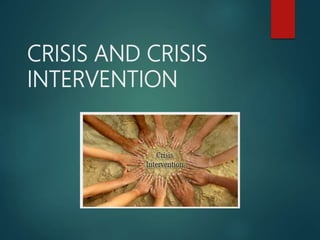



CRISIS AND CRISIS
INTERVENTION
Introduction
Stressful situations are a part of
everyday life. Any stressful situation can
precipitate a crisis. Crises result in a
disequilibrium from which many
individuals require assistance to recover.
Crisis
A sudden event in one’s life that
disturbs homeostasis, during which usual
coping mechanisms cannot resolve the
problem.
Characteristics of crisis
1. Crisis occurs in all individuals at one time or another
and is not necessarily equated with psychopathology.
2. Crises are precipitated by specific identifiable events.
3. Crises are personal by nature. What may be considered
a crisis situation by one individual may not be so for another.
4. Crises are acute, not chronic, and will be resolved in one way or
another within a brief period.
5. A crisis situation contains the potential for psychological
growth or deterioration.
PHASES IN THE
DEVELOPMENT
OF A CRISIS
The development of a crisis situation follows a
relatively predictable course. Caplan (1964) outlined four
specific phases through which individuals progress in
response to a precipitating stressor and that culminate in
the state of acute crisis.
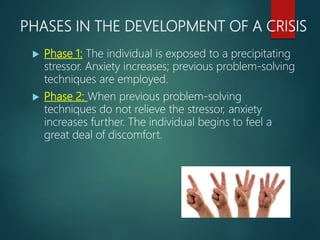
PHASES IN THE DEVELOPMENT OF A CRISIS
 Phase 1: The individual is exposed to a precipitating
stressor. Anxiety increases; previous problem-solving
techniques are employed.
 Phase 2: When previous problem-solving
techniques do not relieve the stressor, anxiety
increases further. The individual begins to feel a
great deal of discomfort.
 Phase 3: All possible resources, both internal and
external, are called on to resolve the problem and
relieve the discomfort.
 Phase 4: If resolution does not occur in previous
phases, “the tension mounts beyond threshold or its
burden increases over time to a breaking point. Major
disorganization of the individual with drastic results
occurs.”
Types of Crises
 Baldwin (1978) identified six classes of emotional crises,
which progress by degree of severity.
Class 1: Dispositional Crises
 Definition An acute response to an external situational
stressor.
 For example: dispositional crisis occurs when a house
is under fire, or when a partner have an abusive
relationship with another partner.
Class 2: Crisis of Anticipated Life Transitions
 Definition: Normal life-cycle transitions that may
be anticipated but over which the individual
feel a lack of control.
 These are normative, developmental crises that
are fairly common in our society. They may
result from midlife career changes, getting
married, becoming a parent, divorce, the onset
of chronic or terminal illness, or changing
schools.
Class 3: Crises Resulting From Traumatic Stress
 Definition: These crises result from externally imposed
stress situations that are unexpected, uncontrolled, and
emotionally overwhelming.
 Examples are rape, assault, sudden death of a loved
one, sudden loss of job status, sudden onset of illness,
accident, war.
Class 4: Maturational/Developmental Crises
 Definition Crises that occur in response to situations
that trigger emotions related to unresolved conflicts in
one’s life.
 These crises are of internal origin and reflect underlying
developmental issues that involve dependency, value
conflicts, sexual identity, control, and capacity for
emotional intimacy.
 Examples are the repeated loss of jobs because of an
inability to get along with supervisors, the intense
homesickness or depression of college students away
from home for the first time, and midlife crises.
Class 5: Crises Reflecting Psychopathology
Definition Emotional crises in which preexisting
psychopathology has been instrumental in precipitating
crisis or in which psychopathology significantly impairs or
complicates adaptive resolution.
Examples of psychopathology that may precipitate
crises include personality disorders, anxiety disorders,
bipolar disorder, and schizophrenia.
Class 6: Psychiatric Emergencies
Definition: Crisis situations in which general functioning
has been severely impaired and the individual rendered
incompetent or unable to assume personal responsibility.
Examples include acutely suicidal individuals, drug
overdoses, reactions to hallucinogenic drugs, acute
psychosis, uncontrollable anger, and
alcohol intoxication.
Signs and symptoms of crisis
 Heavy burden of free floating anxiety
 Depression
 Anger, guilt
 Use various coping mechanisms, healthy or unhealthy.
 Incapable of taking care of daily needs
 Neglect responsibilities.
 Irrational and blame others for what was happened to him.
Resolution of crisis
Healthy resolution of crisis depends upon the following
three factors:
1. Realistic appraisal of the precipitating event
2. Availability of support systems
3. Availability of coping measures over a lifetime
There are three ways by which the individual may
resolve the crisis.
*Pseudo- resolution
* Unsuccessful resolution
* Successful resolution
Pseudo resolution
In this the client uses repression and pushes out of
consciousness the incident and the intense emotions
associated with it, resulting in the individual functioning at
the same earlier level.
 But in future any crisis may be more difficult to resolve
because the feelings associated with the earlier crisis
are neither expressed nor handled at that time.
Unsuccessful resolution
The victim uses pathological adaptation at
any phase of crisis, resulting in a lower level
of functioning.
 An example is prolonged grief reaction,
which results in depression.
Successful resolution
The victim may go through the various phases of crisis,
various coping measures are utilized to resolve the crisis
situation.
 The victim develops better skills and problem solving
ability, which can be used in various crisis situations in
future.
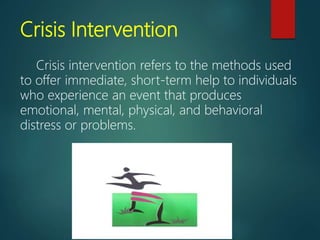
Crisis Intervention
Crisis intervention refers to the methods used
to offer immediate, short-term help to individuals
who experience an event that produces
emotional, mental, physical, and behavioral
distress or problems.
Goal of Crisis intervention
The goal of crisis intervention is the resolution of
an immediate crisis.
Its focus is on the supportive, with the restoration
of the individual to his pre-crisis level of functioning or
possibly to a higher level of functioning.
The therapist’s role is direct, supportive,
and that of an active participant.
Principles of crisis intervention
 Be specific
 Encourage the expression of feelings
 Allow sufficient time for the individuals to process
information and ask questions.
 Assist the person in confronting reality.
 Encourage the person to focus on one implication at
a time.
Techniques of crisis intervention
 Catharsis: the process of releasing, and thereby
providing relief from, strong or repressed emotions.
 Clarification: the action of making a statement or
situation less confused and more comprehensible.
 Manipulation: the action of improving the skills of a
person
 Support of defenses
 Reinforcement of behaviors
 Increasing self –esteem
 Exploring solutions
Three major components of Crisis
intervention:
A stressful event alone does not constitute a crisis;
rather, crisis is determined by the individual’s view of the
event and response to it. (Smead, 1988).
 The actual crisis – victim’s perception of an
unmanageable situation,
 The individual in crisis, and
 The helper who provides aid.
PHASES OF CRISIS INTERVENTION:
THE ROLE OF THE NURSE
Phase 1. Assessment
In this phase, the crisis helper gathers
information regarding
the precipitating stressor and
the resulting crisis that prompted the
individual to seek professional help.
Some nursing diagnoses that may be relevant
include:
● Ineffective coping
● Anxiety (severe to panic)
● Disturbed thought processes
● Risk for self- or other-directed violence
● Rape-trauma syndrome
● Post-trauma syndrome
● Fear
Phase 2. Planning of Therapeutic
Intervention
In the planning phase of crisis intervention, the nurse
selects the appropriate nursing actions for the identified
nursing diagnoses. In planning the interventions, the type
of crisis, as well as the individual’s strengths and available
resources for support, are taken into consideration.
Goals are established for crisis resolution and a return
to, or increase in, the pre-crisis level of functioning.
Phase 2. Planning of Therapeutic
Intervention
Objectives:
1. The client experiences minimal or no injury to self.
2. Demonstrates behaviors necessary to protect self from
further injury.
3. Maintains anxiety at manageable level
4. Expresses beliefs and values about spiritual issues.
5. Demonstrates ability to deal with emotional reactions in
an individually appropriate manner.
Phase 3. Intervention
During phase 3, the actions that were identified in phase 2
are implemented. The following interventions are the focus
of nursing in crisis intervention:
 Use a reality –oriented approach
 Remain with the individual who is experiencing panic
anxiety.
 Establish a rapid working relationship by showing
unconditional acceptance, by active listening, and by
attending to immediate needs.
 Discourage lengthy explanations,
 promote an atmosphere for verbalization of true
feelings.
 Set limits on aggressive, destructive behaviors.
 Assess for any suicidal/ homicidal thoughts or plans.
 Determine degree of anxiety
 Determine presence of physical symptoms
 Identify psychological responses
 Engage client in learning new coping behaviors-
progressive muscle relaxation, thought-shopping.
 Encourage use of techniques to manage stress.
 Give positive feedback when client demonstrates better
ways to manage anxiety .
Phase 4: Evaluation of crisis resolution and
anticipatory planning.
 During this period the nurse and client
summarize what has occurred during the
intervention.
 A determination is made regarding follow –up
therapy; if needed, the nurse provides referral
information
MODALITIES OF CRISIS INTERVENTION
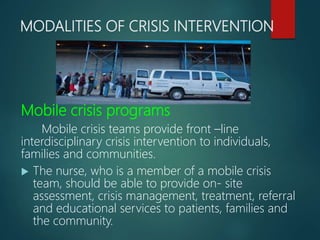
Mobile crisis programs
Mobile crisis teams provide front –line
interdisciplinary crisis intervention to individuals,
families and communities.
 The nurse, who is a member of a mobile crisis
team, should be able to provide on- site
assessment, crisis management, treatment, referral
and educational services to patients, families and
the community.
Telephone contacts
 Crisis intervention is sometimes
practiced by telephone rather
than through face-to face
contacts.
 The nurse should have effective
listening skills to provide crisis
intervention to victims.
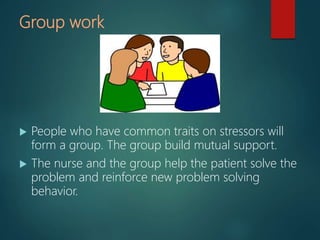
Group work
 People who have common traits on stressors will
form a group. The group build mutual support.
 The nurse and the group help the patient solve the
problem and reinforce new problem solving
behavior.
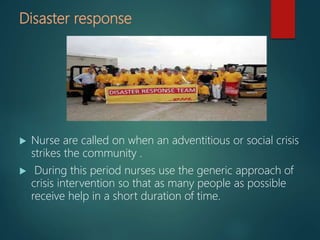
Disaster response
 Nurse are called on when an adventitious or social crisis
strikes the community .
 During this period nurses use the generic approach of
crisis intervention so that as many people as possible
receive help in a short duration of time.
Victim outreach program
 Uses crisis intervention techniques to identify the
needs of the victims and then to connect them with
appropriate referrals and other resources.
Crisis intervention centers
 It provide emergency psychiatric care
and counseling to victims, experiencing
extreme stress or conflict , often involving
suicide attempts or drug or alcohol abuse.
These centers provide services 24 hours a
day .
Health Education
 Nurses identify the people are at risk
for developing crisis and in teaching
coping strategies to avoid the
development of crisis.
Crisis intervention

Crisis intervention

  • 1.
  • 2.
    Introduction Stressful situations area part of everyday life. Any stressful situation can precipitate a crisis. Crises result in a disequilibrium from which many individuals require assistance to recover.
  • 3.
    Crisis A sudden eventin one’s life that disturbs homeostasis, during which usual coping mechanisms cannot resolve the problem.
  • 4.
    Characteristics of crisis 1.Crisis occurs in all individuals at one time or another and is not necessarily equated with psychopathology. 2. Crises are precipitated by specific identifiable events. 3. Crises are personal by nature. What may be considered a crisis situation by one individual may not be so for another. 4. Crises are acute, not chronic, and will be resolved in one way or another within a brief period. 5. A crisis situation contains the potential for psychological growth or deterioration.
  • 5.
    PHASES IN THE DEVELOPMENT OFA CRISIS The development of a crisis situation follows a relatively predictable course. Caplan (1964) outlined four specific phases through which individuals progress in response to a precipitating stressor and that culminate in the state of acute crisis.
  • 6.
    PHASES IN THEDEVELOPMENT OF A CRISIS  Phase 1: The individual is exposed to a precipitating stressor. Anxiety increases; previous problem-solving techniques are employed.  Phase 2: When previous problem-solving techniques do not relieve the stressor, anxiety increases further. The individual begins to feel a great deal of discomfort.
  • 7.
     Phase 3:All possible resources, both internal and external, are called on to resolve the problem and relieve the discomfort.  Phase 4: If resolution does not occur in previous phases, “the tension mounts beyond threshold or its burden increases over time to a breaking point. Major disorganization of the individual with drastic results occurs.”
  • 8.
    Types of Crises Baldwin (1978) identified six classes of emotional crises, which progress by degree of severity. Class 1: Dispositional Crises  Definition An acute response to an external situational stressor.  For example: dispositional crisis occurs when a house is under fire, or when a partner have an abusive relationship with another partner.
  • 9.
    Class 2: Crisisof Anticipated Life Transitions  Definition: Normal life-cycle transitions that may be anticipated but over which the individual feel a lack of control.  These are normative, developmental crises that are fairly common in our society. They may result from midlife career changes, getting married, becoming a parent, divorce, the onset of chronic or terminal illness, or changing schools.
  • 10.
    Class 3: CrisesResulting From Traumatic Stress  Definition: These crises result from externally imposed stress situations that are unexpected, uncontrolled, and emotionally overwhelming.  Examples are rape, assault, sudden death of a loved one, sudden loss of job status, sudden onset of illness, accident, war.
  • 11.
    Class 4: Maturational/DevelopmentalCrises  Definition Crises that occur in response to situations that trigger emotions related to unresolved conflicts in one’s life.  These crises are of internal origin and reflect underlying developmental issues that involve dependency, value conflicts, sexual identity, control, and capacity for emotional intimacy.  Examples are the repeated loss of jobs because of an inability to get along with supervisors, the intense homesickness or depression of college students away from home for the first time, and midlife crises.
  • 12.
    Class 5: CrisesReflecting Psychopathology Definition Emotional crises in which preexisting psychopathology has been instrumental in precipitating crisis or in which psychopathology significantly impairs or complicates adaptive resolution. Examples of psychopathology that may precipitate crises include personality disorders, anxiety disorders, bipolar disorder, and schizophrenia.
  • 13.
    Class 6: PsychiatricEmergencies Definition: Crisis situations in which general functioning has been severely impaired and the individual rendered incompetent or unable to assume personal responsibility. Examples include acutely suicidal individuals, drug overdoses, reactions to hallucinogenic drugs, acute psychosis, uncontrollable anger, and alcohol intoxication.
  • 14.
    Signs and symptomsof crisis  Heavy burden of free floating anxiety  Depression  Anger, guilt  Use various coping mechanisms, healthy or unhealthy.  Incapable of taking care of daily needs  Neglect responsibilities.  Irrational and blame others for what was happened to him.
  • 15.
    Resolution of crisis Healthyresolution of crisis depends upon the following three factors: 1. Realistic appraisal of the precipitating event 2. Availability of support systems 3. Availability of coping measures over a lifetime
  • 16.
    There are threeways by which the individual may resolve the crisis. *Pseudo- resolution * Unsuccessful resolution * Successful resolution
  • 17.
    Pseudo resolution In thisthe client uses repression and pushes out of consciousness the incident and the intense emotions associated with it, resulting in the individual functioning at the same earlier level.  But in future any crisis may be more difficult to resolve because the feelings associated with the earlier crisis are neither expressed nor handled at that time.
  • 18.
    Unsuccessful resolution The victimuses pathological adaptation at any phase of crisis, resulting in a lower level of functioning.  An example is prolonged grief reaction, which results in depression.
  • 19.
    Successful resolution The victimmay go through the various phases of crisis, various coping measures are utilized to resolve the crisis situation.  The victim develops better skills and problem solving ability, which can be used in various crisis situations in future.
  • 20.
    Crisis Intervention Crisis interventionrefers to the methods used to offer immediate, short-term help to individuals who experience an event that produces emotional, mental, physical, and behavioral distress or problems.
  • 21.
    Goal of Crisisintervention The goal of crisis intervention is the resolution of an immediate crisis. Its focus is on the supportive, with the restoration of the individual to his pre-crisis level of functioning or possibly to a higher level of functioning. The therapist’s role is direct, supportive, and that of an active participant.
  • 22.
    Principles of crisisintervention  Be specific  Encourage the expression of feelings  Allow sufficient time for the individuals to process information and ask questions.  Assist the person in confronting reality.  Encourage the person to focus on one implication at a time.
  • 23.
    Techniques of crisisintervention  Catharsis: the process of releasing, and thereby providing relief from, strong or repressed emotions.  Clarification: the action of making a statement or situation less confused and more comprehensible.  Manipulation: the action of improving the skills of a person  Support of defenses  Reinforcement of behaviors  Increasing self –esteem  Exploring solutions
  • 24.
    Three major componentsof Crisis intervention: A stressful event alone does not constitute a crisis; rather, crisis is determined by the individual’s view of the event and response to it. (Smead, 1988).  The actual crisis – victim’s perception of an unmanageable situation,  The individual in crisis, and  The helper who provides aid.
  • 25.
    PHASES OF CRISISINTERVENTION: THE ROLE OF THE NURSE Phase 1. Assessment In this phase, the crisis helper gathers information regarding the precipitating stressor and the resulting crisis that prompted the individual to seek professional help.
  • 26.
    Some nursing diagnosesthat may be relevant include: ● Ineffective coping ● Anxiety (severe to panic) ● Disturbed thought processes ● Risk for self- or other-directed violence ● Rape-trauma syndrome ● Post-trauma syndrome ● Fear
  • 27.
    Phase 2. Planningof Therapeutic Intervention In the planning phase of crisis intervention, the nurse selects the appropriate nursing actions for the identified nursing diagnoses. In planning the interventions, the type of crisis, as well as the individual’s strengths and available resources for support, are taken into consideration. Goals are established for crisis resolution and a return to, or increase in, the pre-crisis level of functioning.
  • 28.
    Phase 2. Planningof Therapeutic Intervention Objectives: 1. The client experiences minimal or no injury to self. 2. Demonstrates behaviors necessary to protect self from further injury. 3. Maintains anxiety at manageable level 4. Expresses beliefs and values about spiritual issues. 5. Demonstrates ability to deal with emotional reactions in an individually appropriate manner.
  • 29.
    Phase 3. Intervention Duringphase 3, the actions that were identified in phase 2 are implemented. The following interventions are the focus of nursing in crisis intervention:  Use a reality –oriented approach  Remain with the individual who is experiencing panic anxiety.  Establish a rapid working relationship by showing unconditional acceptance, by active listening, and by attending to immediate needs.  Discourage lengthy explanations,  promote an atmosphere for verbalization of true feelings.
  • 30.
     Set limitson aggressive, destructive behaviors.  Assess for any suicidal/ homicidal thoughts or plans.  Determine degree of anxiety  Determine presence of physical symptoms  Identify psychological responses  Engage client in learning new coping behaviors- progressive muscle relaxation, thought-shopping.  Encourage use of techniques to manage stress.  Give positive feedback when client demonstrates better ways to manage anxiety .
  • 31.
    Phase 4: Evaluationof crisis resolution and anticipatory planning.  During this period the nurse and client summarize what has occurred during the intervention.  A determination is made regarding follow –up therapy; if needed, the nurse provides referral information
  • 32.
    MODALITIES OF CRISISINTERVENTION Mobile crisis programs Mobile crisis teams provide front –line interdisciplinary crisis intervention to individuals, families and communities.  The nurse, who is a member of a mobile crisis team, should be able to provide on- site assessment, crisis management, treatment, referral and educational services to patients, families and the community.
  • 33.
    Telephone contacts  Crisisintervention is sometimes practiced by telephone rather than through face-to face contacts.  The nurse should have effective listening skills to provide crisis intervention to victims.
  • 34.
    Group work  Peoplewho have common traits on stressors will form a group. The group build mutual support.  The nurse and the group help the patient solve the problem and reinforce new problem solving behavior.
  • 35.
    Disaster response  Nurseare called on when an adventitious or social crisis strikes the community .  During this period nurses use the generic approach of crisis intervention so that as many people as possible receive help in a short duration of time.
  • 36.
    Victim outreach program Uses crisis intervention techniques to identify the needs of the victims and then to connect them with appropriate referrals and other resources.
  • 37.
    Crisis intervention centers It provide emergency psychiatric care and counseling to victims, experiencing extreme stress or conflict , often involving suicide attempts or drug or alcohol abuse. These centers provide services 24 hours a day .
  • 38.
    Health Education  Nursesidentify the people are at risk for developing crisis and in teaching coping strategies to avoid the development of crisis.