1
CRISIS
INTERVENTION
C R I T I C A L C A R E U N I T
CONTENTS
Introduction Aims
Definition Robert-Otten’s Model
Characteristics Steps
Risk Factors Principles
Types Levels
Phases Techniques
Aguilera Model Geriatric Considerations
Sign/Symptoms Role of Nurse
Resolution of Crisis Crisis in CCU
Crisis Intervention Modalities
Factors Bibliography
2
INTRODUCTION
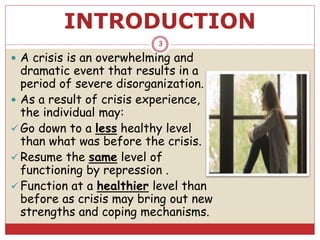
 A crisis is an overwhelming and
dramatic event that results in a
period of severe disorganization.
 As a result of crisis experience,
the individual may:
 Go down to a less healthy level
than what was before the crisis.
 Resume the same level of
functioning by repression .
 Function at a healthier level than
before as crisis may bring out new
strengths and coping mechanisms.
3
●Intervention at a crisis is extremely important to
prevent mental illness.
●If proper guidance is provided at the correct time,
the victim will come out of it and be better equipped
to handle future problems in life.
●Crisis intervention is the technique used to help an
individual or family to understand and cope with the
intense feelings that are typical of a crisis.
●Thus, crisis intervention is the emergency first aid
for mental health.
4
DEFINITION
 Crisis is a state of disequilibrium resulting from
the interaction of an event with the individual’s or
family’s coping mechanisms, which are inadequate
to meet the demands of the situation, combined
with the individual’s or family’s perception of the
meaning of the event.
~ Taylor (1989)
 Crisis Intervention is an immediate and short
term emergency response to mental, emotional,
physical and behavioural distress.
5
CHARACTERISTICS
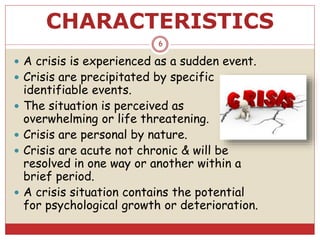
 A crisis is experienced as a sudden event.
 Crisis are precipitated by specific
identifiable events.
 The situation is perceived as
overwhelming or life threatening.
 Crisis are personal by nature.
 Crisis are acute not chronic & will be
resolved in one way or another within a
brief period.
 A crisis situation contains the potential
for psychological growth or deterioration.
6
RISK FACTORS
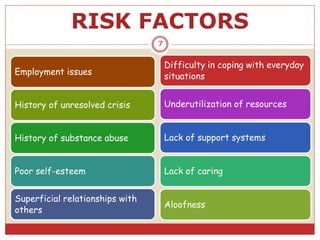
Employment issues
History of unresolved crisis
History of substance abuse
Poor self-esteem
Superficial relationships with
others
Difficulty in coping with everyday
situations
Underutilization of resources
Lack of support systems
Lack of caring
Aloofness
7
TYPES OF CRISIS
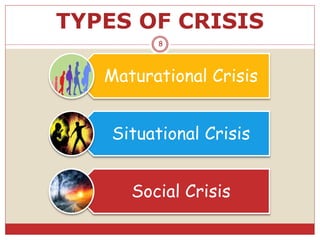
Maturational Crisis
Situational Crisis
Social Crisis
8
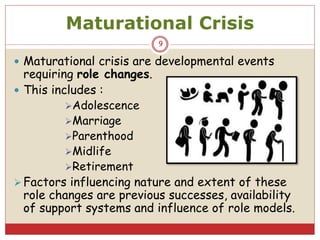
Maturational Crisis
 Maturational crisis are developmental events
requiring role changes.
 This includes :
Adolescence
Marriage
Parenthood
Midlife
Retirement
Factors influencing nature and extent of these
role changes are previous successes, availability
of support systems and influence of role models.
9
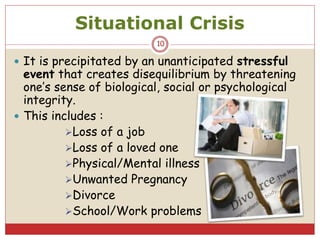
Situational Crisis
 It is precipitated by an unanticipated stressful
event that creates disequilibrium by threatening
one’s sense of biological, social or psychological
integrity.
 This includes :
Loss of a job
Loss of a loved one
Physical/Mental illness
Unwanted Pregnancy
Divorce
School/Work problems
10
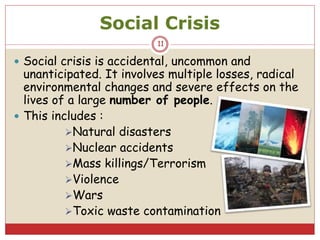
Social Crisis
 Social crisis is accidental, uncommon and
unanticipated. It involves multiple losses, radical
environmental changes and severe effects on the
lives of a large number of people.
 This includes :
Natural disasters
Nuclear accidents
Mass killings/Terrorism
Violence
Wars
Toxic waste contamination
11
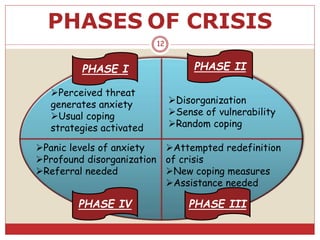
PHASES OF CRISIS
Perceived threat
generates anxiety
Usual coping
strategies activated
Disorganization
Sense of vulnerability
Random coping
Attempted redefinition
of crisis
New coping measures
Assistance needed
Panic levels of anxiety
Profound disorganization
Referral needed
PHASE I PHASE II
PHASE IV PHASE III
12
AGUILERA MODEL
13
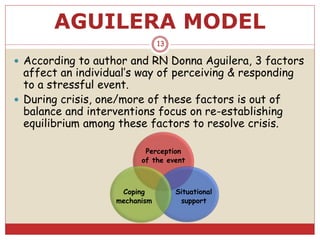
 According to author and RN Donna Aguilera, 3 factors
affect an individual’s way of perceiving & responding
to a stressful event.
 During crisis, one/more of these factors is out of
balance and interventions focus on re-establishing
equilibrium among these factors to resolve crisis.
Perception
of the event
Situational
support
Coping
mechanism
14
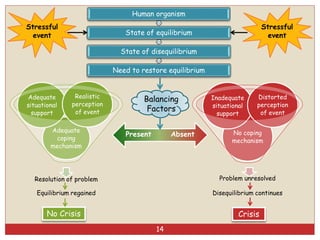
Human organism
State of equilibrium
State of disequilibrium
Need to restore equilibrium
Resolution of problem
Adequate
coping
mechanism
Adequate
situational
support
Realistic
perception
of event
Problem unresolved
No coping
mechanism
Inadequate
situational
support
Distorted
perception
of event
Equilibrium regained Disequilibrium continues
No Crisis Crisis
Stressful
event
Stressful
event
Balancing
Factors
Present Absent
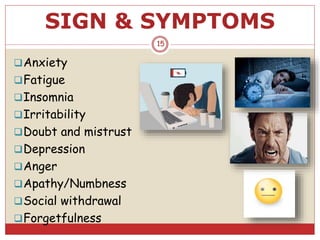
SIGN & SYMPTOMS
Anxiety
Fatigue
Insomnia
Irritability
Doubt and mistrust
Depression
Anger
Apathy/Numbness
Social withdrawal
Forgetfulness
15
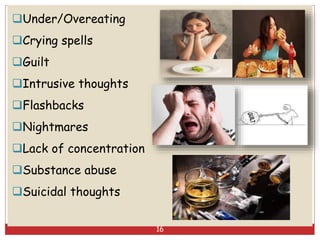
Under/Overeating
Crying spells
Guilt
Intrusive thoughts
Flashbacks
Nightmares
Lack of concentration
Substance abuse
Suicidal thoughts
16
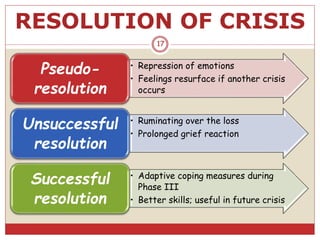
RESOLUTION OF CRISIS
• Repression of emotions
• Feelings resurface if another crisis
occurs
Pseudo-
resolution
• Ruminating over the loss
• Prolonged grief reaction
Unsuccessful
resolution
• Adaptive coping measures during
Phase III
• Better skills; useful in future crisis
Successful
resolution
17
CRISIS INTERVENTION
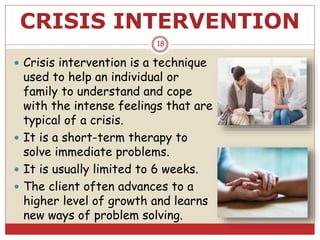
 Crisis intervention is a technique
used to help an individual or
family to understand and cope
with the intense feelings that are
typical of a crisis.
 It is a short-term therapy to
solve immediate problems.
 It is usually limited to 6 weeks.
 The client often advances to a
higher level of growth and learns
new ways of problem solving.
18
FACTORS AFFECTING CRISIS
INTERVENTION
Age
Gender
Individual personality
traits
Family roles
Social relationships
Availability of support
systems
Socioeconomic status
Housing and living
conditions
Religious belief
system
Cultural attitudes
19
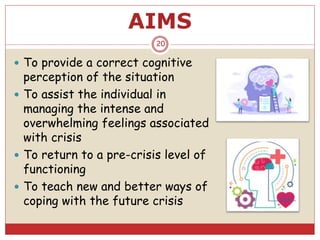
AIMS
 To provide a correct cognitive
perception of the situation
 To assist the individual in
managing the intense and
overwhelming feelings associated
with crisis
 To return to a pre-crisis level of
functioning
 To teach new and better ways of
coping with the future crisis
20
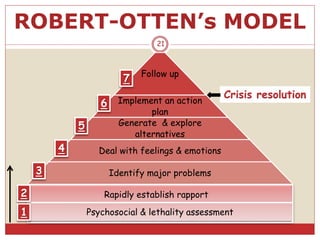
ROBERT-OTTEN’s MODEL
Follow up
Implement an action
plan
Generate & explore
alternatives
Deal with feelings & emotions
Identify major problems
Rapidly establish rapport
Psychosocial & lethality assessment
Crisis resolution
21
1
2
3
4
5
6
7
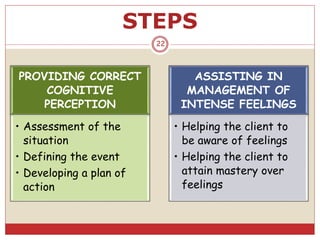
STEPS
PROVIDING CORRECT
COGNITIVE
PERCEPTION
• Assessment of the
situation
• Defining the event
• Developing a plan of
action
ASSISTING IN
MANAGEMENT OF
INTENSE FEELINGS
• Helping the client to
be aware of feelings
• Helping the client to
attain mastery over
feelings
22
 Providing correct cognitive
perception
 ASSESSMENT OF THE SITUATION
Direct questioning with the purpose of
identification of the problem and people involved
Identify the available support systems
Identify strengths and limitations of the victim
 DEFINING THE EVENT
As the victim may be in denial or reluctant to
talk, it may be necessary for the therapist to
review the details of the incident.
23
The therapist helps the victim become aware of
the precipitating event by reviewing the details for
the past 2-4 weeks.
DEVELOPING A PLAN OF ACTION
Active involvement of the victim and the people
closely associated with him.
As the victim may not be in a condition to mentally
comprehend complicated information due to the
overwhelming anxiety experienced by him, the
instructions given by the therapist must be simple
and clear, and too much information should not be
given at a time. The instruction may have to be
written down as victim may not be able to retain
information.
24
 Assistance in managing intense
feelings
 HELPING THE INDIVIDUAL TO BE AWARE OF
THE FEELINGS
The victim needs help in identifying his own feelings.
The therapist should use appropriate communication
technique.
The therapist should be efficient in observing verbal
& non-verbal behaviour of the victim.
 HELPING THE INDIVIDUAL TO ATTAIN
MASTERY OVR THE FEELINGS
Adequate support and guidance without any false
reassurance.
25
The following behaviours should NOT be
encouraged:
 Blaming others to escape from taking any
responsibility.
 Developing too much dependence on the therapist.
 Sudden recovery from feelings/ not showing
emotional reaction at all may indicate repression.
To improve coping with the situation necessary
environmental manipulation must be done in physical
or interpersonal areas.
Follow up appointment within a week to reassess,
revise & modify the plan as needed.
26
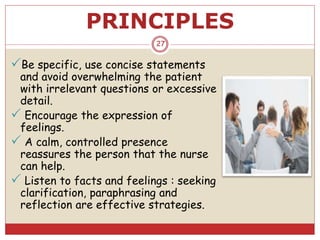
PRINCIPLES
Be specific, use concise statements
and avoid overwhelming the patient
with irrelevant questions or excessive
detail.
 Encourage the expression of
feelings.
 A calm, controlled presence
reassures the person that the nurse
can help.
 Listen to facts and feelings : seeking
clarification, paraphrasing and
reflection are effective strategies.
27
Allow sufficient time for the individuals involved
to process information and ask questions.
Help patient legitimize feelings by letting them
know that others in similar situation have
experienced comparable emotions.
 Clarify distortions by getting persons to look at
the situation realistically, focus on what can be
changed and what cannot.
 Empower person by allowing them to make
informed choices.
 Assist the person in confronting reality.
 Encourage the person to focus on one implication
at a time.
28
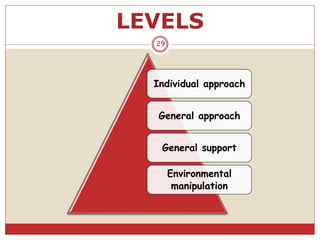
LEVELS
Individual approach
General approach
General support
Environmental
manipulation
29
 Environmental Manipulation
 Interventions that directly change the patient’s
physical or interpersonal situation.
 Provide situational support & remove stress.
 Example : Taking a sick leave, going on a vacation
 General Support
 Nurse provides warmth, acceptance, empathy and
reassurance
 Conveys the feeling that the nurse is on the patient’s
side and will be a helping hand.
• Generic Approach
 Designed to reach high risk individuals and large groups
30
as quickly as possible.
Debriefing method : Disaster victims are helped
to recall events and clarify traumatic experiences
Group support, information on normal reaction.
•Individual Approach
Useful in combined situational and maturational
crisis
Also beneficial when symptoms include homicidal &
suicidal risk
Nurse understands the specific patient’s
characteristics with interventions aimed to
facilitate cognitive and emotional processing of the
traumatic experience.
31
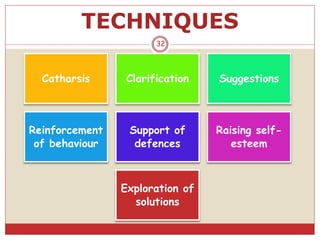
TECHNIQUES
Catharsis Clarification Suggestions
Reinforcement
of behaviour
Support of
defences
Raising self-
esteem
Exploration of
solutions
32
• CATHARSIS :The release of feelings that takes
place as the patient talks about emotionally charged
areas.
Eg. “Tell me how you have been feeling since the
accident.”
●CLARIFICATION : Encouraging the patient to
express more clearly the relationship between
certain events.
Eg. “I have noticed that after the calamity, you have
been avoiding places near water.”
●SUGGESTION : Influencing a person to accept an
idea or belief, particularly the belief that the nurse
can help and the person will feel better in time.
33
Eg. “Many people have found it helpful to talk about
this and I think you will too.”
●REINFORCEMENT OF BEHAVIOUR : Giving
positive responses to adaptive behaviour.
Eg. “That is the first time you expressed your
feelings regarding the incident. I appreciate that.”
SUPPORT OF DEFENCES : Encouraging the use of
healthy/adaptive defences and discouraging those
that are unhealthy/maladaptive.
Eg. “Going for exercise when you were so angry was
helpful because when you returned, you were able to
34
talk things through with your family.”
●RAISING SELF-ESTEEM :Giving the patient
positive reinforcement to adaptive behaviour
Eg. “You are a very strong person to be able to
manage the family all this time. I think you will be
able to handle this situation too.”
EXPLORATION OF SOLUTIONS: Examining
alternative ways of solving the immediate problem.
Eg. “An occupational rehabilitation program can help
you in regaining functional capacity.”
35
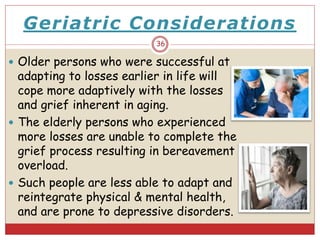
Geriatric Considerations
 Older persons who were successful at
adapting to losses earlier in life will
cope more adaptively with the losses
and grief inherent in aging.
 The elderly persons who experienced
more losses are unable to complete the
grief process resulting in bereavement
overload.
 Such people are less able to adapt and
reintegrate physical & mental health,
and are prone to depressive disorders.
36
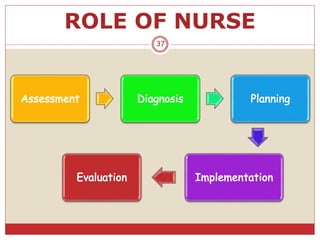
ROLE OF NURSE
37
Assessment
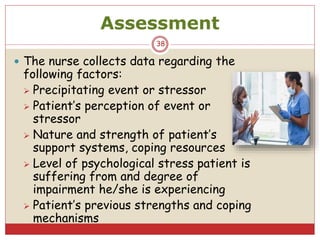
 The nurse collects data regarding the
following factors:
 Precipitating event or stressor
 Patient’s perception of event or
stressor
 Nature and strength of patient’s
support systems, coping resources
 Level of psychological stress patient is
suffering from and degree of
impairment he/she is experiencing
 Patient’s previous strengths and coping
mechanisms
38
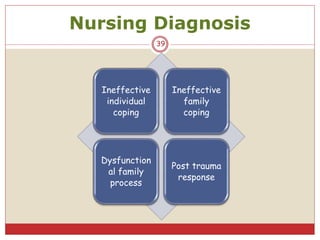
Nursing Diagnosis
Ineffective
individual
coping
Ineffective
family
coping
Dysfunction
al family
process
Post trauma
response
39
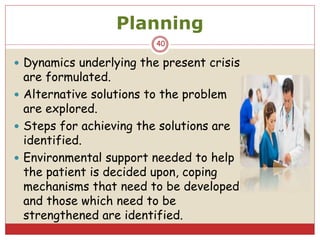
Planning
 Dynamics underlying the present crisis
are formulated.
 Alternative solutions to the problem
are explored.
 Steps for achieving the solutions are
identified.
 Environmental support needed to help
the patient is decided upon, coping
mechanisms that need to be developed
and those which need to be
strengthened are identified.
40
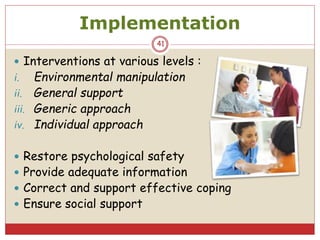
Implementation
 Interventions at various levels :
i. Environmental manipulation
ii. General support
iii. Generic approach
iv. Individual approach
 Restore psychological safety
 Provide adequate information
 Correct and support effective coping
 Ensure social support
41
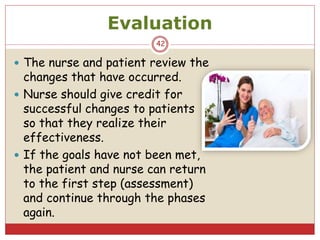
Evaluation
 The nurse and patient review the
changes that have occurred.
 Nurse should give credit for
successful changes to patients
so that they realize their
effectiveness.
 If the goals have not been met,
the patient and nurse can return
to the first step (assessment)
and continue through the phases
again.
42
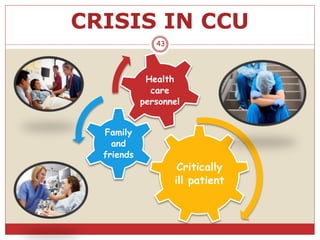
CRISIS IN CCU
Critically
ill patient
Family
and
friends
Health
care
personnel
43
Critically ill patient
44
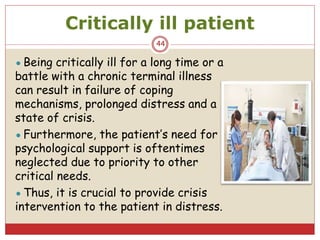
●Being critically ill for a long time or a
battle with a chronic terminal illness
can result in failure of coping
mechanisms, prolonged distress and a
state of crisis.
●Furthermore, the patient’s need for
psychological support is oftentimes
neglected due to priority to other
critical needs.
●Thus, it is crucial to provide crisis
intervention to the patient in distress.
Family
45
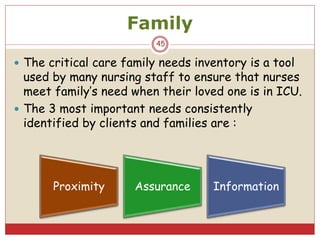
 The critical care family needs inventory is a tool
used by many nursing staff to ensure that nurses
meet family’s need when their loved one is in ICU.
 The 3 most important needs consistently
identified by clients and families are :
Proximity Assurance Information
46
•TOP 9 PRIORITIES FOR FAMILIES IN
CRITICAL SETTINGS :
To be assured that the best care is being given to
their family member by health personnel/team.
To feel that there is a hope.
To know the prognosis and outcome.
To understand the mode of treatment.
47
To be assured that it is alright to leave for a while.
To feel accepted by hospital staff.
To feel someone is concerned with family’s health.
To feel hospital staff care about the patient.
To give time to time information in terms that can
be understood by the family.
Personnel
48
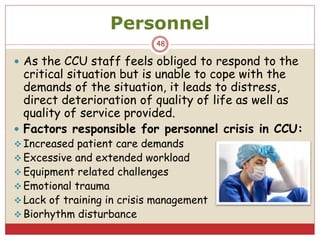
 As the CCU staff feels obliged to respond to the
critical situation but is unable to cope with the
demands of the situation, it leads to distress,
direct deterioration of quality of life as well as
quality of service provided.
 Factors responsible for personnel crisis in CCU:
 Increased patient care demands
 Excessive and extended workload
 Equipment related challenges
 Emotional trauma
 Lack of training in crisis management
 Biorhythm disturbance
49
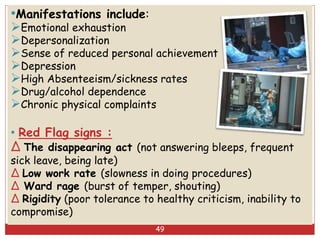
•Manifestations include:
Emotional exhaustion
Depersonalization
Sense of reduced personal achievement
Depression
High Absenteeism/sickness rates
Drug/alcohol dependence
Chronic physical complaints
• Red Flag signs :
∆ The disappearing act (not answering bleeps, frequent
sick leave, being late)
∆ Low work rate (slowness in doing procedures)
∆ Ward rage (burst of temper, shouting)
∆ Rigidity (poor tolerance to healthy criticism, inability to
compromise)
50
∆ Bypass syndrome (colleagues tend to avoid the
affected staff)
∆ Career problems (uncertainty about career choice)
 Management:
Meeting regular needs on a daily basis (regular eating,
drinking and sleep schedule)
Taking designated breaks and relaxation techniques
(music, warm bath, dance, deep breathing, meditation)
Keeping in touch with friends and family, communication
with colleagues
Limiting media exposure
Appreciating the “superhero” status of your profession –
taking care of those most in need.
Taking professional help when necessary.
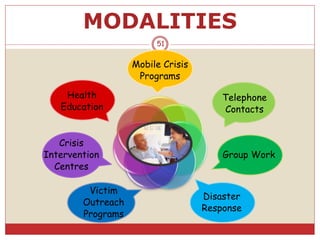
MODALITIES
Mobile Crisis
Programs
Telephone
Contacts
Group Work
Disaster
Response
Victim
Outreach
Programs
Crisis
Intervention
Centres
Health
Education
51
MOBILE CRISIS PROGRAMS
 Mobile crisis teams provide frontline
interdisciplinary crisis intervention to individuals,
families and communities.
 Nurse provides on-site care to ensure mental
health.
TELEPHONE CONTACTS
 Crisis Intervention is sometimes practiced over
telephone rather than face to face contacts.
 Nurse should have effective listening skills.
52
CRISIS INTERVENTION
CENTRES
 These provide emergency care and counselling to
victims experiencing extreme stress or conflict,
often involving suicide attempts or drug abuse.
 These centres, which are usually self contained
units in a hospital or CHC provide services 24 hours
a day.
VICTIM OUTREACH PROGRAMS
 Victim outreach programs use crisis intervention
techniques to identify needs of victims and connect
53
them with appropriate referrals and other
resources.
 Nurses often work in these programs, where
victims are often seen immediately after the crisis.
DISASTER RESPONSE
 During social crisis (floods, earthquakes, airplane
crashes, fire, etc.), the nurse acts as the case
finder for persons suffering from psychosocial
stress.
 She/he visits hospitals, shelters, morgues , etc.
where victims are likely to gather in the immediate
post disaster period and uses generic approach of
crisis intervention.
54
GROUP WORK
 People who have common traits on stressors will
form a group.
 It provides an opportunity for members to express
common concerns & experiences and build mutual
support.
HEALTH EDUCATION
 Nurses are involved in identifying people who are at
high risk for developing crisis and in teaching coping
strategies.
 The public also needs to be educated for awareness
regarding available services.
55
BIBLIOGRAPHY
56
 BOOKS
• Sreevani.R, “A Guide to Mental Health and Psychiatric Nursing”,
Edition : 4th, JayPee Publishers, Page = 332-339
• Sharma Suresh, “Communication and Educational Technology in
Nursing”, Edition : 3rd , Elsevier Publishers, Page = 117-123
• Ansari Javed, Kaur Davinder, “Medical Surgical Nursing-I”, Edition:
2015, PeeVee Publishers, Page =
• Chugh SL, “
 WEBSITES
• https://en.wikipedia.org › wiki › Crisis_intervention
• https://www.researchgate.net › publication ›
331783539_Crisis_Intervention
• https://journals.lww.com › indianjpsychiatry › Fulltext › 2021 › 63060
57

CRISIS INTERVENTION.pptx

  • 1.
    1 CRISIS INTERVENTION C R IT I C A L C A R E U N I T
  • 2.
    CONTENTS Introduction Aims Definition Robert-Otten’sModel Characteristics Steps Risk Factors Principles Types Levels Phases Techniques Aguilera Model Geriatric Considerations Sign/Symptoms Role of Nurse Resolution of Crisis Crisis in CCU Crisis Intervention Modalities Factors Bibliography 2
  • 3.
    INTRODUCTION  A crisisis an overwhelming and dramatic event that results in a period of severe disorganization.  As a result of crisis experience, the individual may:  Go down to a less healthy level than what was before the crisis.  Resume the same level of functioning by repression .  Function at a healthier level than before as crisis may bring out new strengths and coping mechanisms. 3
  • 4.
    ●Intervention at acrisis is extremely important to prevent mental illness. ●If proper guidance is provided at the correct time, the victim will come out of it and be better equipped to handle future problems in life. ●Crisis intervention is the technique used to help an individual or family to understand and cope with the intense feelings that are typical of a crisis. ●Thus, crisis intervention is the emergency first aid for mental health. 4
  • 5.
    DEFINITION  Crisis isa state of disequilibrium resulting from the interaction of an event with the individual’s or family’s coping mechanisms, which are inadequate to meet the demands of the situation, combined with the individual’s or family’s perception of the meaning of the event. ~ Taylor (1989)  Crisis Intervention is an immediate and short term emergency response to mental, emotional, physical and behavioural distress. 5
  • 6.
    CHARACTERISTICS  A crisisis experienced as a sudden event.  Crisis are precipitated by specific identifiable events.  The situation is perceived as overwhelming or life threatening.  Crisis are personal by nature.  Crisis are acute not chronic & will be resolved in one way or another within a brief period.  A crisis situation contains the potential for psychological growth or deterioration. 6
  • 7.
    RISK FACTORS Employment issues Historyof unresolved crisis History of substance abuse Poor self-esteem Superficial relationships with others Difficulty in coping with everyday situations Underutilization of resources Lack of support systems Lack of caring Aloofness 7
  • 8.
    TYPES OF CRISIS MaturationalCrisis Situational Crisis Social Crisis 8
  • 9.
    Maturational Crisis  Maturationalcrisis are developmental events requiring role changes.  This includes : Adolescence Marriage Parenthood Midlife Retirement Factors influencing nature and extent of these role changes are previous successes, availability of support systems and influence of role models. 9
  • 10.
    Situational Crisis  Itis precipitated by an unanticipated stressful event that creates disequilibrium by threatening one’s sense of biological, social or psychological integrity.  This includes : Loss of a job Loss of a loved one Physical/Mental illness Unwanted Pregnancy Divorce School/Work problems 10
  • 11.
    Social Crisis  Socialcrisis is accidental, uncommon and unanticipated. It involves multiple losses, radical environmental changes and severe effects on the lives of a large number of people.  This includes : Natural disasters Nuclear accidents Mass killings/Terrorism Violence Wars Toxic waste contamination 11
  • 12.
    PHASES OF CRISIS Perceivedthreat generates anxiety Usual coping strategies activated Disorganization Sense of vulnerability Random coping Attempted redefinition of crisis New coping measures Assistance needed Panic levels of anxiety Profound disorganization Referral needed PHASE I PHASE II PHASE IV PHASE III 12
  • 13.
    AGUILERA MODEL 13  Accordingto author and RN Donna Aguilera, 3 factors affect an individual’s way of perceiving & responding to a stressful event.  During crisis, one/more of these factors is out of balance and interventions focus on re-establishing equilibrium among these factors to resolve crisis. Perception of the event Situational support Coping mechanism
  • 14.
    14 Human organism State ofequilibrium State of disequilibrium Need to restore equilibrium Resolution of problem Adequate coping mechanism Adequate situational support Realistic perception of event Problem unresolved No coping mechanism Inadequate situational support Distorted perception of event Equilibrium regained Disequilibrium continues No Crisis Crisis Stressful event Stressful event Balancing Factors Present Absent
  • 15.
    SIGN & SYMPTOMS Anxiety Fatigue Insomnia Irritability Doubtand mistrust Depression Anger Apathy/Numbness Social withdrawal Forgetfulness 15
  • 16.
  • 17.
    RESOLUTION OF CRISIS •Repression of emotions • Feelings resurface if another crisis occurs Pseudo- resolution • Ruminating over the loss • Prolonged grief reaction Unsuccessful resolution • Adaptive coping measures during Phase III • Better skills; useful in future crisis Successful resolution 17
  • 18.
    CRISIS INTERVENTION  Crisisintervention is a technique used to help an individual or family to understand and cope with the intense feelings that are typical of a crisis.  It is a short-term therapy to solve immediate problems.  It is usually limited to 6 weeks.  The client often advances to a higher level of growth and learns new ways of problem solving. 18
  • 19.
    FACTORS AFFECTING CRISIS INTERVENTION Age Gender Individualpersonality traits Family roles Social relationships Availability of support systems Socioeconomic status Housing and living conditions Religious belief system Cultural attitudes 19
  • 20.
    AIMS  To providea correct cognitive perception of the situation  To assist the individual in managing the intense and overwhelming feelings associated with crisis  To return to a pre-crisis level of functioning  To teach new and better ways of coping with the future crisis 20
  • 21.
    ROBERT-OTTEN’s MODEL Follow up Implementan action plan Generate & explore alternatives Deal with feelings & emotions Identify major problems Rapidly establish rapport Psychosocial & lethality assessment Crisis resolution 21 1 2 3 4 5 6 7
  • 22.
    STEPS PROVIDING CORRECT COGNITIVE PERCEPTION • Assessmentof the situation • Defining the event • Developing a plan of action ASSISTING IN MANAGEMENT OF INTENSE FEELINGS • Helping the client to be aware of feelings • Helping the client to attain mastery over feelings 22
  • 23.
     Providing correctcognitive perception  ASSESSMENT OF THE SITUATION Direct questioning with the purpose of identification of the problem and people involved Identify the available support systems Identify strengths and limitations of the victim  DEFINING THE EVENT As the victim may be in denial or reluctant to talk, it may be necessary for the therapist to review the details of the incident. 23
  • 24.
    The therapist helpsthe victim become aware of the precipitating event by reviewing the details for the past 2-4 weeks. DEVELOPING A PLAN OF ACTION Active involvement of the victim and the people closely associated with him. As the victim may not be in a condition to mentally comprehend complicated information due to the overwhelming anxiety experienced by him, the instructions given by the therapist must be simple and clear, and too much information should not be given at a time. The instruction may have to be written down as victim may not be able to retain information. 24
  • 25.
     Assistance inmanaging intense feelings  HELPING THE INDIVIDUAL TO BE AWARE OF THE FEELINGS The victim needs help in identifying his own feelings. The therapist should use appropriate communication technique. The therapist should be efficient in observing verbal & non-verbal behaviour of the victim.  HELPING THE INDIVIDUAL TO ATTAIN MASTERY OVR THE FEELINGS Adequate support and guidance without any false reassurance. 25
  • 26.
    The following behavioursshould NOT be encouraged:  Blaming others to escape from taking any responsibility.  Developing too much dependence on the therapist.  Sudden recovery from feelings/ not showing emotional reaction at all may indicate repression. To improve coping with the situation necessary environmental manipulation must be done in physical or interpersonal areas. Follow up appointment within a week to reassess, revise & modify the plan as needed. 26
  • 27.
    PRINCIPLES Be specific, useconcise statements and avoid overwhelming the patient with irrelevant questions or excessive detail.  Encourage the expression of feelings.  A calm, controlled presence reassures the person that the nurse can help.  Listen to facts and feelings : seeking clarification, paraphrasing and reflection are effective strategies. 27
  • 28.
    Allow sufficient timefor the individuals involved to process information and ask questions. Help patient legitimize feelings by letting them know that others in similar situation have experienced comparable emotions.  Clarify distortions by getting persons to look at the situation realistically, focus on what can be changed and what cannot.  Empower person by allowing them to make informed choices.  Assist the person in confronting reality.  Encourage the person to focus on one implication at a time. 28
  • 29.
    LEVELS Individual approach General approach Generalsupport Environmental manipulation 29
  • 30.
     Environmental Manipulation Interventions that directly change the patient’s physical or interpersonal situation.  Provide situational support & remove stress.  Example : Taking a sick leave, going on a vacation  General Support  Nurse provides warmth, acceptance, empathy and reassurance  Conveys the feeling that the nurse is on the patient’s side and will be a helping hand. • Generic Approach  Designed to reach high risk individuals and large groups 30
  • 31.
    as quickly aspossible. Debriefing method : Disaster victims are helped to recall events and clarify traumatic experiences Group support, information on normal reaction. •Individual Approach Useful in combined situational and maturational crisis Also beneficial when symptoms include homicidal & suicidal risk Nurse understands the specific patient’s characteristics with interventions aimed to facilitate cognitive and emotional processing of the traumatic experience. 31
  • 32.
    TECHNIQUES Catharsis Clarification Suggestions Reinforcement ofbehaviour Support of defences Raising self- esteem Exploration of solutions 32
  • 33.
    • CATHARSIS :Therelease of feelings that takes place as the patient talks about emotionally charged areas. Eg. “Tell me how you have been feeling since the accident.” ●CLARIFICATION : Encouraging the patient to express more clearly the relationship between certain events. Eg. “I have noticed that after the calamity, you have been avoiding places near water.” ●SUGGESTION : Influencing a person to accept an idea or belief, particularly the belief that the nurse can help and the person will feel better in time. 33
  • 34.
    Eg. “Many peoplehave found it helpful to talk about this and I think you will too.” ●REINFORCEMENT OF BEHAVIOUR : Giving positive responses to adaptive behaviour. Eg. “That is the first time you expressed your feelings regarding the incident. I appreciate that.” SUPPORT OF DEFENCES : Encouraging the use of healthy/adaptive defences and discouraging those that are unhealthy/maladaptive. Eg. “Going for exercise when you were so angry was helpful because when you returned, you were able to 34
  • 35.
    talk things throughwith your family.” ●RAISING SELF-ESTEEM :Giving the patient positive reinforcement to adaptive behaviour Eg. “You are a very strong person to be able to manage the family all this time. I think you will be able to handle this situation too.” EXPLORATION OF SOLUTIONS: Examining alternative ways of solving the immediate problem. Eg. “An occupational rehabilitation program can help you in regaining functional capacity.” 35
  • 36.
    Geriatric Considerations  Olderpersons who were successful at adapting to losses earlier in life will cope more adaptively with the losses and grief inherent in aging.  The elderly persons who experienced more losses are unable to complete the grief process resulting in bereavement overload.  Such people are less able to adapt and reintegrate physical & mental health, and are prone to depressive disorders. 36
  • 37.
  • 38.
    Assessment  The nursecollects data regarding the following factors:  Precipitating event or stressor  Patient’s perception of event or stressor  Nature and strength of patient’s support systems, coping resources  Level of psychological stress patient is suffering from and degree of impairment he/she is experiencing  Patient’s previous strengths and coping mechanisms 38
  • 39.
  • 40.
    Planning  Dynamics underlyingthe present crisis are formulated.  Alternative solutions to the problem are explored.  Steps for achieving the solutions are identified.  Environmental support needed to help the patient is decided upon, coping mechanisms that need to be developed and those which need to be strengthened are identified. 40
  • 41.
    Implementation  Interventions atvarious levels : i. Environmental manipulation ii. General support iii. Generic approach iv. Individual approach  Restore psychological safety  Provide adequate information  Correct and support effective coping  Ensure social support 41
  • 42.
    Evaluation  The nurseand patient review the changes that have occurred.  Nurse should give credit for successful changes to patients so that they realize their effectiveness.  If the goals have not been met, the patient and nurse can return to the first step (assessment) and continue through the phases again. 42
  • 43.
    CRISIS IN CCU Critically illpatient Family and friends Health care personnel 43
  • 44.
    Critically ill patient 44 ●Beingcritically ill for a long time or a battle with a chronic terminal illness can result in failure of coping mechanisms, prolonged distress and a state of crisis. ●Furthermore, the patient’s need for psychological support is oftentimes neglected due to priority to other critical needs. ●Thus, it is crucial to provide crisis intervention to the patient in distress.
  • 45.
    Family 45  The criticalcare family needs inventory is a tool used by many nursing staff to ensure that nurses meet family’s need when their loved one is in ICU.  The 3 most important needs consistently identified by clients and families are : Proximity Assurance Information
  • 46.
    46 •TOP 9 PRIORITIESFOR FAMILIES IN CRITICAL SETTINGS : To be assured that the best care is being given to their family member by health personnel/team. To feel that there is a hope. To know the prognosis and outcome. To understand the mode of treatment.
  • 47.
    47 To be assuredthat it is alright to leave for a while. To feel accepted by hospital staff. To feel someone is concerned with family’s health. To feel hospital staff care about the patient. To give time to time information in terms that can be understood by the family.
  • 48.
    Personnel 48  As theCCU staff feels obliged to respond to the critical situation but is unable to cope with the demands of the situation, it leads to distress, direct deterioration of quality of life as well as quality of service provided.  Factors responsible for personnel crisis in CCU:  Increased patient care demands  Excessive and extended workload  Equipment related challenges  Emotional trauma  Lack of training in crisis management  Biorhythm disturbance
  • 49.
    49 •Manifestations include: Emotional exhaustion Depersonalization Senseof reduced personal achievement Depression High Absenteeism/sickness rates Drug/alcohol dependence Chronic physical complaints • Red Flag signs : ∆ The disappearing act (not answering bleeps, frequent sick leave, being late) ∆ Low work rate (slowness in doing procedures) ∆ Ward rage (burst of temper, shouting) ∆ Rigidity (poor tolerance to healthy criticism, inability to compromise)
  • 50.
    50 ∆ Bypass syndrome(colleagues tend to avoid the affected staff) ∆ Career problems (uncertainty about career choice)  Management: Meeting regular needs on a daily basis (regular eating, drinking and sleep schedule) Taking designated breaks and relaxation techniques (music, warm bath, dance, deep breathing, meditation) Keeping in touch with friends and family, communication with colleagues Limiting media exposure Appreciating the “superhero” status of your profession – taking care of those most in need. Taking professional help when necessary.
  • 51.
  • 52.
    MOBILE CRISIS PROGRAMS Mobile crisis teams provide frontline interdisciplinary crisis intervention to individuals, families and communities.  Nurse provides on-site care to ensure mental health. TELEPHONE CONTACTS  Crisis Intervention is sometimes practiced over telephone rather than face to face contacts.  Nurse should have effective listening skills. 52
  • 53.
    CRISIS INTERVENTION CENTRES  Theseprovide emergency care and counselling to victims experiencing extreme stress or conflict, often involving suicide attempts or drug abuse.  These centres, which are usually self contained units in a hospital or CHC provide services 24 hours a day. VICTIM OUTREACH PROGRAMS  Victim outreach programs use crisis intervention techniques to identify needs of victims and connect 53
  • 54.
    them with appropriatereferrals and other resources.  Nurses often work in these programs, where victims are often seen immediately after the crisis. DISASTER RESPONSE  During social crisis (floods, earthquakes, airplane crashes, fire, etc.), the nurse acts as the case finder for persons suffering from psychosocial stress.  She/he visits hospitals, shelters, morgues , etc. where victims are likely to gather in the immediate post disaster period and uses generic approach of crisis intervention. 54
  • 55.
    GROUP WORK  Peoplewho have common traits on stressors will form a group.  It provides an opportunity for members to express common concerns & experiences and build mutual support. HEALTH EDUCATION  Nurses are involved in identifying people who are at high risk for developing crisis and in teaching coping strategies.  The public also needs to be educated for awareness regarding available services. 55
  • 56.
    BIBLIOGRAPHY 56  BOOKS • Sreevani.R,“A Guide to Mental Health and Psychiatric Nursing”, Edition : 4th, JayPee Publishers, Page = 332-339 • Sharma Suresh, “Communication and Educational Technology in Nursing”, Edition : 3rd , Elsevier Publishers, Page = 117-123 • Ansari Javed, Kaur Davinder, “Medical Surgical Nursing-I”, Edition: 2015, PeeVee Publishers, Page = • Chugh SL, “  WEBSITES • https://en.wikipedia.org › wiki › Crisis_intervention • https://www.researchgate.net › publication › 331783539_Crisis_Intervention • https://journals.lww.com › indianjpsychiatry › Fulltext › 2021 › 63060
  • 57.