


CRISIS INTERVENTION
DR. JYOTI SRIVASTAVA
VARANASI
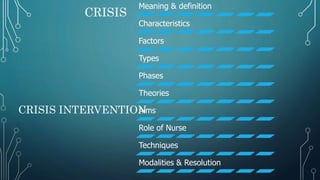
CRISIS
Meaning & definition
Characteristics
Factors
Types
Phases
Theories
Aims
Role of Nurse
Techniques
Modalities & Resolution
CRISIS INTERVENTION
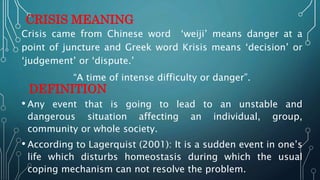
CRISIS MEANING
โ€ข Any event that is going to lead to an unstable and
dangerous situation affecting an individual, group,
community or whole society.
โ€ข According to Lagerquist (2001): It is a sudden event in oneโ€™s
life which disturbs homeostasis during which the usual
coping mechanism can not resolve the problem.
DEFINITION
Crisis came from Chinese word โ€˜weijiโ€™ means danger at a
point of juncture and Greek word Krisis means โ€˜decisionโ€™ or
โ€˜judgementโ€™ or โ€˜dispute.โ€™
โ€œA time of intense difficulty or dangerโ€.
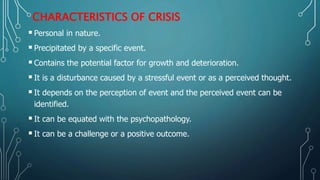
CHARACTERISTICS OF CRISIS
๏‚งPersonal in nature.
๏‚งPrecipitated by a specific event.
๏‚งContains the potential factor for growth and deterioration.
๏‚งIt is a disturbance caused by a stressful event or as a perceived thought.
๏‚งIt depends on the perception of event and the perceived event can be
identified.
๏‚งIt can be equated with the psychopathology.
๏‚งIt can be a challenge or a positive outcome.
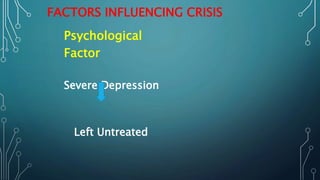
FACTORS INFLUENCING CRISIS
Psychological
Factor
Severe Depression
Left Untreated
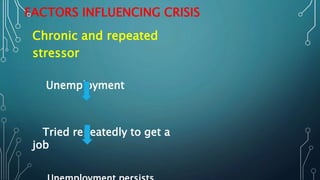
FACTORS INFLUENCING CRISIS
Chronic and repeated
stressor
Unemployment
Tried repeatedly to get a
job
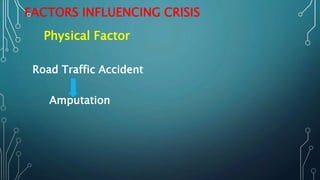
FACTORS INFLUENCING CRISIS
Physical Factor
Road Traffic Accident
Amputation
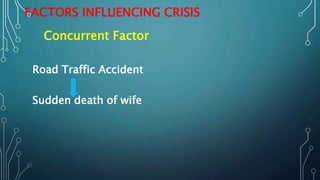
FACTORS INFLUENCING CRISIS
Concurrent Factor
Road Traffic Accident
Sudden death of wife
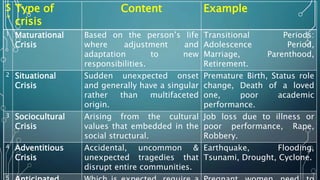
S
.N
Type of
crisis
Content Example
1 Maturational
Crisis
Based on the personโ€™s life
where adjustment and
adaptation to new
responsibilities.
Transitional Periods:
Adolescence Period,
Marriage, Parenthood,
Retirement.
2 Situational
Crisis
Sudden unexpected onset
and generally have a singular
rather than multifaceted
origin.
Premature Birth, Status role
change, Death of a loved
one, poor academic
performance.
3 Sociocultural
Crisis
Arising from the cultural
values that embedded in the
social structural.
Job loss due to illness or
poor performance, Rape,
Robbery.
4 Adventitious
Crisis
Accidental, uncommon &
unexpected tragedies that
disrupt entire communities.
Earthquake, Flooding,
Tsunami, Drought, Cyclone.
5
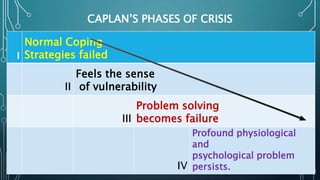
CAPLANโ€™S PHASES OF CRISIS
I
Normal Coping
Strategies failed
II
Feels the sense
of vulnerability
III
Problem solving
becomes failure
IV
Profound physiological
and
psychological problem
persists.
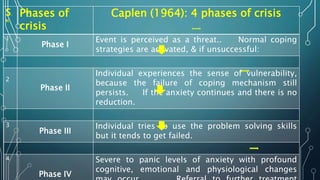
S.
N
Phases of
crisis
Caplen (1964): 4 phases of crisis
1
Phase I
Event is perceived as a threat.. Normal coping
strategies are activated, & if unsuccessful:
2
Phase II
Individual experiences the sense of vulnerability,
because the failure of coping mechanism still
persists. If the anxiety continues and there is no
reduction.
3
Phase III
Individual tries to use the problem solving skills
but it tends to get failed.
4
Phase IV
Severe to panic levels of anxiety with profound
cognitive, emotional and physiological changes
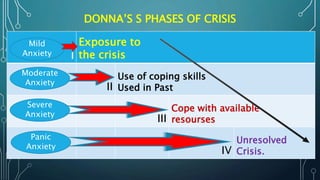
DONNAโ€™S S PHASES OF CRISIS
I
Exposure to
the crisis
II
Use of coping skills
Used in Past
III
Cope with available
resourses
IV
Unresolved
Crisis.
Mild
Anxiety
Moderate
Anxiety
Severe
Anxiety
Panic
Anxiety
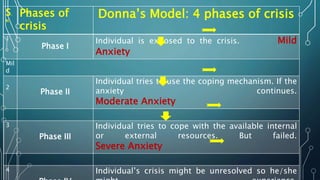
S.
N
Phases of
crisis
Donnaโ€™s Model: 4 phases of crisis
1
Phase I
Individual is exposed to the crisis. Mild
Anxiety
Mil
d
2
Phase II
Individual tries to use the coping mechanism. If the
anxiety continues.
Moderate Anxiety
3
Phase III
Individual tries to cope with the available internal
or external resources. But failed.
Severe Anxiety
4 Individualโ€™s crisis might be unresolved so he/she
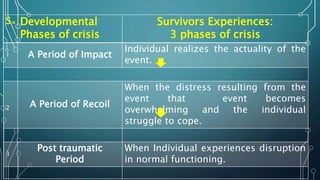
S.N Developmental
Phases of crisis
Survivors Experiences:
3 phases of crisis
1 A Period of Impact
Individual realizes the actuality of the
event.
2 A Period of Recoil
When the distress resulting from the
event that event becomes
overwhelming and the individual
struggle to cope.
3
Post traumatic
Period
When Individual experiences disruption
in normal functioning.
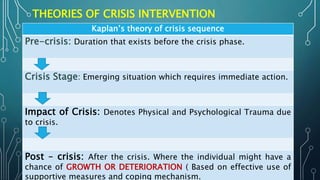
THEORIES OF CRISIS INTERVENTION
Kaplanโ€™s theory of crisis sequence
Pre-crisis: Duration that exists before the crisis phase.
Crisis Stage: Emerging situation which requires immediate action.
Impact of Crisis: Denotes Physical and Psychological Trauma due
to crisis.
Post โ€“ crisis: After the crisis. Where the individual might have a
chance of GROWTH OR DETERIORATION ( Based on effective use of
supportive measures and coping mechanism.
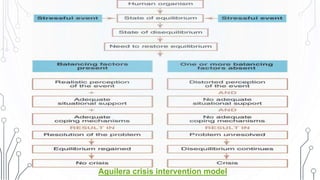
Aguilera crisis intervention model
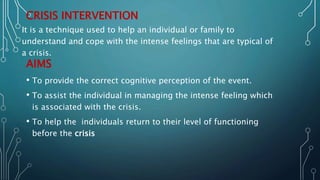
CRISIS INTERVENTION
AIMS
โ€ข To provide the correct cognitive perception of the event.
โ€ข To assist the individual in managing the intense feeling which
is associated with the crisis.
โ€ข To help the individuals return to their level of functioning
before the crisis
It is a technique used to help an individual or family to
understand and cope with the intense feelings that are typical of
a crisis.
ROLE OF NURSE
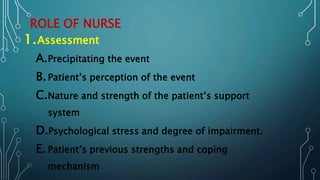
1.Assessment
A.Precipitating the event
B.Patientโ€™s perception of the event
C.Nature and strength of the patientโ€™s support
system
D.Psychological stress and degree of impairment.
E. Patientโ€™s previous strengths and coping
mechanism
ROLE OF NURSE
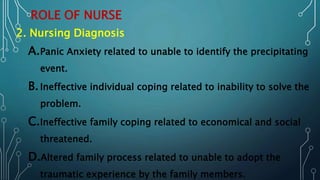
2. Nursing Diagnosis
A.Panic Anxiety related to unable to identify the precipitating
event.
B.Ineffective individual coping related to inability to solve the
problem.
C.Ineffective family coping related to economical and social
threatened.
D.Altered family process related to unable to adopt the
traumatic experience by the family members.
ROLE OF NURSE
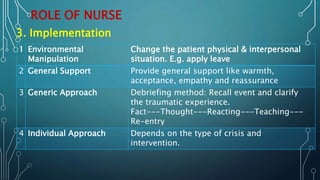
3. Implementation
1 Environmental
Manipulation
Change the patient physical & interpersonal
situation. E.g. apply leave
2 General Support Provide general support like warmth,
acceptance, empathy and reassurance
3 Generic Approach Debriefing method: Recall event and clarify
the traumatic experience.
Fact---Thought---Reacting---Teaching---
Re-entry
4 Individual Approach Depends on the type of crisis and
intervention.
ROLE OF NURSE
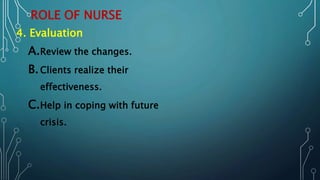
4. Evaluation
A.Review the changes.
B.Clients realize their
effectiveness.
C.Help in coping with future
crisis.
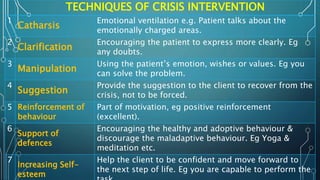
TECHNIQUES OF CRISIS INTERVENTION
1
Catharsis
Emotional ventilation e.g. Patient talks about the
emotionally charged areas.
2
Clarification
Encouraging the patient to express more clearly. Eg
any doubts.
3
Manipulation
Using the patientโ€™s emotion, wishes or values. Eg you
can solve the problem.
4
Suggestion
Provide the suggestion to the client to recover from the
crisis, not to be forced.
5 Reinforcement of
behaviour
Part of motivation, eg positive reinforcement
(excellent).
6
Support of
defences
Encouraging the healthy and adoptive behaviour &
discourage the maladaptive behaviour. Eg Yoga &
meditation etc.
7
Increasing Self-
esteem
Help the client to be confident and move forward to
the next step of life. Eg you are capable to perform the
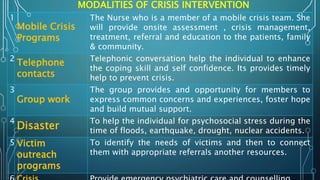
MODALITIES OF CRISIS INTERVENTION
1
Mobile Crisis
Programs
The Nurse who is a member of a mobile crisis team. She
will provide onsite assessment , crisis management,
treatment, referral and education to the patients, family
& community.
2
Telephone
contacts
Telephonic conversation help the individual to enhance
the coping skill and self confidence. Its provides timely
help to prevent crisis.
3
Group work
The group provides and opportunity for members to
express common concerns and experiences, foster hope
and build mutual support.
4
Disaster
To help the individual for psychosocial stress during the
time of floods, earthquake, drought, nuclear accidents.
5 Victim
outreach
programs
To identify the needs of victims and then to connect
them with appropriate referrals another resources.
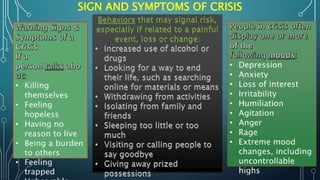
SIGN AND SYMPTOMS OF CRISIS
โ€ข
โ€ข
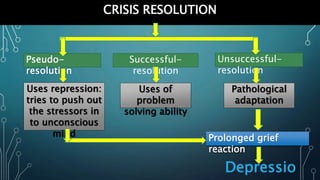
CRISIS RESOLUTION
Successful-
resolution
Pseudo-
resolution
Unsuccessful-
resolution
Uses of
problem
solving ability
Uses repression:
tries to push out
the stressors in
to unconscious
mind
Pathological
adaptation
Prolonged grief
reaction
Depressio
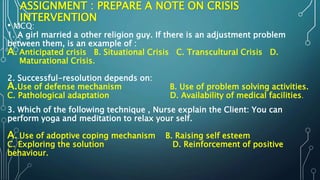
ASSIGNMENT : PREPARE A NOTE ON CRISIS
INTERVENTION
โ€ข MCQ:
1. A girl married a other religion guy. If there is an adjustment problem
between them, is an example of :
A. Anticipated crisis B. Situational Crisis C. Transcultural Crisis D.
Maturational Crisis.
2. Successful-resolution depends on:
A.Use of defense mechanism B. Use of problem solving activities.
C. Pathological adaptation D. Availability of medical facilities.
3. Which of the following technique , Nurse explain the Client: You can
perform yoga and meditation to relax your self.
A. Use of adoptive coping mechanism B. Raising self esteem
C. Exploring the solution D. Reinforcement of positive
behaviour.
Crisis intervention

Crisis intervention

  • 1.
    CRISIS INTERVENTION DR. JYOTISRIVASTAVA VARANASI
  • 2.
    CRISIS Meaning & definition Characteristics Factors Types Phases Theories Aims Roleof Nurse Techniques Modalities & Resolution CRISIS INTERVENTION
  • 3.
    CRISIS MEANING โ€ข Anyevent that is going to lead to an unstable and dangerous situation affecting an individual, group, community or whole society. โ€ข According to Lagerquist (2001): It is a sudden event in oneโ€™s life which disturbs homeostasis during which the usual coping mechanism can not resolve the problem. DEFINITION Crisis came from Chinese word โ€˜weijiโ€™ means danger at a point of juncture and Greek word Krisis means โ€˜decisionโ€™ or โ€˜judgementโ€™ or โ€˜dispute.โ€™ โ€œA time of intense difficulty or dangerโ€.
  • 4.
    CHARACTERISTICS OF CRISIS ๏‚งPersonalin nature. ๏‚งPrecipitated by a specific event. ๏‚งContains the potential factor for growth and deterioration. ๏‚งIt is a disturbance caused by a stressful event or as a perceived thought. ๏‚งIt depends on the perception of event and the perceived event can be identified. ๏‚งIt can be equated with the psychopathology. ๏‚งIt can be a challenge or a positive outcome.
  • 5.
  • 6.
    FACTORS INFLUENCING CRISIS Chronicand repeated stressor Unemployment Tried repeatedly to get a job
  • 7.
    FACTORS INFLUENCING CRISIS PhysicalFactor Road Traffic Accident Amputation
  • 8.
    FACTORS INFLUENCING CRISIS ConcurrentFactor Road Traffic Accident Sudden death of wife
  • 9.
    S .N Type of crisis Content Example 1Maturational Crisis Based on the personโ€™s life where adjustment and adaptation to new responsibilities. Transitional Periods: Adolescence Period, Marriage, Parenthood, Retirement. 2 Situational Crisis Sudden unexpected onset and generally have a singular rather than multifaceted origin. Premature Birth, Status role change, Death of a loved one, poor academic performance. 3 Sociocultural Crisis Arising from the cultural values that embedded in the social structural. Job loss due to illness or poor performance, Rape, Robbery. 4 Adventitious Crisis Accidental, uncommon & unexpected tragedies that disrupt entire communities. Earthquake, Flooding, Tsunami, Drought, Cyclone. 5
  • 10.
    CAPLANโ€™S PHASES OFCRISIS I Normal Coping Strategies failed II Feels the sense of vulnerability III Problem solving becomes failure IV Profound physiological and psychological problem persists.
  • 11.
    S. N Phases of crisis Caplen (1964):4 phases of crisis 1 Phase I Event is perceived as a threat.. Normal coping strategies are activated, & if unsuccessful: 2 Phase II Individual experiences the sense of vulnerability, because the failure of coping mechanism still persists. If the anxiety continues and there is no reduction. 3 Phase III Individual tries to use the problem solving skills but it tends to get failed. 4 Phase IV Severe to panic levels of anxiety with profound cognitive, emotional and physiological changes
  • 12.
    DONNAโ€™S S PHASESOF CRISIS I Exposure to the crisis II Use of coping skills Used in Past III Cope with available resourses IV Unresolved Crisis. Mild Anxiety Moderate Anxiety Severe Anxiety Panic Anxiety
  • 13.
    S. N Phases of crisis Donnaโ€™s Model:4 phases of crisis 1 Phase I Individual is exposed to the crisis. Mild Anxiety Mil d 2 Phase II Individual tries to use the coping mechanism. If the anxiety continues. Moderate Anxiety 3 Phase III Individual tries to cope with the available internal or external resources. But failed. Severe Anxiety 4 Individualโ€™s crisis might be unresolved so he/she
  • 14.
    S.N Developmental Phases ofcrisis Survivors Experiences: 3 phases of crisis 1 A Period of Impact Individual realizes the actuality of the event. 2 A Period of Recoil When the distress resulting from the event that event becomes overwhelming and the individual struggle to cope. 3 Post traumatic Period When Individual experiences disruption in normal functioning.
  • 15.
    THEORIES OF CRISISINTERVENTION Kaplanโ€™s theory of crisis sequence Pre-crisis: Duration that exists before the crisis phase. Crisis Stage: Emerging situation which requires immediate action. Impact of Crisis: Denotes Physical and Psychological Trauma due to crisis. Post โ€“ crisis: After the crisis. Where the individual might have a chance of GROWTH OR DETERIORATION ( Based on effective use of supportive measures and coping mechanism.
  • 16.
  • 17.
    CRISIS INTERVENTION AIMS โ€ข Toprovide the correct cognitive perception of the event. โ€ข To assist the individual in managing the intense feeling which is associated with the crisis. โ€ข To help the individuals return to their level of functioning before the crisis It is a technique used to help an individual or family to understand and cope with the intense feelings that are typical of a crisis.
  • 18.
    ROLE OF NURSE 1.Assessment A.Precipitatingthe event B.Patientโ€™s perception of the event C.Nature and strength of the patientโ€™s support system D.Psychological stress and degree of impairment. E. Patientโ€™s previous strengths and coping mechanism
  • 19.
    ROLE OF NURSE 2.Nursing Diagnosis A.Panic Anxiety related to unable to identify the precipitating event. B.Ineffective individual coping related to inability to solve the problem. C.Ineffective family coping related to economical and social threatened. D.Altered family process related to unable to adopt the traumatic experience by the family members.
  • 20.
    ROLE OF NURSE 3.Implementation 1 Environmental Manipulation Change the patient physical & interpersonal situation. E.g. apply leave 2 General Support Provide general support like warmth, acceptance, empathy and reassurance 3 Generic Approach Debriefing method: Recall event and clarify the traumatic experience. Fact---Thought---Reacting---Teaching--- Re-entry 4 Individual Approach Depends on the type of crisis and intervention.
  • 21.
    ROLE OF NURSE 4.Evaluation A.Review the changes. B.Clients realize their effectiveness. C.Help in coping with future crisis.
  • 22.
    TECHNIQUES OF CRISISINTERVENTION 1 Catharsis Emotional ventilation e.g. Patient talks about the emotionally charged areas. 2 Clarification Encouraging the patient to express more clearly. Eg any doubts. 3 Manipulation Using the patientโ€™s emotion, wishes or values. Eg you can solve the problem. 4 Suggestion Provide the suggestion to the client to recover from the crisis, not to be forced. 5 Reinforcement of behaviour Part of motivation, eg positive reinforcement (excellent). 6 Support of defences Encouraging the healthy and adoptive behaviour & discourage the maladaptive behaviour. Eg Yoga & meditation etc. 7 Increasing Self- esteem Help the client to be confident and move forward to the next step of life. Eg you are capable to perform the
  • 23.
    MODALITIES OF CRISISINTERVENTION 1 Mobile Crisis Programs The Nurse who is a member of a mobile crisis team. She will provide onsite assessment , crisis management, treatment, referral and education to the patients, family & community. 2 Telephone contacts Telephonic conversation help the individual to enhance the coping skill and self confidence. Its provides timely help to prevent crisis. 3 Group work The group provides and opportunity for members to express common concerns and experiences, foster hope and build mutual support. 4 Disaster To help the individual for psychosocial stress during the time of floods, earthquake, drought, nuclear accidents. 5 Victim outreach programs To identify the needs of victims and then to connect them with appropriate referrals another resources.
  • 24.
    SIGN AND SYMPTOMSOF CRISIS โ€ข โ€ข
  • 25.
    CRISIS RESOLUTION Successful- resolution Pseudo- resolution Unsuccessful- resolution Uses of problem solvingability Uses repression: tries to push out the stressors in to unconscious mind Pathological adaptation Prolonged grief reaction Depressio
  • 26.
    ASSIGNMENT : PREPAREA NOTE ON CRISIS INTERVENTION โ€ข MCQ: 1. A girl married a other religion guy. If there is an adjustment problem between them, is an example of : A. Anticipated crisis B. Situational Crisis C. Transcultural Crisis D. Maturational Crisis. 2. Successful-resolution depends on: A.Use of defense mechanism B. Use of problem solving activities. C. Pathological adaptation D. Availability of medical facilities. 3. Which of the following technique , Nurse explain the Client: You can perform yoga and meditation to relax your self. A. Use of adoptive coping mechanism B. Raising self esteem C. Exploring the solution D. Reinforcement of positive behaviour.