War and
Terrorism
Group Members:
•Jigar Adhiya
•Omang Karia
•Girish Panchal
•Divyesh Panchal
•Akshay Gujarathi
•Manasvi Rathod
Introduction to War
“Of all the enemies to public liberty, war is, perhaps, the most to
be dreaded because it comprises and develops the germ of every
other. War is the parent of armies; from these proceed debts and
taxes … known instruments for bringing the many under the
domination of the few.…
No nation could preserve its freedom in the midst of continual
warfare.”
James Madison, Political Observations, 1795
• War- generally described as state of arm conflict between
societies.
• Some scholars see war as a
universal and ancestral aspect of human nature, others argue
that it is only a result of specific socio-cultural or ecological
circumstances.
War has been far too common in human history and thus is the
central problem of international relations.
• Many political scientists and foreign policymakers view war
as the continuation of politics: When diplomacy fails, some
states decide to use force.
• Others see war as the result of a breakdown of the modern
international system because so many of the rules of
international institutions were designed to reduce conflict
among states.
Introduction to War
Types of War
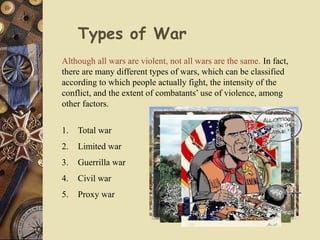
Although all wars are violent, not all wars are the same. In fact,
there are many different types of wars, which can be classified
according to which people actually fight, the intensity of the
conflict, and the extent of combatants’ use of violence, among
other factors.
1. Total war
2. Limited war
3. Guerrilla war
4. Civil war
5. Proxy war
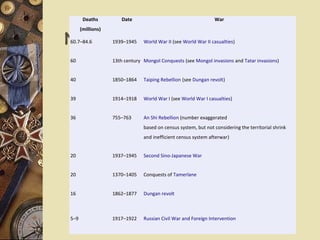
Nine largest wars
Deaths
(millions)
Date War
60.7–84.6 1939–1945 World War II (see World War II casualties)
60 13th century Mongol Conquests (see Mongol invasions and Tatar invasions)
40 1850–1864 Taiping Rebellion (see Dungan revolt)
39 1914–1918 World War I (see World War I casualties)
36 755–763 An Shi Rebellion (number exaggerated
based on census system, but not considering the territorial shrink
and inefficient census system afterwar)
20 1937–1945 Second Sino-Japanese War
20 1370–1405 Conquests of Tamerlane
16 1862–1877 Dungan revolt
5–9 1917–1922 Russian Civil War and Foreign Intervention
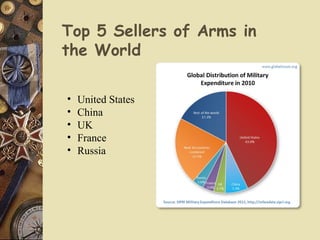
Top 5 Sellers of Arms in
the World
• United States
• China
• UK
• France
• Russia
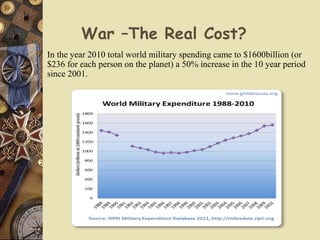
War –The Real Cost?
 In the year 2010 total world military spending came to $1600billion (or
$236 for each person on the planet) a 50% increase in the 10 year period
since 2001.
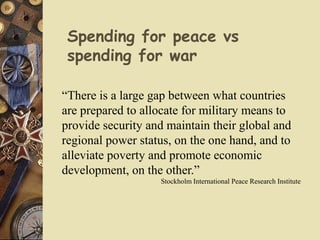
Spending for peace vs
spending for war
“There is a large gap between what countries
are prepared to allocate for military means to
provide security and maintain their global and
regional power status, on the one hand, and to
alleviate poverty and promote economic
development, on the other.”
Stockholm International Peace Research Institute
War versus Poverty
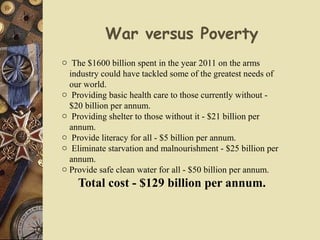
o The $1600 billion spent in the year 2011 on the arms
industry could have tackled some of the greatest needs of
our world.
o Providing basic health care to those currently without -
$20 billion per annum.
o Providing shelter to those without it - $21 billion per
annum.
o Provide literacy for all - $5 billion per annum.
o Eliminate starvation and malnourishment - $25 billion per
annum.
o Provide safe clean water for all - $50 billion per annum.
Total cost - $129 billion per annum.
The Human Cost of War
1. Crops, land and environment are destroyed.
2. Destruction of food stores, shops and property.
3. Inflation increases dramatically at times of conflict leading to
poverty for most of the population.
4. People are forced to flee and become refugees or internally
displaced.
5. Much trade and small business ceases.
6. Governments stop spending on social needs and divert funds to
military hardware.
7. Roads and means of travel are often dangerous.
8. It can be difficult to get access for emergency relief.
9. Young people are forced to become soldiers.
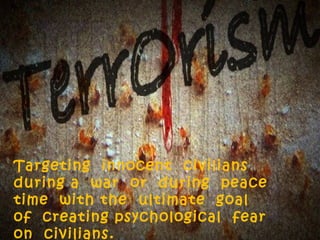
Targeting innocent civilians
during a war or during peace
time with the ultimate goal
of creating psychological fear
on civilians.
Types of terrorism
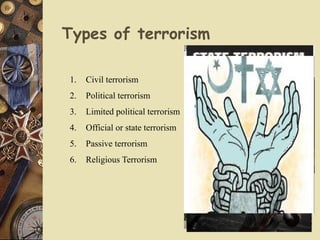
1. Civil terrorism
2. Political terrorism
3. Limited political terrorism
4. Official or state terrorism
5. Passive terrorism
6. Religious Terrorism
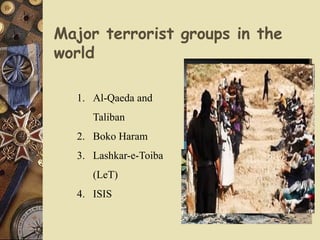
Major terrorist groups in the
world
1. Al-Qaeda and
Taliban
2. Boko Haram
3. Lashkar-e-Toiba
(LeT)
4. ISIS
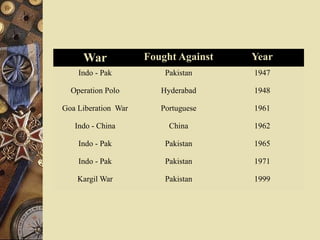
WARS THAT
INDIA HAS
FOUGHT
War Fought Against Year
Indo - Pak Pakistan 1947
Operation Polo Hyderabad 1948
Goa Liberation War Portuguese 1961
Indo - China China 1962
Indo - Pak Pakistan 1965
Indo - Pak Pakistan 1971
Kargil War Pakistan 1999
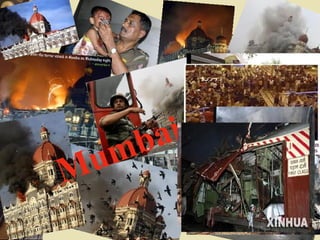
10 Major Terrorist attacks in INDIA
1. German Bakery Bomb Blast, Koregaon Park, Pune
2. Mumbai Terrorist Attacks
3. Bangalore Series Blast
4. Jaipur Bombings
5. Mumbai Train Bombings
6. Malegaon Blasts
7. Varanasi Bombings
8. Ram JanmBhumi Attack, Ayodhya
9. Delhi Serial Bombings
10.Indian Parliament Attack
Mumbai Attack
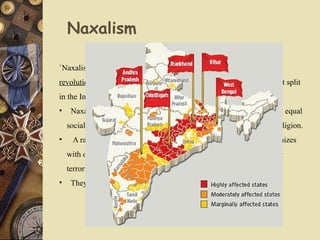
Naxalism
`Naxalism` is an informal name given to radical, often violent,
revolutionary communist groups that were born out of the Sino-Soviet split
in the Indian communist movement.
• Naxalites are those who fight for freedom of the downtrodden and equal
social and financial status for all , irrespective of class, caste and religion.
• A radical who employs terror as a political weapon; usually organizes
with other terrorists in small cells; often uses religion as a cover for
terrorist activities.
• They are organised mostly where there is forest cover.
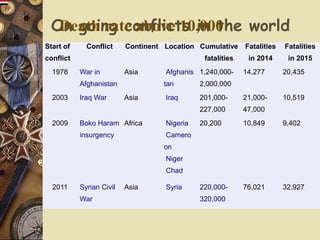
On going conflicts in the world
Start of
conflict
Conflict Continent Location Cumulative
fatalities
Fatalities
in 2014
Fatalities
in 2015
1978 War in
Afghanistan
Asia Afghanis
tan
1,240,000-
2,000,000
14,277 20,435
2003 Iraq War Asia Iraq 201,000-
227,000
21,000-
47,000
10,519
2009 Boko Haram
insurgency
Africa Nigeria
Camero
on
Niger
Chad
20,200 10,849 9,402
2011 Syrian Civil
War
Asia Syria 220,000-
320,000
76,021 32,927
Death rate above 10,000
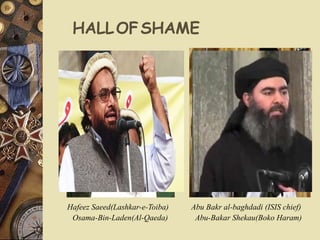
HALLOFSHAME
Osama-Bin-Laden(Al-Qaeda) Abu-Bakar Shekau(Boko Haram)
Hafeez Saeed(Lashkar-e-Toiba) Abu Bakr al-baghdadi (ISIS chief)
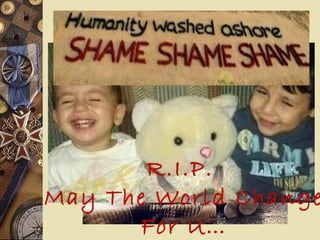
R.I.P.
May The World Change
For U…
War and Terrorism

War and Terrorism

  • 1.
    War and Terrorism Group Members: •JigarAdhiya •Omang Karia •Girish Panchal •Divyesh Panchal •Akshay Gujarathi •Manasvi Rathod
  • 2.
    Introduction to War “Ofall the enemies to public liberty, war is, perhaps, the most to be dreaded because it comprises and develops the germ of every other. War is the parent of armies; from these proceed debts and taxes … known instruments for bringing the many under the domination of the few.… No nation could preserve its freedom in the midst of continual warfare.” James Madison, Political Observations, 1795 • War- generally described as state of arm conflict between societies. • Some scholars see war as a universal and ancestral aspect of human nature, others argue that it is only a result of specific socio-cultural or ecological circumstances.
  • 3.
    War has beenfar too common in human history and thus is the central problem of international relations. • Many political scientists and foreign policymakers view war as the continuation of politics: When diplomacy fails, some states decide to use force. • Others see war as the result of a breakdown of the modern international system because so many of the rules of international institutions were designed to reduce conflict among states. Introduction to War
  • 4.
    Types of War Althoughall wars are violent, not all wars are the same. In fact, there are many different types of wars, which can be classified according to which people actually fight, the intensity of the conflict, and the extent of combatants’ use of violence, among other factors. 1. Total war 2. Limited war 3. Guerrilla war 4. Civil war 5. Proxy war
  • 5.
    Nine largest wars Deaths (millions) DateWar 60.7–84.6 1939–1945 World War II (see World War II casualties) 60 13th century Mongol Conquests (see Mongol invasions and Tatar invasions) 40 1850–1864 Taiping Rebellion (see Dungan revolt) 39 1914–1918 World War I (see World War I casualties) 36 755–763 An Shi Rebellion (number exaggerated based on census system, but not considering the territorial shrink and inefficient census system afterwar) 20 1937–1945 Second Sino-Japanese War 20 1370–1405 Conquests of Tamerlane 16 1862–1877 Dungan revolt 5–9 1917–1922 Russian Civil War and Foreign Intervention
  • 6.
    Top 5 Sellersof Arms in the World • United States • China • UK • France • Russia
  • 7.
    War –The RealCost?  In the year 2010 total world military spending came to $1600billion (or $236 for each person on the planet) a 50% increase in the 10 year period since 2001.
  • 8.
    Spending for peacevs spending for war “There is a large gap between what countries are prepared to allocate for military means to provide security and maintain their global and regional power status, on the one hand, and to alleviate poverty and promote economic development, on the other.” Stockholm International Peace Research Institute
  • 9.
    War versus Poverty oThe $1600 billion spent in the year 2011 on the arms industry could have tackled some of the greatest needs of our world. o Providing basic health care to those currently without - $20 billion per annum. o Providing shelter to those without it - $21 billion per annum. o Provide literacy for all - $5 billion per annum. o Eliminate starvation and malnourishment - $25 billion per annum. o Provide safe clean water for all - $50 billion per annum. Total cost - $129 billion per annum.
  • 10.
    The Human Costof War 1. Crops, land and environment are destroyed. 2. Destruction of food stores, shops and property. 3. Inflation increases dramatically at times of conflict leading to poverty for most of the population. 4. People are forced to flee and become refugees or internally displaced. 5. Much trade and small business ceases. 6. Governments stop spending on social needs and divert funds to military hardware. 7. Roads and means of travel are often dangerous. 8. It can be difficult to get access for emergency relief. 9. Young people are forced to become soldiers.
  • 11.
    Targeting innocent civilians duringa war or during peace time with the ultimate goal of creating psychological fear on civilians.
  • 12.
    Types of terrorism 1.Civil terrorism 2. Political terrorism 3. Limited political terrorism 4. Official or state terrorism 5. Passive terrorism 6. Religious Terrorism
  • 13.
    Major terrorist groupsin the world 1. Al-Qaeda and Taliban 2. Boko Haram 3. Lashkar-e-Toiba (LeT) 4. ISIS
  • 14.
  • 15.
    War Fought AgainstYear Indo - Pak Pakistan 1947 Operation Polo Hyderabad 1948 Goa Liberation War Portuguese 1961 Indo - China China 1962 Indo - Pak Pakistan 1965 Indo - Pak Pakistan 1971 Kargil War Pakistan 1999
  • 16.
    10 Major Terroristattacks in INDIA 1. German Bakery Bomb Blast, Koregaon Park, Pune 2. Mumbai Terrorist Attacks 3. Bangalore Series Blast 4. Jaipur Bombings 5. Mumbai Train Bombings 6. Malegaon Blasts 7. Varanasi Bombings 8. Ram JanmBhumi Attack, Ayodhya 9. Delhi Serial Bombings 10.Indian Parliament Attack Mumbai Attack
  • 17.
    Naxalism `Naxalism` is aninformal name given to radical, often violent, revolutionary communist groups that were born out of the Sino-Soviet split in the Indian communist movement. • Naxalites are those who fight for freedom of the downtrodden and equal social and financial status for all , irrespective of class, caste and religion. • A radical who employs terror as a political weapon; usually organizes with other terrorists in small cells; often uses religion as a cover for terrorist activities. • They are organised mostly where there is forest cover.
  • 18.
    On going conflictsin the world Start of conflict Conflict Continent Location Cumulative fatalities Fatalities in 2014 Fatalities in 2015 1978 War in Afghanistan Asia Afghanis tan 1,240,000- 2,000,000 14,277 20,435 2003 Iraq War Asia Iraq 201,000- 227,000 21,000- 47,000 10,519 2009 Boko Haram insurgency Africa Nigeria Camero on Niger Chad 20,200 10,849 9,402 2011 Syrian Civil War Asia Syria 220,000- 320,000 76,021 32,927 Death rate above 10,000
  • 19.
    HALLOFSHAME Osama-Bin-Laden(Al-Qaeda) Abu-Bakar Shekau(BokoHaram) Hafeez Saeed(Lashkar-e-Toiba) Abu Bakr al-baghdadi (ISIS chief)
  • 20.
    R.I.P. May The WorldChange For U…

Editor's Notes

  • #2 <number>
  • #5 1.) A total war is a war in which combatants use every resource available to destroy the social fabric of the enemy. Total wars are highly destructive and are characterized by mass civilian casualties because winning a total war often requires combatants to break the people’s will to continue fighting. World Wars I and II were total wars, marked by the complete destruction of the civilian economy and society in many countries, including France, Germany, the Soviet Union, Italy, Great Britain, and Japan. 2.) A limited war is a war fought primarily between professional armies to achieve specific political objectives without causing widespread destruction. Although the total of civilian casualties may be high, combatants do not seek to completely destroy the enemy’s social and economic frameworks. The Persian Gulf War of 1990–1991 was a limited war in which the United States and its allies forcibly removed Iraqi troops from Kuwait 3.) A guerrilla war is a war in which one or both combatants use small, lightly armed militia units rather than professional, organized armies. Guerrilla fighters usually seek to topple their government, often enjoying the support of the people. These wars are often very long but also tend to be successful for the insurgents as evidenced by Mao Zedong’s victory over Chiang Kai-shek in China in the 1940s, the Vietcong’s victory over the United States in the Vietnam War, and the Mujahideen’s victory over the Soviet Union in Afghanistan in the 1980s. 4.) A civil war is a war fought within a single country between or among different groups of citizens who want to control the government and do not recognize another group’s right to rule. Civil wars are almost always total wars because each side feels compelled to destroy the enemy’s political support base. Regional rifts, such as the American Civil War between the North and the South, characterize some civil wars, whereas other civil wars have been fought among ethnic rivals, religious rivals, and rival clans. Revolutions can spark civil wars as well. 5.) A proxy war is a war fought by third parties rather than by the enemy states themselves. Many of the militarized conflicts during the Cold War, such as the Korean War and the Vietnam War, can be interpreted as proxy wars between the United States and the Soviet Union, neither of which wanted to fight each other directly. A war can often be a limited war, a guerrilla war, and a civil war all at the same time. The Soviet invasion of Afghanistan in 1979 is a great example. The United States sent trainers, money, and weapons to Afghan rebels to fight against the invaders, making it a low-intensity, limited conflict from the U.S. point of view. The Afghan resistance mostly relied on guerrilla tactics. And the war split Afghanistan, so it was also a civil war. <number>
  • #6 Deaths (millions) Date War 60.7–84.6 1939–1945 World War II (see World War II casualties)  60 13th century Mongol Conquests (see Mongol invasions and Tatar invasions) 40 1850–1864 Taiping Rebellion (see Dungan revolt) 39 1914–1918 World War I (see World War I casualties) 36 755–763 An Shi Rebellion (number exaggerated based on census system, but not considering the territorial shrink and inefficient census system afterwar) 20 1937–1945 Second Sino-Japanese War 20 1370–1405 Conquests of Tamerlane 16 1862–1877 Dungan revolt 5–9 1917–1922 Russian Civil War and Foreign Intervention <number>
  • #10 Are these figures surprising or shocking? Who makes the choices here? Why do we spend more on war than on peace? What does this say about the world that we live in? <number>
  • #18 `Naxalism` is an informal name given to radical, often violent, revolutionary communist groups that were born out of the Sino-Soviet split in the Indian communist movement. Naxalites are those who fight for freedom of the downtrodden and equal social and financial status for all , irrespective of class, caste and religion. A radical who employs terror as a political weapon; usually organizes with other terrorists in small cells; often uses religion as a cover for terrorist activities. They are organised mostly where there is a forest cover. <number>
  • #20 Osama-Bin-Laden(Al-Qaeda) Abu-Bakar Shekau(Boko Haram) Hafeez Saeed(Lashkar-e-Toiba) Abu Bakr al-baghdadi (ISIS chief) <number>