Presenter:
Aruna Shastri
M.Sc Nsg1st yr.
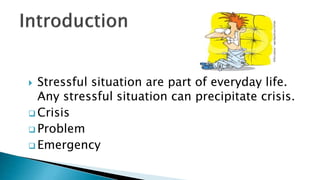
 Stressful situation are part of everyday life.
Any stressful situation can precipitate crisis.
 Crisis
 Problem
 Emergency
According to Larngerquist
Crisis is a sudden event in one’s life that
disturbs homeostasis, during which the
individual’s usual coping mechanisms cannot
resolve the problem.
 Crisis occurs in all the individuals.
 Its is not always related to psychopathology.
 Crisis are precipitated by specific identifiable
events.
 It’s an integral component of everyday life
situations.
 Crises are personal by nature.
 Crises are acute and it gets resolved by
within a brief period.
 A crisis situation contains the potential for
psychological growth or deterioration.
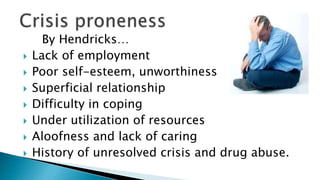
By Hendricks…
 Lack of employment
 Poor self-esteem, unworthiness
 Superficial relationship
 Difficulty in coping
 Under utilization of resources
 Aloofness and lack of caring
 History of unresolved crisis and drug abuse.
Phase 1:The individual is exposed to a precipitating
stressor
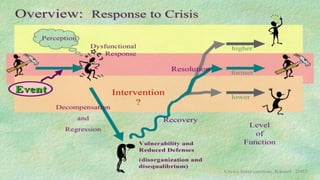
 Anxiety increases and the previous problem
solving techniques are used
When the previous problem solving techniques do
not relieve the stressor ,anxiety increases further.
 The individual begins to feel great deal of
discomfort at this point.
 Coping techniques that have worked in the past
are attempted .
 When they are not successful ,that will create
feeling of helplessness.
All possible resources both internal and
external ,are called on to solve the problems
and relieve the discomfort.
 The individual may try to look at the problem
from different perspectives.
 New problem solving techniques are used.
 If it is effective the individual will come out of
the stressful situation
If resolution does not occur ,the tension
mounts beyond then threshold and individual
reaches to a breaking point.
 Anxiety will reach to a panic level.
 Cognitive functions get disordered.
 Behavior may reflect psychotic thinking.
Baldwin in 1978 has identified six classes
of emotional crisis.
Class 1: Dispositional crisis
 It is an acute response to an external
situational stressor.
 E.g. physical and verbal abuse from husband.
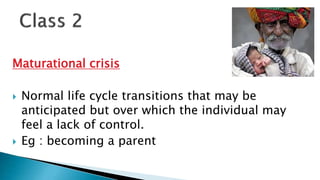
Maturational crisis
 Normal life cycle transitions that may be
anticipated but over which the individual may
feel a lack of control.
 Eg : becoming a parent
Crisis resulting from traumatic stress.
 Crisis precipitated by unexpected external
stresses over which the individual has little or
no control and from which he or she feels
emotionally overwhelmed and defeated.
 Eg :victim of a rape
Crisis reflecting psychopathology
Emotional crisis in which preexisting
psychopathology has been instrumental
in precipitating the crises.
Or psychopathology may complicates the
adaptive resolution
Eg :borderline personalty,neuroses etc
Psychiatric emergencies
Crisis situation in which general functioning
has been severely impaired.
Individual is unable to assume personal
responsibility.
Eg : suicidal individuals, alcohol intoxication
etc
Social Crisis
Accidental, uncommon, and result in multiple
losses.
eg: Floods, earthquakes, violence and mass
killings etc.
 Heavy burden of free floating anxiety.
 Depression.
 Anger.
 Incapability in ADL.
 Irrational and blaming others.
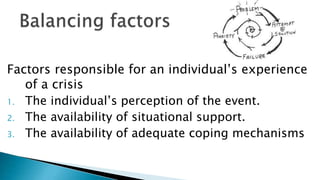
Factors responsible for an individual’s experience
of a crisis
1. The individual’s perception of the event.
2. The availability of situational support.
3. The availability of adequate coping mechanisms
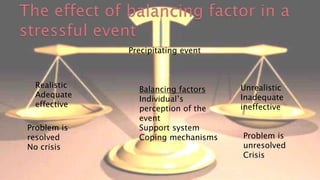
Realistic
Adequate
effective
Unrealistic
Inadequate
ineffective
Balancing factors
Individual’s
perception of the
event
Support system
Coping mechanisms
Problem is
resolved
No crisis
Problem is
unresolved
Crisis
Precipitating event
Pseudo-resolution
 Uses repression
 Relapsing of feelings
 Unsuccessful resolution
pathological adaptation
eg: prolonged grief leads to depression
 Successful resolution
Technique used to help an individual or family
to understand and cope with the intense
feelings that are typical of a crisis.
 To provide a correct cognitive perception of
the situation.
 To assist the individual in managing the
intense and overwhelming feelings associated
with the crisis.
a) Assessment of the situation
direct questioning
support systems
strengths and limitations
b) Defining the event
review of incidents
to make aware of the event
c) Develop a plan of action
Include all the support
a) Helping the individual to be aware of the
feelings
identify his own feelings
appropriate communication techniques
observe verbal and non verbal behavior.
b) Helping the individual to attain mastery over
the feelings
Avoid false re assurance
Not encourage to blame others
Prevent too much dependency
Environmental manipulation
Follow up
Phase 1 : Assessment
Gather information regarding the
precipitating stressor
Resulting crisis that prompted the individual
to seek help.
 Describe the event that precipitated crisis?
 When it occurred?
 Assess physical and mental status
 Determine whether the individual has
experienced this stressor before?
 If ,how did he cope?
 Have these methods been tried this time?
 Assess suicide or homicide?
 Support system?
 Level of pre-crisis functioning?
 Individual’s perception of personal strengths
and limitations?
 H/o substance use?
 Risk for injury
 Anxiety
 Fear
 Disturbed thought process
 Risk for post trauma syndrome
 Ineffective community coping
 Risk for self or other directed violence
 Selects appropriate nursing action for the
identified nursing diagnoses
 The type of crisis and individual’s strength
and available resources for support are taken
into consideration
 Environmental manipulation
 General support
 Generic approach
Debriefing
 Individual approach
 Catharsis
 Clarification
 Manipulation
 Reinforcement of behavior
 Support of defences
 Increasing self esteem
 Exploration of solutions
 Reassessment is made to see if the stated
objectives were achieved
 Have positive behavioral changes occurred ?
 New coping strategies have been effective?
 Has the individual gained insight out of
experience?
 Does the individual believe that he could
respond with healthy adaptation in future
stressful situation to prevent the
development of crisis?
 Can he describe a plan for dealing with
similar stress in the future?
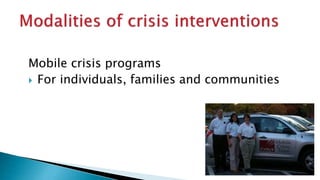
Mobile crisis programs
 For individuals, families and communities
 Telephone contacts
Group work
Disaster response
Victim outreach program
 Crisis intervention centers
 Save India Family Foundation, Banglore.
 Sumaitri, Delhi
 Lifeline Foundation, Kolkata
 Maithri,Kerala
 Health education
Crisis intervention is more than a shoulder to
cry on, a hand to hold, or an ear with which
to listen. It involves skill and knowledge,
combined in a simple but powerful way,
providing victims with a sense of safety and
security.
 Definition
 Characteristics of crisis
 Phases of crisis
 Types of crisis
 Balancing factors
 Crisis intervention and role of nurse
 Mary C Townsend,Psychiatric Mental Health
Nursing,4th edition,F.A Davis publication;page
no:194 to 205
 Gail W,stuart,Michele T Lararia,principles and
practice of psychiatric nursing ,8th
edition,Elsevier pub;page no:222 to 237
Crisis intervention

Crisis intervention

  • 1.
  • 2.
     Stressful situationare part of everyday life. Any stressful situation can precipitate crisis.  Crisis  Problem  Emergency
  • 3.
    According to Larngerquist Crisisis a sudden event in one’s life that disturbs homeostasis, during which the individual’s usual coping mechanisms cannot resolve the problem.
  • 4.
     Crisis occursin all the individuals.  Its is not always related to psychopathology.  Crisis are precipitated by specific identifiable events.  It’s an integral component of everyday life situations.
  • 5.
     Crises arepersonal by nature.  Crises are acute and it gets resolved by within a brief period.  A crisis situation contains the potential for psychological growth or deterioration.
  • 6.
    By Hendricks…  Lackof employment  Poor self-esteem, unworthiness  Superficial relationship  Difficulty in coping  Under utilization of resources  Aloofness and lack of caring  History of unresolved crisis and drug abuse.
  • 7.
    Phase 1:The individualis exposed to a precipitating stressor  Anxiety increases and the previous problem solving techniques are used
  • 8.
    When the previousproblem solving techniques do not relieve the stressor ,anxiety increases further.  The individual begins to feel great deal of discomfort at this point.  Coping techniques that have worked in the past are attempted .  When they are not successful ,that will create feeling of helplessness.
  • 9.
    All possible resourcesboth internal and external ,are called on to solve the problems and relieve the discomfort.  The individual may try to look at the problem from different perspectives.  New problem solving techniques are used.  If it is effective the individual will come out of the stressful situation
  • 10.
    If resolution doesnot occur ,the tension mounts beyond then threshold and individual reaches to a breaking point.  Anxiety will reach to a panic level.  Cognitive functions get disordered.  Behavior may reflect psychotic thinking.
  • 12.
    Baldwin in 1978has identified six classes of emotional crisis. Class 1: Dispositional crisis  It is an acute response to an external situational stressor.  E.g. physical and verbal abuse from husband.
  • 13.
    Maturational crisis  Normallife cycle transitions that may be anticipated but over which the individual may feel a lack of control.  Eg : becoming a parent
  • 14.
    Crisis resulting fromtraumatic stress.  Crisis precipitated by unexpected external stresses over which the individual has little or no control and from which he or she feels emotionally overwhelmed and defeated.  Eg :victim of a rape
  • 15.
    Crisis reflecting psychopathology Emotionalcrisis in which preexisting psychopathology has been instrumental in precipitating the crises. Or psychopathology may complicates the adaptive resolution Eg :borderline personalty,neuroses etc
  • 16.
    Psychiatric emergencies Crisis situationin which general functioning has been severely impaired. Individual is unable to assume personal responsibility. Eg : suicidal individuals, alcohol intoxication etc
  • 17.
    Social Crisis Accidental, uncommon,and result in multiple losses. eg: Floods, earthquakes, violence and mass killings etc.
  • 18.
     Heavy burdenof free floating anxiety.  Depression.  Anger.  Incapability in ADL.  Irrational and blaming others.
  • 19.
    Factors responsible foran individual’s experience of a crisis 1. The individual’s perception of the event. 2. The availability of situational support. 3. The availability of adequate coping mechanisms
  • 20.
    Realistic Adequate effective Unrealistic Inadequate ineffective Balancing factors Individual’s perception ofthe event Support system Coping mechanisms Problem is resolved No crisis Problem is unresolved Crisis Precipitating event
  • 21.
  • 22.
     Unsuccessful resolution pathologicaladaptation eg: prolonged grief leads to depression
  • 23.
  • 24.
    Technique used tohelp an individual or family to understand and cope with the intense feelings that are typical of a crisis.
  • 25.
     To providea correct cognitive perception of the situation.  To assist the individual in managing the intense and overwhelming feelings associated with the crisis.
  • 26.
    a) Assessment ofthe situation direct questioning support systems strengths and limitations
  • 27.
    b) Defining theevent review of incidents to make aware of the event
  • 28.
    c) Develop aplan of action Include all the support
  • 29.
    a) Helping theindividual to be aware of the feelings identify his own feelings appropriate communication techniques observe verbal and non verbal behavior.
  • 30.
    b) Helping theindividual to attain mastery over the feelings Avoid false re assurance Not encourage to blame others Prevent too much dependency Environmental manipulation Follow up
  • 31.
    Phase 1 :Assessment Gather information regarding the precipitating stressor Resulting crisis that prompted the individual to seek help.
  • 32.
     Describe theevent that precipitated crisis?  When it occurred?  Assess physical and mental status  Determine whether the individual has experienced this stressor before?  If ,how did he cope?  Have these methods been tried this time?
  • 33.
     Assess suicideor homicide?  Support system?  Level of pre-crisis functioning?  Individual’s perception of personal strengths and limitations?  H/o substance use?
  • 34.
     Risk forinjury  Anxiety  Fear  Disturbed thought process  Risk for post trauma syndrome  Ineffective community coping  Risk for self or other directed violence
  • 35.
     Selects appropriatenursing action for the identified nursing diagnoses  The type of crisis and individual’s strength and available resources for support are taken into consideration
  • 36.
     Environmental manipulation General support  Generic approach Debriefing  Individual approach
  • 37.
     Catharsis  Clarification Manipulation  Reinforcement of behavior  Support of defences  Increasing self esteem  Exploration of solutions
  • 38.
     Reassessment ismade to see if the stated objectives were achieved  Have positive behavioral changes occurred ?  New coping strategies have been effective?
  • 39.
     Has theindividual gained insight out of experience?  Does the individual believe that he could respond with healthy adaptation in future stressful situation to prevent the development of crisis?  Can he describe a plan for dealing with similar stress in the future?
  • 40.
    Mobile crisis programs For individuals, families and communities
  • 41.
  • 42.
  • 43.
  • 44.
  • 45.
     Crisis interventioncenters  Save India Family Foundation, Banglore.  Sumaitri, Delhi  Lifeline Foundation, Kolkata  Maithri,Kerala  Health education
  • 46.
    Crisis intervention ismore than a shoulder to cry on, a hand to hold, or an ear with which to listen. It involves skill and knowledge, combined in a simple but powerful way, providing victims with a sense of safety and security.
  • 47.
     Definition  Characteristicsof crisis  Phases of crisis  Types of crisis  Balancing factors  Crisis intervention and role of nurse
  • 48.
     Mary CTownsend,Psychiatric Mental Health Nursing,4th edition,F.A Davis publication;page no:194 to 205  Gail W,stuart,Michele T Lararia,principles and practice of psychiatric nursing ,8th edition,Elsevier pub;page no:222 to 237

Editor's Notes

  • #3 Crisis intervention requires problem –solving skills that are often diminished by the level of anxiety . Therefore assistance is required to solve the problem and preserve the self esteem.