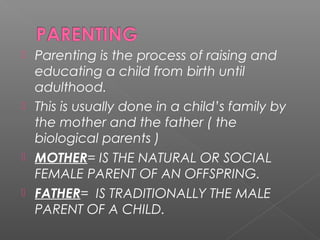
 Parenting is the process of raising and
  educating a child from birth until
  adulthood.
 This is usually done in a child’s family by
  the mother and the father ( the
  biological parents )
 MOTHER= IS THE NATURAL OR SOCIAL
  FEMALE PARENT OF AN OFFSPRING.
 FATHER= IS TRADITIONALLY THE MALE
  PARENT OF A CHILD.
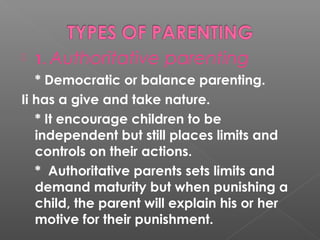
   1. Authoritative   parenting
   * Democratic or balance parenting.
Ii has a give and take nature.
   * It encourage children to be
   independent but still places limits and
   controls on their actions.
   * Authoritative parents sets limits and
   demand maturity but when punishing a
   child, the parent will explain his or her
   motive for their punishment.
   Parent are attentive to their children's
    needs and concerns and will typically
    forgive and teach instead of punishing if
    a child falls short.

 Result in children having a higher self
  esteem.
 This is the most recommended style of
  parenting by child rearing experts.
 Also called strict parenting.
 Characterized by high expectations of
  conformity and compliance to parental
  rules and directions.
 It is a restrictive punitive style in which
  parents advise the child to follow their
  directions and to respect their work and
  effort.
   Authoritarian parents expect
    much of their child but generally
    do not explain the reason for the
    rules and boundaries.

   Authoritarian parents are less
    responsive to their children’s
    needs and are more likely to
    spank a child rather than discuss
    the problem.
 Permissive parents want to and tend to
  give up most control of the home and
  family life to their children.
 Parents make very few rules and even
  when they do decide to make a rule,
  the rules that they make are usually not
  enforced all the time or properly.
 Parents want children to feel as if they
  can be free to do or say as they wish.
 This is also called uninvolved, detached,
  dismissive or hands- off parenting style.
 The parents are low in warmth and
  control and are generally not involved in
  the child’s life.
 Parents are emotionally unsupportive of
  their children but will still provide their
  basic needs.
   Refers to the ability of
    the couple or parents
    to respond to the
    needs and aspiration
    of the family and
    children.
 The size of the family should be a shared
  responsibility of couples or parents based
  on their available resources and the
  standard of living they wish to achieve.
 By waiting to get married and have
  children, young people can give
  themselves more time to pursue the
  things that can help to make them
  better partners and parents- education,
  employment, personal maturity, self
  confidence etc

Parenting ppt

  • 2.
     Parenting isthe process of raising and educating a child from birth until adulthood.  This is usually done in a child’s family by the mother and the father ( the biological parents )  MOTHER= IS THE NATURAL OR SOCIAL FEMALE PARENT OF AN OFFSPRING.  FATHER= IS TRADITIONALLY THE MALE PARENT OF A CHILD.
  • 3.
    1. Authoritative parenting * Democratic or balance parenting. Ii has a give and take nature. * It encourage children to be independent but still places limits and controls on their actions. * Authoritative parents sets limits and demand maturity but when punishing a child, the parent will explain his or her motive for their punishment.
  • 4.
    Parent are attentive to their children's needs and concerns and will typically forgive and teach instead of punishing if a child falls short.  Result in children having a higher self esteem.  This is the most recommended style of parenting by child rearing experts.
  • 5.
     Also calledstrict parenting.  Characterized by high expectations of conformity and compliance to parental rules and directions.  It is a restrictive punitive style in which parents advise the child to follow their directions and to respect their work and effort.
  • 6.
    Authoritarian parents expect much of their child but generally do not explain the reason for the rules and boundaries.  Authoritarian parents are less responsive to their children’s needs and are more likely to spank a child rather than discuss the problem.
  • 7.
     Permissive parentswant to and tend to give up most control of the home and family life to their children.  Parents make very few rules and even when they do decide to make a rule, the rules that they make are usually not enforced all the time or properly.  Parents want children to feel as if they can be free to do or say as they wish.
  • 8.
     This isalso called uninvolved, detached, dismissive or hands- off parenting style.  The parents are low in warmth and control and are generally not involved in the child’s life.  Parents are emotionally unsupportive of their children but will still provide their basic needs.
  • 9.
    Refers to the ability of the couple or parents to respond to the needs and aspiration of the family and children.
  • 10.
     The sizeof the family should be a shared responsibility of couples or parents based on their available resources and the standard of living they wish to achieve.  By waiting to get married and have children, young people can give themselves more time to pursue the things that can help to make them better partners and parents- education, employment, personal maturity, self confidence etc