Strategic Management 
Life-cycle Strategies
Industry Life-cycle Analysis 
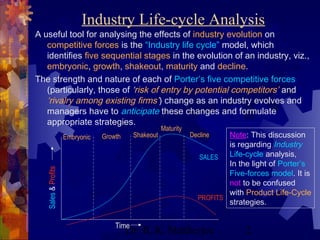
A useful tool for analysing the effects of industry evolution on 
competitive forces is the “Industry life cycle” model, which 
identifies five sequential stages in the evolution of an industry, viz., 
embryonic, growth, shakeout, maturity and decline. 
The strength and nature of each of Porter’s five competitive forces 
(particularly, those of ‘risk of entry by potential competitors’ and 
‘rivalry among existing firms’) change as an industry evolves and 
managers have to anticipate these changes and formulate 
appropriate strategies. 
Embryonic Growth Shakeout 
Dr. B. K. Mukherjee 2 
Sales & Profits 
Time 
Maturity 
Decline 
SALES 
PROFITS 
Note: This discussion 
is regarding Industry 
Life-cycle analysis, 
In the light of Porter’s 
Five-forces model. It is 
not to be confused 
with Product Life-Cycle 
strategies.
Stage v/s Strategy 
EMBRYONIC STATE: Industry is just beginning to develop (eg., personal 
computers in 1976). Growth at this stage is slow due to factors such as: 
 Buyers’ unfamiliarity with the industry’s products, 
 High prices due to poor economies of scale, and 
 Poorly developed distribution channels. 
Barriers to entry tend to be based on access to key technological know-how. 
Higher the complexity, higher the barrier for new entrants. 
Rivalry is based not so much on price as on 
 educating customers, 
 opening up distribution channels, and 
 perfecting the design of the product. 
The company that is first to solve design problems or employ innovative 
efforts is often able to build up a significant market share, eg. Personal 
computers (Apple), vacuum cleaners (Hoover) and photocopiers (Xerox – 
the ultimate proof of the success of a brand). 
The company has major opportunity to capitalize on the lack of rivalry and 
build up a strong market presence. 
Dr. B. K. Mukherjee 3
Growth stage 
In this stage, demand is expanding rapidly and the industry’s products take 
Dr. B. K. Mukherjee 4 
off because 
 Customers have become familiar with the product, 
 Prices fall because experience and economies of scale have been 
attained, and 
 Distribution channels have developed. 
The U.S. cell-phone industry was in the growth stage most of the 1990s. In 
1990 there were only 5 million cellular subscribers in the nation. By 2002, 
this figure had increased to 88 million and demand was growing @ more 
than 25% per year. 
Entry barriers: Control over technological knowledge has diminished by this 
time, also few companies have yet achieved significant scale of 
economies or built brand loyalty. Thus, threat from potential competitors 
is generally highest at this point. 
Rivalry: High growth rate usually means new entrants can be absorbed into 
an industry without marked increase in intensity of rivalry. Thus, rivalry 
tends to relatively low. A strategically aware company takes advantage of 
this relatively benign environment to prepare itself for the forthcoming 
intense competition in the shakeout stage.
Industry Shakeout 
Explosive growth cannot be maintained indefinitely. Sooner or 
later, rate of growth slows, demand approaches saturation 
levels and most of the demand is limited to replacement 
because there are few potential first-time buyers left (eg., U.S. 
personal computer industry – Dell Computers case). 
As an industry enters the shakeout stage, rivalry between 
companies become intense. 
Companies accustomed to rapid growth had in the past installed 
large production facilities. However, demand is no longer 
growing at historical rates, resulting today in excess capacity. 
Rivalry: In an attempt to utilize this capacity, companies often cut 
prices. The result can be a price war, which drives many of the 
most inefficient companies to bankruptcy. 
New entrants: Not a significant factor at this stage. It is now a case 
of “survival of the fittest” which is enough to deter any new 
entry. 
Dr. B. K. Mukherjee 5
Mature stage 
The companies that survive the shakeout enter the mature stage of the 
industry: the market is totally saturated, demand is limited to replacement 
demand, and growth is low or zero. Whatever growth there is comes from 
population expansion or from increase in replacement demand. 
Barriers to entry increase and the threat of entry from potential competitors 
decrease. Competition for market share drives down prices, often resulting 
in a price war (eg. Airline and PC industries). To survive the shakeout, 
companies begin to focus on cost minimization and building brand loyalty 
(eg, low-cost airlines and ‘frequent flyer’ programs, excellent after-sales 
service by PC companies). Only those with brand loyalty and low-cost 
operations will survive. 
At the same time, high entry barriers in mature industries give companies the 
opportunity to increase prices and profits. The end result will be a more 
consolidated industry structure. 
Rivalry: In mature industries, companies tend to recognize their 
interdependence. They try to avoid price wars and enter into cartels/price 
leadership/market segment agreements (eg, the domestic pressure cooker 
industry), thereby allowing greater profitability. 
However, an economic slump can depress industry demand, reduce profits, 
break down agreements, increase rivalry and result in renewed price wars. 
Dr. B. K. Mukherjee 6
Decline stage 
Eventually, most industries enter a decline stage: growth becomes negative 
for a variety of reasons, including 
 Technological substitution (eg, air travel for rail travel); 
 Social changes (eg, greater health consciousness hitting tobacco sales); 
 Demographics (declining birthrate hurting the babycare and child products 
Dr. B. K. Mukherjee 7 
market); and 
 International competition (cheap Chinese imports flooding many world 
markets). 
The main problem is once again that of excess capacity and, in such a 
scenario, rivalry among established companies usually increases. 
Exit barriers play a part in adjusting excess capacity. The greater the exit 
barriers, the harder it is for companies to reduce capacity and greater is 
the threat of severe price competition. 
(However, there is always the scope for ‘end-game strategy’ at this stage). 
In summary, Strategic managers have to tailor their strategies to changing 
industry conditions. They have to learn to recognize the crucial points in an 
industry’s development so that they can forecast when the shakeout stage 
might begin or when the industry might move into decline.

9. life cycle strategies

  • 1.
  • 2.
    Industry Life-cycle Analysis A useful tool for analysing the effects of industry evolution on competitive forces is the “Industry life cycle” model, which identifies five sequential stages in the evolution of an industry, viz., embryonic, growth, shakeout, maturity and decline. The strength and nature of each of Porter’s five competitive forces (particularly, those of ‘risk of entry by potential competitors’ and ‘rivalry among existing firms’) change as an industry evolves and managers have to anticipate these changes and formulate appropriate strategies. Embryonic Growth Shakeout Dr. B. K. Mukherjee 2 Sales & Profits Time Maturity Decline SALES PROFITS Note: This discussion is regarding Industry Life-cycle analysis, In the light of Porter’s Five-forces model. It is not to be confused with Product Life-Cycle strategies.
  • 3.
    Stage v/s Strategy EMBRYONIC STATE: Industry is just beginning to develop (eg., personal computers in 1976). Growth at this stage is slow due to factors such as:  Buyers’ unfamiliarity with the industry’s products,  High prices due to poor economies of scale, and  Poorly developed distribution channels. Barriers to entry tend to be based on access to key technological know-how. Higher the complexity, higher the barrier for new entrants. Rivalry is based not so much on price as on  educating customers,  opening up distribution channels, and  perfecting the design of the product. The company that is first to solve design problems or employ innovative efforts is often able to build up a significant market share, eg. Personal computers (Apple), vacuum cleaners (Hoover) and photocopiers (Xerox – the ultimate proof of the success of a brand). The company has major opportunity to capitalize on the lack of rivalry and build up a strong market presence. Dr. B. K. Mukherjee 3
  • 4.
    Growth stage Inthis stage, demand is expanding rapidly and the industry’s products take Dr. B. K. Mukherjee 4 off because  Customers have become familiar with the product,  Prices fall because experience and economies of scale have been attained, and  Distribution channels have developed. The U.S. cell-phone industry was in the growth stage most of the 1990s. In 1990 there were only 5 million cellular subscribers in the nation. By 2002, this figure had increased to 88 million and demand was growing @ more than 25% per year. Entry barriers: Control over technological knowledge has diminished by this time, also few companies have yet achieved significant scale of economies or built brand loyalty. Thus, threat from potential competitors is generally highest at this point. Rivalry: High growth rate usually means new entrants can be absorbed into an industry without marked increase in intensity of rivalry. Thus, rivalry tends to relatively low. A strategically aware company takes advantage of this relatively benign environment to prepare itself for the forthcoming intense competition in the shakeout stage.
  • 5.
    Industry Shakeout Explosivegrowth cannot be maintained indefinitely. Sooner or later, rate of growth slows, demand approaches saturation levels and most of the demand is limited to replacement because there are few potential first-time buyers left (eg., U.S. personal computer industry – Dell Computers case). As an industry enters the shakeout stage, rivalry between companies become intense. Companies accustomed to rapid growth had in the past installed large production facilities. However, demand is no longer growing at historical rates, resulting today in excess capacity. Rivalry: In an attempt to utilize this capacity, companies often cut prices. The result can be a price war, which drives many of the most inefficient companies to bankruptcy. New entrants: Not a significant factor at this stage. It is now a case of “survival of the fittest” which is enough to deter any new entry. Dr. B. K. Mukherjee 5
  • 6.
    Mature stage Thecompanies that survive the shakeout enter the mature stage of the industry: the market is totally saturated, demand is limited to replacement demand, and growth is low or zero. Whatever growth there is comes from population expansion or from increase in replacement demand. Barriers to entry increase and the threat of entry from potential competitors decrease. Competition for market share drives down prices, often resulting in a price war (eg. Airline and PC industries). To survive the shakeout, companies begin to focus on cost minimization and building brand loyalty (eg, low-cost airlines and ‘frequent flyer’ programs, excellent after-sales service by PC companies). Only those with brand loyalty and low-cost operations will survive. At the same time, high entry barriers in mature industries give companies the opportunity to increase prices and profits. The end result will be a more consolidated industry structure. Rivalry: In mature industries, companies tend to recognize their interdependence. They try to avoid price wars and enter into cartels/price leadership/market segment agreements (eg, the domestic pressure cooker industry), thereby allowing greater profitability. However, an economic slump can depress industry demand, reduce profits, break down agreements, increase rivalry and result in renewed price wars. Dr. B. K. Mukherjee 6
  • 7.
    Decline stage Eventually,most industries enter a decline stage: growth becomes negative for a variety of reasons, including  Technological substitution (eg, air travel for rail travel);  Social changes (eg, greater health consciousness hitting tobacco sales);  Demographics (declining birthrate hurting the babycare and child products Dr. B. K. Mukherjee 7 market); and  International competition (cheap Chinese imports flooding many world markets). The main problem is once again that of excess capacity and, in such a scenario, rivalry among established companies usually increases. Exit barriers play a part in adjusting excess capacity. The greater the exit barriers, the harder it is for companies to reduce capacity and greater is the threat of severe price competition. (However, there is always the scope for ‘end-game strategy’ at this stage). In summary, Strategic managers have to tailor their strategies to changing industry conditions. They have to learn to recognize the crucial points in an industry’s development so that they can forecast when the shakeout stage might begin or when the industry might move into decline.