Organization Development in
Global Settings
OD is now practiced in every region of the world as
the global expansion of many organizations has
generated complex and rapid growth.
Hofstede first developed his framework when his
research on IBM employees in 40 different countries
showed how differences in national cultures impact
management practices. He and his son have
continued to expand this research and other
researchers have replicated and expanded Hofstede’s
work and found support for his dimensions of
national culture
Cummings & Worley, 8e (c)2005 Thomson/South-Western
21
-3
» The rapid development of foreign economies
» The increasing worldwide availability of
technical and financial resources
» The emergence of a global economy
» Power Distance
» Uncertainty Avoidance
» Achievement Orientation
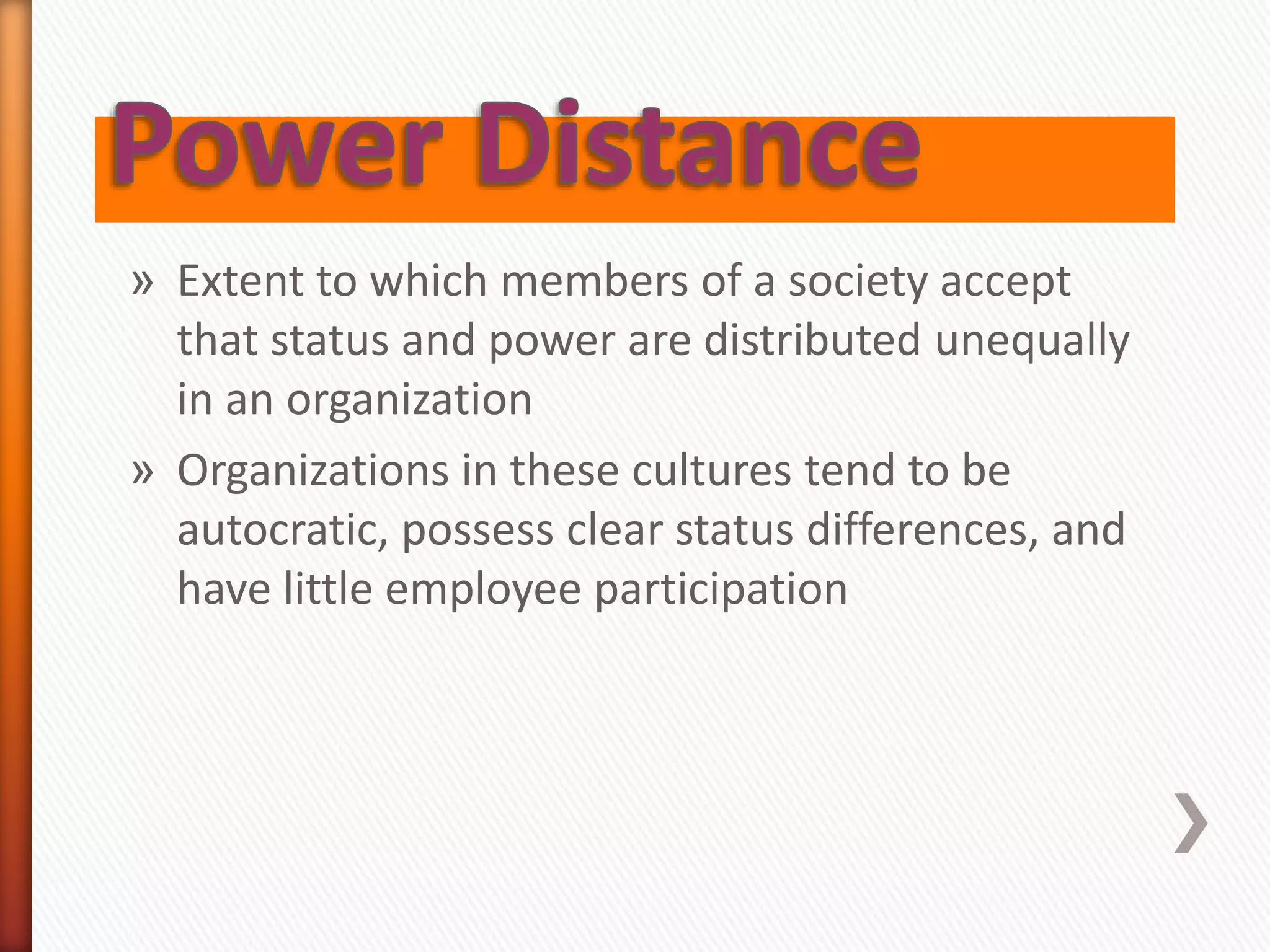
» Extent to which members of a society accept
that status and power are distributed unequally
in an organization
» Organizations in these cultures tend to be
autocratic, possess clear status differences, and
have little employee participation
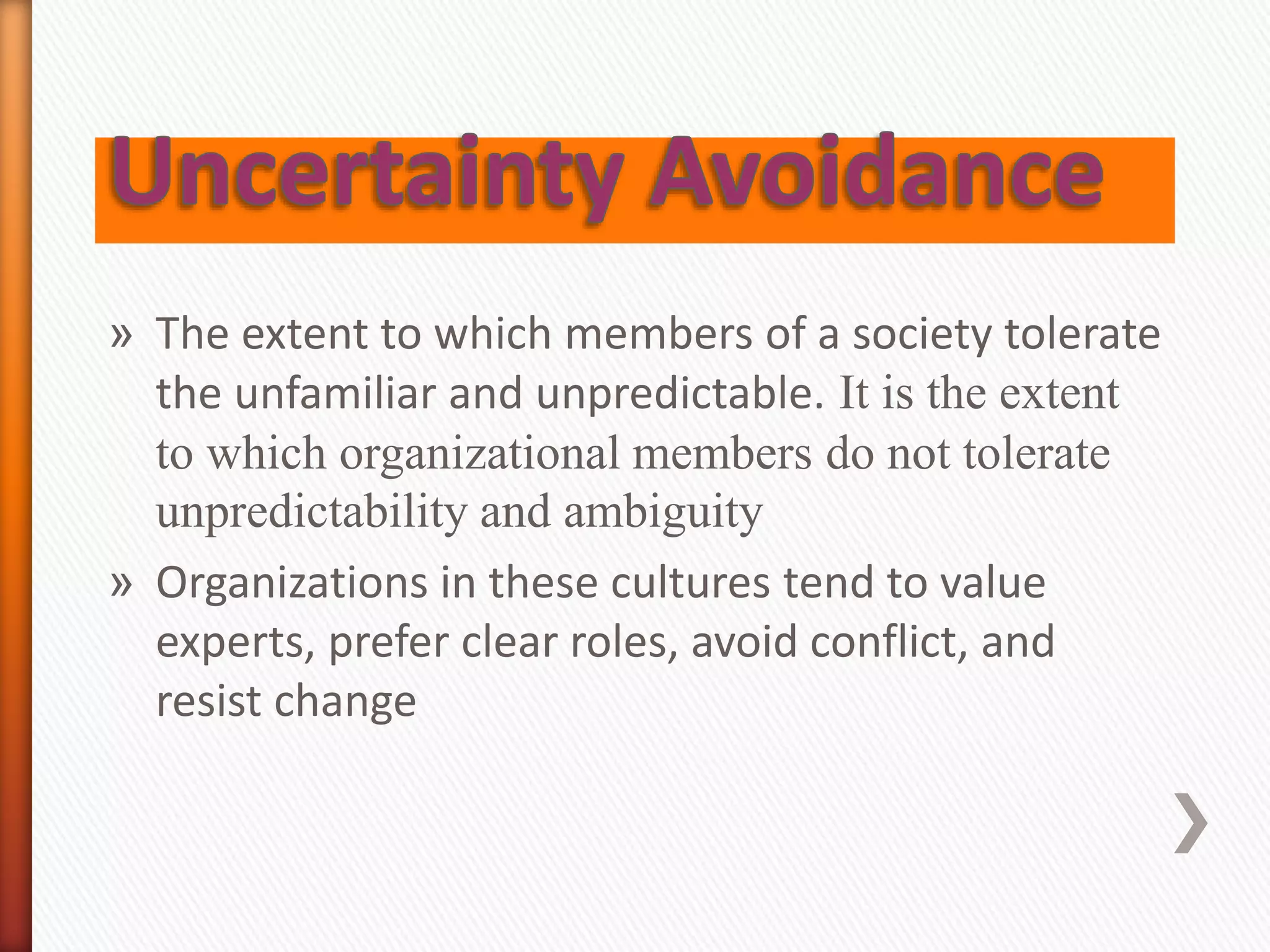
» The extent to which members of a society tolerate
the unfamiliar and unpredictable. It is the extent
to which organizational members do not tolerate
unpredictability and ambiguity
» Organizations in these cultures tend to value
experts, prefer clear roles, avoid conflict, and
resist change
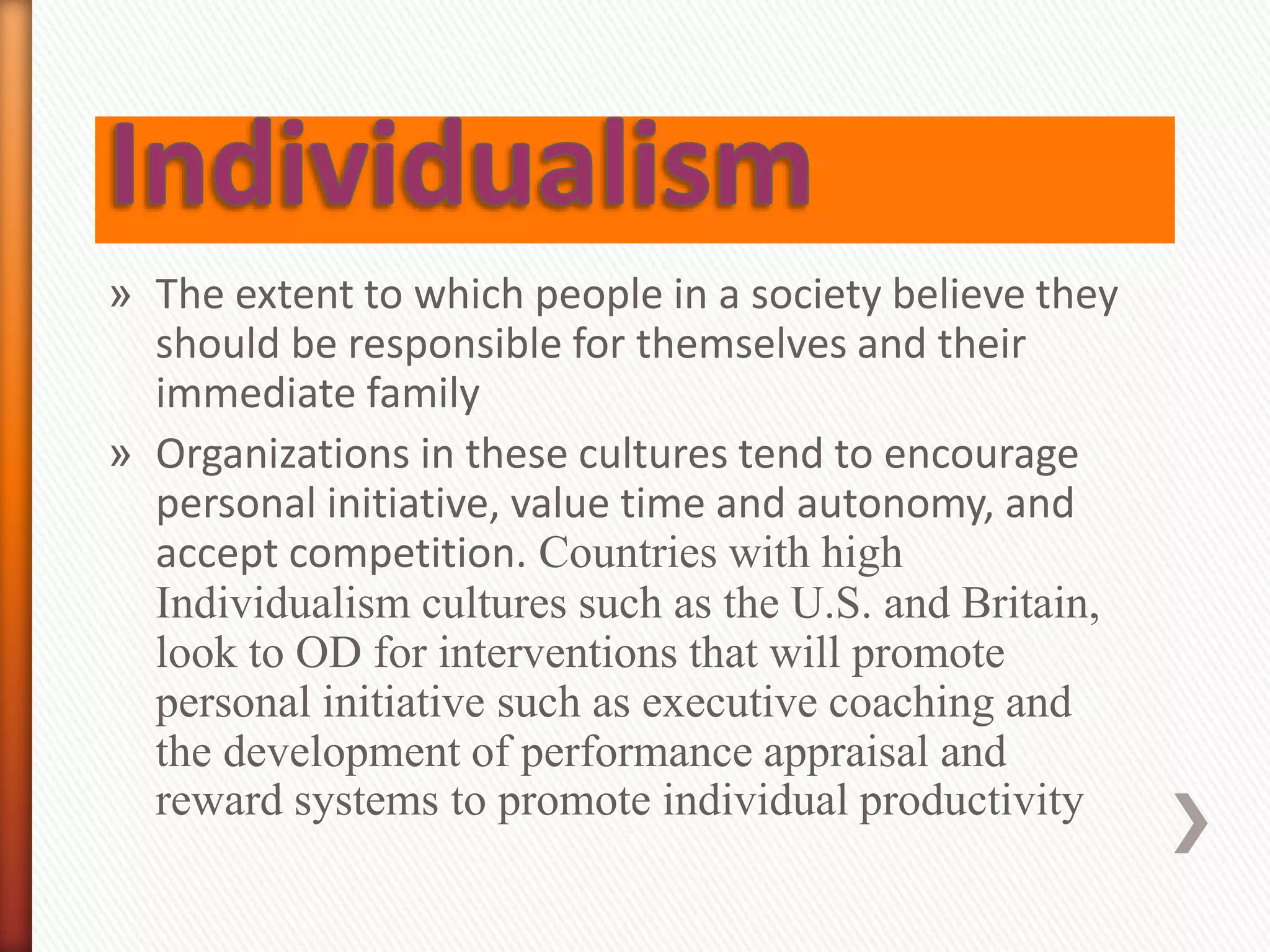
» The extent to which people in a society believe they
should be responsible for themselves and their
immediate family
» Organizations in these cultures tend to encourage
personal initiative, value time and autonomy, and
accept competition. Countries with high
Individualism cultures such as the U.S. and Britain,
look to OD for interventions that will promote
personal initiative such as executive coaching and
the development of performance appraisal and
reward systems to promote individual productivity
This was the only one of the original dimensions where
Hofstede (1991) found a systematic difference in the
answers between women and men.
He explains that, “a society is called masculine when
emotional gender roles are clearly distinct. Men are
supposed to be tough and women are supposed to be
tender. A society is called feminine when emotional
gender roles overlap: both men and women are
supposed to be modest, tender, and concerned with
quality of life”
Long-Term Orientation (LTO), “stands for the fostering
of virtues oriented toward future rewards – in
particular, perseverance and thrift”
Example: China, Hong Kong, Taiwan, Japan, Vietnam
and South Korea.
The Short-Term Orientation (STO) is defined by
Hofstede and Hofstede (2005) as, “the fostering of
virtues related to the past and present”
Example: European countries fall in the mid range, and
the U.S., Britain, and other Anglo countries score on
the short-term side.
» Offer products or services worldwide
» Balance product and functional concerns with
geographic issues
» Coordination must address complex personnel
and cross-cultural issues
» Its competitive position in one national market is
affected by its global integration and local
responsiveness
» Offer products/services in more than one
country
» Balance product and functional concerns with
geographic issues of distance, time, and culture
» Carry out coordinated activities across cultural
boundaries using a wide variety of personnel
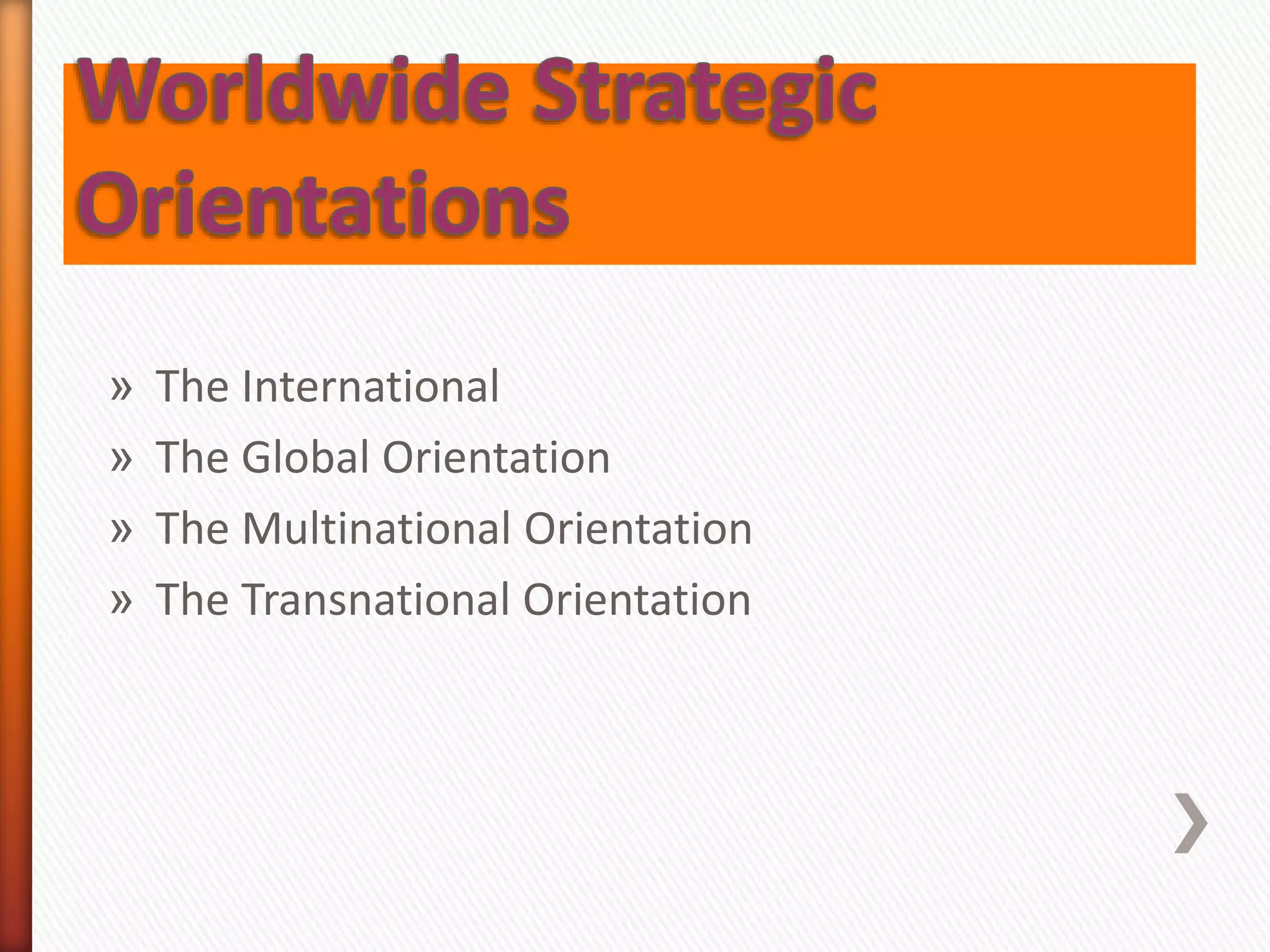
» The International
» The Global Orientation
» The Multinational Orientation
» The Transnational Orientation
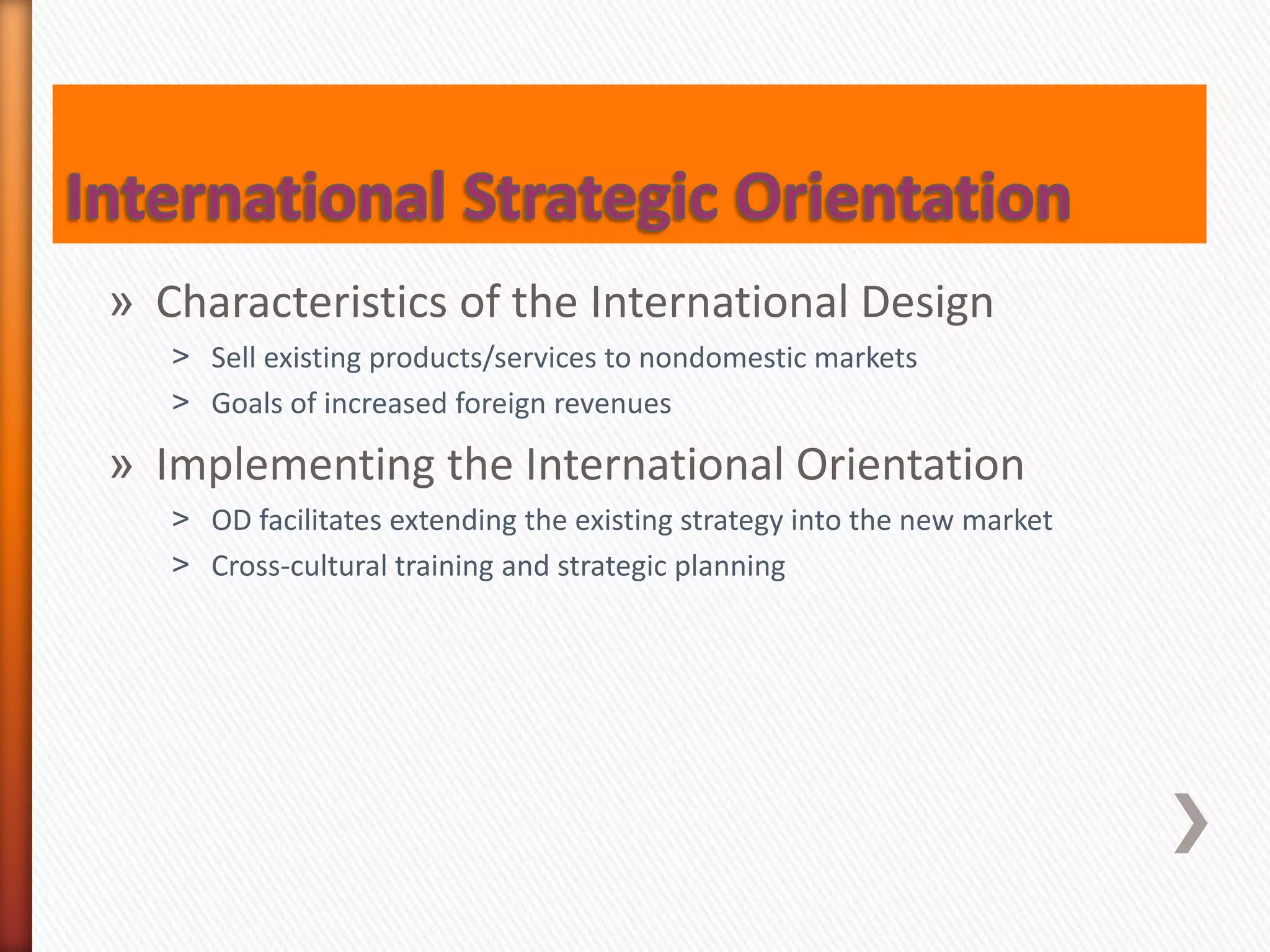
» Characteristics of the International Design
˃ Sell existing products/services to nondomestic markets
˃ Goals of increased foreign revenues
» Implementing the International Orientation
˃ OD facilitates extending the existing strategy into the new market
˃ Cross-cultural training and strategic planning
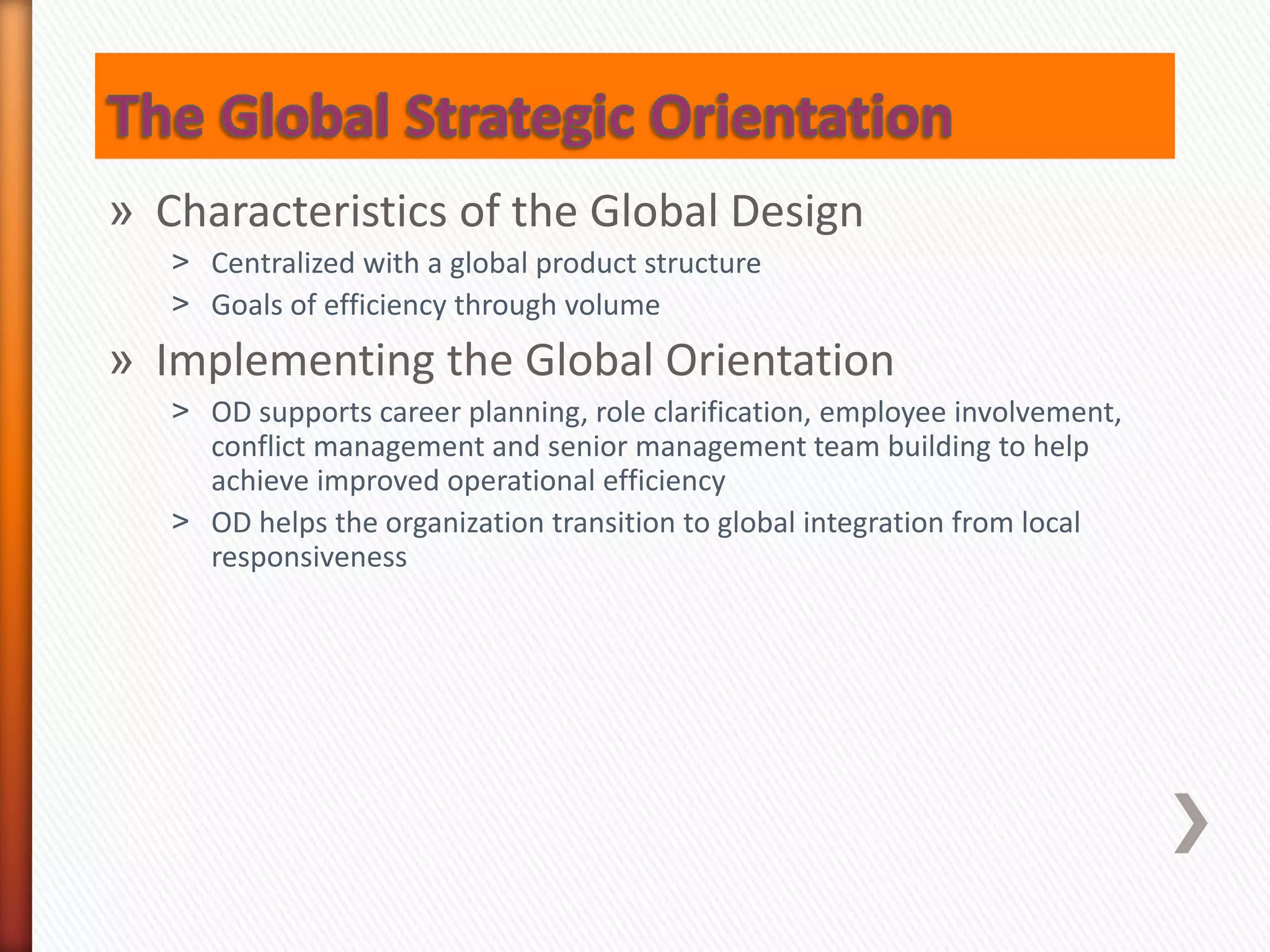
» Characteristics of the Global Design
˃ Centralized with a global product structure
˃ Goals of efficiency through volume
» Implementing the Global Orientation
˃ OD supports career planning, role clarification, employee involvement,
conflict management and senior management team building to help
achieve improved operational efficiency
˃ OD helps the organization transition to global integration from local
responsiveness
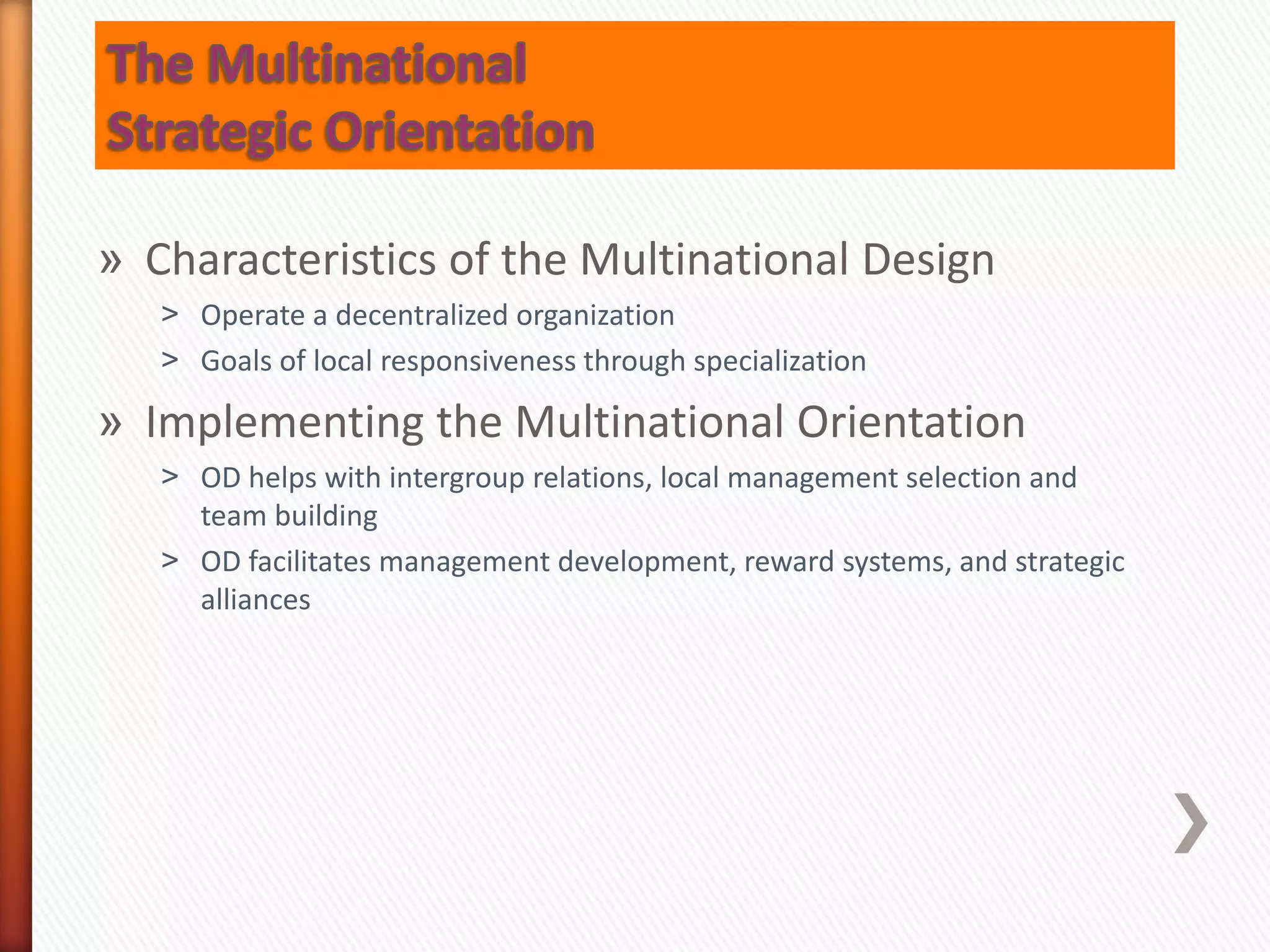
» Characteristics of the Multinational Design
˃ Operate a decentralized organization
˃ Goals of local responsiveness through specialization
» Implementing the Multinational Orientation
˃ OD helps with intergroup relations, local management selection and
team building
˃ OD facilitates management development, reward systems, and strategic
alliances
» Characteristics of the Transnational Design
˃ Tailored products
˃ Goals of learning and responsiveness through
integrations
» Implementing the Transnational Orientation
˃ Extensive selection and rotation
˃ Acquire cultural knowledge and develop intergroup
relations
˃ Build corporate vision
» THANK YOU
Cummings & Worley, 8e (c)2005 Thomson/South-Western

21 organization development in global settings

  • 1.
  • 2.
    OD is nowpracticed in every region of the world as the global expansion of many organizations has generated complex and rapid growth. Hofstede first developed his framework when his research on IBM employees in 40 different countries showed how differences in national cultures impact management practices. He and his son have continued to expand this research and other researchers have replicated and expanded Hofstede’s work and found support for his dimensions of national culture
  • 3.
    Cummings & Worley,8e (c)2005 Thomson/South-Western 21 -3
  • 4.
    » The rapiddevelopment of foreign economies » The increasing worldwide availability of technical and financial resources » The emergence of a global economy
  • 5.
    » Power Distance »Uncertainty Avoidance » Achievement Orientation
  • 6.
    » Extent towhich members of a society accept that status and power are distributed unequally in an organization » Organizations in these cultures tend to be autocratic, possess clear status differences, and have little employee participation
  • 7.
    » The extentto which members of a society tolerate the unfamiliar and unpredictable. It is the extent to which organizational members do not tolerate unpredictability and ambiguity » Organizations in these cultures tend to value experts, prefer clear roles, avoid conflict, and resist change
  • 8.
    » The extentto which people in a society believe they should be responsible for themselves and their immediate family » Organizations in these cultures tend to encourage personal initiative, value time and autonomy, and accept competition. Countries with high Individualism cultures such as the U.S. and Britain, look to OD for interventions that will promote personal initiative such as executive coaching and the development of performance appraisal and reward systems to promote individual productivity
  • 9.
    This was theonly one of the original dimensions where Hofstede (1991) found a systematic difference in the answers between women and men. He explains that, “a society is called masculine when emotional gender roles are clearly distinct. Men are supposed to be tough and women are supposed to be tender. A society is called feminine when emotional gender roles overlap: both men and women are supposed to be modest, tender, and concerned with quality of life”
  • 10.
    Long-Term Orientation (LTO),“stands for the fostering of virtues oriented toward future rewards – in particular, perseverance and thrift” Example: China, Hong Kong, Taiwan, Japan, Vietnam and South Korea. The Short-Term Orientation (STO) is defined by Hofstede and Hofstede (2005) as, “the fostering of virtues related to the past and present” Example: European countries fall in the mid range, and the U.S., Britain, and other Anglo countries score on the short-term side.
  • 11.
    » Offer productsor services worldwide » Balance product and functional concerns with geographic issues » Coordination must address complex personnel and cross-cultural issues » Its competitive position in one national market is affected by its global integration and local responsiveness
  • 12.
    » Offer products/servicesin more than one country » Balance product and functional concerns with geographic issues of distance, time, and culture » Carry out coordinated activities across cultural boundaries using a wide variety of personnel
  • 13.
    » The International »The Global Orientation » The Multinational Orientation » The Transnational Orientation
  • 14.
    » Characteristics ofthe International Design ˃ Sell existing products/services to nondomestic markets ˃ Goals of increased foreign revenues » Implementing the International Orientation ˃ OD facilitates extending the existing strategy into the new market ˃ Cross-cultural training and strategic planning
  • 15.
    » Characteristics ofthe Global Design ˃ Centralized with a global product structure ˃ Goals of efficiency through volume » Implementing the Global Orientation ˃ OD supports career planning, role clarification, employee involvement, conflict management and senior management team building to help achieve improved operational efficiency ˃ OD helps the organization transition to global integration from local responsiveness
  • 16.
    » Characteristics ofthe Multinational Design ˃ Operate a decentralized organization ˃ Goals of local responsiveness through specialization » Implementing the Multinational Orientation ˃ OD helps with intergroup relations, local management selection and team building ˃ OD facilitates management development, reward systems, and strategic alliances
  • 17.
    » Characteristics ofthe Transnational Design ˃ Tailored products ˃ Goals of learning and responsiveness through integrations » Implementing the Transnational Orientation ˃ Extensive selection and rotation ˃ Acquire cultural knowledge and develop intergroup relations ˃ Build corporate vision
  • 18.
    » THANK YOU Cummings& Worley, 8e (c)2005 Thomson/South-Western

Editor's Notes

  • #10 Was defined in 2005
  • #11 Was defined in 1988 and 2005