Portfolio Management
         LECTURE THREE


     FUNDAMENTAL ANALYSIS
   (INDUSTRIES AND COMPANIES)


            Prepared By:
      Noorulhadi Qureshi
 Lecturer Govt College of Management
          Sciences Peshawar
Industry & Company Analysis
• Company can be characterized as belonging
  to an industry. The performance of
  companies would, therefore, be influenced by
  the fortune of the industry it belongs.
• An Analyst has to undertake an industry
  analysis so as to study the fundamental
  factors affecting the performance of different
  industries.
Industry & Company Analysis
• An Industry is generally described as a
  homogenous group of companies. Or group
  of firms producing reasonably similar
  products which serves the same needs of
  common set of buyers.

• Industry analysis refers to an evaluation of
  the relative strengths and weaknesses of
  particular industries.
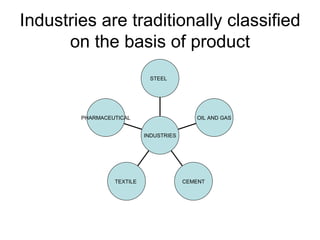
Industries are traditionally classified
      on the basis of product
                            STEEL


        PHARMACEUTICAL                     OIL AND GAS


                           INDUSTRIES


                 TEXTILE                CEMENT
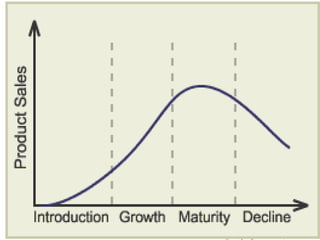
Product life-cycle (PLC) Like human beings, products also
    have an arc. From birth to death, human beings pass
    through various stages e.g. birth, growth, maturity,
    decline and death. A similar life-cycle is seen in the case
    of products. The product life cycle goes through multiple
    phases, involves many professional disciplines, and
    requires many skills, tools and processes. Product life
    cycle (PLC) has to do with the life of a product in the
    market with respect to business/commercial costs and
    sales measures. To say that a product has a life cycle is
    to assert three things:
The four main stages of a product's life cycle and the
    accompanying characteristics are:
StageCharacteristics
1. Market introduction stage
2. Growth stage
3. Maturity stage
4. Saturation and decline stage
The four main stages of a product's life cycle
  and the accompanying characteristics are:
Stage Characteristics
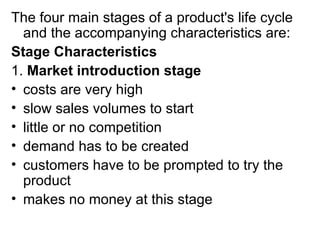
1. Market introduction stage
• costs are very high
• slow sales volumes to start
• little or no competition
• demand has to be created
• customers have to be prompted to try the
  product
• makes no money at this stage
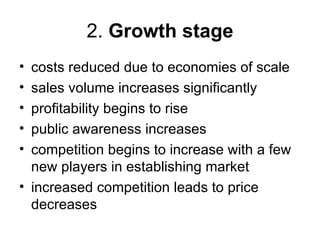
2. Growth stage
• costs reduced due to economies of scale
• sales volume increases significantly
• profitability begins to rise
• public awareness increases
• competition begins to increase with a few
  new players in establishing market
• increased competition leads to price
  decreases
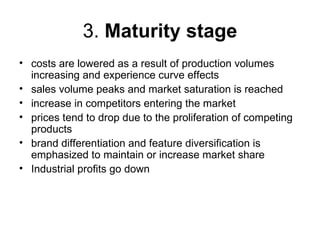
3. Maturity stage
• costs are lowered as a result of production volumes
  increasing and experience curve effects
• sales volume peaks and market saturation is reached
• increase in competitors entering the market
• prices tend to drop due to the proliferation of competing
  products
• brand differentiation and feature diversification is
  emphasized to maintain or increase market share
• Industrial profits go down
4. Saturation and decline stage


•   costs become counter-optimal
•   sales volume decline
•   prices, profitability diminish
•   profit becomes more a challenge of
    production/distribution efficiency than
    increased sales
Definition of 'Industry Lifecycle'
A concept relating to the different stages an
  industry will go through, from the first product
  entry to its eventual decline.
• A form of fundamental analysis involving the
  process of making investment decisions based
  on the different stages an industry is at during a
  given point in time. The type of position taken
  will depend on firm specific characteristics, as
  well as where the industry is at in its life cycle.
Industry Life Cycle
• According to Julius Grodinsky industry life
  cycle theory-the life of an industry can be
  segregated into the-

•   Pioneering Stage
•   Expansion Stage
•   Stagnation Stage
•   Decay Stage
Introduction stage/ Pioneering
              Stage:

• This is the first stage in the industrial life cycle of
  a new industry where the technology as well as
  the product are relatively new and have not
  reached a state of perfection. The pioneering
  stage is characterized by rapid growth in
  demand for the output of industry. As a result,
  there is a great opportunity for profit & highly
  risk. It’s also called sunrises industries. For
  example, ‘a leasing industry’ Computer Software
  & information technology etc.
Growth stage /Expansion Stage:
• This is second stage of expansion or
  growth and survived the pioneering stage.
  The stage of an industry are quite
  attractive for investment purposes.
  Investors cab get high returns at low risk
  because demand exceeds supply in the
  this stage. Companies will earn increasing
  amounts of profits and pay attractive
  dividends.
Maturity stage/Stagnation Stage:
• This is the third stage in the industry life
  cycle. In this stage, the growth of the
  industry stabilizes. The ability of the
  industry to grow appears to have been
  lost. sales may be increasing but at a
  slower rate than that experienced by
  competitive industries or by the overall
  economy. For example, Desktop PC
  Computers.
Decline stage/ Decay Stage:
• From the stagnation sage the industry passes to
  the decay stage. This occurs when the products
  of the industry are no longer in demand. New
  products and new technologies have come to
  the market. Customers have change their habits,
  style and liking. As a result, the industry
  becomes obsolete and gradually ceases to exist.
  Thus, changes in social habits, changes in
  technology and declining demand are the
  causes of decay of an industry.
• The industry life cycle approach has
  important implications for the investor. It
  gives an insight into the apparent of
  investment in given industry a t a given
  time. In fact, each development stage is
  unique and exhibits different characteristic
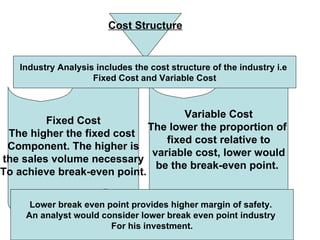
Cost Structure


   Industry Analysis includes the cost structure of the industry i.e
                    Fixed Cost and Variable Cost


                                     Variable Cost
         Fixed Cost
                             The lower the proportion of
 The higher the fixed cost
                                 fixed cost relative to
 Component. The higher is
                              variable cost, lower would
the sales volume necessary
                               be the break-even point.
To achieve break-even point.


      Lower break even point provides higher margin of safety.
     An analyst would consider lower break even point industry
                        For his investment.

industrial analysis

  • 1.
    Portfolio Management LECTURE THREE FUNDAMENTAL ANALYSIS (INDUSTRIES AND COMPANIES) Prepared By: Noorulhadi Qureshi Lecturer Govt College of Management Sciences Peshawar
  • 2.
    Industry & CompanyAnalysis • Company can be characterized as belonging to an industry. The performance of companies would, therefore, be influenced by the fortune of the industry it belongs. • An Analyst has to undertake an industry analysis so as to study the fundamental factors affecting the performance of different industries.
  • 3.
    Industry & CompanyAnalysis • An Industry is generally described as a homogenous group of companies. Or group of firms producing reasonably similar products which serves the same needs of common set of buyers. • Industry analysis refers to an evaluation of the relative strengths and weaknesses of particular industries.
  • 4.
    Industries are traditionallyclassified on the basis of product STEEL PHARMACEUTICAL OIL AND GAS INDUSTRIES TEXTILE CEMENT
  • 5.
    Product life-cycle (PLC)Like human beings, products also have an arc. From birth to death, human beings pass through various stages e.g. birth, growth, maturity, decline and death. A similar life-cycle is seen in the case of products. The product life cycle goes through multiple phases, involves many professional disciplines, and requires many skills, tools and processes. Product life cycle (PLC) has to do with the life of a product in the market with respect to business/commercial costs and sales measures. To say that a product has a life cycle is to assert three things: The four main stages of a product's life cycle and the accompanying characteristics are: StageCharacteristics 1. Market introduction stage 2. Growth stage 3. Maturity stage 4. Saturation and decline stage
  • 7.
    The four mainstages of a product's life cycle and the accompanying characteristics are: Stage Characteristics 1. Market introduction stage • costs are very high • slow sales volumes to start • little or no competition • demand has to be created • customers have to be prompted to try the product • makes no money at this stage
  • 8.
    2. Growth stage •costs reduced due to economies of scale • sales volume increases significantly • profitability begins to rise • public awareness increases • competition begins to increase with a few new players in establishing market • increased competition leads to price decreases
  • 9.
    3. Maturity stage •costs are lowered as a result of production volumes increasing and experience curve effects • sales volume peaks and market saturation is reached • increase in competitors entering the market • prices tend to drop due to the proliferation of competing products • brand differentiation and feature diversification is emphasized to maintain or increase market share • Industrial profits go down
  • 10.
    4. Saturation anddecline stage • costs become counter-optimal • sales volume decline • prices, profitability diminish • profit becomes more a challenge of production/distribution efficiency than increased sales
  • 11.
    Definition of 'IndustryLifecycle' A concept relating to the different stages an industry will go through, from the first product entry to its eventual decline. • A form of fundamental analysis involving the process of making investment decisions based on the different stages an industry is at during a given point in time. The type of position taken will depend on firm specific characteristics, as well as where the industry is at in its life cycle.
  • 12.
    Industry Life Cycle •According to Julius Grodinsky industry life cycle theory-the life of an industry can be segregated into the- • Pioneering Stage • Expansion Stage • Stagnation Stage • Decay Stage
  • 13.
    Introduction stage/ Pioneering Stage: • This is the first stage in the industrial life cycle of a new industry where the technology as well as the product are relatively new and have not reached a state of perfection. The pioneering stage is characterized by rapid growth in demand for the output of industry. As a result, there is a great opportunity for profit & highly risk. It’s also called sunrises industries. For example, ‘a leasing industry’ Computer Software & information technology etc.
  • 14.
    Growth stage /ExpansionStage: • This is second stage of expansion or growth and survived the pioneering stage. The stage of an industry are quite attractive for investment purposes. Investors cab get high returns at low risk because demand exceeds supply in the this stage. Companies will earn increasing amounts of profits and pay attractive dividends.
  • 15.
    Maturity stage/Stagnation Stage: •This is the third stage in the industry life cycle. In this stage, the growth of the industry stabilizes. The ability of the industry to grow appears to have been lost. sales may be increasing but at a slower rate than that experienced by competitive industries or by the overall economy. For example, Desktop PC Computers.
  • 16.
    Decline stage/ DecayStage: • From the stagnation sage the industry passes to the decay stage. This occurs when the products of the industry are no longer in demand. New products and new technologies have come to the market. Customers have change their habits, style and liking. As a result, the industry becomes obsolete and gradually ceases to exist. Thus, changes in social habits, changes in technology and declining demand are the causes of decay of an industry.
  • 17.
    • The industrylife cycle approach has important implications for the investor. It gives an insight into the apparent of investment in given industry a t a given time. In fact, each development stage is unique and exhibits different characteristic
  • 26.
    Cost Structure Industry Analysis includes the cost structure of the industry i.e Fixed Cost and Variable Cost Variable Cost Fixed Cost The lower the proportion of The higher the fixed cost fixed cost relative to Component. The higher is variable cost, lower would the sales volume necessary be the break-even point. To achieve break-even point. Lower break even point provides higher margin of safety. An analyst would consider lower break even point industry For his investment.