Expansion
Strategies
Dr. Sandeep Kulshrestha
Types of Expansion strategies
Expansion through Concentration
Expansion through integration
Expansion through diversification
Expansion through co-operation
Expansion through
 Internationalisation
Expansion through digitalisation
CONCENTRATION STRATEGIES

When an organisation focuses on
 intensifying its core businesses with a
 view on expanding through either
 acquiring a new customer base or
 diversifying its product portfolio, it is
 having a concentration strategy
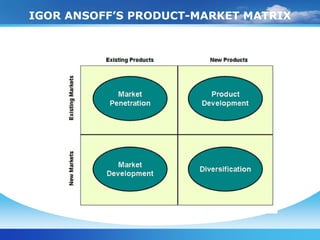
IGOR ANSOFF’S PRODUCT-MARKET MATRIX
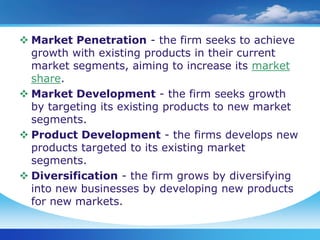
 Market Penetration - the firm seeks to achieve
  growth with existing products in their current
  market segments, aiming to increase its market
  share.
 Market Development - the firm seeks growth
  by targeting its existing products to new market
  segments.
 Product Development - the firms develops new
  products targeted to its existing market
  segments.
 Diversification - the firm grows by diversifying
  into new businesses by developing new products
  for new markets.
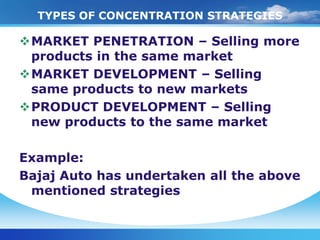
TYPES OF CONCENTRATION STRATEGIES

MARKET PENETRATION – Selling more
 products in the same market
MARKET DEVELOPMENT – Selling
 same products to new markets
PRODUCT DEVELOPMENT – Selling
 new products to the same market

Example:
Bajaj Auto has undertaken all the above
 mentioned strategies
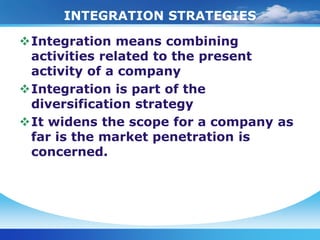
INTEGRATION STRATEGIES

Integration means combining
 activities related to the present
 activity of a company
Integration is part of the
 diversification strategy
It widens the scope for a company as
 far is the market penetration is
 concerned.
TYPES OF INTEGRATION STRATEGIES

Horizontal Integration
Vertical Integration
HORIZONTAL INTEGRATION

Horizontal Integration: When an
 organization takes up the same types
 of products at the same level of
 production or marketing process, it is
 said to follow a strategy of Horizontal
 Integration (Also known as
 Merger/Acquisition)

Example: Takeover of Satyam by
 Mahindras
VERTICAL INTEGRATION
 Vertical Integration: Expansion to serve
  its own needs. Vertical Integration is of
  two types, namely Backward and
  Forward Integration
      - Backward Integration means going
  back       to the source of raw materials
(Example: A Thermal power company may
  do coal-mining)
      - Forward Integration implies moving
        closer to the finished product
  (example: A car spare parts
  manufacturer would start manufacturing
  passenger cars)
DIVERSIFICATION STRATEGIES
Concentric or Related Diversification
Conglomerate or Unrelated
 Diversification
CONCENTRIC OR RELATED
          DIVERSIFICATION
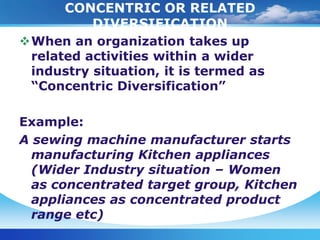
When an organization takes up
 related activities within a wider
 industry situation, it is termed as
 “Concentric Diversification”

Example:
A sewing machine manufacturer starts
  manufacturing Kitchen appliances
  (Wider Industry situation – Women
  as concentrated target group, Kitchen
  appliances as concentrated product
  range etc)
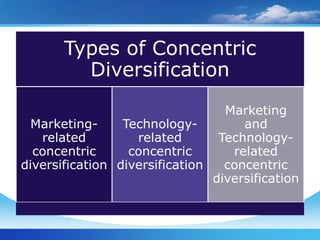
Types of Concentric
         Diversification
                                  Marketing
  Marketing-     Technology-         and
   related         related       Technology-
  concentric      concentric       related
diversification diversification   concentric
                                diversification
CONGLOMERATE OR UNRELATED DIVERSIFICATION


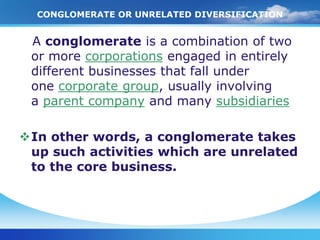
 A conglomerate is a Unrelated of two
    Conglomerate or combination
           Diversification
 or more corporations engaged in entirely
 different businesses that fall under
 one corporate group, usually involving
 a parent company and many subsidiaries

In other words, a conglomerate takes
 up such activities which are unrelated
 to the core business.
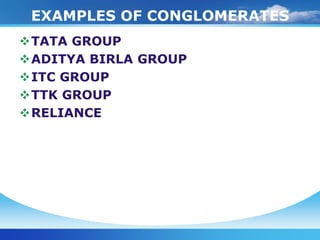
EXAMPLES OF CONGLOMERATES
TATA GROUP
ADITYA BIRLA GROUP
ITC GROUP
TTK GROUP
RELIANCE
ORGANISATIONS WHICH SELDOM DIVERSIFY

Public Sector Enterprises
Non Government Organisations
 (NGOs)
REASONS OF DIVERSIFICATION
Minimizing Risk
Capitalize on Strengths
Provide a new perspective in business
Risks of Diversification
Unrelated diversification is complex
 and confusing
Diversification demand a wide variety
 of skills
Decreasing commitment on the core
 business
Often results in losses
Increases the administrative costs
Expansion strategies

Expansion strategies

  • 1.
  • 2.
    Types of Expansionstrategies Expansion through Concentration Expansion through integration Expansion through diversification Expansion through co-operation Expansion through Internationalisation Expansion through digitalisation
  • 3.
    CONCENTRATION STRATEGIES When anorganisation focuses on intensifying its core businesses with a view on expanding through either acquiring a new customer base or diversifying its product portfolio, it is having a concentration strategy
  • 4.
  • 5.
     Market Penetration- the firm seeks to achieve growth with existing products in their current market segments, aiming to increase its market share.  Market Development - the firm seeks growth by targeting its existing products to new market segments.  Product Development - the firms develops new products targeted to its existing market segments.  Diversification - the firm grows by diversifying into new businesses by developing new products for new markets.
  • 6.
    TYPES OF CONCENTRATIONSTRATEGIES MARKET PENETRATION – Selling more products in the same market MARKET DEVELOPMENT – Selling same products to new markets PRODUCT DEVELOPMENT – Selling new products to the same market Example: Bajaj Auto has undertaken all the above mentioned strategies
  • 7.
    INTEGRATION STRATEGIES Integration meanscombining activities related to the present activity of a company Integration is part of the diversification strategy It widens the scope for a company as far is the market penetration is concerned.
  • 8.
    TYPES OF INTEGRATIONSTRATEGIES Horizontal Integration Vertical Integration
  • 9.
    HORIZONTAL INTEGRATION Horizontal Integration:When an organization takes up the same types of products at the same level of production or marketing process, it is said to follow a strategy of Horizontal Integration (Also known as Merger/Acquisition) Example: Takeover of Satyam by Mahindras
  • 10.
    VERTICAL INTEGRATION  VerticalIntegration: Expansion to serve its own needs. Vertical Integration is of two types, namely Backward and Forward Integration - Backward Integration means going back to the source of raw materials (Example: A Thermal power company may do coal-mining) - Forward Integration implies moving closer to the finished product (example: A car spare parts manufacturer would start manufacturing passenger cars)
  • 11.
    DIVERSIFICATION STRATEGIES Concentric orRelated Diversification Conglomerate or Unrelated Diversification
  • 12.
    CONCENTRIC OR RELATED DIVERSIFICATION When an organization takes up related activities within a wider industry situation, it is termed as “Concentric Diversification” Example: A sewing machine manufacturer starts manufacturing Kitchen appliances (Wider Industry situation – Women as concentrated target group, Kitchen appliances as concentrated product range etc)
  • 13.
    Types of Concentric Diversification Marketing Marketing- Technology- and related related Technology- concentric concentric related diversification diversification concentric diversification
  • 14.
    CONGLOMERATE OR UNRELATEDDIVERSIFICATION A conglomerate is a Unrelated of two Conglomerate or combination Diversification or more corporations engaged in entirely different businesses that fall under one corporate group, usually involving a parent company and many subsidiaries In other words, a conglomerate takes up such activities which are unrelated to the core business.
  • 15.
    EXAMPLES OF CONGLOMERATES TATAGROUP ADITYA BIRLA GROUP ITC GROUP TTK GROUP RELIANCE
  • 16.
    ORGANISATIONS WHICH SELDOMDIVERSIFY Public Sector Enterprises Non Government Organisations (NGOs)
  • 17.
    REASONS OF DIVERSIFICATION MinimizingRisk Capitalize on Strengths Provide a new perspective in business
  • 18.
    Risks of Diversification Unrelateddiversification is complex and confusing Diversification demand a wide variety of skills Decreasing commitment on the core business Often results in losses Increases the administrative costs