“Strategy is about making choices; it’s about deliberately choosing to be different.”
- Michael Porter
Strategy
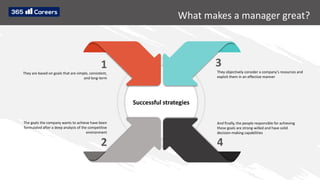
Successful strategies
2
The goals the company wants to achieve have been
formulated after a deep analysis of the competitive
environment
1
They are based on goals that are simple, consistent,
and long-term
4
And finally, the people responsible for achieving
these goals are strong-willed and have solid
decision-making capabilities
3
They objectively consider a company’s resources and
exploit them in an effective manner
What makes a manager great?
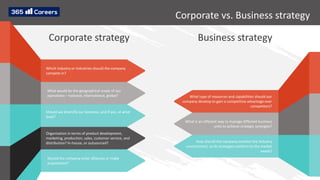
Which industry or industries should the company
compete in?
Corporate vs. Business strategy
Corporate strategy Business strategy
What would be the geographical scope of our
operations – national, international, global?
Should we diversify our business, and if yes, at what
level?
Organization in terms of product development,
marketing, production, sales, customer service, and
distribution? In-house, or outsourced?
Should the company enter alliances or make
acquisitions?
What type of resources and capabilities should our
company develop to gain a competitive advantage over
competitors?
What is an efficient way to manage different business
units to achieve strategic synergies?
How should the company monitor the industry
environment, so its strategies conform to the market
needs?
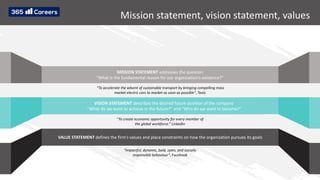
Mission statement, vision statement, values
MISSION STATEMENT addresses the question
“What is the fundamental reason for our organization’s existence?”
VISION STATEMENT describes the desired future position of the company
“What do we want to achieve in the future?” and “Who do we want to become?”
VALUE STATEMENT defines the firm’s values and place constraints on how the organization pursues its goals
“To accelerate the advent of sustainable transport by bringing compelling mass
market electric cars to market as soon as possible”, Tesla
“To create economic opportunity for every member of
the global workforce.” LinkedIn
“Impactful, dynamic, bold, open, and socially
responsible behaviour”, Facebook
The industry lifecycle model
Example
Action
Characteristics
Stage
Low customer awareness, high
capital needs, low competition
Consumers learn of the
industry & sales and profits
grow
Compete and generate cash
flow
Look for new opportunities
Absolute decrease of sales,
customers abandon the market
All companies have entered the
market, high competition, sales
peak and strop growing
Enter the industry
Pioneer the industry
Personal care
Vinyl records
Car sharing services
Consumer robotics
INTRODUCTION
GROWTH
MATURITY
DECLINE
LOREM IPSUM
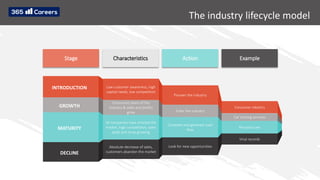
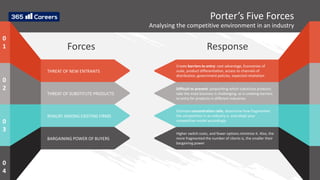
THREAT OF NEW ENTRANTS
Forces Response
Create barriers to entry: cost advantage, Economies of
scale, product differentiation, access to channels of
distribution, government policies, expected retaliation
Porter’s Five Forces
Analysing the competitive environment in an industry
0
1
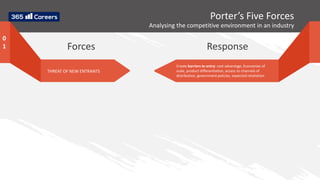
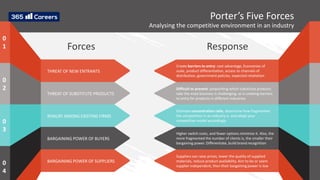
THREAT OF NEW ENTRANTS
Forces
THREAT OF SUBSTITUTE PRODUCTS
Response
Create barriers to entry: cost advantage, Economies of
scale, product differentiation, access to channels of
distribution, government policies, expected retaliation
Difficult to prevent: pinpointing which substitute products
take the most business is challenging, as is creating barriers
to entry for products in different industries
Porter’s Five Forces
Analysing the competitive environment in an industry
0
1
0
2
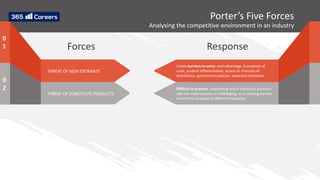
THREAT OF NEW ENTRANTS
Forces
THREAT OF SUBSTITUTE PRODUCTS
RIVALRY AMONG EXISTING FIRMS
Response
Create barriers to entry: cost advantage, Economies of
scale, product differentiation, access to channels of
distribution, government policies, expected retaliation
Difficult to prevent: pinpointing which substitute products
take the most business is challenging, as is creating barriers
to entry for products in different industries
Estimate concentration ratio, determine how fragmented
the competition in an industry is, and adapt your
competitive model accordingly
Porter’s Five Forces
Analysing the competitive environment in an industry
0
1
0
2
0
3
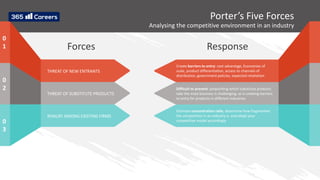
THREAT OF NEW ENTRANTS
Forces
THREAT OF SUBSTITUTE PRODUCTS
RIVALRY AMONG EXISTING FIRMS
BARGAINING POWER OF BUYERS
Response
Create barriers to entry: cost advantage, Economies of
scale, product differentiation, access to channels of
distribution, government policies, expected retaliation
Difficult to prevent: pinpointing which substitute products
take the most business is challenging, as is creating barriers
to entry for products in different industries
Estimate concentration ratio, determine how fragmented
the competition in an industry is, and adapt your
competitive model accordingly
Higher switch costs, and fewer options minimize it. Also, the
more fragmented the number of clients is, the smaller their
bargaining power
Porter’s Five Forces
Analysing the competitive environment in an industry
0
1
0
2
0
3
0
4
THREAT OF NEW ENTRANTS
Forces
THREAT OF SUBSTITUTE PRODUCTS
RIVALRY AMONG EXISTING FIRMS
BARGAINING POWER OF BUYERS
BARGAINING POWER OF SUPPLIERS
Response
Create barriers to entry: cost advantage, Economies of
scale, product differentiation, access to channels of
distribution, government policies, expected retaliation
Difficult to prevent: pinpointing which substitute products
take the most business is challenging, as is creating barriers
to entry for products in different industries
Estimate concentration ratio, determine how fragmented
the competition in an industry is, and adapt your
competitive model accordingly
Suppliers can raise prices, lower the quality of supplied
materials, reduce product availability. Aim to be or seem
supplier independent, then their bargaining power is low
Higher switch costs, and fewer options minimize it. Also, the
more fragmented the number of clients is, the smaller their
bargaining power. Differentiate, build brand recognition
Porter’s Five Forces
Analysing the competitive environment in an industry
0
1
0
2
0
3
0
4
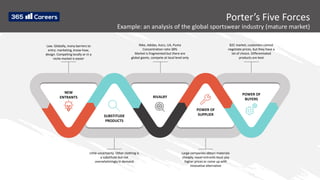
Porter’s Five Forces
Example: an analysis of the global sportswear industry (mature market)
NEW
ENTRANTS
SUBSTITUDE
PRODUCTS
RIVALRY
POWER OF
SUPPLIER
POWER OF
BUYERS
Low. Globally, many barriers to
entry: marketing, know-how,
design. Competing locally or in a
niche market is easier
Nike, Adidas, Asics, UA, Puma
Concentration ratio 38%
Market is fragmented but there are
global giants, compete at local level only
B2C market, customers cannot
negotiate prices, but they have a
lot of choice. Differentiated
products are best
Little uncertainty. Other clothing is
a substitute but not
overwhelmingly in demand
Large companies obtain materials
cheaply, novel entrants must pay
higher prices or come up with
innovative alternative
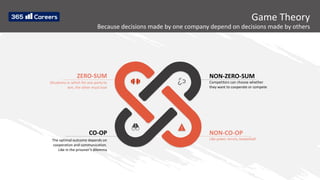
Game Theory
Because decisions made by one company depend on decisions made by others
ZERO-SUM
Situations in which for one party to
win, the other must lose
NON-ZERO-SUM
Competitors can choose whether
they want to cooperate or compete
CO-OP
The optimal outcome depends on
cooperation and communication.
Like in the prisoner’s dilemma
NON-CO-OP
Like poker, tennis, basketball
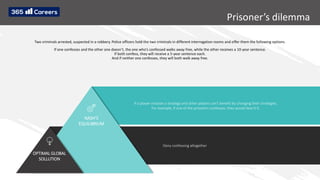
Prisoner’s dilemma
OPTIMAL GLOBAL
SOLLUTION
NASH’S
EQUILIBRIUM
If a player chooses a strategy and other players can’t benefit by changing their strategies.
For example, if one of the prisoners confesses, they would face 0-5.
Deny confessing altogether
Two criminals arrested, suspected in a robbery. Police officers hold the two criminals in different interrogation rooms and offer them the following options.
If one confesses and the other one doesn’t, the one who’s confessed walks away free, while the other receives a 10-year sentence.
If both confess, they will receive a 5-year sentence each.
And if neither one confesses, they will both walk away free.
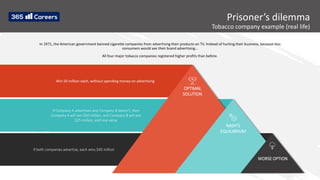
In 1971, the American government banned cigarette companies from advertising their products on TV. Instead of hurting their business, because less
consumers would see their brand advertising…
All four major tobacco companies registered higher profits than before.
Prisoner’s dilemma
Tobacco company example (real life)
Win 50 million each, without spending money on advertising
WORSE OPTION
NASH’S
EQUILIBRIUM
OPTIMAL
SOLUTION
If Company A advertises and Company B doesn’t, then
Company A will win $60 million, and Company B will win
$25 million, and vice versa
If both companies advertise, each wins $40 million
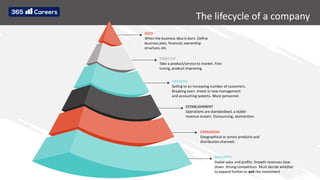
The lifecycle of a company
When the business idea is born. Define
business plan, financial, ownership
structure, etc.
SEED
Take a product/service to market. Fine
tuning, product improving
START-UP
Selling to an increasing number of customers.
Breaking even. Invest in new management
and accounting systems. More personnel.
GROWTH
Operations are standardized, a stable
revenue stream. Outsourcing, atomantion.
ESTABLISHMENT
Geographical or across products and
distribution channels
EXPANSION
Stable sales and profits. Growth revenues slow
down. Strong competition. Must decide whether
to expand further or exit the investment
MATURITY
The lifecycle of a company (ctnd)
Selling the company to another firm operating in
the same industry or to financial investors
EXIT
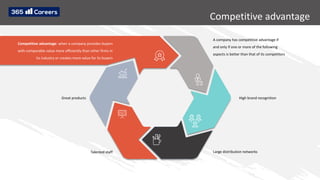
Competitive advantage
A company has competitive advantage if
and only if one or more of the following
aspects is better than that of its competitors
High brand recognition
Large distribution networks
Competitive advantage: when a company provides buyers
with comparable value more efficiently than other firms in
its industry or creates more value for its buyers
Great products
Talented staff
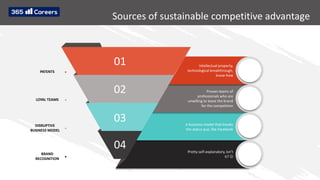
Sources of sustainable competitive advantage
PATENTS
LOYAL TEAMS
DISRUPTIVE
BUSINESS MODEL
BRAND
RECOGNITION
01
02
03
04
Intellectual property,
technological breakthrough,
know-how
Proven teams of
professionals who are
unwilling to leave the brand
for the competition
A business model that breaks
the status quo, like Facebook
Pretty self-explanatory, isn’t
it? ☺
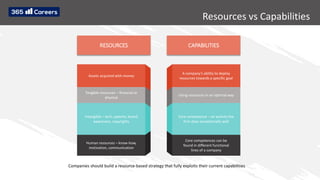
Resources vs Capabilities
RESOURCES
Assets acquired with money
Tangible resources – financial or
physical
Intangible – tech, patents, brand
awareness, copyrights
Human resources – know-how,
motivation, communication
LOREM IPSUM
CAPABILITIES
A company’s ability to deploy
resources towards a specific goal
Using resources in an optimal way
Core competence – an activity the
firm does exceptionally well
Core competences can be
found in different functional
lines of a company
LOREM IPSUM
Companies should build a resource-based strategy that fully exploits their current capabilities
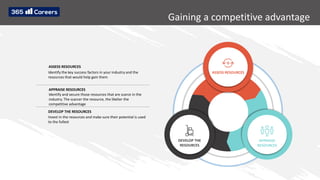
Gaining a competitive advantage
DEVELOP THE
RESOURCES
ASSESS RESOURCES
APPRAISE
RESOURCES
ASSESS RESOURCES
Identify the key success factors in your industry and the
resources that would help gain them
APPRAISE RESOURCES
Identify and secure those resources that are scarce in the
industry. The scarcer the resource, the likelier the
competitive advantage
DEVELOP THE RESOURCES
Invest in the resources and make sure their potential is used
to the fullest
Competitive advantage
Cost leadership
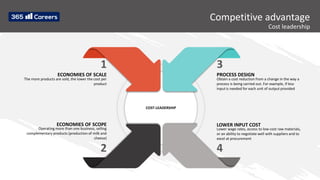
COST-LEADERSHIP
2
Operating more than one business, selling
complementary products (production of milk and
cheese)
ECONOMIES OF SCOPE
1
ECONOMIES OF SCALE
The more products are sold, the lower the cost per
product
4
Lower wage rates, access to low-cost raw materials,
or an ability to negotiate well with suppliers and to
excel at procurement
LOWER INPUT COST
3
PROCESS DESIGN
Obtain a cost reduction from a change in the way a
process is being carried out. For example, if less
input is needed for each unit of output provided
Competitive advantage
Differentiation
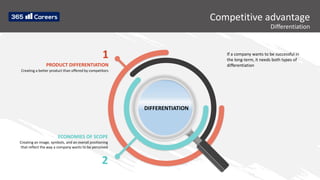
DIFFERENTIATION
1
PRODUCT DIFFERENTIATION
Creating a better product than offered by competitors
2
Creating an image, symbols, and an overall positioning
that reflect the way a company wants to be perceived
ECONOMIES OF SCOPE
If a company wants to be successful in
the long-term, it needs both types of
differentiation
Competitive advantage
Niche / Focus strategy
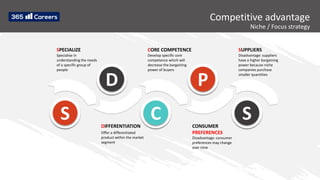
S
D
C
P
S
SPECIALIZE
Specialise in
understanding the needs
of a specific group of
people
DIFFERENTIATION
Offer a differentiated
product within the market
segment
CORE COMPETENCE
Develop specific core
competence which will
decrease the bargaining
power of buyers
CONSUMER
PREFERENCES
Disadvantage: consumer
preferences may change
over time
SUPPLIERS
Disadvantage: suppliers
have a higher bargaining
power because niche
companies purchase
smaller quantities
Competitive advantage
Using hybrid strategies
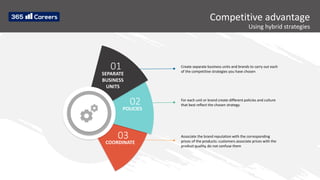
Create separate business units and brands to carry out each
of the competitive strategies you have chosen
For each unit or brand create different policies and culture
that best reflect the chosen strategy
Associate the brand reputation with the corresponding
prices of the products: customers associate prices with the
product quality, do not confuse them
SEPARATE
BUSINESS
UNITS
POLICIES
COORDINATE
01
02
03
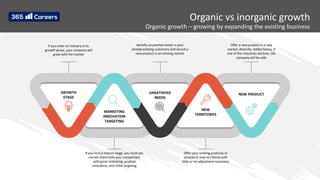
Organic vs inorganic growth
Organic growth – growing by expanding the existing business
GROWTH
STAGE
MARKETING
INNOVATION
TARGETING
UNSATISFIED
NEEDS
NEW
TERRITORIES
NEW PRODUCT
If you enter an industry in its
growth phase, your company will
grow with the market
Identify unsatisfied needs in your
already existing customers and launch a
new product in an existing market
Offer a new product in a new
market, diversify. Added bonus, if
one of the industries declines, the
company will be safe
If you’re in a mature stage, you must win
market share from your competitors
with great marketing, product
innovation, and niche targeting
Offer your existing products or
services in new territories with
little or no adjustment necessary
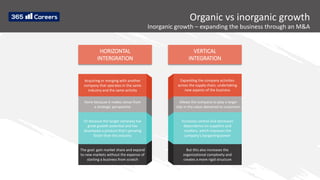
Organic vs inorganic growth
Inorganic growth – expanding the business through an M&A
HORIZONTAL
INTERGRATION
Acquiring or merging with another
company that operates in the same
industry and the same activity
Done because it makes sense from
a strategic perspective
Or because the target company has
great growth potential and has
developed a product that’s growing
faster than the industry
The goal: gain market share and expand
to new markets without the expense of
starting a business from scratch
LOREM IPSUM
VERTICAL
INTEGRATION
Expanding the company activities
across the supply chain, undertaking
new aspects of the business
Allows the company to play a larger
role in the value delivered to customers
Increases control and decreases
dependence on suppliers and
resellers, which improves the
company’s bargaining power
But this also increases the
organizational complexity and
creates a more rigid structure
LOREM IPSUM
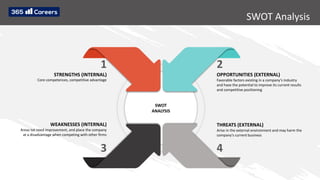
SWOT Analysis
SWOT
ANALYSIS
3
Areas tat need improvement, and place the company
at a disadvantage when competing with other firms
WEAKNESSES (INTERNAL)
1
STRENGTHS (INTERNAL)
Core competences, competitive advantage
4
Arise in the external environment and may harm the
company’s current business
THREATS (EXTERNAL)
2
OPPORTUNITIES (EXTERNAL)
Favorable factors existing in a company’s industry
and have the potential to improve its current results
and competitive positioning

Strategy-Course-Notes+(1).pdf

  • 1.
    “Strategy is aboutmaking choices; it’s about deliberately choosing to be different.” - Michael Porter Strategy
  • 2.
    Successful strategies 2 The goalsthe company wants to achieve have been formulated after a deep analysis of the competitive environment 1 They are based on goals that are simple, consistent, and long-term 4 And finally, the people responsible for achieving these goals are strong-willed and have solid decision-making capabilities 3 They objectively consider a company’s resources and exploit them in an effective manner What makes a manager great?
  • 3.
    Which industry orindustries should the company compete in? Corporate vs. Business strategy Corporate strategy Business strategy What would be the geographical scope of our operations – national, international, global? Should we diversify our business, and if yes, at what level? Organization in terms of product development, marketing, production, sales, customer service, and distribution? In-house, or outsourced? Should the company enter alliances or make acquisitions? What type of resources and capabilities should our company develop to gain a competitive advantage over competitors? What is an efficient way to manage different business units to achieve strategic synergies? How should the company monitor the industry environment, so its strategies conform to the market needs?
  • 4.
    Mission statement, visionstatement, values MISSION STATEMENT addresses the question “What is the fundamental reason for our organization’s existence?” VISION STATEMENT describes the desired future position of the company “What do we want to achieve in the future?” and “Who do we want to become?” VALUE STATEMENT defines the firm’s values and place constraints on how the organization pursues its goals “To accelerate the advent of sustainable transport by bringing compelling mass market electric cars to market as soon as possible”, Tesla “To create economic opportunity for every member of the global workforce.” LinkedIn “Impactful, dynamic, bold, open, and socially responsible behaviour”, Facebook
  • 5.
    The industry lifecyclemodel Example Action Characteristics Stage Low customer awareness, high capital needs, low competition Consumers learn of the industry & sales and profits grow Compete and generate cash flow Look for new opportunities Absolute decrease of sales, customers abandon the market All companies have entered the market, high competition, sales peak and strop growing Enter the industry Pioneer the industry Personal care Vinyl records Car sharing services Consumer robotics INTRODUCTION GROWTH MATURITY DECLINE LOREM IPSUM
  • 6.
    THREAT OF NEWENTRANTS Forces Response Create barriers to entry: cost advantage, Economies of scale, product differentiation, access to channels of distribution, government policies, expected retaliation Porter’s Five Forces Analysing the competitive environment in an industry 0 1
  • 7.
    THREAT OF NEWENTRANTS Forces THREAT OF SUBSTITUTE PRODUCTS Response Create barriers to entry: cost advantage, Economies of scale, product differentiation, access to channels of distribution, government policies, expected retaliation Difficult to prevent: pinpointing which substitute products take the most business is challenging, as is creating barriers to entry for products in different industries Porter’s Five Forces Analysing the competitive environment in an industry 0 1 0 2
  • 8.
    THREAT OF NEWENTRANTS Forces THREAT OF SUBSTITUTE PRODUCTS RIVALRY AMONG EXISTING FIRMS Response Create barriers to entry: cost advantage, Economies of scale, product differentiation, access to channels of distribution, government policies, expected retaliation Difficult to prevent: pinpointing which substitute products take the most business is challenging, as is creating barriers to entry for products in different industries Estimate concentration ratio, determine how fragmented the competition in an industry is, and adapt your competitive model accordingly Porter’s Five Forces Analysing the competitive environment in an industry 0 1 0 2 0 3
  • 9.
    THREAT OF NEWENTRANTS Forces THREAT OF SUBSTITUTE PRODUCTS RIVALRY AMONG EXISTING FIRMS BARGAINING POWER OF BUYERS Response Create barriers to entry: cost advantage, Economies of scale, product differentiation, access to channels of distribution, government policies, expected retaliation Difficult to prevent: pinpointing which substitute products take the most business is challenging, as is creating barriers to entry for products in different industries Estimate concentration ratio, determine how fragmented the competition in an industry is, and adapt your competitive model accordingly Higher switch costs, and fewer options minimize it. Also, the more fragmented the number of clients is, the smaller their bargaining power Porter’s Five Forces Analysing the competitive environment in an industry 0 1 0 2 0 3 0 4
  • 10.
    THREAT OF NEWENTRANTS Forces THREAT OF SUBSTITUTE PRODUCTS RIVALRY AMONG EXISTING FIRMS BARGAINING POWER OF BUYERS BARGAINING POWER OF SUPPLIERS Response Create barriers to entry: cost advantage, Economies of scale, product differentiation, access to channels of distribution, government policies, expected retaliation Difficult to prevent: pinpointing which substitute products take the most business is challenging, as is creating barriers to entry for products in different industries Estimate concentration ratio, determine how fragmented the competition in an industry is, and adapt your competitive model accordingly Suppliers can raise prices, lower the quality of supplied materials, reduce product availability. Aim to be or seem supplier independent, then their bargaining power is low Higher switch costs, and fewer options minimize it. Also, the more fragmented the number of clients is, the smaller their bargaining power. Differentiate, build brand recognition Porter’s Five Forces Analysing the competitive environment in an industry 0 1 0 2 0 3 0 4
  • 11.
    Porter’s Five Forces Example:an analysis of the global sportswear industry (mature market) NEW ENTRANTS SUBSTITUDE PRODUCTS RIVALRY POWER OF SUPPLIER POWER OF BUYERS Low. Globally, many barriers to entry: marketing, know-how, design. Competing locally or in a niche market is easier Nike, Adidas, Asics, UA, Puma Concentration ratio 38% Market is fragmented but there are global giants, compete at local level only B2C market, customers cannot negotiate prices, but they have a lot of choice. Differentiated products are best Little uncertainty. Other clothing is a substitute but not overwhelmingly in demand Large companies obtain materials cheaply, novel entrants must pay higher prices or come up with innovative alternative
  • 12.
    Game Theory Because decisionsmade by one company depend on decisions made by others ZERO-SUM Situations in which for one party to win, the other must lose NON-ZERO-SUM Competitors can choose whether they want to cooperate or compete CO-OP The optimal outcome depends on cooperation and communication. Like in the prisoner’s dilemma NON-CO-OP Like poker, tennis, basketball
  • 13.
    Prisoner’s dilemma OPTIMAL GLOBAL SOLLUTION NASH’S EQUILIBRIUM Ifa player chooses a strategy and other players can’t benefit by changing their strategies. For example, if one of the prisoners confesses, they would face 0-5. Deny confessing altogether Two criminals arrested, suspected in a robbery. Police officers hold the two criminals in different interrogation rooms and offer them the following options. If one confesses and the other one doesn’t, the one who’s confessed walks away free, while the other receives a 10-year sentence. If both confess, they will receive a 5-year sentence each. And if neither one confesses, they will both walk away free.
  • 14.
    In 1971, theAmerican government banned cigarette companies from advertising their products on TV. Instead of hurting their business, because less consumers would see their brand advertising… All four major tobacco companies registered higher profits than before. Prisoner’s dilemma Tobacco company example (real life) Win 50 million each, without spending money on advertising WORSE OPTION NASH’S EQUILIBRIUM OPTIMAL SOLUTION If Company A advertises and Company B doesn’t, then Company A will win $60 million, and Company B will win $25 million, and vice versa If both companies advertise, each wins $40 million
  • 15.
    The lifecycle ofa company When the business idea is born. Define business plan, financial, ownership structure, etc. SEED Take a product/service to market. Fine tuning, product improving START-UP Selling to an increasing number of customers. Breaking even. Invest in new management and accounting systems. More personnel. GROWTH Operations are standardized, a stable revenue stream. Outsourcing, atomantion. ESTABLISHMENT Geographical or across products and distribution channels EXPANSION Stable sales and profits. Growth revenues slow down. Strong competition. Must decide whether to expand further or exit the investment MATURITY
  • 16.
    The lifecycle ofa company (ctnd) Selling the company to another firm operating in the same industry or to financial investors EXIT
  • 17.
    Competitive advantage A companyhas competitive advantage if and only if one or more of the following aspects is better than that of its competitors High brand recognition Large distribution networks Competitive advantage: when a company provides buyers with comparable value more efficiently than other firms in its industry or creates more value for its buyers Great products Talented staff
  • 18.
    Sources of sustainablecompetitive advantage PATENTS LOYAL TEAMS DISRUPTIVE BUSINESS MODEL BRAND RECOGNITION 01 02 03 04 Intellectual property, technological breakthrough, know-how Proven teams of professionals who are unwilling to leave the brand for the competition A business model that breaks the status quo, like Facebook Pretty self-explanatory, isn’t it? ☺
  • 19.
    Resources vs Capabilities RESOURCES Assetsacquired with money Tangible resources – financial or physical Intangible – tech, patents, brand awareness, copyrights Human resources – know-how, motivation, communication LOREM IPSUM CAPABILITIES A company’s ability to deploy resources towards a specific goal Using resources in an optimal way Core competence – an activity the firm does exceptionally well Core competences can be found in different functional lines of a company LOREM IPSUM Companies should build a resource-based strategy that fully exploits their current capabilities
  • 20.
    Gaining a competitiveadvantage DEVELOP THE RESOURCES ASSESS RESOURCES APPRAISE RESOURCES ASSESS RESOURCES Identify the key success factors in your industry and the resources that would help gain them APPRAISE RESOURCES Identify and secure those resources that are scarce in the industry. The scarcer the resource, the likelier the competitive advantage DEVELOP THE RESOURCES Invest in the resources and make sure their potential is used to the fullest
  • 21.
    Competitive advantage Cost leadership COST-LEADERSHIP 2 Operatingmore than one business, selling complementary products (production of milk and cheese) ECONOMIES OF SCOPE 1 ECONOMIES OF SCALE The more products are sold, the lower the cost per product 4 Lower wage rates, access to low-cost raw materials, or an ability to negotiate well with suppliers and to excel at procurement LOWER INPUT COST 3 PROCESS DESIGN Obtain a cost reduction from a change in the way a process is being carried out. For example, if less input is needed for each unit of output provided
  • 22.
    Competitive advantage Differentiation DIFFERENTIATION 1 PRODUCT DIFFERENTIATION Creatinga better product than offered by competitors 2 Creating an image, symbols, and an overall positioning that reflect the way a company wants to be perceived ECONOMIES OF SCOPE If a company wants to be successful in the long-term, it needs both types of differentiation
  • 23.
    Competitive advantage Niche /Focus strategy S D C P S SPECIALIZE Specialise in understanding the needs of a specific group of people DIFFERENTIATION Offer a differentiated product within the market segment CORE COMPETENCE Develop specific core competence which will decrease the bargaining power of buyers CONSUMER PREFERENCES Disadvantage: consumer preferences may change over time SUPPLIERS Disadvantage: suppliers have a higher bargaining power because niche companies purchase smaller quantities
  • 24.
    Competitive advantage Using hybridstrategies Create separate business units and brands to carry out each of the competitive strategies you have chosen For each unit or brand create different policies and culture that best reflect the chosen strategy Associate the brand reputation with the corresponding prices of the products: customers associate prices with the product quality, do not confuse them SEPARATE BUSINESS UNITS POLICIES COORDINATE 01 02 03
  • 25.
    Organic vs inorganicgrowth Organic growth – growing by expanding the existing business GROWTH STAGE MARKETING INNOVATION TARGETING UNSATISFIED NEEDS NEW TERRITORIES NEW PRODUCT If you enter an industry in its growth phase, your company will grow with the market Identify unsatisfied needs in your already existing customers and launch a new product in an existing market Offer a new product in a new market, diversify. Added bonus, if one of the industries declines, the company will be safe If you’re in a mature stage, you must win market share from your competitors with great marketing, product innovation, and niche targeting Offer your existing products or services in new territories with little or no adjustment necessary
  • 26.
    Organic vs inorganicgrowth Inorganic growth – expanding the business through an M&A HORIZONTAL INTERGRATION Acquiring or merging with another company that operates in the same industry and the same activity Done because it makes sense from a strategic perspective Or because the target company has great growth potential and has developed a product that’s growing faster than the industry The goal: gain market share and expand to new markets without the expense of starting a business from scratch LOREM IPSUM VERTICAL INTEGRATION Expanding the company activities across the supply chain, undertaking new aspects of the business Allows the company to play a larger role in the value delivered to customers Increases control and decreases dependence on suppliers and resellers, which improves the company’s bargaining power But this also increases the organizational complexity and creates a more rigid structure LOREM IPSUM
  • 27.
    SWOT Analysis SWOT ANALYSIS 3 Areas tatneed improvement, and place the company at a disadvantage when competing with other firms WEAKNESSES (INTERNAL) 1 STRENGTHS (INTERNAL) Core competences, competitive advantage 4 Arise in the external environment and may harm the company’s current business THREATS (EXTERNAL) 2 OPPORTUNITIES (EXTERNAL) Favorable factors existing in a company’s industry and have the potential to improve its current results and competitive positioning