EXTERNAL ANALYSIS

  The General Environment
The Competitive Environment
EXTERNAL ANALYSIS
•   Clear Idea of the Industry
•   Industry & Sector
•   Industry & Market Segment
•   Changing Industry Boundaries
•   Strategic Groups within industries
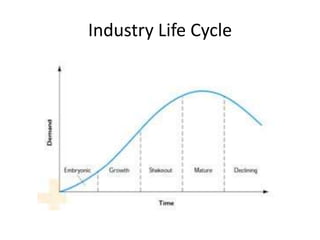
•   Industry Life cycle analysis
Defining the Industry
• An industry is a group of companies offering
  products & services that are close substitutes
  for each other – that is products or services
  that satisfy the same customer needs
• A company’s closest competitors or its rivals
  are those that satisfy the same customer
  needs
• Examples Personal Computer industry,
Industry & Sector
• Sector – a gp. of closely related industries of
  which it is a part.
• E.G Telecommunication sector has two
  industries – Telecommunication equipment
  industry & Telecommunication service
  industry
Changing Industry Boundaries
• This seems to be a very thin line between
  industries
• How Technological Change has altered the
  industry boundaries – Telecommunication and
  computer industries
Strategic Group Within Industries
• Companies within an Industry can differ on
  various lines such as distribution channels,
  market segments, quality, technology, leadership,
  customer service & pricing etc & as such they
  may be having different positioning strategies.
  Such companies may formulate themselves into
  groups and each group having a different
  strategy. Each such group within an industry is
  refereed to as a strategic group E. G in Pharama
  we may have Generic and Proprietary Groups.
Implications of Strategic Group
• Companies closest competitors are those within the
  same strategic group i.e companies within a strategic
  group are direct substitutes for each other. E. G in the
  retail industry there may be group of discounters who
  are competing with each other
• Each Strategic Group within an industry may be having
  a different sets of opportunities or threats (Porters five
  forces and the degree of complimentarily will vary
  from one strategic group to another E. G
  Pharmaceuticals (Generic & Proprietary
Role of Mobility Barriers
• Some strategic groups within an industry are
  more desirable than others, that is there may
  be more opportunities or less threats in a
  strategic group resulting in more profits and
  weak competitive forces (porters). In such
  situation companies from one strategic group
  may try to alter their positioning approach &
  move to compete in the strategic group.
Role of Mobility Barriers
• Taking advantage of this opportunity may be
  difficult because of the mobility barriers
  between strategic groups.
• These include barriers to entry or exit
• For example A company in a generic strategic
  group will encounter mobility barriers if it tries
  to enter a proprietary group as it will lack R &
  D skills and building these skills will be an
  expensive proposition
Industry Life Cycle Analysis
• External factors (opportunities & Threats) will
  have a varied impact on an industry
  depending upon at what stage of the life cycle
  industry is.
• The similarities & differences between
  companies in an industry often become more
  pronounced overtime.
• The strategic group structure may also change
  as the industry evolves
Industry Life Cycle Five Stages
•   Embryonic
•   Growth
•   Shakeout
•   Mature
•   Decline
Industry Life Cycle
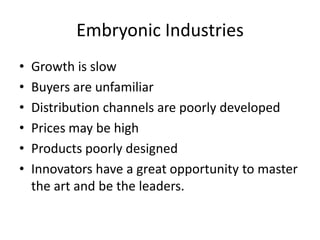
Embryonic Industries
•   Growth is slow
•   Buyers are unfamiliar
•   Distribution channels are poorly developed
•   Prices may be high
•   Products poorly designed
•   Innovators have a great opportunity to master
    the art and be the leaders.
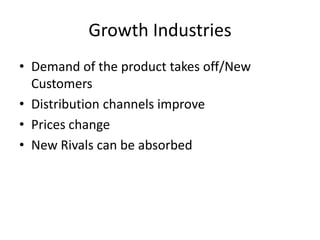
Growth Industries
• Demand of the product takes off/New
  Customers
• Distribution channels improve
• Prices change
• New Rivals can be absorbed
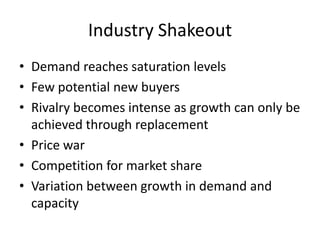
Industry Shakeout
• Demand reaches saturation levels
• Few potential new buyers
• Rivalry becomes intense as growth can only be
  achieved through replacement
• Price war
• Competition for market share
• Variation between growth in demand and
  capacity
Mature Industries
• Market is totally saturated
• Brand loyalty
• Entry of potential competitors is diminished &
  the prices and profits can increase
• Consolidation
• Price leadership agreement / but this can
  break and price war can start again
Declining Industries
•   Technological substitution
•   Social changes
•   International competition
•   Falling demand leads to emergence of excess
    capacity
Industry Environment
• External Environment
• Internal Environment
External Environment
• Competitive Environment
• General Environment
Competitive Environment
• Identification of the competitive forces that
  have a bearing on industries opportunities &
  Threats
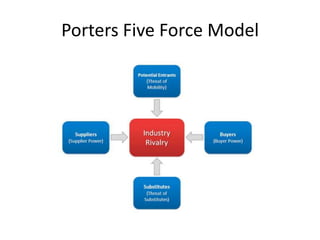
• Michael E Porters Five forces model identifies
  five forces that shape competition within an
  industry
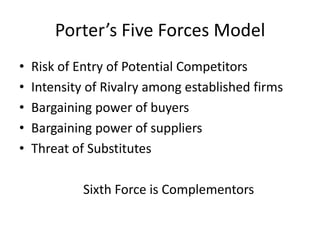
Porter’s Five Forces Model
•   Risk of Entry of Potential Competitors
•   Intensity of Rivalry among established firms
•   Bargaining power of buyers
•   Bargaining power of suppliers
•   Threat of Substitutes

             Sixth Force is Complementors
Porters Five Force Model
1.    Risk of Entry of Potential
                Competitors
• It is in part a function of the height of Barriers
  to Entry which can be made stronger through
1. Brand Loyalty
2. Absolute Cost Advantage
3. Economies of Scale
4. Customer Switching Costs
5. Government Regulations
Brand Loyalty can be achieved through
•   Continuous advertising
•   Patent Protections
•   Continuous Innovation
•   High Product quality
•   After sale service
Absolute Cost Advantage can arise
                from
• Superior production operations/processes
• Control of Particular Inputs
• Access to Cheaper Funds
Economies of Scale can be achieved
               through
• Cost reduction through Mass Production
• Discounts on Bulk purchases of Raw material
• Spreading Fixed Production costs over a large
  production volume
• Spreading marketing & promotion costs over
  large production volume
Customer Switching Costs
• Time
• Energy
• Money
Government Regulations
• When government regulations are high it is
  difficult for new entrants to enter into the
  industry/market
2. Rivalry Among Established
                Companies
• Intense rivalry constitutes a strong threat to
  profitability & it is a function of
1. Industry Competitive Structure
2. Demand Conditions
3. Exit Barriers
Industry Competitive Structure
• Fragmented Industry
• Consolidated Industry
Industry Demand
• Growing Demand
• Declining Demand
Exit Barriers
• When exit barriers are high companies
  become locked in an industry & a static or
  declining demand will mean excess capacity
  resulting in declining price wars
Exit Barriers include
•   Investment in assets
•   High Fixed cost of exit
•   Emotional attachment to an industry
•   Economic Dependence on an industry
3. Bargaining power of Buyers
•   More Suppliers Few Buyers
•   Buyers Purchase in Large quantities
•   Switching costs for the buyers are low
•   Buyers can threaten to enter into the market
4. Bargaining Power of Suppliers
• Powerful suppliers are a threat & suppliers can be
  powerful when
1. Few substitutes for the product suppliers supply
2. When industry is not an important customer to
   the suppliers
3. Large switching costs
4. Suppliers threaten to enter into the industry
   themselves
5. Companies in an industry can not enter into the
   suppliers market
5. Threat of Substitutes
• If the substitutes are high threat to the
  existing profits is more, and one can not raise
  prices enormously
• If the substitutes are few or non existent
  companies can charge higher prices
Sixth Force Complementors
• More complementors in an industry can boost
  the demand and create more opportunities
General Environment/ Macro
              Environment
• PEST Analysis
• Any change in any of the above mentioned
  factors will have a direct impact on Porters 5
  forces and this can alter the equation
  positively or Negatively

External analysis

  • 1.
    EXTERNAL ANALYSIS The General Environment The Competitive Environment
  • 2.
    EXTERNAL ANALYSIS • Clear Idea of the Industry • Industry & Sector • Industry & Market Segment • Changing Industry Boundaries • Strategic Groups within industries • Industry Life cycle analysis
  • 3.
    Defining the Industry •An industry is a group of companies offering products & services that are close substitutes for each other – that is products or services that satisfy the same customer needs • A company’s closest competitors or its rivals are those that satisfy the same customer needs • Examples Personal Computer industry,
  • 4.
    Industry & Sector •Sector – a gp. of closely related industries of which it is a part. • E.G Telecommunication sector has two industries – Telecommunication equipment industry & Telecommunication service industry
  • 5.
    Changing Industry Boundaries •This seems to be a very thin line between industries • How Technological Change has altered the industry boundaries – Telecommunication and computer industries
  • 6.
    Strategic Group WithinIndustries • Companies within an Industry can differ on various lines such as distribution channels, market segments, quality, technology, leadership, customer service & pricing etc & as such they may be having different positioning strategies. Such companies may formulate themselves into groups and each group having a different strategy. Each such group within an industry is refereed to as a strategic group E. G in Pharama we may have Generic and Proprietary Groups.
  • 7.
    Implications of StrategicGroup • Companies closest competitors are those within the same strategic group i.e companies within a strategic group are direct substitutes for each other. E. G in the retail industry there may be group of discounters who are competing with each other • Each Strategic Group within an industry may be having a different sets of opportunities or threats (Porters five forces and the degree of complimentarily will vary from one strategic group to another E. G Pharmaceuticals (Generic & Proprietary
  • 8.
    Role of MobilityBarriers • Some strategic groups within an industry are more desirable than others, that is there may be more opportunities or less threats in a strategic group resulting in more profits and weak competitive forces (porters). In such situation companies from one strategic group may try to alter their positioning approach & move to compete in the strategic group.
  • 9.
    Role of MobilityBarriers • Taking advantage of this opportunity may be difficult because of the mobility barriers between strategic groups. • These include barriers to entry or exit • For example A company in a generic strategic group will encounter mobility barriers if it tries to enter a proprietary group as it will lack R & D skills and building these skills will be an expensive proposition
  • 10.
    Industry Life CycleAnalysis • External factors (opportunities & Threats) will have a varied impact on an industry depending upon at what stage of the life cycle industry is. • The similarities & differences between companies in an industry often become more pronounced overtime. • The strategic group structure may also change as the industry evolves
  • 11.
    Industry Life CycleFive Stages • Embryonic • Growth • Shakeout • Mature • Decline
  • 12.
  • 13.
    Embryonic Industries • Growth is slow • Buyers are unfamiliar • Distribution channels are poorly developed • Prices may be high • Products poorly designed • Innovators have a great opportunity to master the art and be the leaders.
  • 14.
    Growth Industries • Demandof the product takes off/New Customers • Distribution channels improve • Prices change • New Rivals can be absorbed
  • 15.
    Industry Shakeout • Demandreaches saturation levels • Few potential new buyers • Rivalry becomes intense as growth can only be achieved through replacement • Price war • Competition for market share • Variation between growth in demand and capacity
  • 16.
    Mature Industries • Marketis totally saturated • Brand loyalty • Entry of potential competitors is diminished & the prices and profits can increase • Consolidation • Price leadership agreement / but this can break and price war can start again
  • 17.
    Declining Industries • Technological substitution • Social changes • International competition • Falling demand leads to emergence of excess capacity
  • 18.
    Industry Environment • ExternalEnvironment • Internal Environment
  • 19.
    External Environment • CompetitiveEnvironment • General Environment
  • 20.
    Competitive Environment • Identificationof the competitive forces that have a bearing on industries opportunities & Threats • Michael E Porters Five forces model identifies five forces that shape competition within an industry
  • 21.
    Porter’s Five ForcesModel • Risk of Entry of Potential Competitors • Intensity of Rivalry among established firms • Bargaining power of buyers • Bargaining power of suppliers • Threat of Substitutes Sixth Force is Complementors
  • 22.
  • 23.
    1. Risk of Entry of Potential Competitors • It is in part a function of the height of Barriers to Entry which can be made stronger through 1. Brand Loyalty 2. Absolute Cost Advantage 3. Economies of Scale 4. Customer Switching Costs 5. Government Regulations
  • 24.
    Brand Loyalty canbe achieved through • Continuous advertising • Patent Protections • Continuous Innovation • High Product quality • After sale service
  • 25.
    Absolute Cost Advantagecan arise from • Superior production operations/processes • Control of Particular Inputs • Access to Cheaper Funds
  • 26.
    Economies of Scalecan be achieved through • Cost reduction through Mass Production • Discounts on Bulk purchases of Raw material • Spreading Fixed Production costs over a large production volume • Spreading marketing & promotion costs over large production volume
  • 27.
    Customer Switching Costs •Time • Energy • Money
  • 28.
    Government Regulations • Whengovernment regulations are high it is difficult for new entrants to enter into the industry/market
  • 29.
    2. Rivalry AmongEstablished Companies • Intense rivalry constitutes a strong threat to profitability & it is a function of 1. Industry Competitive Structure 2. Demand Conditions 3. Exit Barriers
  • 30.
    Industry Competitive Structure •Fragmented Industry • Consolidated Industry
  • 31.
    Industry Demand • GrowingDemand • Declining Demand
  • 32.
    Exit Barriers • Whenexit barriers are high companies become locked in an industry & a static or declining demand will mean excess capacity resulting in declining price wars
  • 33.
    Exit Barriers include • Investment in assets • High Fixed cost of exit • Emotional attachment to an industry • Economic Dependence on an industry
  • 34.
    3. Bargaining powerof Buyers • More Suppliers Few Buyers • Buyers Purchase in Large quantities • Switching costs for the buyers are low • Buyers can threaten to enter into the market
  • 35.
    4. Bargaining Powerof Suppliers • Powerful suppliers are a threat & suppliers can be powerful when 1. Few substitutes for the product suppliers supply 2. When industry is not an important customer to the suppliers 3. Large switching costs 4. Suppliers threaten to enter into the industry themselves 5. Companies in an industry can not enter into the suppliers market
  • 36.
    5. Threat ofSubstitutes • If the substitutes are high threat to the existing profits is more, and one can not raise prices enormously • If the substitutes are few or non existent companies can charge higher prices
  • 37.
    Sixth Force Complementors •More complementors in an industry can boost the demand and create more opportunities
  • 38.
    General Environment/ Macro Environment • PEST Analysis • Any change in any of the above mentioned factors will have a direct impact on Porters 5 forces and this can alter the equation positively or Negatively